Geometry, area, volume and basic trigonometry
UAT 101 Applied Mathematics for Technology
Lesson
By the end of this module you will be able to
- Compute the areas of rectangles, triangles and circles, and convert to rai
- Compute the volumes of boxes and cylinders, and convert to litres
- Use Pythagoras' theorem to find straight-line distances
- Use the sine, cosine and tangent ratios to find heights and distances
Why this matters
Before spraying you must know how many rai the field is, how many litres the tank holds and how tall the tallest tree at the field edge is, to set a safe flight height. These questions use basic geometry and trigonometry, the mathematics used most often in field work.
Area
| Shape | Formula | Drone example |
|---|---|---|
| Rectangle | A paddy field | |
| Triangle | A wedge-shaped field corner | |
| Circle | A no-fly area around the take-off point |
Split complex fields into simple shapes and add their areas, then convert to rai with 1 rai = 1,600 m².
Volume
The volume of a box is width × length × height. The volume of a cylinder is the circular base area times height, , and 1 cubic metre = 1,000 litres.
Example 1 Field areas and tank capacity
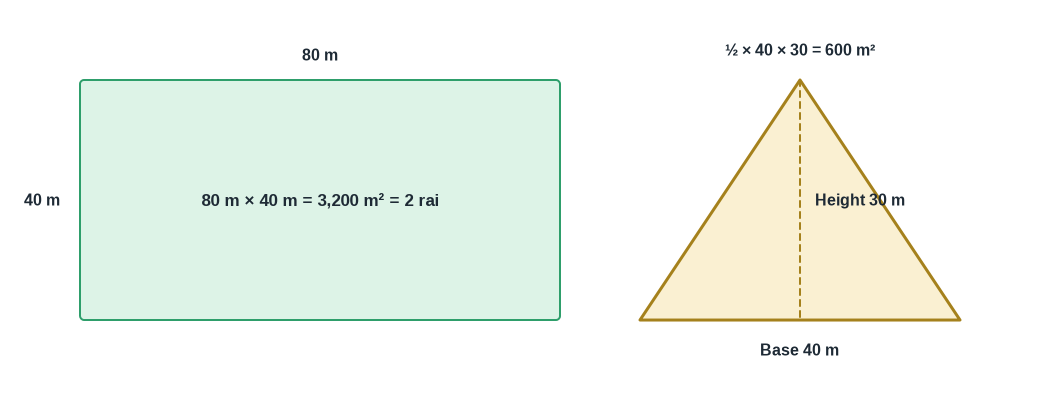
A rectangular field 80 × 40 m, a triangular field with a 40 m base and 30 m height, and a cylindrical tank of radius 0.12 m and height 0.25 m.
import math

L, W = 80, 40                              # rectangular field (m)
rect = L * W
tri = 0.5 * 40 * 30                        # triangular field, base 40 m, height 30 m
print(f"rectangle {rect} m2 = {rect / 1600:.2f} rai, triangle {tri:.0f} m2 = {tri / 1600:.3f} rai")
R, H = 0.12, 0.25                          # cylindrical tank radius and height (m)
vol = math.pi * R ** 2 * H
print(f"tank volume {vol:.5f} m3 = {vol * 1000:.1f} L")
rectangle 3200 m2 = 2.00 rai, triangle 600 m2 = 0.375 rai
tank volume 0.01131 m3 = 11.3 LThe rectangle is 3,200 m², exactly 2 rai; the triangle is 600 m², 0.375 rai. The tank holds about 11.3 L; if the maker rates it at 10 L, the extra space at the top allows for sloshing.
Pythagoras’ theorem
In a right-angled triangle, the side opposite the right angle (the longest side) relates to the other two sides by
If a drone is 40 m from the pilot horizontally and 30 m high, the straight-line distance is m, the distance used to judge whether the drone can still be seen clearly.
Basic trigonometry
In a right-angled triangle with angle , the ratios between sides have names
where “opposite” is the side across from , “adjacent” the side next to it and “hypotenuse” the side opposite the right angle. Set the calculator to degree mode (DEG) when angles are in degrees.
Example 2 How tall is the tree at the field edge?
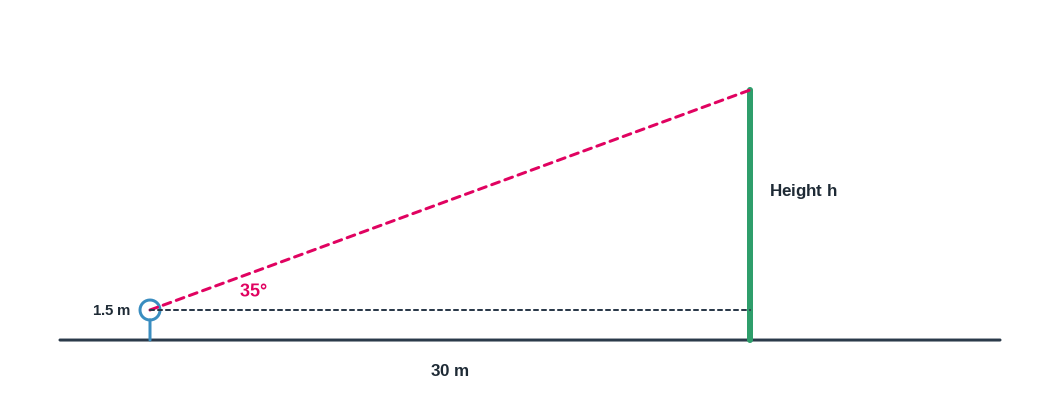
Standing 30 m from a tree, the top is seen at a 35° angle of elevation from eye height 1.5 m; the drone is 40 m away and 30 m up.
import math

D, ANGLE, EYE = 30.0, 35.0, 1.5             # distance to the tree (m), elevation angle (degrees), eye height (m)
h = D * math.tan(math.radians(ANGLE)) + EYE
print(f"tree height = 30 x tan 35 + 1.5 = {h:.1f} m")
X, Y = 40.0, 30.0                           # horizontal distance and height of the drone (m)
print(f"straight-line distance = {math.hypot(X, Y):.0f} m, angle of elevation {math.degrees(math.atan2(Y, X)):.1f} deg")
tree height = 30 x tan 35 + 1.5 = 22.5 m
straight-line distance = 50 m, angle of elevation 36.9 degThe tree height is m, so the spraying height should be set well above the treetops following the drone’s manual and flight rules. The straight-line distance to the drone is 50 m and the pilot looks up at about 36.9°.
Class activity
Activity: measuring areas and heights on campus
- Measure a lawn or plot with a tape, split it into simple shapes and compute its area in square metres and rai
- Measure the angle of elevation of a pole or tree top with a phone angle app and the distance to its base, then compute the height with the code in Example 2
- Measure a cylindrical container, compute its volume in litres, then check by filling it with water
- Compare groups’ results and discuss why they differ
Common mistakes
Watch out
- Forgetting the half in the triangle area formula
- Using the diameter instead of the radius in circle and cylinder formulas
- Leaving the calculator in radians when entering degrees
- Forgetting to add eye height when measuring elevation from the eye
- Converting cubic metres to litres wrongly: 1 m³ = 1,000 L, not 100 L
Summary
- Rectangle area , triangle , circle , and 1 rai = 1,600 m²
- Cylinder volume , and 1 m³ = 1,000 L
- Pythagoras gives straight-line distance
- sin, cos and tan link angles to sides of right-angled triangles, giving heights and distances
Check your understanding
- How many rai is a 100 × 64 m rectangular field?
- About how many litres does a cylinder of radius 0.1 m and height 0.3 m hold?
- With 60 m horizontal distance and 80 m height, what is the straight-line distance?
- Standing 20 m from a pole, its top is at 45° elevation from the ground. How tall is it?
- A 10 m ramp makes 30° with the ground. How high is its top?
Answers
- rai
- m³, about 9.4 L
- m
- m
- m
Key formulas
| Area | |
| Cylinder volume | |
| Pythagoras | |
| Trigonometry |
Key references
Further reading
Study the assigned knowledge units in advance, review media and take the module quiz
In class / field
Lecture, case discussion and in-class problem solving
Learning evidence: Quiz results and submitted exercises