Designing surveillance and security systems
UAT 454 UAS for Surveillance, Monitoring and Security
Lesson
By the end of this module you will be able to
- Explain the deter, detect, delay and respond principles of site security
- Apply timely detection to compare response time with the intruder's task time
- Identify the drone's role in a security system, especially alarm assessment
- Compute response time from the location of an automated drone dock
Why this matters
Many security systems have dozens of cameras and strong fences yet still have warehouses broken into, because when an alarm sounds nobody knows immediately what is happening, and by the time someone is sent to look the intruder has gone. Drones do not solve this on their own, but designed into the right step of the system they can close the gap between “an alarm” and “knowing what happened”.
Modules 6 to 10 of this course follow one fictional case through every module: a distribution centre in central Thailand, 600 × 400 m, with a 2,000 m perimeter fence split into 20 zones, fence sensors, 30 fixed cameras, a control room and one automated drone dock (drone-in-a-box). Two fence sections border homes. All figures are fictional. The Python code can be downloaded from /downloads/uat-454/.
Deter, detect, delay and respond
Garcia (2007) describes a physical protection system as performing three functions in sequence:
- Detect knowing that an intrusion is happening, which includes receiving the alarm and assessing whether it is real or a nuisance
- Delay making the intruder take longer, with fences, strong doors and layered locks
- Respond sending people to stop the intrusion
Deterrence, such as signs, lighting and visible patrols, reduces the chance of an attempt but is hard to measure. Garcia’s key principle is timely detection: the system must detect and assess early enough for the response force to arrive before the intruder finishes. A fence with no detection is just an obstacle, not useful delay.
Response time against the intruder’s time
Example 1 Send a guard to look, or the drone first?
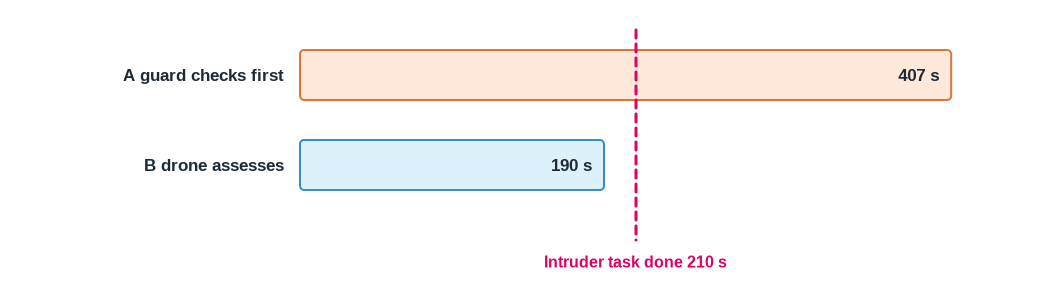
The fence sensor alarms in zone 7. The intruder needs 60 seconds to cut the fence, 30 seconds to run 150 m to the warehouse and 120 seconds to force the door. Option A: a guard walks 400 m to look before calling for backup. Option B: the dock drone flies to confirm imagery and the control room dispatches the response team immediately.
# intruder after the fence alarm (seconds): cut fence, run to warehouse, force door
intruder = {"cut fence": 60, "run 150 m": 30, "force door": 120}
task = sum(intruder.values())

# option A: a guard walks to check first, then calls for backup
guard_walk = 400 / 1.5                  # walk 400 m at 1.5 m/s
a = guard_walk + 20 + 120               # look for 20 s, then wait 120 s for backup
# option B: the dock drone confirms imagery, then the response team is sent
launch, dist, v, assess, respond = 30, 300, 12, 15, 120
b = launch + dist / v + assess + respond

print(f"adversary task time after detection: {task} s")
for name, t in (("A guard checks first", a), ("B drone assesses", b)):
    print(f"{name}: {t:.0f} s -> {'interrupts' if t < task else 'too late'} ({task - t:+.0f} s)")
adversary task time after detection: 210 s
A guard checks first: 407 s -> too late (-197 s)
B drone assesses: 190 s -> interrupts (+20 s)The intruder needs 210 seconds. Option A takes 407 seconds, 197 seconds too late. Option B takes 190 seconds, in time with a 20-second margin. What the drone changes is assessment time, not response time: people still have to stop the intrusion, and a 20-second margin is thin, so the team should also add delay at the warehouse doors.
The drone’s role in a security system
| Role | Example | Limitation |
|---|---|---|
| Alarm assessment | Fly to the zone where a sensor alarmed | Must launch fast; weather must allow |
| Scheduled patrol | Fly the fence at unpredictable times | Uses battery and flight time |
| Following an intruder | Send the intruder’s position to the response team | Needs authority and adequate justification (module 10) |
| Checking fixed-camera blind spots | Roofs, truck yards | Not continuous like fixed cameras |
Drones complement fixed cameras rather than replace them. Fixed cameras watch continuously and record evidence; drones go to places cameras cannot see or see poorly. The DORI criteria of the 2014 edition of IEC 62676-4 can set the required resolution of both (the 2025 edition replaced DORI with seven levels; see module 3 of this course).
Locating the automated dock
An automated dock (drone-in-a-box) stores and charges the drone, opens its lid and launches it when the control room commands. Flying from a dock with no pilot on site is a remote operation that needs specific CAAT approval under the CAAT-GM-UAS-PDRA101 guidance; check the latest conditions before installing.
Example 2 Dock at the centre or at a corner?
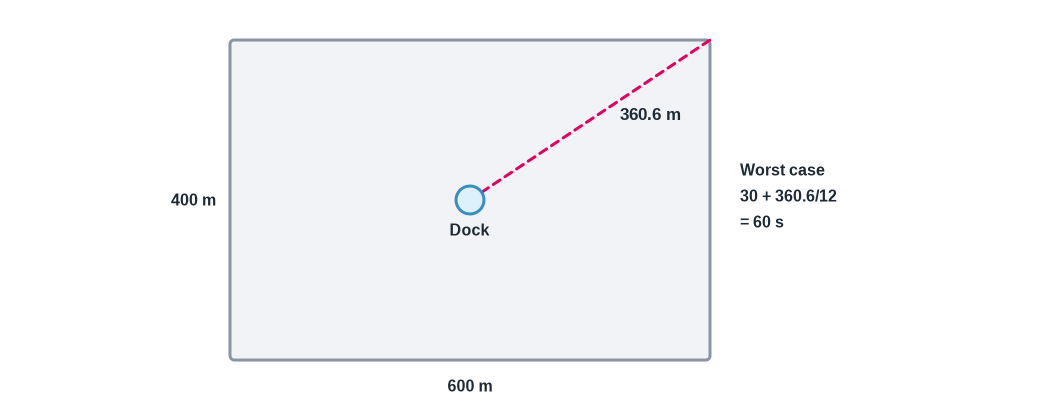
The drone flies at 12 m/s and opening the dock and taking off takes 30 seconds. Compare a dock at the centre with one at a fence corner.
import math
# 600 x 400 m site, drone speed 12 m/s, dock opening and take-off 30 s
W, H, v, launch = 600, 400, 12, 30
corners = [(0, 0), (W, 0), (W, H), (0, H)]

for name, dock in (("centre", (W / 2, H / 2)), ("corner", (0, 0))):
    far = max(math.dist(dock, c) for c in corners)
    print(f"dock at {name:6s}: farthest fence point {far:6.1f} m, "
          f"worst response {launch + far / v:5.1f} s")
dock at centre: farthest fence point 360.6 m, worst response 60.0 s
dock at corner: farthest fence point 721.1 m, worst response 90.1 sA central dock reaches the farthest point of the fence in 60 seconds; a corner dock takes 90 seconds. The 30-second difference matters when the margin in Example 1 is only 20 seconds. Still, the centre may have buildings blocking signals or be near truck lanes, so survey the real site before deciding.
Assessing the security risk
A site has several assets and kinds of loss, and a risk assessment puts them on one scale. The risk equation used in physical security at Sandia National Laboratories (Jaeger, 1998) is , where is the likelihood of an attack, the effectiveness of the protection system and the consequence of the loss. Effectiveness is : the probability of interruption , the chance that the response force arrives before the adversary finishes (Chapman and Harlan, 1985), times the probability of neutralisation , the chance that it then prevails (Ozkutuk and Chirayath, 2023). Garcia (2007) covers all of this, with the EASI model. Here is simplified to a step: the sensor’s detection probability when assessment plus response is shorter than the intruder’s task time, and zero otherwise.
Example 3 Where does the drone remove the most risk?
Assumed values (attack chance per year, loss in million baht, intruder task time after detection): warehouse 0.20, 5.0, 210 s; truck yard 0.30, 1.5, 90 s; office 0.10, 0.8, 300 s. The sensor detects with probability 0.90 and the response force then prevails with 0.80. Response times come from Example 1: 407 s with a guard and 190 s with the drone.
# assets: (attack chance per year, loss in million baht, intruder task time after detection in s)
assets = {"warehouse": (0.20, 5.0, 210), "truck yard": (0.30, 1.5, 90), "office": (0.10, 0.8, 300)}
p_det, p_neut = 0.90, 0.80          # sensor detection, response force wins once in time

def risk(p_a, c, t_task, t_resp):
    p_e = (p_det if t_resp < t_task else 0.0) * p_neut     # interruption only if the response is in time
    return p_a * (1 - p_e) * c

for label, t in (("guard checks", 407), ("drone assesses", 190)):   # response times from Example 1 (s)
    parts = {k: risk(p, c, task, t) for k, (p, c, task) in assets.items()}
    print(f"{label:15s}: " + ", ".join(f"{k} {v:.3f}" for k, v in parts.items()) + f" | total {sum(parts.values()):.3f}")
guard checks : warehouse 1.000, truck yard 0.450, office 0.080 | total 1.530
drone assesses : warehouse 0.280, truck yard 0.450, office 0.022 | total 0.752The drone cuts the warehouse risk from 1.000 to 0.280 and the office from 0.080 to 0.022 million baht a year, because 190 s beats their task times, and the total falls by half. It does nothing for the truck yard: the intruder finishes in 90 s, before any response, so the yard (0.450) is now the largest risk. The cheapest fix there is delay, such as a locked gate, not more detection.
Module lab
Lab: analysing intrusion paths and response time
- Use a real plan of a building or store on campus; mark the assets to protect, fences, doors, cameras and possible dock locations
- Choose two intrusion paths and estimate the intruder’s time for each step
- Compute response time with and without a drone using the code in Example 1, and find the best dock location with the code in Example 2
- Propose one improvement that adds the most margin, and say whether it is detection, delay or response
Common mistakes
Watch out
- Thinking many cameras means secure, with nobody assessing and responding in time
- Thinking drones stop intruders, when they help only with assessment and following
- Leaving dock opening and take-off out of response time
- Placing delay before the detection point, so intruders pass unnoticed
- Installing a dock without approval for remote operations
Summary
- A security system works through detection and assessment, delay and response
- Detection is timely when assessment plus response time is less than the intruder’s remaining task time
- Drones cut assessment time and complement fixed cameras; people still respond
- Dock location sets the worst-case response , and flying from a dock needs specific approval
Check your understanding
- The intruder needs 180 seconds after detection; assessment takes 70 seconds and response 120 seconds. Is it in time?
- A dock is 480 m from the farthest point, the drone flies 12 m/s and take-off takes 30 seconds. What is the worst case?
- A steel door raises forcing time from 120 to 300 seconds. Which function does it serve?
- Why does a fence with no sensor help little under Garcia’s principle?
- Which part of the time in Example 1 does the drone change?
Answers
- , not in time, 10 seconds late
- seconds
- Delay
- The intruder passes unnoticed, so the time spent cutting the fence does not help the response team arrive in time
- Assessment time, from walking to look to flying to confirm imagery
Key formulas
| Timely detection condition | |
| Drone response time from the dock |
Key references
- Garcia, M. L. (2007). Design and evaluation of physical protection systems (2nd ed.). Butterworth-Heinemann. link
- Fahlstrom, P. G., Gleason, T. J., & Sadraey, M. H. (2022). Introduction to UAV systems (5th ed.). Wiley. link
- สำนักงานการบินพลเรือนแห่งประเทศไทย. (2568). แนวปฏิบัติในการขอปฏิบัติการบินอากาศยานซึ่งไม่มีนักบินโดยใช้การประเมินความเสี่ยงที่เป็นไปตามเงื่อนไขที่กำหนดสำหรับการบินเกินกว่าระยะสายตา (CAAT-GM-UAS-PDRA101 ปรับปรุงครั้งที่ 00). link
- International Electrotechnical Commission. (2014). Video surveillance systems for use in security applications – Part 4: Application guidelines (IEC 62676-4:2014, Ed. 1.0; revised by Ed. 2.0 in 2025). link
- International Electrotechnical Commission. (2025). Video surveillance systems for use in security applications – Part 4: Application guidelines (IEC 62676-4:2025, Ed. 2.0). link
- Jaeger, C. D. (1998). Engineered surety using the risk equation (EnSURE) [Conference publication]. Sandia National Laboratories. link
- Chapman, L. D., & Harlan, C. P. (1985). PC-EASI: Adversary sequence interruption model (Technical report ESTSC-000642IBMPC00; OSTI ID 140091). Sandia National Laboratories. link
- Ozkutuk, M., & Chirayath, S. S. (2023). Vulnerability assessment of a physical protection system design using a multi path analysis and moving critical detection points [Conference paper]. Institute of Nuclear Materials Management. link
Further reading
Study the assigned knowledge units in advance, review media and take the module quiz
In class / field
Lab or field practice from worksheets with a safety checklist
Learning evidence: Checked worksheets and quiz results