Infrared and thermal cameras
UAT 455 Sensor, Camera and Thermal Imaging Technology for UAS
Lesson
By the end of this module you will be able to
- Explain thermal emission and use Wien's displacement law to choose a waveband
- Compare LWIR and MWIR thermal cameras and NETD
- Assess how a wrong emissivity setting changes temperature readings
- Choose a thermal camera for night surveillance
- Compare near-infrared and short-wave infrared cameras with thermal cameras and compute a detector's cutoff wavelength
Why this matters
Boats entering a protected zone illegally often come at night. An RGB camera sees almost nothing, but hot engines and people aboard emit heat that a thermal camera sees clearly. Thermal images do not measure temperature directly, though, and without the radiation physics it is easy to misread them, for example seeing a metal hull as very cold when it is hot.
Thermal emission
Every object above absolute zero emits electromagnetic radiation, more as it gets hotter. By the Stefan-Boltzmann law total radiation varies with , and the wavelength of peak emission falls as temperature rises, by Wien’s displacement law micrometres with in kelvin (Vollmer and Möllmann, 2017).
Example 1 At what wavelength does each target emit most?
# Wien's displacement law: peak emission wavelength (micrometres) = 2898 / T (kelvin)
b = 2898.0
for name, t_c in (("sea surface", 29.0), ("person", 34.0), ("boat engine", 90.0), ("wood fire", 630.0)):
    t_k = t_c + 273.15
    lam = b / t_k
    band = "LWIR 8-14 um" if 8 <= lam <= 14 else ("MWIR 3-5 um" if 3 <= lam <= 5 else "between bands")
    print(f"{name:12s} {t_c:6.1f} C -> peak {lam:5.2f} um ({band})")
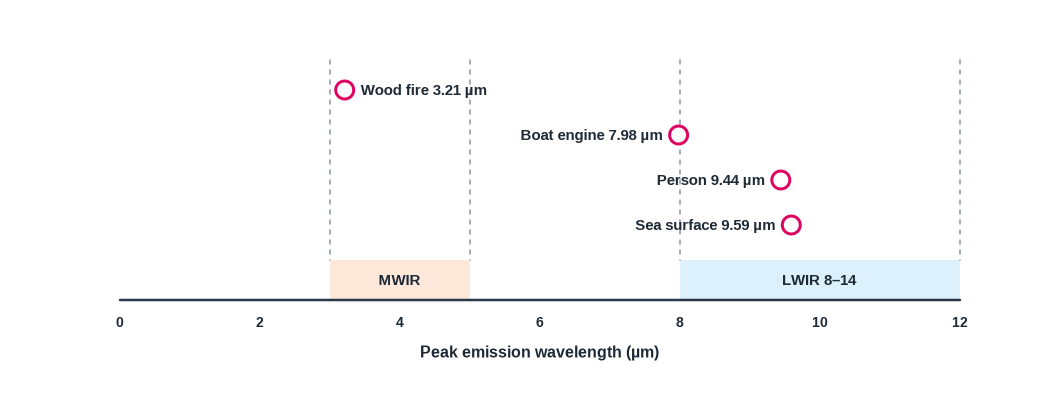
sea surface 29.0 C -> peak 9.59 um (LWIR 8-14 um)
person 34.0 C -> peak 9.44 um (LWIR 8-14 um)
boat engine 90.0 C -> peak 7.98 um (between bands)
wood fire 630.0 C -> peak 3.21 um (MWIR 3-5 um)The sea surface and a person peak at about 9.4–9.6 µm, in the LWIR (8–14 µm) band. A wood fire at about 630 °C peaks at 3.21 µm, in MWIR (3–5 µm). A boat engine at 90 °C falls between the bands but still emits plenty in LWIR. Thermal cameras for people and boats therefore usually use LWIR, which is also a band where the atmosphere transmits well.
LWIR and MWIR
| Feature | LWIR 8–14 µm | MWIR 3–5 µm |
|---|---|---|
| Common sensor | Microbolometer, uncooled | Cooled sensor |
| Cost and weight | Lower, suits drones | Higher and heavier |
| Suits | People, animals, boats, buildings near ambient temperature | Very hot objects, long range, high sensitivity |
Thermal camera sensitivity is given as NETD (noise equivalent temperature difference), the smallest temperature difference distinguishable from noise, e.g. below 50 mK. A low-NETD camera sees small differences well, such as a person in water whose skin is close to water temperature (Teledyne FLIR).
Emissivity and misreadings
Emissivity (ε) is the fraction an object emits compared with an ideal black body, from 0 to 1. Water and leaves are close to 1; shiny metal is very low, and what it does not emit it reflects from its surroundings instead (Teledyne FLIR). The camera computes temperature from the radiation it receives, so a wrong ε gives a wrong reading.
Example 2 How wrong is ε = 1.0 for everything?
All objects are truly at 30 °C. This uses the total-radiation approximation and ignores reflected radiation, a simple model to show the direction of the error.
# effect of a wrong emissivity setting, total-radiation approximation (reflected radiation ignored)
t_true_c = 30.0
for name, eps in (("water", 0.98), ("mangrove leaf", 0.95), ("painted hull", 0.90)):
    t_app = eps ** 0.25 * (t_true_c + 273.15) - 273.15   # camera set to emissivity = 1.0
    print(f"{name:13s} eps {eps:.2f}: camera reads {t_app:5.1f} C (error {t_app - t_true_c:+.1f} C)")
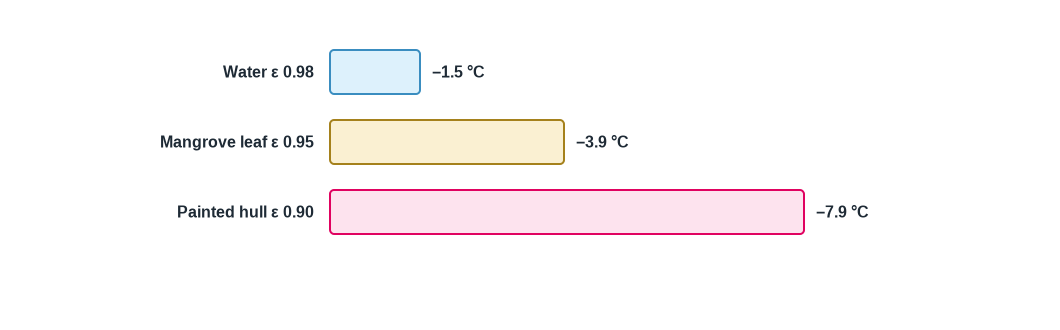
water eps 0.98: camera reads 28.5 C (error -1.5 C)
mangrove leaf eps 0.95: camera reads 26.1 C (error -3.9 C)
painted hull eps 0.90: camera reads 22.1 C (error -7.9 C)Water (ε 0.98) reads 1.5 °C low, a mangrove leaf (ε 0.95) 3.9 °C low, and a painted hull (ε 0.90) 7.9 °C low. Real cameras measure only their own band and reflected sky radiation matters a lot, so real errors differ from these figures, but the direction is the same: low-ε objects are misread badly. Surveillance therefore uses thermal images for contrast between object and background rather than trusting absolute temperatures.
Near-infrared and short-wave infrared cameras
“Infrared” does not always mean a thermal camera. The infrared range starts just beyond red light at about 0.75 µm and runs to tens of micrometres, divided into sub-bands that work very differently (band limits differ slightly between sources) (Vollmer and Möllmann, 2017).
| Band | Approximate wavelength | What the camera sees | Common sensor |
|---|---|---|---|
| Near infrared (NIR) | 0.75–1.1 µm | Light reflected by objects, like an ordinary camera | Silicon (the same CMOS as an RGB camera, without the infrared-blocking filter) |
| Short-wave infrared (SWIR) | About 0.9–1.7 µm (some models to 2.5 µm) | Light reflected by objects | Indium gallium arsenide (InGaAs) |
| MWIR | 3–5 µm | Heat radiation emitted by objects | Cooled sensor |
| LWIR | 8–14 µm | Heat radiation emitted by objects | Microbolometer |
The key difference is that objects near ambient temperature emit almost nothing in NIR and SWIR (Example 1 shows their peak near 9.5 µm). These cameras therefore form images from reflected light, like an RGB camera. At night they need moonlight or an IR illuminator that people cannot see. The benefit is an image that looks like an ordinary photograph, so letters painted on a hull can still be read, whereas a thermal image often shows them poorly because the paint and the hull are at the same temperature.
Why can a silicon camera not see beyond about 1.1 µm? A sensor responds only when the photon energy exceeds the material’s band gap (), so the cutoff wavelength is nanometres with in electronvolts. Silicon has = 1.12 eV and cuts off near 1,100 nm, while InGaAs image sensors cut off at 1.7 µm in standard types and up to 2.55 µm in long-wavelength types (Hamamatsu Photonics).
SWIR has two strengths for coastal work. First, light of longer wavelength than visible light is scattered less by fine particles such as fog and smoke, so it sees through thin haze and smoke better than an RGB camera (though not through thick fog or heavy rain as radar in Module 4 does). Second, water absorbs strongly near 1.45 µm (Hamamatsu Photonics), so water surfaces tend to look dark in SWIR images and boats and banks stand out from the water. The limits are that InGaAs sensors have far fewer pixels than silicon ones, for example 640 × 512, and cost more.
Example 3 Which light sources can each sensor see?
The team considers an 850 nm IR illuminator, a 1550 nm SWIR illuminator, and a boat engine’s heat peaking near 7,980 nm from Example 1 (the illuminator wavelengths are assumed). The InGaAs band gap of 0.73 eV is back-calculated from its 1.7 µm cutoff.
# cutoff wavelength of a detector: lambda_c (nm) = 1240 / Eg (eV)
detectors = {"silicon (Si)": 1.12, "InGaAs (standard)": 0.73}
sources = {"IR lamp 850 nm": 850, "SWIR lamp 1550 nm": 1550, "boat engine 7980 nm": 7980}
for det, eg in detectors.items():
    lam_c = 1240 / eg
    seen = [name for name, lam in sources.items() if lam <= lam_c]
    print(f"{det:17s} Eg {eg:.2f} eV -> cutoff {lam_c:5.0f} nm, sees: {', '.join(seen)}")
silicon (Si) Eg 1.12 eV -> cutoff 1107 nm, sees: IR lamp 850 nm
InGaAs (standard) Eg 0.73 eV -> cutoff 1699 nm, sees: IR lamp 850 nm, SWIR lamp 1550 nmThe silicon camera cuts off at 1,107 nm, so it sees the 850 nm illuminator but not the 1550 nm one. InGaAs cuts off near 1,700 nm and sees both, but neither sensor sees the engine’s heat, which needs an LWIR camera. For the mangrove case, the LWIR camera is used to detect boats at night, while a NIR or SWIR camera with an illuminator is used to identify them, for example reading a boat’s name or number at short range; a 1550 nm illuminator also does not show up in the cheap silicon cameras that intruders might carry.
Choosing a thermal camera for night work
- Choose LWIR for people and boats: uncooled and lighter
- Compute IFOV from pixel pitch and lens so targets cover enough pixels, using the criteria from UAT 454
- Choose low NETD to find people in water or after rain, when temperature differences are small
- Choose a radiometric camera if temperature values must be recorded for later analysis
- Check frame rate; some low-cost thermal cameras limit frame rate because of export rules
Module lab
Lab: thermal images of different materials
- Place a tray of water, leaves, a shiny metal plate and a painted metal plate in the sun until equally warm; measure true temperatures with a contact thermometer
- Take thermal images with ε = 1.0 and read each material
- Set ε for each material, read again, and compare with true values and the code in Example 2
- Observe how the shiny metal reflects the sky or the photographer
Common mistakes
Watch out
- Trusting temperatures on shiny metal, which reflects more than it emits
- Thinking thermal cameras see through walls or glass; glass is opaque to LWIR
- Pointing LWIR at a very hot fire without checking for saturation
- Not setting distance and humidity when temperatures are needed at long range
- Choosing by NETD alone without looking at resolution and lens
- Expecting a NIR or SWIR camera to see heat; these bands see reflected light and need an illuminator at night
Summary
- Peak emission ; people and boats fall in LWIR, very hot fires in MWIR
- Uncooled LWIR microbolometers suit drones; NETD states sensitivity to temperature differences
- A wrong ε gives wrong temperatures; low-ε objects such as shiny metal are badly misread
- Surveillance relies on contrast with the background more than absolute values
- NIR (silicon, cutoff near 1.1 µm) and SWIR (InGaAs, cutoff near 1.7 µm) cameras see reflected light, not heat, and identify targets with an illuminator
Check your understanding
- At what wavelength does a 37 °C object emit most?
- An InGaAs sensor cuts off at 1.7 µm. What is its band gap, roughly, and can it see a person’s body heat?
- An object truly at 30 °C with ε 0.95 is read with ε set to 1.0. About what reading (using the module’s approximation)?
- What does a low NETD mean?
- Why can’t a thermal camera see through a window?
Answers
- µm
- eV. It cannot see body heat, because a person emits most near 9.4 µm, far beyond the cutoff; that needs an LWIR camera
- °C
- The camera can separate very small temperature differences from noise
- Ordinary glass absorbs and reflects almost all LWIR, so the camera sees the glass surface temperature and reflections
Key formulas
| Wien's displacement law | |
| Stefan-Boltzmann law | |
| Reading with ε set to 1 (approximate) | |
| Cutoff wavelength of a detector (Eg in eV) |
Key references
- Vollmer, M., & Möllmann, K.-P. (2017). Infrared thermal imaging: Fundamentals, research and applications (2nd ed.). Wiley-VCH. link
- Teledyne FLIR. Comparing sensitivity of thermal imaging cameras and modules (NETD). link
- Teledyne FLIR. How does emissivity affect thermal imaging? link
- Teledyne FLIR. (2019, October 4). Can thermal imaging see through walls? And other common questions. link
- Fraden, J. (2016). Handbook of modern sensors: Physics, designs, and applications (5th ed.). Springer. link
- Hamamatsu Photonics. (n.d.). Si photodiodes [Technical note KSPD9001E]. link
- Hamamatsu Photonics. (n.d.). InGaAs area image sensors [Technical note KMIR9004E]. link
Further reading
Study the assigned knowledge units in advance, review media and take the module quiz
In class / field
Lab or field practice from worksheets with a safety checklist
Learning evidence: Checked worksheets and quiz results