Selecting aircraft, sensors and payloads
UAT 460 UAS for Public Safety, Search and Rescue, and Emergency Management
Lesson
By the end of this module you will be able to
- Convert the mission objectives and the risk-assessment results into measurable technical requirements for the aircraft and equipment
- Calculate hover power, flight time and the effect of payload mass and temperature with momentum theory
- Choose a thermal camera lens and a standoff distance from the wall that give the required pixels, and count the images to be taken
- Select an aircraft with a weighted decision matrix that has knock-out criteria, and test its sensitivity to the weights
- Calculate the number of battery sets and chargers for a continuous mission
Why this matters
The storage cabinet of the municipal drone team holds three types of aircraft (four aircraft in total), and now the incident commander asks, “Which aircraft shall we use?” Type A (two aircraft) weighs 9 kg and carries a zoom camera, a thermal camera and a searchlight. It tolerates strong wind but takes a long time to prepare. Type B weighs less than 1 kg and can launch within a minute, but it tolerates little wind and has no zoom camera. Type C is tethered, so it can fly without a time limit, but it cannot move freely. There is no “best aircraft”, because every task asks for something different. A person who answers from the brochure usually picks the aircraft that looks strongest, without checking whether it answers the objective, copes with the wind assessed in Module 17 and is ready within the time set in Module 16.
NFPA 2400, the standard for small unmanned aircraft systems used for public safety operations, says that procurement requirements must consider the operational requirements, the minimum system configuration, quantitative data that show the capability of the drone and the life cycle (National Fire Protection Association, n.d.). NIST develops standard test methods and performance metrics that make it possible to measure and compare, in numbers, the capability of systems and the proficiency of operators, and it uses that data to support decisions on procurement and use. Ten of its test methods, on piloting and on operating the payload of small drones, are used in NFPA 2400 as measures of pilot proficiency (National Institute of Standards and Technology, n.d.). The principle of this module is therefore to choose from numbers that are measured or calculated, not from advertising, and to keep the team’s own test results as evidence.
From objectives to technical requirements
The first step is to translate the objectives of Module 16 and the results of Module 17 into requirements that can be checked with numbers. This table is used again in Modules 19 and 20.
| Source | Requirement | Numbers for the case study |
|---|---|---|
| O1 thermal status of four sides | A thermal camera, and pixels on a window | At least 10 pixels across a window 1.2 m wide |
| O2 people at windows | Pixels on a person by the Johnson criterion | At least 7 pixels across a person 0.5 m wide (modules 6–10 of this course) |
| Fire safety | Standoff from the wall | At least 45 m (a team value, set together with the safety officer) |
| Wind (Module 17) | Wind the aircraft must tolerate at the scan position | Expected wind 8.7 m/s at 80 m, so a manufacturer limit of at least 10.9 m/s is needed with a 20% margin |
| Time (Module 16) | Prepared and airborne in time for 16:35 | Airborne within 6 minutes of setting up the kit |
| Search night (C2) | Time over the area, and a camera that works at night | Thermal camera, searchlight and enough energy for 6 hours including swaps |
| Rules | Mass within what the 2026 notification of the Civil Aviation Authority of Thailand (CAAT) covers (Civil Aviation Authority of Thailand, 2026) | No more than 25 kg (heavier aircraft fall under a different notification) |
The last row matters because adding payload adds mass, which affects both flight time and legal status. Aircraft A at 9 kg is still within the limit.
Flight time and payload
The flight time that a manufacturer states is usually measured with no payload in cool air. To estimate the real flight time we use the momentum theory of a hovering rotor, which Leishman (2006) describes. The power needed to hover is the ideal induced power with thrust , divided by the figure of merit (FM), which tells how much worse a real rotor is than the ideal one, and divided by the total electrical efficiency of the motors and controllers.
Here is the air density and is the total rotor disc area. FM and must come from hover tests of each aircraft. This example uses 0.65 and 0.80 (assumed values). The air density is calculated from the ideal gas law, which at 15 °C and 101,325 Pa gives 1.225 kg/m³, in agreement with the ICAO standard atmosphere (International Civil Aviation Organization, 1993). Hot air is thinner, so the hover power rises. The usable flight time is counted until the battery has 20% left, which ArduPilot documentation gives as a level for the low-battery warning setting (ArduPilot Dev Team, n.d.).
Example 1 Flight time of the three aircraft and the price of payload
Aircraft A (type A) weighs 9.0 kg including 1.3 kg of equipment, has a total rotor disc area of 0.894 m² and carries a 650 Wh battery. Aircraft B weighs 0.95 kg, has a disc area of 0.140 m² and a 77 Wh battery. Aircraft C uses a 6.2 kg airframe, has the same disc area as A and receives 1,500 W from the ground through a tether that weighs 0.030 kg per metre and is 70 m long. The team compares flight time at 25 °C and 35 °C and finds how much flight time one kilogram of payload costs.
import math
# hover power and endurance from momentum theory: P = (m g)^1.5 / (sqrt(2 rho A) * FM * eta)   (all aircraft data assumed)
g = 9.81
def rho(temp_c, p=101325.0): return p / (287.05 * (temp_c + 273.15))        # ideal gas, dry air at sea-level pressure
def hover_w(mass, disk_area, air, fm=0.65, eta=0.80):
    return (mass * g) ** 1.5 / math.sqrt(2 * air * disk_area) / (fm * eta)
fleet = {  # name: (take-off mass kg, total rotor disc area m2, battery Wh, payload kg, manufacturer wind limit m/s)
    "A medium quad, zoom+thermal+light": (9.0, 0.894, 650, 1.3, 12.0),
    "B compact quad, thermal only":      (0.95, 0.140, 77, 0.0, 8.0),
}
print(f"air density 25 C {rho(25):.3f} kg/m3, 35 C {rho(35):.3f} kg/m3")
for name, (m, area, wh, pay, wl) in fleet.items():
    for t in (25, 35):
        p = hover_w(m, area, rho(t))
        usable = wh * 0.80                                   # fly until 20 % remains (the battery-failsafe level)
        print(f"{name:<36} {t} C: hover {p:6.0f} W, usable {usable:4.0f} Wh -> {usable / p * 60:5.1f} min")
m, area, wh, pay, wl = fleet["A medium quad, zoom+thermal+light"]
light, full = hover_w(m - pay, area, rho(35)), hover_w(m, area, rho(35))
print(f"A without the {pay} kg payload: hover {light:.0f} W vs {full:.0f} W; endurance {wh * 0.8 / light * 60:.1f} vs {wh * 0.8 / full * 60:.1f} min")
print(f"each extra kg costs about {(wh * 0.8 / light - wh * 0.8 / full) * 60 / pay:.1f} min of hover time at 35 C")
tether_m, h_tether, supply = 0.030, 70, 1500                 # kg per metre of tether, tether length (m), ground supply (W) (assumed)
mc = 6.2 + tether_m * h_tether                               # C: 6.2 kg aircraft with sensors, plus the hanging tether
pc = hover_w(mc, area, rho(35))
print(f"C tethered at {h_tether} m: mass {mc:.1f} kg, hover {pc:.0f} W of {supply} W supplied ({1 - pc / supply:.0%} margin), endurance limited only by the ground power")
for name, wl in (("A", 12.0), ("B", 8.0), ("C", 10.0)):
    print(f"aircraft {name}: wind limit {wl:4.1f} m/s -> planning limit {0.8 * wl:4.1f} m/s")
air density 25 C 1.184 kg/m3, 35 C 1.146 kg/m3
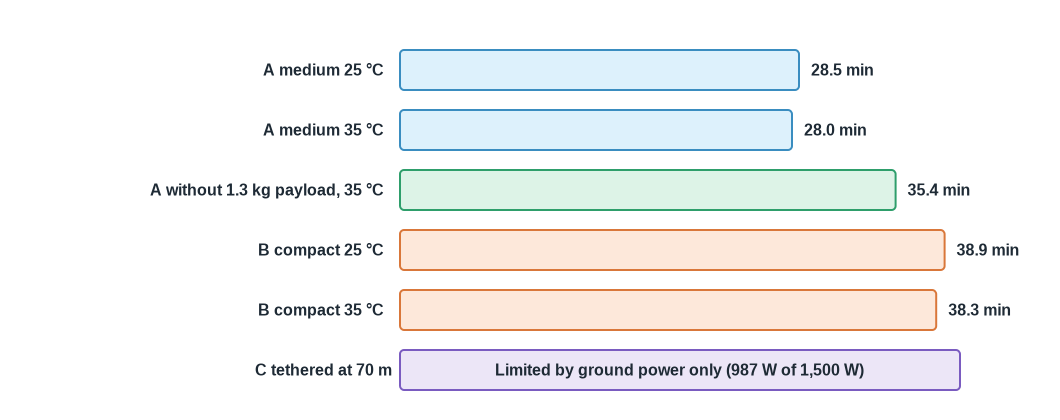
A medium quad, zoom+thermal+light 25 C: hover 1097 W, usable 520 Wh -> 28.5 min
A medium quad, zoom+thermal+light 35 C: hover 1115 W, usable 520 Wh -> 28.0 min
B compact quad, thermal only 25 C: hover 95 W, usable 62 Wh -> 38.9 min
B compact quad, thermal only 35 C: hover 97 W, usable 62 Wh -> 38.3 min
A without the 1.3 kg payload: hover 882 W vs 1115 W; endurance 35.4 vs 28.0 min
each extra kg costs about 5.7 min of hover time at 35 C
C tethered at 70 m: mass 8.3 kg, hover 987 W of 1500 W supplied (34% margin), endurance limited only by the ground power
aircraft A: wind limit 12.0 m/s -> planning limit 9.6 m/s
aircraft B: wind limit 8.0 m/s -> planning limit 6.4 m/s
aircraft C: wind limit 10.0 m/s -> planning limit 8.0 m/sAircraft A can hover for about 28 minutes at 35 °C and aircraft B for about 38 minutes, but B tolerates less wind. Raising the temperature from 25 to 35 °C cuts the flight time by less than 1 minute. The effect of mass is much larger. The 1.3 kg payload cuts the flight time of A from 35.4 to 28.0 minutes, about 5.7 minutes per kilogram. The team must therefore ask which objective needs the searchlight or the zoom camera. If they can be removed on sorties that do not need them, the flight gains almost 7.4 minutes. Aircraft C uses 987 W of the 1,500 W that the ground can supply, which leaves a 34% margin, so it can stay up as long as the generator runs, but the tether limits direction and height. The last lines convert the manufacturer’s limits into planning limits (with a 20% margin as in Module 17): A 9.6, B 6.4 and C 8.0 m/s. These are used in Example 3.
Thermal cameras, lenses and standoff from the wall
The team uses a thermal camera with a resolution of 640 × 512 pixels and a pixel pitch of 12 µm, a common value for drone cameras. The physics of thermal imaging is taught in UAT 455 and the calculation of camera image resolution in UAT 455. Here we use only the geometry needed to choose a lens. The size on the wall of one pixel at standoff and focal length is
where is the pixel pitch. The size of an image on the wall is the number of pixels times . If a wall of width is to be covered by overlapping images of width with overlap , the number of images needed is when , and 1 when .
There are two criteria to check. First, for O1 the team must know which window is hot. It requires at least 10 pixels across a window 1.2 m wide (a team criterion, assumed value). Second, for O2 the team must recognise whether it is a person at the window. It uses the Johnson criterion taught in modules 6–10 of this course: 7 pixels across a person 0.5 m wide.
Example 2 Which lens at what standoff meets both criteria with the fewest images
The team compares 9, 13 and 19 mm lenses at standoffs of 45, 60 and 90 m from the wall. It must cover a wall up to 40 m wide and floors 8 to 28 (a height band of 71.4 m), with 20% image overlap.
import math
# thermal lens and standoff for the facade scan: 640 x 512 detector, 12 um pitch (assumed)
# rules: at least 10 pixels across a 1.2 m window (O1, team rule, assumed) and 7 across a 0.5 m person (O2, Johnson recognition criterion), standoff at least 45 m (assumed)
W, H, pitch = 640, 512, 12e-6
window, person, need_w, need_p, overlap = 1.2, 0.5, 10, 7, 0.20
face_w, band = 40.0, 71.4                                   # widest face (m) and height band to cover, floors 8-28 (m)
def frames(span, foot): return 1 if span <= foot else math.ceil((span - foot) / (foot * (1 - overlap))) + 1
print("lens   standoff  pixel  px/window  px/person  footprint W x H   frames on 40 m face  O1  O2")
rows = []
for f in (9e-3, 13e-3, 19e-3):
    hfov, vfov = 2 * math.atan(W * pitch / 2 / f), 2 * math.atan(H * pitch / 2 / f)
    for d in (45, 60, 90):
        fw, fh = 2 * d * math.tan(hfov / 2), 2 * d * math.tan(vfov / 2)
        pix = pitch * d / f
        pw, pp = window / pix, person / pix
        n = frames(face_w, fw) * frames(band, fh)
        o1, o2 = round(pw, 6) >= need_w, round(pp, 6) >= need_p
        rows.append((n, f, d, o1, o2))
        print(f"{f * 1e3:4.0f} mm {d:5d} m {pix * 100:5.1f} cm {pw:8.1f} {pp:9.1f}     {fw:5.1f} x {fh:4.1f} m   {n:3d}                  {'ok' if o1 else '-':>3} {'ok' if o2 else '-':>3}")
best = min((r for r in rows if r[3] and r[4] and r[2] == 45), key=lambda r: r[0])
print(f"standoff 45 m, both rules met: fewest frames with the {best[1] * 1e3:.0f} mm lens ({best[0]} frames on the 40 m face)")
far = max((d for n, f, d, o1, o2 in rows if f == 9e-3 and o1 and o2), default=0)
print(f"with the 9 mm lens both rules hold out to {far} m of the tested standoffs; longest standoff for the person rule = {0.5 / need_p * 9e-3 / pitch:.1f} m")
lens standoff pixel px/window px/person footprint W x H frames on 40 m face O1 O2
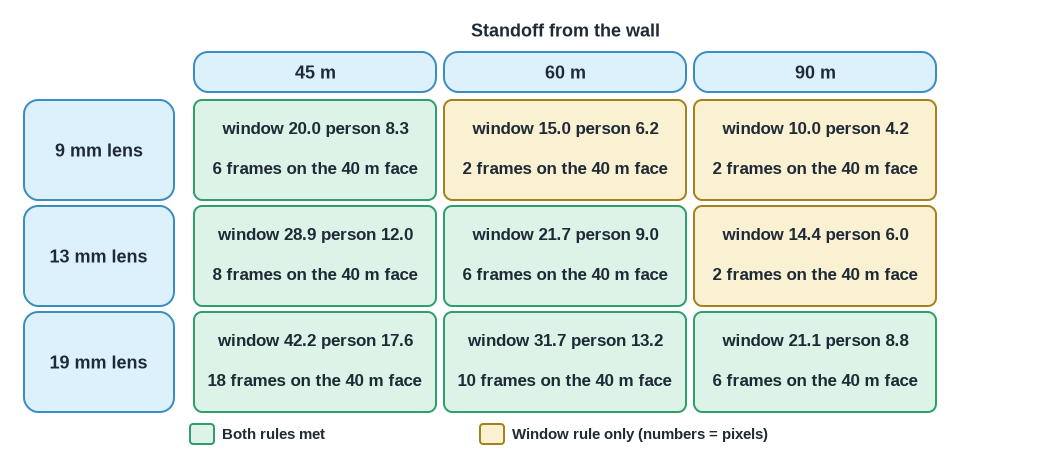
9 mm 45 m 6.0 cm 20.0 8.3 38.4 x 30.7 m 6 ok ok
9 mm 60 m 8.0 cm 15.0 6.2 51.2 x 41.0 m 2 ok -
9 mm 90 m 12.0 cm 10.0 4.2 76.8 x 61.4 m 2 ok -
13 mm 45 m 4.2 cm 28.9 12.0 26.6 x 21.3 m 8 ok ok
13 mm 60 m 5.5 cm 21.7 9.0 35.4 x 28.4 m 6 ok ok
13 mm 90 m 8.3 cm 14.4 6.0 53.2 x 42.5 m 2 ok -
19 mm 45 m 2.8 cm 42.2 17.6 18.2 x 14.6 m 18 ok ok
19 mm 60 m 3.8 cm 31.7 13.2 24.3 x 19.4 m 10 ok ok
19 mm 90 m 5.7 cm 21.1 8.8 36.4 x 29.1 m 6 ok ok
standoff 45 m, both rules met: fewest frames with the 9 mm lens (6 frames on the 40 m face)
with the 9 mm lens both rules hold out to 45 m of the tested standoffs; longest standoff for the person rule = 53.6 mAt 45 m the 9 mm lens meets both criteria (20.0 pixels on the window, 8.3 pixels on a person) and needs the fewest images: 6 images for the 40 m wall. If the aircraft backs off to 60 m, the same lens needs only 2 images, but the pixels on a person fall to 6.2, below 7, so it fails O2. The way out is the 13 mm lens at 60 m, which meets both criteria with 6 images, the same number as the 9 mm lens at 45 m. The key observation is that both the pixels on the target and the number of images depend only on the ratio (45/9 = 5.0 and 60/13 = 4.6). Choosing a longer lens and backing off further therefore does not give a better picture, but it makes the risk footprint of Module 17 larger. The rule is to use the shortest lens that meets the criteria, and back off only as far as the safety officer requires. In this case that is the 9 mm lens at 45 m, which is the figure that Module 19 uses next.
Weighted decision matrix with knock-out criteria
Some requirements can be answered with a number, but many must be judged together. For those, the team uses a weighted decision matrix of the SMART type (simple multi-attribute rating technique) proposed by Edwards (1977). Score each option on each criterion, give each criterion a weight that reflects the importance of that task, and add up . There are two cautions. First, some criteria cannot be traded off. Wind above the limit should not be offset by good flight time, so the team applies a knock-out before calculating scores, like the knock-out criteria at gate G2. Second, the weights are a matter of judgement, and a good result must not change when the weights change a little, so the team must test the sensitivity: randomly change each weight by up to ±50% ten thousand times and count how many times each option ranks first.
Example 3 Which aircraft suits which task
The scores from 1 to 5 of aircraft A, B and C on six criteria (wind, flight time, fast set-up, sensors, safety, night) come from the team’s trial flights (assumed values). There are four tasks: T0 first look (6 minutes), T1 facade scan, T2 night search of the collapsed building, and T3 six-hour overwatch. The wind expected at the task position is 6.0, 8.7, 4.0 and 7.0 m/s respectively. The knock-out criterion is that the expected wind must not exceed 80% of the manufacturer’s limit.
import random
# weighted decision matrix (SMART) with knock-out rules and a weight-sensitivity test; scores 1-5 from the team's trial flights (assumed)
crit = ["wind", "endurance", "launch", "sensors", "safety", "night"]
score = {"A medium quad": [5, 3, 3, 5, 4, 5], "B compact quad": [2, 4, 5, 2, 3, 3], "C tethered quad": [3, 5, 2, 4, 5, 4]}
wind_limit = {"A medium quad": 12.0, "B compact quad": 8.0, "C tethered quad": 10.0}       # manufacturer limit, m/s
MARGIN = 0.80                                                                              # same planning margin as in module 17
tasks = {  # weights in the order of crit, and the wind expected at the station (m/s)
    "T0 first look (6 min)": ([0.05, 0.05, 0.55, 0.10, 0.10, 0.15], 6.0),
    "T1 facade scan":        ([0.30, 0.10, 0.10, 0.25, 0.15, 0.10], 8.7),
    "T2 night rubble":       ([0.05, 0.20, 0.10, 0.25, 0.15, 0.25], 4.0),
    "T3 six-hour overwatch": ([0.15, 0.35, 0.05, 0.15, 0.20, 0.10], 7.0),
}
rng = random.Random(480)
for task, (w, wind_need) in tasks.items():
    ok = [a for a in score if wind_need <= MARGIN * wind_limit[a]]                       # knock-out: wind is not compensated by other scores
    base = {a: sum(x * y for x, y in zip(w, score[a])) for a in ok}
    wins = dict.fromkeys(ok, 0)
    for _ in range(10000):
        v = [x * rng.uniform(0.5, 1.5) for x in w]                                       # every weight moved by up to +/-50 %
        s = sum(v)
        v = [x / s for x in v]
        wins[max(ok, key=lambda a: sum(x * y for x, y in zip(v, score[a])))] += 1
    out = ", ".join(f"{a} {base[a]:.2f} (first in {wins[a] / 100:.0f}%)" for a in sorted(ok, key=base.get, reverse=True))
    dropped = [a for a in score if a not in ok]
    print(f"{task:<23} {out}" + (f"; knocked out: {', '.join(dropped)}" if dropped else ""))
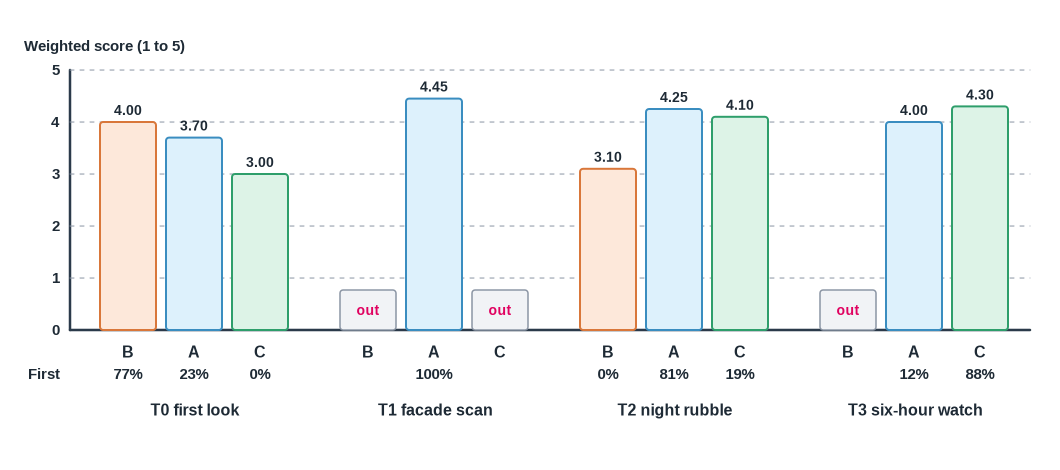
T0 first look (6 min) B compact quad 4.00 (first in 77%), A medium quad 3.70 (first in 23%), C tethered quad 3.00 (first in 0%)
T1 facade scan A medium quad 4.45 (first in 100%); knocked out: B compact quad, C tethered quad
T2 night rubble A medium quad 4.25 (first in 81%), C tethered quad 4.10 (first in 19%), B compact quad 3.10 (first in 0%)
T3 six-hour overwatch C tethered quad 4.30 (first in 88%), A medium quad 4.00 (first in 12%); knocked out: B compact quadFor T1 facade scan only A passes the knock-out, because the expected wind of 8.7 m/s exceeds the planning limit of C (8.0) and of B (6.4). For T3 six-hour overwatch, B is knocked out and C wins 88% of the random weightings, because flight time and safety matter most. For T0, where speed is needed, B wins 77% but not decisively: if the commander gives more weight to sensors, A wins. For T2 at night, A wins 81% and C wins 19%. The result says to send type A (two aircraft) as the main aircraft and to prepare B to launch first for the first look, while C suits long overwatch when a safe place for the tether is available. Knowing that two of the results are not decisive lets the team prepare backup options early.
Batteries, chargers and the staged kit
The time for “set up the kit” in the schedule of Module 16 can be reduced by keeping a staged kit: the aircraft, ground station, fully charged batteries, camera, light and checklist in a box that is ready to lift into a vehicle. A problem that is often forgotten is batteries over a long mission. The next example counts the battery sets and chargers needed if aircraft A does a six-hour overwatch with one aircraft over the building at all times, and compares this with aircraft C, which uses only a generator.
Example 4 How many battery sets for six hours
The usable flight time per set is 28 minutes. Travel there and back and landing cost 4 minutes per sortie, a battery swap takes 3 minutes, charging one set takes 70 minutes, each set holds 650 Wh and the charger efficiency is 90% (assumed values).
import math
# battery sets and chargers for six hours of continuous overwatch with aircraft A (all numbers assumed)
hours, usable_min, transit = 6.0, 28.0, 4.0              # plan length, usable flight time per set (module 18), time lost to transit and landing per sortie
swap, charge_min, wh, eta = 3.0, 70.0, 650.0, 0.90       # swap time, charge time of one set, battery energy, charger efficiency
on_station = usable_min - transit                        # minutes over the tower per sortie
sorties = math.ceil(hours * 60 / on_station)
cycle = usable_min + swap + charge_min                   # a set returns to service this long after take-off
sets = math.ceil(cycle / on_station)                     # sets needed so that the next sortie never waits for a charger
chargers = math.ceil(charge_min / on_station)            # sets charging at the same time
power_w = chargers * wh / (charge_min / 60) / eta        # electrical load of the chargers
print(f"on station {on_station:.0f} min per sortie -> {sorties} sorties in {hours:.0f} h")
print(f"a set is back in service {cycle:.0f} min after take-off -> {sets} sets in rotation, {sets + 1} with one spare")
print(f"{chargers} chargers at the same time need about {power_w / 1000:.1f} kW; energy for the night {sorties * wh / 1000:.1f} kWh of battery")
on station 24 min per sortie -> 15 sorties in 6 h
a set is back in service 101 min after take-off -> 5 sets in rotation, 6 with one spare
3 chargers at the same time need about 1.9 kW; energy for the night 9.8 kWh of batteryThere are 24 minutes over the building per sortie, so 15 sorties are needed in 6 hours. A set is back in service 101 minutes after take-off, so 5 sets must be in rotation, and one spare should be added to make 6 sets. 3 chargers are needed at the same time, with a total electrical load of about 1.9 kW, which the team’s generator must be able to supply. Aircraft C, by contrast, draws 987 W from the generator and needs no rotating batteries. That is why T3 chooses C. The lesson is that the cost of a long mission lies in logistics, not in the drone. Lithium batteries must be charged in a fire-resistant container away from people, with an extinguisher at hand, as taught in modules 1–5 of this course.
Module lab
Practical: test the department’s aircraft and choose one for the facade scan
- Requirements table From the objectives and the assessment results of Modules 16 and 17, write a seven-row technical requirements table in the form shown in this module, with numbers.
- Hover test On a closed area of the university, fly within visual line of sight, in daylight and under the conditions of CAAT. Let each aircraft hover at a height of 2 m until the low-battery warning level. Record the time and the power used from the flight log. Do it twice, once with no payload and once with the full payload.
- Fit the model Use the code of Example 1. Adjust FM and to match the measured times, then predict the flight time at 35 °C and compare it with the manufacturer’s figure.
- Lens Measure the apparent size of an object of known size (a sign 1.2 m wide) at 45 m with the department’s thermal or RGB camera. Count the pixels across the sign, compare with the formula and run the code of Example 2 with the cameras and lenses available.
- Decision matrix Score the department’s aircraft from steps 2 to 4. Set the weights for two tasks, run the code of Example 3 with the knock-out included, and report the share of runs in which each aircraft ranks first.
- Logistics Calculate the battery sets and chargers for a four-hour overwatch with the code of Example 4, using the charging time you actually measured.
Common mistakes
Watch out
- Choosing from the brochure instead of measuring or calculating the flight time at the real temperature and payload.
- Forgetting that every kilogram of payload costs flight time, for example flying the searchlight and the zoom camera on every sortie when the task does not need them.
- Choosing a longer lens and backing off further, thinking the picture gets better, when the pixels and the number of images depend only on and the risk footprint grows.
- Letting scores offset a knock-out, for example using good flight time to offset wind above the limit.
- Using the matrix result without testing the sensitivity to the weights, when the weights are a matter of judgement.
- Forgetting the logistics of a long mission: batteries, chargers and the generator.
- Using FM and values that were not tested and believing that the calculated flight time equals the real one.
Summary
- Choose the aircraft from requirements converted from the objectives and the risk-assessment results, and from numbers that are measured or calculated, following the principle of NFPA 2400 and the NIST test methods.
- Hover power gives the flight time. One kilogram of payload costs about 5.7 minutes of flight time for A. Hot air reduces the flight time slightly.
- The pixel size on the wall is . The pixels on the target and the number of images depend only on , so use the shortest lens that meets the criteria at the safest standoff.
- A SMART weighted matrix needs knock-out criteria that cannot be traded off, and a test of sensitivity to the weights. The result for the case study is A as the main aircraft, B for the first look and C for long overwatch.
- A long mission needs battery and charger planning (for aircraft A over six hours: five battery sets in rotation and three chargers).
Self-check questions
- An aircraft weighs 5 kg and has a total rotor disc area of 0.5 m². The air density is 1.18 kg/m³, FM is 0.65 and is 0.80. What is the hover power, and how many minutes can a 300 Wh battery fly until 20% is left?
- A thermal camera has 640 pixels across, a pixel pitch of 12 µm and a 13 mm lens, at a standoff of 50 m. What is the pixel size on the wall, how many pixels fall on a window 1.2 m wide, and how wide is the image?
- An aircraft has a wind limit of 9 m/s. The wind expected at the task position is 7.5 m/s, and the team uses a knock-out of 80% of the limit. Does this aircraft pass?
- For a four-hour overwatch, the usable flight time is 20 minutes, travel costs 3 minutes per sortie, a swap takes 3 minutes and charging takes 60 minutes. How many sorties are needed, how many battery sets are in rotation, and how many chargers are needed at the same time?
- If the 9 mm lens at 45 m is replaced by a 13.5 mm lens at 67.5 m, how do the number of images per wall and the pixels on a window change, and what is lost?
Answers
- W. The usable energy is Wh, so the aircraft can fly minutes.
- m, or 4.62 cm. The window gets pixels. The image is m wide.
- The planning limit is m/s, which is less than the expected wind of 7.5 m/s. This aircraft is knocked out.
- On station the aircraft flies minutes per sortie. sorties. A set is back in service after minutes, so sets are in rotation, and chargers are needed at the same time.
- changes from to , the same as before. The image is still 38.4 m wide, so the number of images and the pixels on a window stay the same. What is lost is that the risk footprint on the ground becomes 22.5 m wider, with nothing gained.
Key formulas
| Hover power from momentum theory | |
| Pixel footprint on the wall | |
| Number of images across the width | |
| Weighted score |
Key references
- National Fire Protection Association. (n.d.). Small unmanned aircraft systems fact sheet [Summary of NFPA 2400, Standard for small unmanned aircraft systems (sUAS) used for public safety operations]. NFPA. link
- National Institute of Standards and Technology. Standard test methods for small unmanned aircraft systems (aerial drone tests). link
- Leishman, J. G. (2006). Principles of helicopter aerodynamics (2nd ed.). Cambridge University Press.
- International Civil Aviation Organization. (1993). Manual of the ICAO standard atmosphere: Extended to 80 kilometres (262 500 feet) (Doc 7488, 3rd ed.). link
- ArduPilot Dev Team. Battery failsafe. ArduPilot Copter documentation. link
- Edwards, W. (1977). How to use multiattribute utility measurement for social decisionmaking. IEEE Transactions on Systems, Man, and Cybernetics, 7(5), 326–340. link
- สำนักงานการบินพลเรือนแห่งประเทศไทย. (2569). ประกาศ กพท. เรื่อง หลักเกณฑ์และวิธีการในการอนุญาตให้ผู้บังคับหรือปล่อยอากาศยานซึ่งไม่มีนักบิน ประเภทอากาศยานที่ควบคุมการบินจากภายนอก ที่มีน้ำหนักไม่เกิน 25 กิโลกรัม ปฏิบัติแตกต่างไปจากเงื่อนไขที่กำหนด พ.ศ. 2569 (มีผล 17 พฤษภาคม 2569). link
Further reading
Study the assigned knowledge units in advance, review media and take the module quiz
กล้อง EO/IR และ gimbal
Payload mass, centre of gravity and energy
Limitations of RGB and thermal imagery
In class / field
Lab or field practice from worksheets with a safety checklist
Learning evidence: Checked worksheets and quiz results