Reynolds, Mach and choosing the model fidelity
Calculate the ratio of inertia to viscosity and of speed to the speed of sound, and distinguish laminar, RANS, URANS and LES

Two numbers help frame the questions
By the end of this chapter, learners will calculate Re, Mach and q and state the meaning of the velocity and length used Re = ρUL/μ = UL/ν, M = U/a, q = ½ρU² , where a is the speed of sound in m/s, Re and M are dimensionless, and q is in Pa. See the definitions in NASA Reynolds and NASA Mach
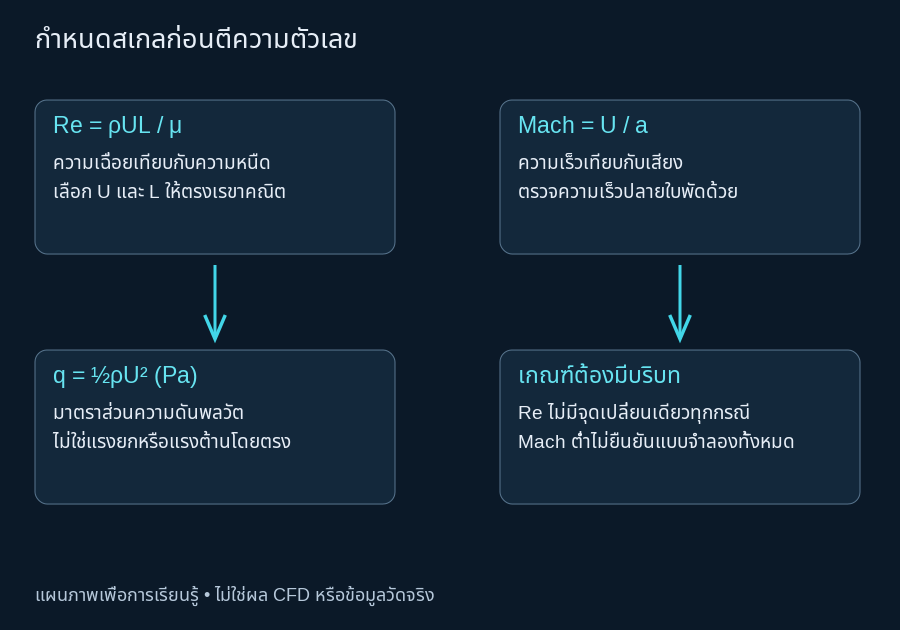
Re compares the importance of inertia to viscosity at the chosen scale; it is not an automatic turbulence detector. Transition depends on geometry, roughness, disturbances and flow history. Do not apply a single round-pipe criterion to judge propellers or flat plates, and even at high Re, viscosity near walls still matters
An example you can calculate by hand
Assume ρ = 1.225 kg/m³, μ = 0.0000181 Pa·s, U = 10 m/s, L = 0.1 m and a = 343 m/s, giving Re ≈ 67,680, M ≈ 0.0292 and q = 61.25 Pa . These property values are specified for the exercise, not measurements of the air at the flight site
If L is the wing chord, write that Re is based on chord. If it is changed to the propeller diameter, Re becomes a different definition even with the same velocity. For a very wide plate channel, the hydraulic diameter Dh ≈ 2H can be used with the mean velocity, but ReDh must be clearly labelled
Try changing values with the calculator at the end of the chapter and predict the result before pressing calculate. When U doubles, Re and M double, while q quadruples. This calculator computes ratios; it does not solve Navier–Stokes
The drone flies slowly, but the blade tips may be fast
A hypothetical example propeller with radius R = 0.1 m spinning at 10,000 rpm has Ω = 2π × 10,000/60 ≈ 1,047.2 rad/s and tip tangential speed ΩR ≈ 104.72 m/s, so Mtip ≈ 0.305 using a = 343 m/s. Induced inflow and forward speed are not yet included
As a rough rule, M below about 0.3 is often used to screen the incompressible assumption, but it does not guarantee constant density everywhere. Local relative velocity, temperature and the required accuracy must be considered. A near-zero aircraft Mach number during hover is therefore not enough for choosing a propeller model
How do laminar, RANS, URANS and LES differ?
| Approach | What is computed and what is additionally modelled | Evidence to pay attention to |
|---|---|---|
| Laminar | Solves the field without adding a turbulence model | The flow must be consistent with the assumption; switching off turbulence does not make the real flow laminar |
| Steady RANS | Solves a steady mean field with a model for Reynolds stresses | Near-wall model, grid and suitability of the steady-mean assumption |
| URANS | Solves a time-varying mean field but still uses a turbulence closure | Time step, rotation cycles and forces reaching a periodic state |
| LES | Resolves large flow structures and models scales smaller than the filter | Spatial and temporal resolution and the statistics collection period |
URANS does not resolve turbulence at all scales, and LES is not the same as DNS, which attempts to resolve all relevant scales. Choosing a more expensive option still requires checking the results. OpenFOAM Foundation v13 separates the laminar, RAS and LES options, and the model details and boundary conditions must be specified consistently
Exercise with answer guide
Problem: use U = 20 m/s and L = 0.05 m with other properties as in the first example. Does Re change, and what is q?
Answer guide: the product UL is unchanged, so Re ≈ 67,680 as before, but M ≈ 0.0583 and q = 245 Pa. Having the same Re alone does not make the forces equal; shape, scale, area and other conditions must also be compared
Next: testing a channel flow with an exact solution
Bibliography
Original sources checked 26 September B.E. 2569 (2026)
Calculate Re, Mach and dynamic pressure
Uses the air properties and scale you specify. It does not solve Navier–Stokes and does not judge turbulence from a single Re value. Data is computed in the browser and not sent off the device