Coordinating missions and rescue airspace
Link the requester, the remote pilot and the command centre, with a mission stop plan and an agreed channel for delivering results
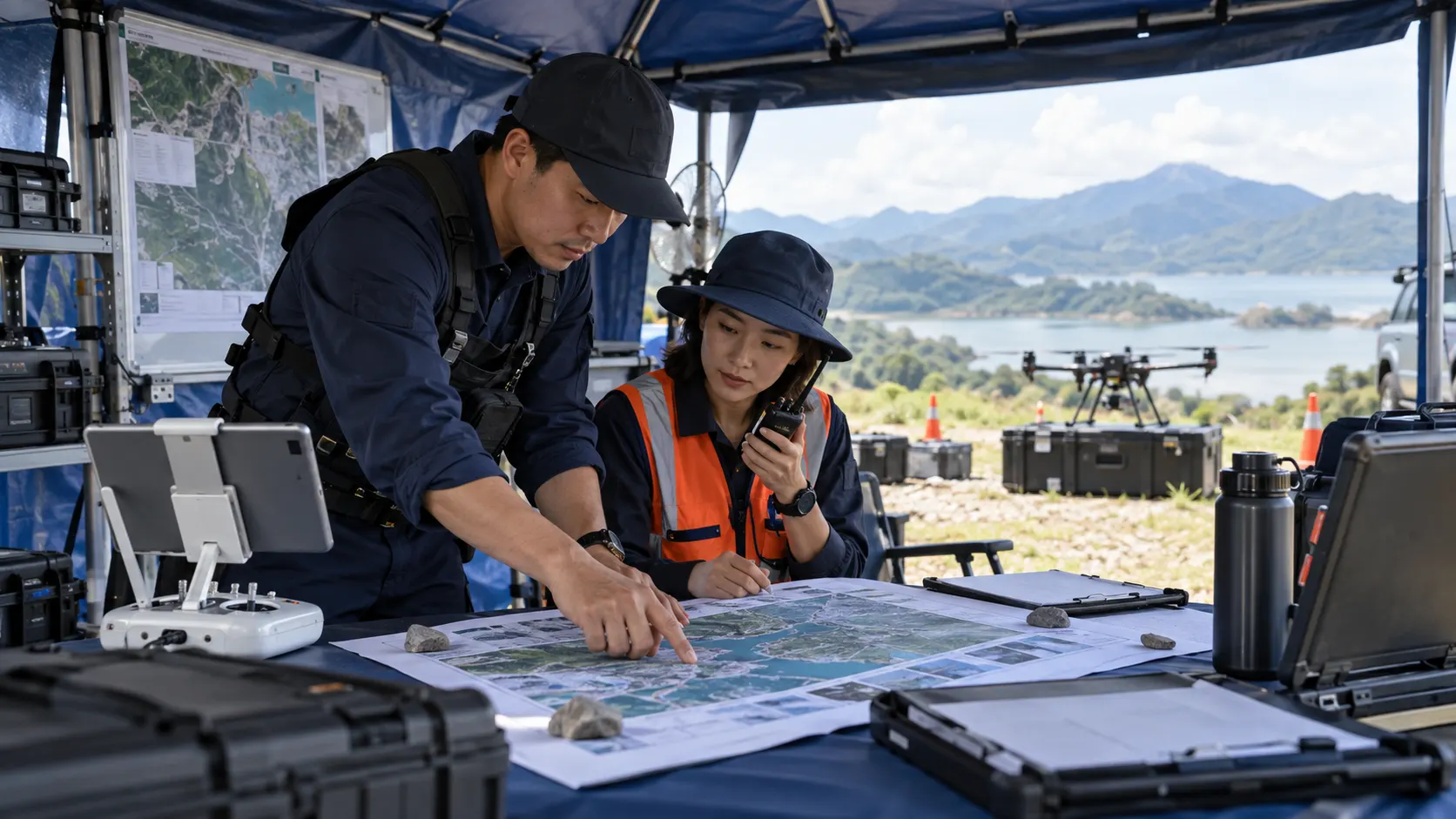
A mission starts with a request and a responsible person
Situations involving multiple agencies need a clearly designated coordinator. A survey request should state the question, the area, the urgency, the recipient of the data and the deliverable format. Before deciding to fly, the remote pilot must check readiness against the requirements and procedures of the responsible agency.
The FAA warns that uncoordinated drones can force firefighting aircraft to suspend operations. This lesson uses that to teach the rationale for airspace coordination; for Thai law and authorisations, check with CAAT UAS Portal and the local incident command, and do not assume that an emergency automatically grants an exemption. FAA toolkit
Separate roles so that information does not fall through the gaps
| Role | Questions to answer |
|---|---|
| Requester | What decision does the data support, and when is it needed? |
| Coordinator | Which units are already operating, and how must flights and the area be coordinated? |
| Remote pilot | Are the team, the aircraft and the mission conditions ready? |
| Analyst and reviewer | What can the imagery tell us, and where is the uncertainty? |
| Recipient | Has the data been received yet, and which points need further checking? |
In a small team, one person may hold several roles in line with the agency's procedures, but the watch-keeping and checking duties must not be lost.
Agree on termination conditions and status reporting
Use conditions from the equipment manual and the authorised plan. Examples of triggers for review include the arrival of another aircraft, abnormal communications, or weather that does not match the plan. When a mission is stopped, notify the coordinator, including which parts have been surveyed and which parts still have no data.
Closing a mission requires confirmation that the files were received; pressing send does not mean the recipient has read the data and can use it.
Diagram to aid understanding
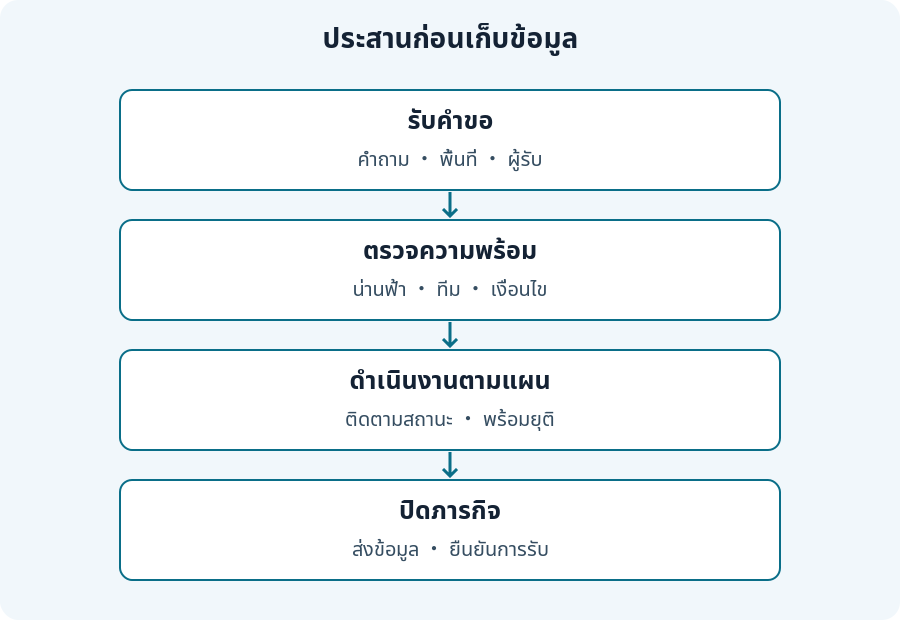
This diagram summarises the concept of the lesson and accompanies the steps and constraints explained above. Click the image to enlarge it.
Try it on a computer
- Create one hypothetical mission request using a simulated area
- Assign the roles of requester, coordinator, remote pilot and recipient
- Inject a hypothetical event in which another aircraft enters the area, then have the team record its decision according to the plan
Deliverable: A mission request with the sequence of status reports and mission close-out
Check the result: Identify the decision maker and the person notified at every step; do not claim flight authorisation on the basis of the exercise
Further study and practice resources
Open the lessons linked to this topic → · Open the scenario exercise set and downloadable files →
Bibliography and further reading
- FAA: Drones and Wildfires Toolkit. Retrieved 8 September B.E. 2569 (2026)
- CAAT: UAS Portal. Retrieved 8 September B.E. 2569 (2026)
- NASA: ACERO and Wildland Fires. Retrieved 8 September B.E. 2569 (2026)
The content and exercises were compiled from the sources above. The photorealistic images are simulated illustrations, not evidence of mission results or equipment test results.