Communications and data transfer when networks fail
Separate aircraft control, status messages and image files, then design fallback paths and acknowledgement of received data
Each type of data has different requirements
Aircraft control must use the aircraft’s verified systems and procedures, whereas a “mission temporarily paused” message and a large number of image files differ in urgency and data volume. Functions should therefore be separated before choosing a technology. Do not use the lesson’s experimental network in place of a real flight control link.
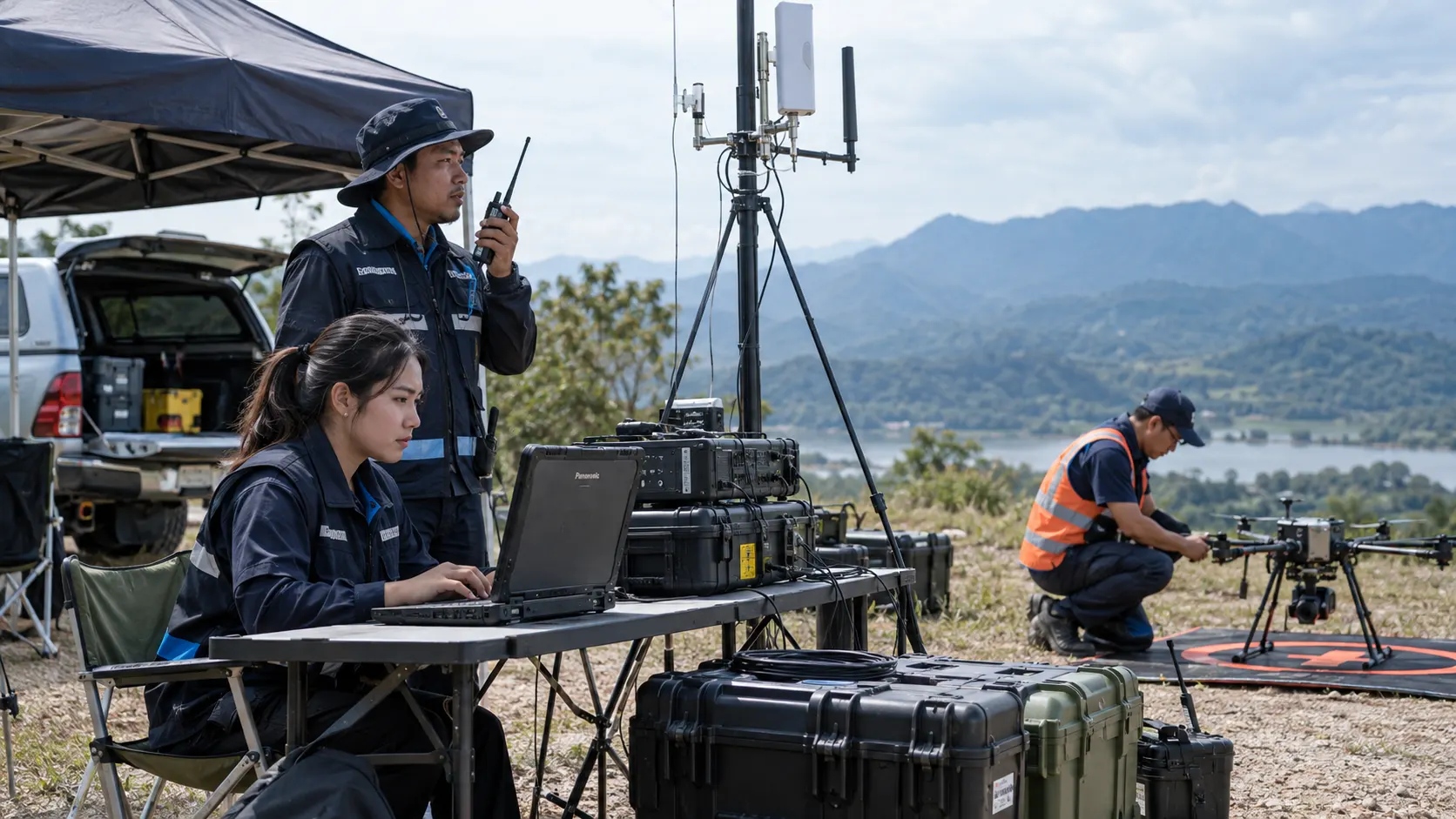
NASA ACERO studies communications support for wildfire operations, an example showing that connectivity is part of the operational system; simply having a drone in the air does not mean communication works everywhere NASA ACERO
Design for when data is not fully delivered
| Data | Handling in the exercise |
|---|---|
| Status message | Include the item code, time and sender |
| Message receipt | The recipient acknowledges with the same code |
| Image files | Keep the originals and a list of files to send |
| Duplicate message | Check the code before creating a new item |
| Old data arrives later | Compare event time and version; do not immediately overwrite newer data |
The store-and-forward concept means storing data and sending it when a channel is available. What matters is that the recipient knows when the data was generated; the time a file arrives is not used in place of the image capture time.
Connecting with IoT and MQTT within limits
Read about the publish–subscribe structure in MQTT and Mosquitto and network limitations in IoMT and LoRa/Mesh before choosing a messaging channel. Do not assume that a channel that can send short status messages can also carry video adequately; the data rate, latency and continuity of the real system must be assessed.
Start practising by exchanging CSV and files on a simulated network. Do not adjust frequency bands, transmit power or flight control systems in this exercise.
Diagram to aid understanding
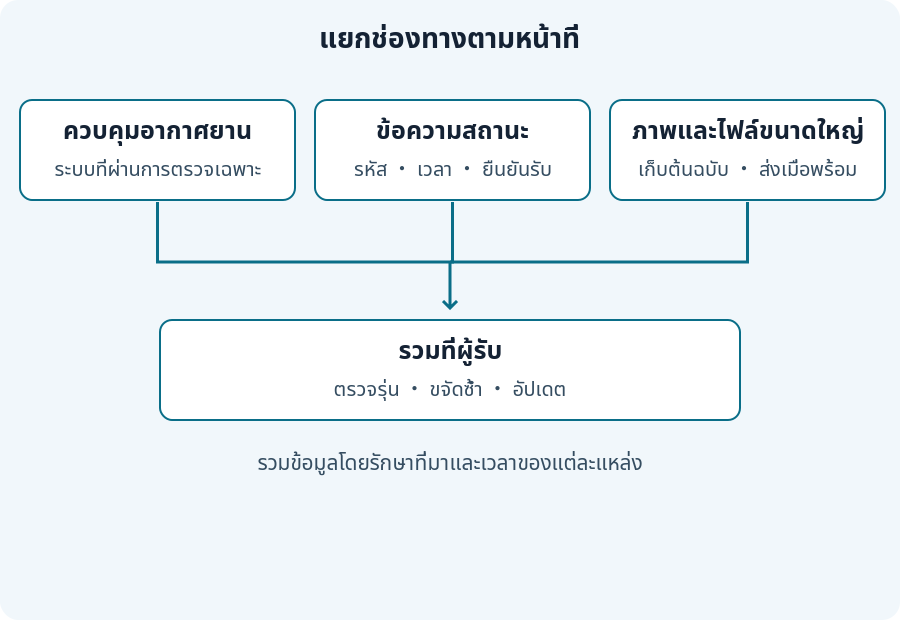
This diagram summarises the chapter’s concepts and accompanies the steps and limitations explained above. Click the image to enlarge it.
Try it on a computer
- Create three simulated status messages with codes and times.
- Send the second item twice, and send an older item after a newer one.
- Have the recipient merge the data without adding duplicate items and without deleting the original evidence.
Deliverables: a send–receive log with the method for handling duplicate messages and delayed data
Check results: the recipient can distinguish capture time from receipt time, and every message that closes a task has an acknowledgement
Further study and practice resources
Open related chapters → · Open scenario practice sets and downloadable files →
Bibliography and further reading
- NASA: ACERO and Wildland Fires. Retrieved 8 September 2569 (2026)
- WFP: Mapping and geospatial analysis in emergency. Retrieved 8 September 2569 (2026)
The content and exercises were compiled from the sources above; the realistic images are simulated illustrations, not evidence of mission results or equipment test results.