Teamwork and situational awareness
Divide roles, communicate with read-back, and manage workload so that the team shares the same picture of the situation

A brief ensures everyone knows their duties
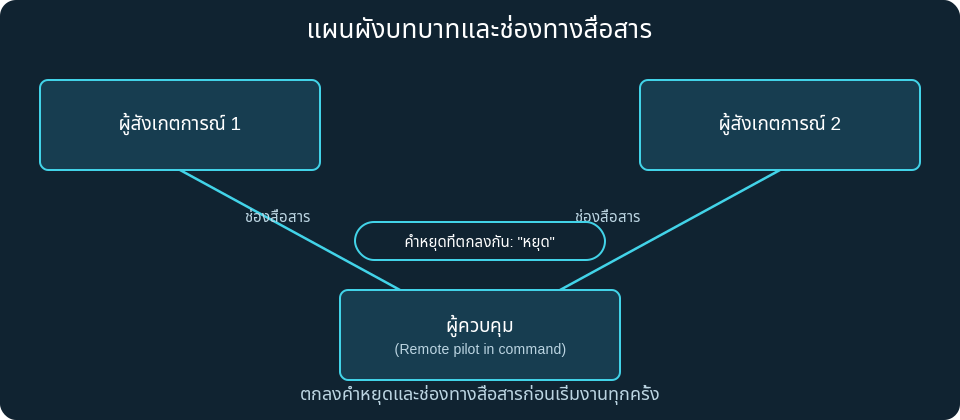
Before starting, review the objective, scope of work, who is responsible for control, the observers, communication channels, and the word used when a stop is needed. Anyone who notices something abnormal should be able to report it without waiting for the remote pilot to notice it themselves.
Read-back closes the communication loop
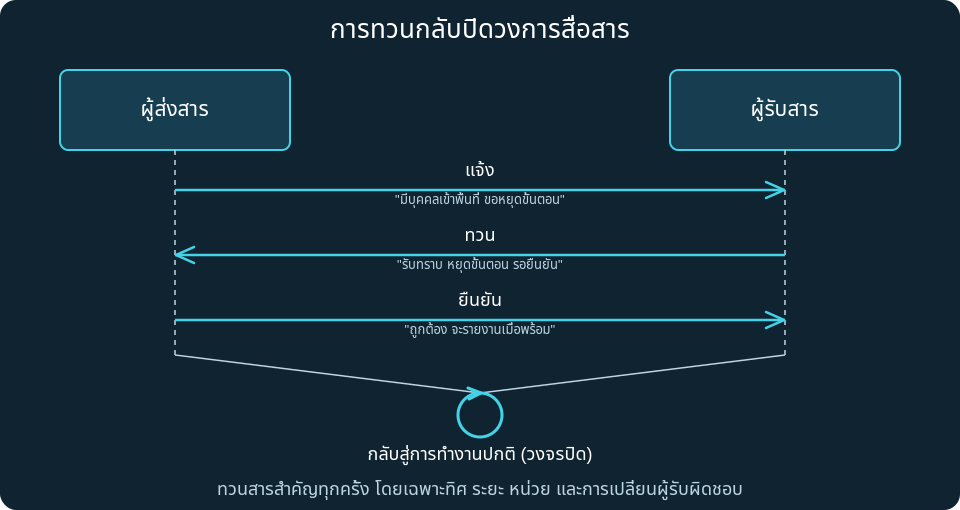
Saying something does not mean the receiver has understood it the same way. The receiver should read back important messages, and the sender confirms or corrects them, especially directions, distances, units and changes of responsibility.
| Step | Tabletop practice example |
|---|---|
| Report | Observer: “A person has entered the training area; request to hold the next step” |
| Read back | Remote pilot: “Copy, holding the next step, awaiting area confirmation” |
| Confirm | Observer: “Correct, I will report when the area is ready to be reassessed” |
This example is communication in an exercise; it does not replace model-specific aircraft control procedures or emergency plans.
Avoid staring at the screen and losing the big picture
The screen and the outside view give different information. Visual scanning must cover the assigned tasks and the conditions of the area. Seeing an object in a two-dimensional image does not allow the real distance to be judged reliably. Divide tasks and practise voicing doubts clearly.
After the exercise, review which messages were missed, when workload was high, and how roles or phrasing will be adjusted. Do not conclude merely that “everyone must be more careful”.
References and scope
Sources checked 7 September B.E. 2569 (2026). Compiled to accompany knowledge kindly provided by DTI. FAA guidance is used to support the principles and does not replace Thai requirements.
Linking knowledge with missions and data
Separate the remote pilot, the watcher and the data handler clearly according to team size. Roles in the exercise are job functions, not licence titles. Everyone should know who makes decisions and who receives important messages Read the reference: CAAT, Guidance for Development of an Operations Manual
Check your understanding: rehearse short messages, with the receiver reading back and the sender confirming, and record one example in which the read-back revealed incorrect information, without ordering a real flight
Read next: lessons that apply this knowledge in a simulated job · sources reviewed 26 September B.E. 2569 (2026)