Separating observation, inference and unknowns
Use an observation table to make reasoning and alternative explanations transparent.
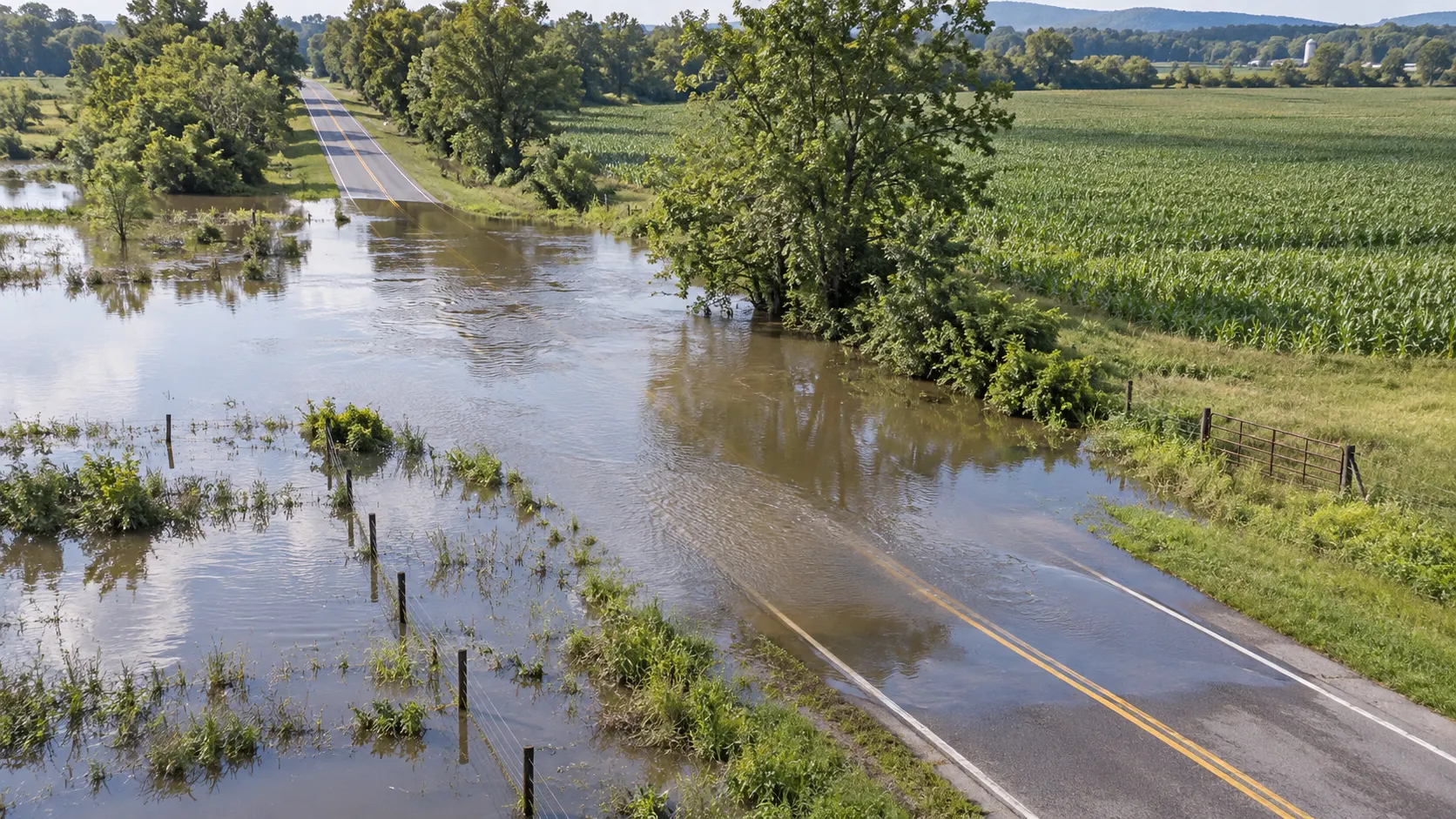
Outcomes and prerequisite knowledge
Learners will be able to write a table that separates observations, inferences, alternatives, unknowns and data needing further checking. Read the analysis overview before starting.
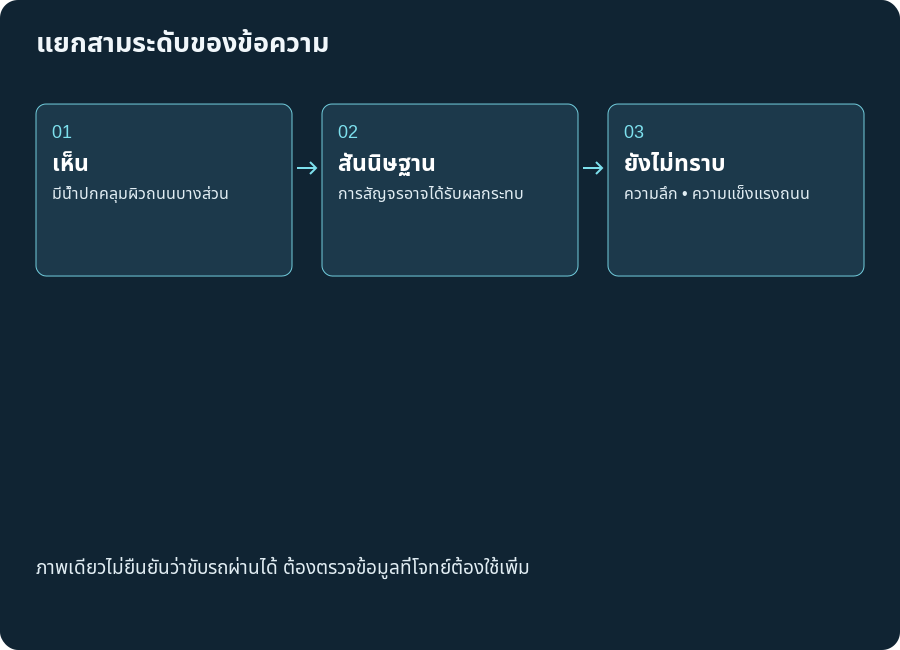
Open the full-size diagram to enlarge and view the details
Words that change the level of a claim
'An elongated dark area beside the road alignment' describes what is seen, while 'the road has subsided' gives a physical meaning that requires other data to support it. If both are written in the same cell, the reviewer cannot tell which step came from the image and which came from the analyst's knowledge or assumptions.
Disclosing assumptions and considering alternatives are principles in ICD 203. The table below is a newly compiled practice format, not a system for scoring truth or confidence as a percentage. ODNI ICD 203
| Column | Example from the simulated scene | Reason for separating |
|---|---|---|
| Seen | R2 has a dark area with an oblique edge | A peer can open the image and check it |
| Inferred | May represent a shadow in the drawing | It assigns meaning |
| Alternative | May represent a surface of a different material | Not tied to a single answer |
| Unknown | No height, temperature or material data | States the limits of the data |
| Check further | In real work, suitable imagery/reference data are required | Sets the next step according to the question |
Do not use the number of images in place of independence
Three copies of the same image are still a single image source. Cropping an image or changing its brightness helps reveal certain details but does not create confirmation of an event from a new source. Record the parent asset of every transformed image so that readers do not assume there is more independent evidence than there really is. Guidance on checking provenance and data transformations is in Berkeley Protocol
When writing a confidence level, follow it with the reasoning, for example 'limited, because there is only one scene and no height data' is better than entering 90% with no explainable calculation method. 'Unknown' is a useful analytical result when it states what must be checked next.
Exercise: review a peer's conclusions
Use scene-a.svg and a copy of observations.csv in imagery workbook . All of it is hypothetical data.
- Record observations for R1 and R2 by referring to positions in the scene; do not create world coordinates.
- Write one inference and at least one alternative for each area.
- Identify the missing data and explain how new data would help distinguish the alternatives.
- Have a peer underline words that conclude beyond the image, such as 'certainly', 'dangerous' or 'road cut off', and explain the evidence still required.
- Revise the report while keeping the original text and the reasons for changes in the version history.
Answers and rubric
R1 shows blue crossing a grey band, but the scene has no data on water level or the real road surface. R2 is dark but there is no temperature evidence; concluding that it is hot from a colour in an SVG is a data-type error.
Score 0–2 per aspect: referencing areas, neutral observations, separating interpretation, having alternatives, and requesting additional data relevant to the question. Differing opinions are acceptable if the reasoning is shown and hypothetical data is not claimed as evidence of a real event.
References and next chapter
- ODNI, ICD 203: Analytic Standards, Original, checked 26 September 2026
- OHCHR / UC Berkeley, Berkeley Protocol, Original, checked 26 September 2026
- Continue with sensor limitations