Numbers, fractions, percentages, ratios and proportions
UAT 101 Applied Mathematics for Technology
Lesson
By the end of this module you will be able to
- Compute with whole numbers, fractions and decimals, and convert between these forms
- Compute percentages, increases and decreases in technology work
- Use mixing ratios and direct proportion to calculate quantities needed
- Check whether answers are reasonable by estimating
Why this matters
Technology work is full of numbers that must be calculated correctly and quickly: what percentage of battery is left, how many litres of fertiliser to mix, how many flights a field needs. A small mistake, such as mixing twice as strong, can damage crops or waste money. This module reviews everyday calculations using real drone examples.
This course follows one fictional case through all five modules: a first-year student helps the university’s agricultural drone team prepare a liquid-fertiliser spraying mission on a demonstration field, from mixing and measuring areas to planning flights and summarising data afterwards. All figures are fictional. The Python code can be downloaded from /downloads/uat-101/.
Numbers, fractions and decimals
The same quantity can be written in several ways: one half is , or . Choosing the right form makes calculation easier.
- Fraction to decimal: divide the numerator by the denominator, for example
- Decimal to percentage: multiply by 100, for example
- Order of operations: brackets first, then powers, then multiplication and division from left to right, then addition and subtraction, so , not 20
Round only once, at the final answer; rounding at every step accumulates error. Keep decimals appropriate to the data’s resolution: a scale that reads whole grams should not be reported to milligrams.
Percentages, increases and decreases
A percentage compares a part with a whole counted as 100.
Percentage change is always calculated from the starting value. A price rising from 2,000 to 2,300 baht is an increase of , but falling from 2,300 back to 2,000 is a decrease of , not 15%.
Ratios and proportions
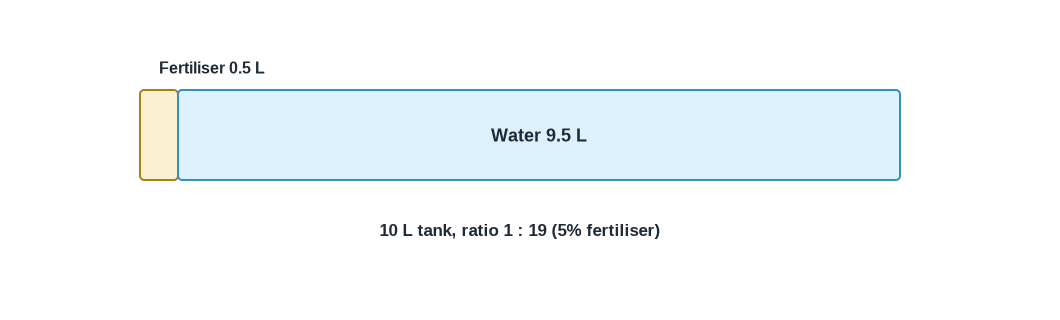
A ratio says how two quantities compare. Mixing liquid fertiliser with water at 1 : 19 means 1 part fertiliser in every 20 parts. In a tank of volume , the fertiliser amount is
Example 1 Mixing fertiliser and checking the battery
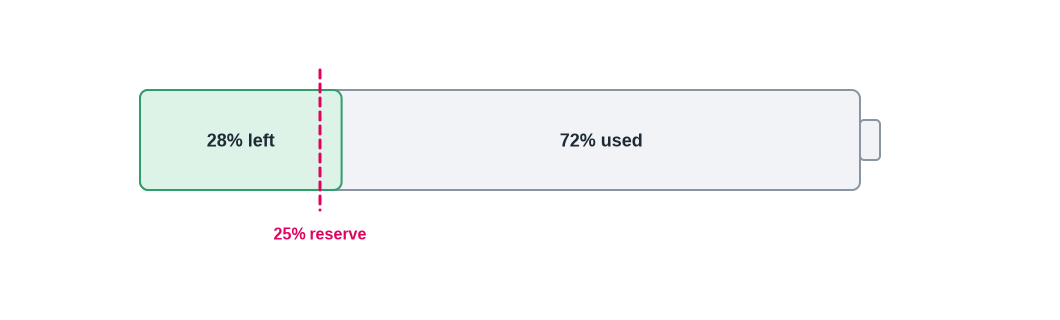
The drone’s spray tank holds 10 L, the mix is 1 : 19 fertiliser to water, and the 5,000 mAh battery has used 3,600 mAh.
TANK_L = 10                                # drone spray tank capacity (litres)
FERT, WATER = 1, 19                        # liquid fertiliser to water ratio 1 : 19
fert = TANK_L * FERT / (FERT + WATER)
print(f"fertiliser {fert} L, water {TANK_L - fert} L, concentration {fert / TANK_L:.0%}")
CAP, USED = 5000, 3600                     # battery capacity and amount used (mAh)
print(f"used {USED / CAP:.0%}, left {1 - USED / CAP:.0%}, fraction left = {CAP - USED}/{CAP}")
fertiliser 0.5 L, water 9.5 L, concentration 5%
used 72%, left 28%, fraction left = 1400/5000Fertiliser is L with 9.5 L of water, a 5% concentration. The battery has used , leaving 28%, or . If the team rule is to land at 25% (an assumed value), only about 3% of usable energy remains, so it is time to head back.
Direct proportion means one quantity grows by the same factor as another, written . If the recommended rate is 2 L per rai, a field twice as large needs twice as much mix.
Example 2 How many litres and how many flights?
The spray rate is 2 L per rai, the demonstration field is 7.5 rai and the tank holds 10 L.
import math

RATE_L_PER_RAI = 2.0                        # recommended spray rate (litres per rai)
FIELD_RAI, TANK_L = 7.5, 10                 # demonstration field size (rai) and spray tank (litres)
total = RATE_L_PER_RAI * FIELD_RAI          # direct proportion: more rai, proportionally more mix
print(f"spray mix needed {total} L, tank loads {math.ceil(total / TANK_L)}")
for rai in (2.5, 5, 7.5, 10):
    print(f"{rai:>4} rai -> {RATE_L_PER_RAI * rai:4.1f} L")
spray mix needed 15.0 L, tank loads 2
2.5 rai -> 5.0 L
5 rai -> 10.0 L
7.5 rai -> 15.0 L
10 rai -> 20.0 LThe field needs L, so at least 2 flights: a full 10 L tank, then 5 L. Always round up the number of flights, because you cannot fly 1.5 flights.
Checking answers by estimating
Before trusting a calculator, estimate in your head: 7.5 rai at 2 litres per rai should be “about 15”. If the calculator shows 150, you pressed something wrong. Estimating catches the most common mistake: a misplaced decimal point.
Class activity
Activity: preparing the mix for your group’s field
- Your lecturer gives each group a field size, spray rate and mixing ratio
- Calculate the total mix, fertiliser and water per tank, and number of flights by hand first, then check with the code in Examples 1 and 2
- Estimate each answer mentally before calculating, and record how far off your estimate was
- Swap answers with another group and check that flights were rounded up correctly
Common mistakes
Watch out
- Reading 1 : 19 as 1 part in 19, when there are 20 parts in total
- Calculating a percentage decrease from the new value instead of the starting value
- Rounding flights down, so there is not enough mix for the whole field
- Rounding at every step, so the final answer drifts
- Not estimating first, so a calculator slip goes unnoticed
Summary
- Fractions, decimals and percentages convert into each other; pick the easiest form and follow the order of operations
- Percentage = part ÷ whole × 100, and change is measured from the starting value
- A ratio has parts in total; direct proportion is
- Round countable things up, and estimate before trusting a calculator
Check your understanding
- What is as a decimal and a percentage?
- A 16 L tank is mixed at 1 : 15. How many litres of fertiliser?
- A 4,000 mAh battery has used 3,000 mAh. What percentage is left?
- At 1.5 L per rai on a 12-rai field with a 10 L tank, how many flights are needed?
- A price falls from 2,500 to 2,000 baht. By what percentage?
Answers
- , or
- L
- L, so 2 flights
Key formulas
| Percentage | |
| Mixing ratio a : b | |
| Direct proportion |
Key references
- Abramson, J. (2021). Algebra and trigonometry (2nd ed.). OpenStax. link
- Stroud, K. A., & Booth, D. J. (2020). Engineering mathematics (8th ed.). Bloomsbury.
Further reading
Study the assigned knowledge units in advance, review media and take the module quiz
In class / field
Lecture, case discussion and in-class problem solving
Learning evidence: Quiz results and submitted exercises