Unit conversion and exponents
UAT 101 Applied Mathematics for Technology
Lesson
By the end of this module you will be able to
- Explain SI base units and prefixes
- Convert the speed, length, area and spray-rate units used in drone work correctly
- Use exponents and scientific notation to write very large or small numbers
- Compute battery energy in watt-hours from voltage and capacity
- Convert degrees-minutes-seconds coordinates to decimal degrees and convert aviation units (nautical miles, knots, feet)
Why this matters
In September 1999 NASA lost the Mars Climate Orbiter; its investigation board found that one piece of ground software used English units where another expected metric. In drone work, wind forecasts are often in kilometres per hour or knots while the drone shows metres per second, some sources give altitude in feet, and Thai farmland is measured in rai. One wrong conversion makes the whole plan wrong.
SI units and prefixes
The International System of Units (SI), maintained by the International Bureau of Weights and Measures (BIPM), has base units such as the metre (m), kilogram (kg), second (s) and ampere (A). Other units are built from them, and prefixes stand for powers of ten.
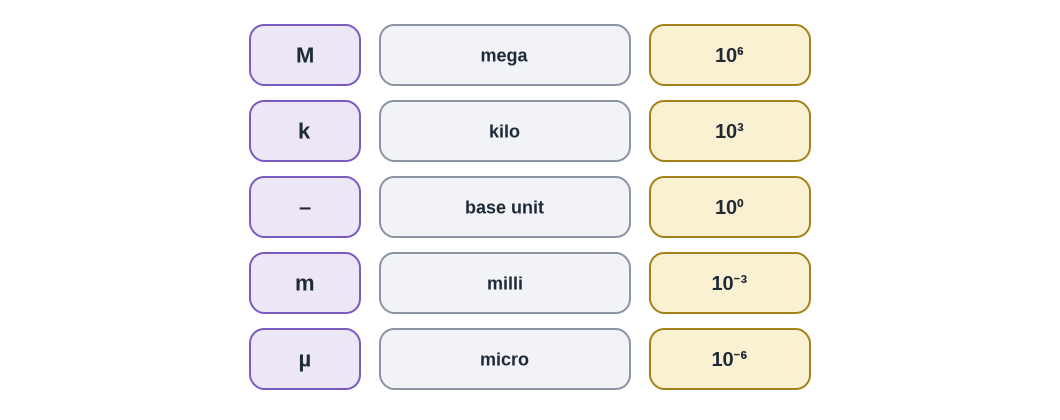
Watch the case: m (milli) and M (mega) differ by a factor of .
Converting with factors
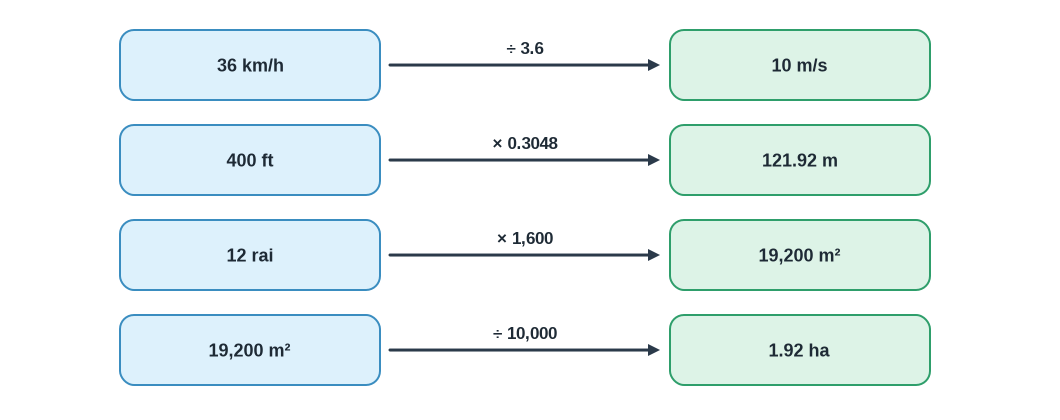
The safe method is to multiply by factors equal to 1 and cancel repeated units, for example
which equals dividing by 3.6. Thailand’s Weights and Measures Act B.E. 2542 (1999) defines 1 rai = 1,600 square metres; 1 hectare = 10,000 square metres, so 1 ha = 6.25 rai; and, by the international definition, 1 foot = exactly 0.3048 metres.
Example 1 Five conversions
conversions = [                             # (value, from unit, factor, to unit)
    (36, "km/h", 1000 / 3600, "m/s"),
    (400, "ft", 0.3048, "m"),
    (12, "rai", 1600, "m2"),
    (19200, "m2", 1 / 10000, "ha"),
    (2, "L/rai", 6.25, "L/ha"),
]
for value, a, factor, b in conversions:
    print(f"{value} {a} = {value * factor:g} {b}")
36 km/h = 10 m/s
400 ft = 121.92 m
12 rai = 19200 m2
19200 m2 = 1.92 ha
2 L/rai = 12.5 L/haA spray rate of 2 litres per rai equals 12.5 litres per hectare, because a hectare is 6.25 rai. Reading a label in litres per hectare and using it directly as litres per rai would spray 6.25 times too strong.
Exponents and scientific notation
and . Useful rules are and .
Scientific notation writes a number as with , making very large or small numbers short and preventing miscounted zeros.
Example 2 Battery energy and very large or small numbers
A six-cell 22.2 V battery with a capacity of 5,000 mAh.
V, CAP_MAH = 22.2, 5000                    # 6S battery and capacity (mAh)
ah = CAP_MAH / 1000                        # mAh -> Ah (divide by 10^3)
print(f"{CAP_MAH} mAh = {ah} Ah, energy = {V} V x {ah} Ah = {V * ah:.0f} Wh")
for name, x in [("GSD 0.025 m", 0.025), ("image data 1 200 000 000 B", 1_200_000_000), ("cell 0.000012 m", 0.000012)]:
    print(f"{name:<28} = {x:.2e}")
5000 mAh = 5.0 Ah, energy = 22.2 V x 5.0 Ah = 111 Wh
GSD 0.025 m = 2.50e-02
image data 1 200 000 000 B = 1.20e+09
cell 0.000012 m = 1.20e-05mAh Ah Ah, so the energy is Wh. This watt-hour figure is used to check air-transport rules for batteries, which are set in Wh. A 1,200,000,000-byte image is bytes, and a 0.000012 m pixel is m.
Aviation units and position coordinates
Aviation uses several units outside the SI. The international nautical mile (NM) is exactly 1,852 m, the knot (kt) is 1 NM per hour, which is 0.5144 m/s rounded, and the foot (ft) is 0.3048 m (Thompson & Taylor, 2008). Weather reports and aeronautical charts therefore often give wind in knots and height in feet, and these must be converted before comparing with a drone spec sheet given in m/s and m.
A position on Earth is written as latitude (north/south) and longitude (east/west) in either of two forms: degrees, minutes, seconds (DMS) or decimal degrees. Convert with degrees + minutes/60 + seconds/3600, then apply the minus sign to the whole sum for the southern or western hemisphere. Putting the minus sign on the degrees only is a common mistake and, in the example below, shifts the position by about 1.5 degrees. Another trap: the same coordinate numbers can point to different places if they use different reference systems (datums), so always record the datum name next to the coordinates.
Example 3 Converting coordinates and aviation units
def dms(deg, minute, second, hemisphere):
    value = deg + minute / 60 + second / 3600          # sign is applied to the whole sum
    return -value if hemisphere in "SW" else value

lat = dms(13, 45, 30, "N")
lon = dms(100, 30, 36, "E")
wrong = -13 + 45 / 60 + 30 / 3600                      # sign put on the degrees only
print(f"13 45'30\" N = {lat:.6f}, 100 30'36\" E = {lon:.6f}")
print(f"13 45'30\" S = {dms(13, 45, 30, 'S'):.6f} (not {wrong:.6f})")

NM, KT, FT = 1852, 1852 / 3600, 0.3048                 # m, m/s per knot, m
print(f"20 NM = {20 * NM / 1000:.2f} km, 8 kt = {8 * KT:.2f} m/s, 400 ft = {400 * FT:.2f} m")
print(f"06:30 UTC = {(6 + 7) % 24:02d}:30 Thai time")
13 45'30" N = 13.758333, 100 30'36" E = 100.510000
13 45'30" S = -13.758333 (not -12.241667)
20 NM = 37.04 km, 8 kt = 4.12 m/s, 400 ft = 121.92 m
06:30 UTC = 13:30 Thai time13°45′30″ N is 13.758333° and 100°30′36″ E is 100.510000°. The southern value must be -13.758333, not -12.241667. 20 NM is 37.04 km, 8 kt is 4.12 m/s, and 06:30 UTC is 13:30 Thai time because Thai time is 7 hours ahead of UTC.
Class activity
Activity: hunting for units in real documents
- Read the specifications of one drone and battery, and one day’s weather forecast, and list every quantity with its unit
- Convert every value to SI by multiplying by factors equal to 1, and check with the code in Example 1
- Compute the battery energy in Wh with the code in Example 2
- Find one agricultural chemical label and convert its application rate to litres per rai
Common mistakes
Watch out
- Confusing m with M, or ms with Ms
- Multiplying by 3.6 instead of dividing when converting km/h to m/s
- Using a per-hectare rate as per-rai, mixing 6.25 times too strong
- Forgetting to convert mAh to Ah before multiplying by voltage, overstating energy a thousandfold
- Writing scientific notation with outside 1 to 10, such as
Summary
- SI has base units and prefixes for powers of ten; watch upper and lower case
- Convert by multiplying by factors equal to 1, such as km/h ÷ 3.6 = m/s and 1 rai = 1,600 m²
- Exponents and scientific notation write very large or small numbers
- Battery energy Wh = V × Ah
Check your understanding
- How many m/s is 54 km/h?
- Convert 20 rai to hectares
- How much energy does a 14.8 V, 4,000 mAh battery store?
- Write 0.00045 in scientific notation
- About how many feet is 120 m?
Answers
- m/s
- m² ha
- Wh
- ft
Key formulas
| Converting DMS to decimal degrees | |
| km/h to m/s | |
| Thai area units | |
| Scientific notation | |
| Battery energy |
Key references
- Bureau International des Poids et Mesures. (2026). The International System of Units (SI) (9th ed., v4.01) [Brochure]. link
- Thompson, A., & Taylor, B. N. (2008). Guide for the use of the International System of Units (SI): Appendix B.8, Factors for units listed alphabetically (NIST Special Publication 811, 2008 ed.). National Institute of Standards and Technology. link
- พระราชบัญญัติมาตราชั่งตวงวัด พ.ศ. 2542 (บัญชีท้ายมาตรา 9 หน่วยพื้นที่). link
- Abramson, J. (2021). Algebra and trigonometry (2nd ed.). OpenStax. link
- Mars Climate Orbiter Mishap Investigation Board. (1999). Mars Climate Orbiter mishap investigation board phase I report. National Aeronautics and Space Administration. link
Further reading
Study the assigned knowledge units in advance, review media and take the module quiz
คณิตศาสตร์พื้นฐานสำหรับงานเทคโนโลยี
Exercise: coordinates, time and reference levels
Coordinates, direction, time and height
In class / field
Lecture, case discussion and in-class problem solving
Learning evidence: Quiz results and submitted exercises