Mechanics and the four forces
UAT 102 Applied Physics for Aircraft Technology
Lesson
By the end of this module you will be able to
- Explain Newton's three laws of motion with examples from drone flight
- Draw free-body diagrams of a multirotor and a fixed-wing aircraft
- Calculate net force, acceleration and thrust-to-weight ratio
- Resolve tilted thrust into components and find horizontal acceleration
- Use force and moment balance to analyse an off-centre payload
- Tell SI base quantities from derived quantities, convert specification values to SI units and check formulas with units
Why a drone can hover
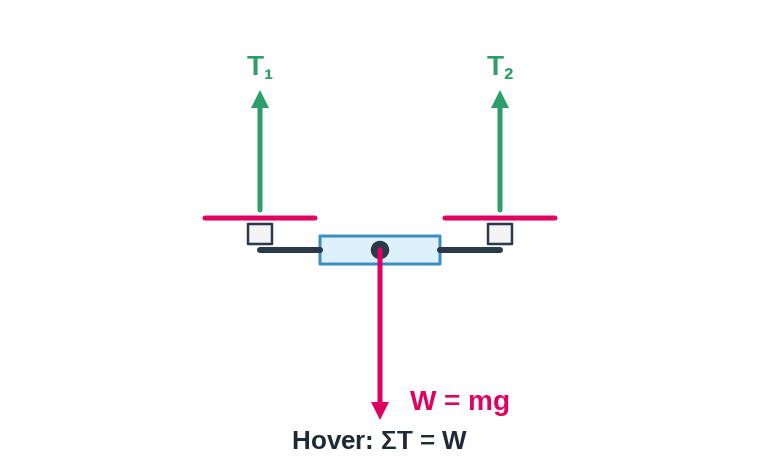
A hovering drone looks as if nothing is happening, but several forces act at once and cancel exactly. Change any one slightly and the drone accelerates, drops or tilts at once. Understanding forces is therefore the basis of everything in this programme, from choosing motors and mounting payloads to tuning the control system.
Force is a vector quantity, with both size and direction. A force at angle to the horizontal splits into a horizontal part and a vertical part , using the basic trigonometry of UAT 101 Module 4. This module uses this idea to explain the forces on an aircraft, starting from Newton’s laws.
Newton’s laws of motion
First law (inertia). An object stays at rest or moves at constant velocity if the net force on it is zero. A hovering drone and a drone flying straight at constant speed both have zero net force.
Second law (force and acceleration). Net force equals mass times acceleration:
Third law (action and reaction). When one object pushes another, the second pushes back with an equal and opposite force. A propeller pushes air down, so the air pushes the propeller up. That is where thrust comes from.
Mass and weight
Mass (, in kg) is the amount of matter and does not change with location. Weight (, in N) is the force of gravity on that mass:
We often say “the drone weighs 2 kilograms”, meaning its mass. Its actual weight is N. Motor makers usually quote thrust in “grams” (gram-force); convert to newtons by multiplying by . For example, 1000 gf is about 9.81 N.
Free-body diagrams
A free-body diagram isolates an object and shows only the external forces acting on it, with their directions. It is the first step in every mechanics problem.
A fixed-wing aircraft has four main forces: lift from the wing, weight, thrust from the propeller or engine, and drag from the air.
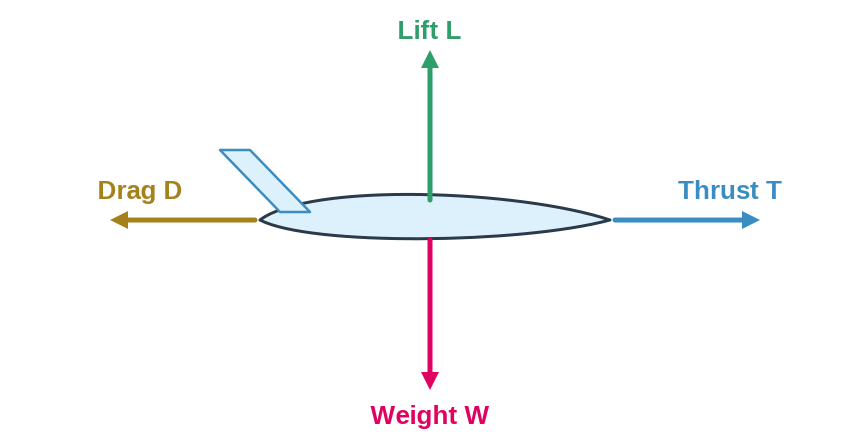
In level flight at constant speed the net force is zero, so and . A multirotor is different: its rotors provide both lift and thrust at the same time.
Net force and acceleration
Example 1. Climbing
A 2 kg drone’s rotors produce 25 N of total upward thrust. What is its acceleration?
- Weight N
- Net upward force N
- Acceleration m/s² upward
Thrust-to-weight ratio
The thrust-to-weight ratio (TWR) is maximum thrust divided by weight. At TWR = 1 the drone can just hover, with nothing left for climbing, fighting wind or correcting attitude. In practice, general-purpose multirotors are designed for a TWR of about 2 or more, hovering at around half throttle; racing drones can reach 5–10.
Example 2. Sizing motors
A 1.5 kg quadcopter needs TWR = 2. What maximum thrust must each motor give?
- Total thrust needed N
- Per motor N, about 750 gf
Tilting to move
A multirotor has no forward-facing propeller. It moves horizontally by tilting, which tilts its thrust. The thrust then has two components.
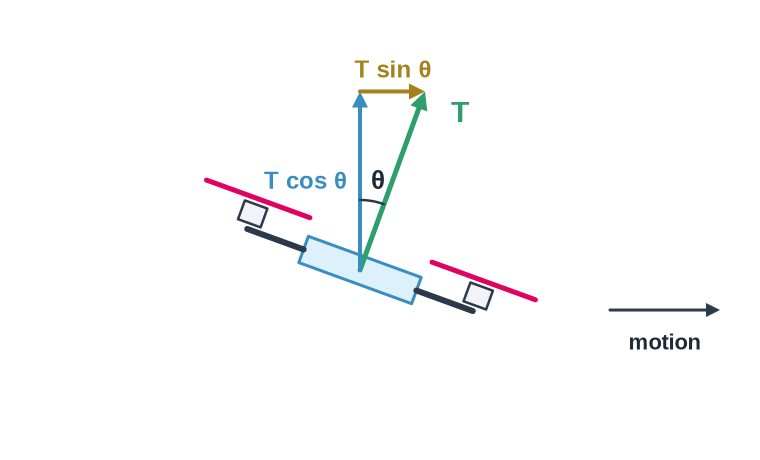
- The vertical component supports the weight.
- The horizontal component accelerates the drone forward.
To hold height, the vertical forces must balance, , so
Example 3. Tilting 20 degrees
- Thrust needed , 6.4% more than in hover
- Horizontal acceleration m/s²
This is why a drone uses more energy flying fast or into wind: it must tilt further and raise total thrust.
Moments and equilibrium
A force acting away from a pivot can make an object rotate. This turning effect is a moment (torque), equal to force times perpendicular distance from the pivot:
An object is in equilibrium when both net force and net moment are zero, and . For a drone, the key pivot is the centre of gravity (CG).
Example 4. Camera mounted forward
A 0.3 kg camera is mounted 0.10 m ahead of the original CG. The front and rear motors are 0.20 m from the centre.
- Nose-down moment from the camera N·m
- To balance it, the front motors must give N more total thrust than the rear
The front motors work harder, run hotter and drain the battery faster. Keeping the CG at the centre of the frame matters a great deal; UAT 302 returns to this in detail.
Momentum and impulse
Momentum is mass times velocity, . When velocity changes in a short time, large forces arise, as described by impulse:
Example 5. A hard landing
A 2 kg drone hits the ground at 3 m/s and stops in 0.05 s. The average force is N, about six times its weight. Flexible landing gear lengthens and so reduces the force.
Vibration
Vibration is motion back and forth about an equilibrium position. On a drone the main sources are fast-spinning propellers and motors. If a propeller’s mass is even slightly unbalanced, an excess mass at distance from the axis produces a rotating force , which grows with the square of the rotation speed.
A mass held on springs has a natural frequency . Excitation near is amplified (resonance), but once the excitation frequency is more than times , a flexible mount starts to reduce the vibration passed through. That is why flight controllers sit on rubber dampers. The ArduPilot documentation states that measured vibration below 30 m/s² is normally acceptable, and above 60 m/s² nearly always causes problems with position or altitude hold.
Example 6 An unbalanced propeller and a damped mount
A propeller at 6,000 rpm carries a 0.2 g imbalance at 10 cm radius, and a 50 g flight controller sits on four dampers of 500 N/m each (hypothetical values).
import math
RPM = 6000
f = RPM / 60                                  # Hz, propeller rotation frequency
w = 2 * math.pi * f
m_imb, e = 0.2e-3, 0.10                        # 0.2 g imbalance at 10 cm radius
print(f"rotation {f:.0f} Hz, imbalance force m·e·ω² = {m_imb * e * w ** 2:.1f} N")

m_fc, k_each, n = 0.05, 500, 4                 # 50 g board on four 500 N/m dampers
fn = math.sqrt(n * k_each / m_fc) / (2 * math.pi)
r = f / fn
T = 1 / abs(1 - r ** 2)                        # transmissibility with no damping
print(f"mount natural frequency {fn:.1f} Hz, ratio {r:.2f}, transmissibility {T:.3f} ({(1 - T):.0%} reduction)")
rotation 100 Hz, imbalance force m·e·ω² = 7.9 N
mount natural frequency 31.8 Hz, ratio 3.14, transmissibility 0.113 (89% reduction)Just 0.2 g produces almost 8 N at 100 Hz, so balancing propellers matters a great deal. The mount’s natural frequency of about 32 Hz is roughly three times below the excitation, so it removes almost 90% of the vibration reaching the board. Dampers that are too stiff, pushing towards 100 Hz, would do the opposite.
Physical quantities and units
Every value in this module, whether mass, force or moment, is a physical quantity: something that can be measured and is always written as a number times a unit. For example, means the number 2 multiplied by the unit kilogram. A number without a unit has no physical meaning: “thrust 750” could be 750 gf or 750 N, which differ by a factor of almost one hundred.
SI base units and derived units
The International System of Units (SI), maintained by the BIPM, chooses 7 base quantities that are treated as independent of each other, each with its own base unit. Since 20 May 2019 all SI units have been defined from natural constants with fixed values, such as the speed of light and the Planck constant, so they no longer depend on any physical prototype.
| Base quantity | Base unit | Symbol | Drone example |
|---|---|---|---|
| Length | metre | m | arm length, flight height |
| Mass | kilogram | kg | drone and payload mass |
| Time | second | s | flight time, signal period |
| Electric current | ampere | A | motor current |
| Thermodynamic temperature | kelvin | K | temperature in the gas law |
| Amount of substance | mole | mol | battery chemistry |
| Luminous intensity | candela | cd | navigation lights |
Every other quantity is a derived quantity, built by multiplying and dividing base quantities, so its unit can always be written as a product of base units. Derived units used often in this course:
- newton (force) , from
- pascal (pressure)
- joule (work and energy)
- watt (power)
- coulomb (charge)
Quantities can also be split another way. A scalar quantity has size only, such as mass, time, energy and temperature. A vector quantity has both size and direction, such as the force, velocity and acceleration used in every earlier section.
Converting specification values to SI and checking formulas with units
Drone part specifications often use non-SI units: thrust in gf, servo torque in kgf·cm, rotational speed in rpm, battery capacity in mAh and energy in Wh. Before substituting into a physics formula, convert every value to SI base or derived units; the answer then comes out in SI units by itself. The method of multiplying by conversion factors equal to 1 is reviewed in UAT 101 Module 2.
Another tool is the dimensional check. A correct equation must have the same units on both sides, and only quantities with the same units can be added or subtracted. If substituting units into a formula gives different units on the two sides, the formula or the rearrangement is definitely wrong. If the units match, the formula is still not proven correct, because unitless factors such as cannot be checked this way. Unit errors are expensive: the Mars Climate Orbiter was lost in 1999 partly because one piece of software supplied values in pound-seconds while another expected newton-seconds.
Example 7. Converting a drone specification to SI units
Part specifications of a drone (assumed values), converted one by one with m/s²:
| Specification value | Conversion | SI value |
|---|---|---|
| Servo torque 10 kgf·cm | 0.981 N·m | |
| Propeller speed 6000 rpm | 628.3 rad/s | |
| Battery capacity 5000 mAh | 18 000 C | |
| Battery energy 111 Wh | 399 600 J (about 400 kJ) | |
| Ground speed 54 km/h | 15 m/s | |
| Air pressure 1013 hPa | 101 300 Pa |
Note that “mAh” is a unit of charge, not energy, so two 5000 mAh batteries at different voltages do not store the same energy.
Example 8. Checking the hover power formula with units
Module 3 uses the ideal induced power, the power a propeller needs to produce thrust in air of density through a rotor disc of area :
Substitute base units: in kg·m·s⁻², in kg·m⁻³ and in m².
- Numerator:
- Denominator:
- Divide:
This equals , the unit of power, so the formula passes the dimensional check. Writing by mistake instead of would give , which is not watts, so the error is caught at once without any numbers.
Basic measuring instruments and reading them
Every physics experiment starts with reading instruments correctly: a ruler or tape for drone arm length, a vernier caliper for a motor shaft, a digital scale for mass and a stopwatch for time. For every instrument you must know its resolution, the smallest value it can show.
- Scale instruments such as rulers can be read to about half the smallest division, so a ruler marked every 1 mm reads to about ±0.5 mm
- Digital instruments such as digital scales have an uncertainty of at least one unit of the last digit, so a scale showing whole grams is uncertain by at least ±1 g
- Record values with units and uncertainty, such as “mass 480 ± 1 g”, with significant figures matching the resolution; do not write 480.000 g from a scale that reads whole grams
Example: relative uncertainty of a measurement
A 250 mm drone arm measured with a ruler to ±0.5 mm is uncertain by . A 480 g drone on a scale reading whole grams is uncertain by . Both are small enough for the force calculations in this module, but weighing a 12 g propeller on the same scale gives about 8% uncertainty, so a finer scale is needed.
Module lab: measuring thrust with a scale
In class
- Mount a motor and propeller upside down on a test stand placed on a digital scale, so the propeller blows air upward.
- Set throttle to 25%, 50% and 75%; record the scale reading (gf) and current (A).
- Convert to newtons and work out what mass of drone would have TWR = 2 with four of these motors.
Safety. Remove propellers whenever the battery is connected for setup. Always stand to the side of the propeller plane, wear eye protection and keep a fire-safe container for batteries.
Common mistakes
Watch out
- Confusing mass and weight. Multiply by before comparing with thrust in newtons.
- Forgetting gf units. Makers quote thrust in grams; convert before calculating.
- Thinking hover means no forces. Forces are present but cancel exactly.
- Assuming thrust stays the same when tilting. Thrust must rise to hold height.
- Substituting values before converting to SI. Using rpm instead of rad/s, or mAh as if it were energy, makes both the number and the unit wrong.
Summary
- Newton’s three laws explain why a drone hovers, accelerates and produces thrust.
- Weight is in newtons; makers quote thrust in gf.
- Free-body diagrams come first; a fixed-wing aircraft has four main forces.
- A TWR of about 2 or more gives control margin.
- Tilting to move requires thrust and gives acceleration .
- Moment ; equilibrium needs and , and an off-centre CG makes some motors work harder.
- Vibration from an unbalanced propeller grows with ; a damped mount works when its natural frequency is well below the excitation
- A physical quantity is a number times a unit. The SI has 7 base units; N, Pa, J and W are derived units. Convert specifications to SI before calculating, and check formulas with units.
Check your understanding
- Convert these specification values to SI units: speed 72 km/h, rotational speed 3000 rpm and battery capacity 2200 mAh.
- A 1.2 kg drone has 15 N of total thrust. What is its vertical acceleration?
- A 2.5 kg drone needs TWR = 2 with six motors. What thrust in gf must each give?
- Tilting at while holding height, by what percentage must thrust rise, and what is the horizontal acceleration?
- A 0.5 kg battery is mounted 0.04 m behind the CG. What moment does it create?
Answers
- m/s, rad/s and C
- m/s² upward
- kgf total, divided by 6 gives about 833 gf each
- , about 15.5% more, and m/s²
- N·m (nose up)
Key formulas
| Derived unit of force | |
| Newton's second law | |
| Weight | |
| Thrust-to-weight ratio | |
| Thrust when tilted at constant height | |
| Moment | |
| Equilibrium | |
| Impulse | |
| Imbalance force and natural frequency |
Key references
- Serway, R. A., & Jewett, J. W. (2018). Physics for scientists and engineers (10th ed.). Cengage.
- NASA Glenn Research Center. (2022). Beginner's guide to aeronautics. link
- Quan, Q. (2017). Introduction to multicopter design and control. Springer Singapore. link
- Anderson, J. D. (2016). Introduction to flight (8th ed.). McGraw-Hill.
- ArduPilot Dev Team. Measuring vibration. ArduPilot Copter documentation. link
- Bureau International des Poids et Mesures. (2026). The International System of Units (SI) (9th ed., v4.01) [Brochure]. link
- Ling, S. J., Sanny, J., & Moebs, W. (2016). University physics volume 1. OpenStax. link
- Mars Climate Orbiter Mishap Investigation Board. (1999). Mars Climate Orbiter mishap investigation board phase I report. National Aeronautics and Space Administration. link
Further reading
Study the assigned knowledge units in advance, review media and take the module quiz
กลศาสตร์ แรง โมเมนต์ และพลศาสตร์การหมุน
UAV/UAS fundamentals and flight simulation
In class / field
Lab or field practice from worksheets with a safety checklist
Learning evidence: Checked worksheets and quiz results