Atmosphere and basic aerodynamics
UAT 102 Applied Physics for Aircraft Technology
Lesson
By the end of this module you will be able to
- Explain air pressure, temperature and density, and calculate density with the ideal gas law
- Use the International Standard Atmosphere (ISA) to assess the effect of altitude and temperature on flight
- Calculate pressure in a liquid at depth, tell gauge from absolute pressure, and apply Pascal's and Archimedes' principles
- Explain Bernoulli's principle, dynamic pressure and airspeed measurement with a pitot tube
- Use the lift and drag equations to find level-flight speed and stall speed
- Explain angle of attack, stall and the meaning of Reynolds number for small drones
Air is what a drone flies on
A drone does not float in empty space. It flies by pushing and turning the air, so the air’s density, pressure and temperature decide how much force its propellers and wings can make. The same drone may fly well on a cool morning yet lift less on a very hot afternoon in the mountains. This module explains why.
Properties of air
- Pressure (, in Pa) is the force air exerts on one square metre.
- Temperature () must be in kelvin for calculations: .
- Density (, in kg/m³) is the mass of air per unit volume. The denser the air, the more air a propeller has to push.
The three are linked by the ideal gas law:
The International Standard Atmosphere
So that performance can be designed and compared, the International Civil Aviation Organization (ICAO) defines a standard atmosphere (ISA). At sea level:
| Quantity | Sea-level value |
|---|---|
| Temperature | 288.15 K (15 °C) |
| Pressure | 101 325 Pa |
| Density | 1.225 kg/m³ |
In the troposphere, temperature falls by about 6.5 °C per 1000 m:
In this model, at 1000 m the temperature is 281.65 K, the pressure about 89 900 Pa and the density about 1.112 kg/m³, roughly 9% below sea level.
Example 1. A hot day in Thailand
At sea level with 101 325 Pa and 35 °C (308.15 K):
That is about 6.5% below the standard 1.225 kg/m³. Because propeller thrust is proportional to density, thrust at the same speed also falls by about 6.5%. On hot days a drone must spin its propellers faster and use more energy to hover.
Pressure in a fluid at rest
A fluid is any substance that flows and takes the shape of its container: liquids such as water and gases such as air. This section looks at fluids at rest first; the next section looks at fluids in motion.
Pressure is the perpendicular force a fluid exerts per unit area, , measured in pascals (1 Pa = 1 N/m²). At any point in a fluid at rest, pressure acts equally in all directions, so it is a scalar. The force it produces always acts perpendicular to the surface being pressed.
Pressure increases with depth
Think of diving: the deeper you go, the more your ears hurt, because more water is pressing down from above. In a liquid of constant density, the pressure at depth below the surface is
where is the pressure at the surface (usually atmospheric pressure) and is the weight of the liquid column divided by its area. Fresh water has kg/m³, so pressure rises by about 9.8 kPa per metre, or almost one atmosphere every 10 m.
Most pressure gauges read zero at atmospheric pressure, so their reading is called gauge pressure. Pressure measured from a vacuum is called absolute pressure:
The ideal gas law in the previous section always needs absolute pressure.
The same idea applies to air, but air is about 800 times lighter than water and its density changes with height. Near sea level, pressure therefore falls by only about Pa for each metre of climb. The barometer in a flight controller uses this small difference to estimate altitude.
A manometer is a U-shaped glass tube holding a liquid. When one end is connected to a pressure source, the liquid levels on the two sides differ by , and the gauge pressure equals . This simple instrument can check the differential pressure sensor of the pitot tube in the next section.
Pascal’s principle and hydraulics
Pascal’s principle states that a change in pressure applied to an enclosed fluid is transmitted undiminished to every part of the fluid and to the walls of its container. If a small piston of area is pushed with force , a large piston of area receives a force
This is how hydraulic brakes and car jacks work. For example, pushing a 1 cm diameter piston with 20 N gives a 4 cm piston a force of N. The large piston moves 16 times less distance, so the work out is no greater than the work in.
Buoyancy and Archimedes’ principle
An object immersed in a fluid is pushed harder from below than from above, because the bottom is deeper. The difference is the buoyant force. Archimedes’ principle states that the buoyant force equals the weight of the fluid the object displaces:
where is the volume of the part below the surface. An object floats when its average density is less than the fluid’s, and while it floats at rest the buoyant force exactly equals its weight. This principle is used to design floats for drones that take off from and land on water. In air, the buoyant force on a drone is tiny, but it is the same principle that lets balloons and airships float.
Example 2. Pressure under water and in the air
A water-sampling drone lowers a probe 3 m deep into a freshwater reservoir ( kg/m³). Atmospheric pressure that day is 101 325 Pa (assumed).
- Gauge pressure at the probe: Pa, about 29.4 kPa
- Absolute pressure: Pa, about 29% higher than at the surface
- If the drone climbs 10 m near sea level, air pressure falls by only Pa, while 10 m of water adds Pa
- If a water manometer is used to check an airspeed sensor reading 150 Pa, the water levels differ by m, or about 15 mm
Step 3 shows why a drone’s barometer must be very sensitive, and why a gust or propeller wash that changes the pressure around the sensor by only a few pascals can make the altitude reading wander.
Example 3. Floats for a drone
A drone of total mass 2.4 kg (assumed) is fitted with two floats for landing on fresh water. The team wants the floats to sink to only half their volume when floating at rest, to leave margin for waves and extra load.
- Floating at rest, , so and m³, or 2.4 L, is the volume that must be under water
- Making this half of the float volume, the floats need 4.8 L in total, or 2.4 L each
- Compare buoyancy in air: if the drone body has a volume of about 3 L (assumed), the buoyant force of air is N, only about 0.15% of its 23.5 N weight, so it can be ignored when calculating thrust
Bernoulli’s principle and dynamic pressure
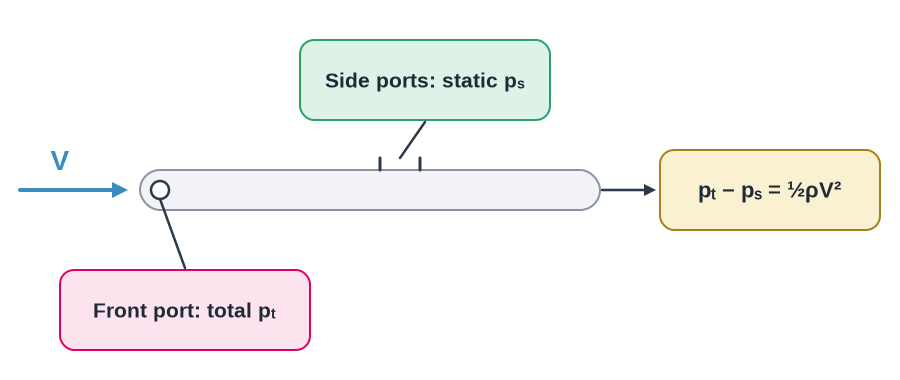
When air flows without losing energy, the sum of static pressure and dynamic pressure is constant along the flow:
The term is the dynamic pressure. It measures how hard the moving air “hits”, and it appears in every lift and drag equation.
Measuring airspeed with a pitot tube
Fixed-wing aircraft measure airspeed with a pitot-static tube. The front port senses total pressure ; the side ports sense static pressure . Their difference is the dynamic pressure.
Example 4. Reading an airspeed sensor
The sensor reads a pressure difference of 150 Pa at kg/m³:
Lift and drag
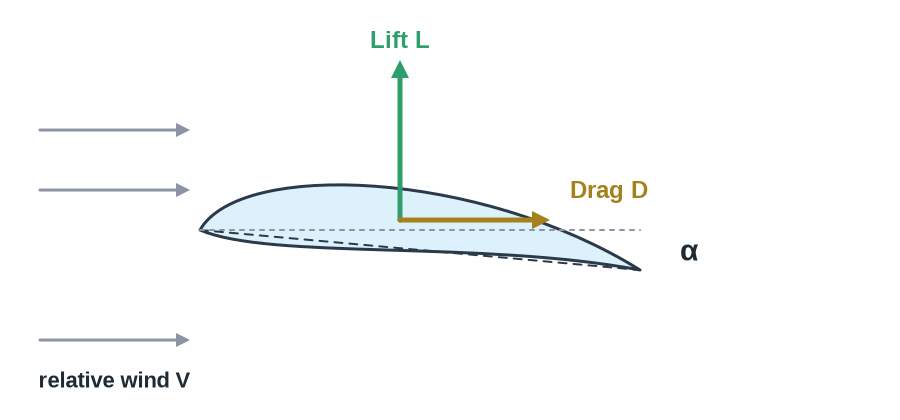
Wings and propeller blades have an airfoil cross-section. When set at an angle to the oncoming air, the angle of attack (), they turn the air downward. The force perpendicular to the airflow is lift; the force along the airflow is drag.
The lift and drag equations have the same form:
where is the wing area and , are the lift and drag coefficients, which gather the effects of shape and angle of attack into a single number. They come from wind-tunnel tests or simulation.
The equation tells us three important things: lift grows with the square of speed, is proportional to air density, and is proportional to wing area.
Example 5. Level-flight speed
A 3 kg fixed-wing drone with a 0.6 m² wing flies at . How fast must it fly to hold level flight?
Level flight means , so
Angle of attack and stall
As angle of attack rises, increases up to a maximum . Beyond that, the air separates from the upper surface and lift drops sharply. This is a stall. The lowest speed at which level flight is still possible is the stall speed:
If the drone in Example 5 has , then m/s. Pilots keep a good margin above this, especially when turning and landing.
Reynolds number
The Reynolds number () compares the air’s inertia with its viscosity:
where is the wing chord. A drone with a 0.2 m chord flying at 12 m/s has , hundreds of times lower than an airliner. At low , viscosity matters more and airfoils are less efficient, so data for large aircraft cannot be applied directly to small drones.
Module lab
In class
- Record temperature and air pressure from a weather station or barometer sensor, then calculate that day’s air density.
- Open NASA’s FoilSim airfoil simulator or a tool chosen by your instructor. Vary angle of attack from 0° to 20°, record and note where stall begins.
- Compare the lift calculated for a hot day with that for a standard day.
Common mistakes
Watch out
- Using Celsius in the gas law. Always convert to kelvin.
- Using gauge pressure in the gas law. The gas law and formulas with need absolute pressure; add atmospheric pressure to a gauge reading first.
- Forgetting to square the speed. Double the speed, four times the lift.
- Assuming more angle of attack is always better. Past the stall angle, lift drops suddenly.
- Using large-aircraft values for small drones. Reynolds numbers differ greatly.
Summary
- Air density falls in hot weather or at altitude, reducing thrust and lift.
- Pressure in a liquid is ; 10 m of water adds almost one atmosphere, and the buoyant force equals the weight of the displaced fluid.
- ISA at sea level is 15 °C, 101 325 Pa and 1.225 kg/m³.
- Dynamic pressure is used to measure airspeed with a pitot tube.
- and ; forces grow with the square of speed.
- Past the critical angle of attack a wing stalls, and small drones operate at low Reynolds numbers.
Check your understanding
- What is the air density at 30 °C and 100 000 Pa?
- In the ISA model, what is the temperature at 2000 m in °C?
- An airspeed sensor reads 245 Pa at . What is the airspeed?
- A 1.8 kg drone floats on fresh water on floats. What total float volume must be under water, and what is the gauge pressure on a probe lowered 2 m deep?
- A 0.15 m chord wing flies at 10 m/s at . What is its Reynolds number, roughly?
Answers
- kg/m³
- K, or 2 °C
- m/s
- m³, or 1.8 L, and Pa (about 19.6 kPa)
Key formulas
| Ideal gas law | |
| ISA temperature | |
| Pressure with depth | |
| Buoyant force (Archimedes) | |
| Bernoulli | |
| Pitot airspeed | |
| Lift | |
| Drag | |
| Reynolds number |
Key references
- International Civil Aviation Organization. (1993). Manual of the ICAO standard atmosphere: Extended to 80 kilometres (262 500 feet) (Doc 7488, 3rd ed.). link
- NASA Glenn Research Center. (2022). Beginner's guide to aeronautics. link
- Anderson, J. D. (2016). Introduction to flight (8th ed.). McGraw-Hill.
- Serway, R. A., & Jewett, J. W. (2018). Physics for scientists and engineers (10th ed.). Cengage.
- Ling, S. J., Sanny, J., & Moebs, W. (2016). University physics volume 1. OpenStax. link
Further reading
Study the assigned knowledge units in advance, review media and take the module quiz
อากาศพลศาสตร์เบื้องต้น แรงยก แรงต้าน และใบพัด
Reading wind, clouds and near-surface weather
Aerodynamics: from Navier–Stokes to drone models
Reynolds, Mach and choosing the model fidelity
The Navier–Stokes equations: reading mass, force and acceleration
Drones near buildings: wind that changes with place and time
In class / field
Lab or field practice from worksheets with a safety checklist
Learning evidence: Checked worksheets and quiz results