Ethics, proposal and presentation
UAT 309 Introduction to Research in Unmanned Aircraft Systems and Automation Technology
Lesson
By the end of this module you will be able to
- Apply the three principles of the Belmont Report to research involving people
- Recognise research misconduct, namely fabrication, falsification and plagiarism
- Write a complete research proposal
- Present research results honestly and clearly
Why this matters
Research is valuable because others can trust it. If participants are harmed, data are invented or wording is copied, the work loses its value at once, however good the analysis. This lesson closes the course with ethics, proposal writing and presentation, using the same two studies: the local government survey and the payload experiment.
Ethics of research involving people
The local government survey collects data from people, so it must be approved by the institution’s human research ethics committee before data collection. The widely used basic principles come from the Belmont Report of 1979, which sets out three principles:
- Respect for persons: participants make their own decisions, and people with diminished autonomy need extra protection. This leads to informed consent.
- Beneficence: do no harm, and maximise benefits relative to risks.
- Justice: select participants fairly and share burdens and benefits equitably.
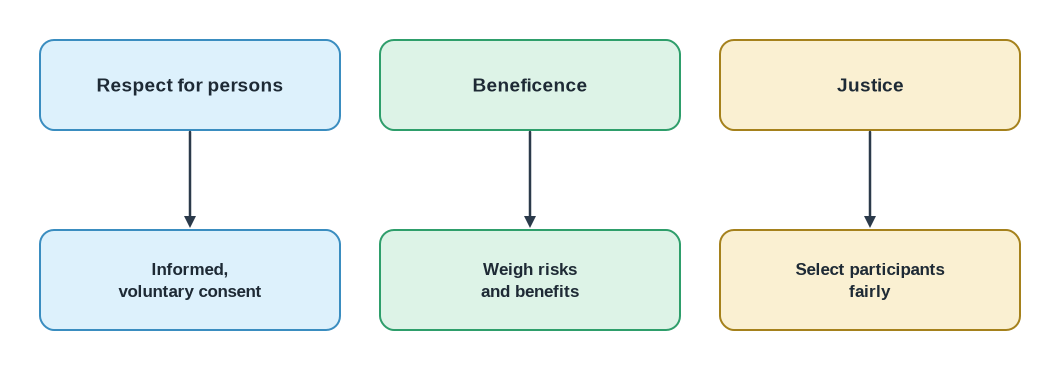
In practice, the participant information sheet must state the purpose, what participants will do, how long it takes, the risks, the right to withdraw at any time without penalty, and how data will be kept. Personal data must be handled under Thailand’s Personal Data Protection Act B.E. 2562, for example collecting only what is needed, separating names from answers and setting a retention period. A supervisor should not hand out questionnaires to their own staff, because staff may feel unable to refuse.
Research integrity
The Singapore Statement on Research Integrity of 2010 sets out principles of honesty, accountability, professional courtesy and good stewardship of research. The most serious misconduct is often summarised as FFP:
- Fabrication: inventing data or results, such as adding flights that were never flown.
- Falsification: altering or dropping data to get a desired result, such as deleting flights that do not fit the hypothesis without a rule set in advance.
- Plagiarism: using others’ ideas or words without credit.
Plagiarism checkers measure text similarity. A simple method splits text into runs of consecutive words (shingles) and computes the Jaccard index .
Example 1 Near-copy versus rewriting with a citation
def shingles(text, n=3):
    words = text.lower().replace(",", "").replace(".", "").split()
    return {tuple(words[i:i + n]) for i in range(len(words) - n + 1)}


def jaccard(a, b):
    A, B = shingles(a), shingles(b)
    return len(A & B) / len(A | B)


source = "Flight time decreased linearly as payload increased, by about one minute for every hundred grams."
copied = "Flight time decreased linearly as payload increased, by about one minute for every hundred grams of mass."
rewritten = "Each extra 100 g of payload shortened the flight by roughly a minute in our tests (Author, 2024)."
print(f"copied vs source    {jaccard(source, copied):.2f}")
print(f"rewritten vs source {jaccard(source, rewritten):.2f}")
copied vs source 0.87
rewritten vs source 0.00A sentence with just two words added still scores 0.87 against the source and is still copying. The sentence rewritten from the writer’s own understanding, with a citation, shares no word runs at all. Low similarity does not remove the need to cite; using someone else’s idea always requires a citation.
If you use AI tools to search, summarise or write, disclose it according to the course and university policy, and check every statement and every reference yourself, because AI may produce references that do not exist.
Writing a research proposal
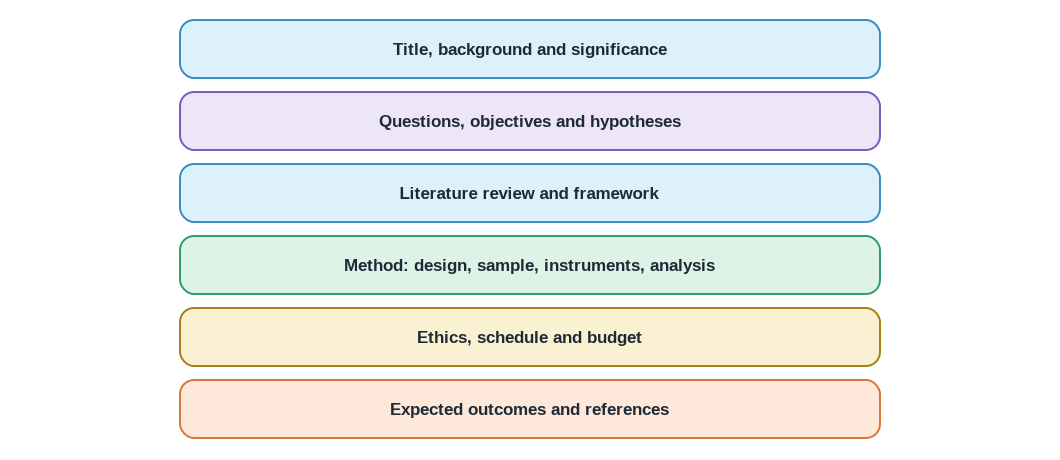
A research proposal persuades reviewers that the question matters, the method is credible, and the work can be done within the time and budget requested. Creswell and Creswell suggest components similar to Figure 2. Reviewers usually read the method most closely, because it shows whether the results will be trustworthy.
Key idea
A good proposal is consistent throughout. Every research question has an objective, variables in the framework, an instrument measuring each variable, and an analysis that answers the question. If a variable has no instrument, or an instrument measures something not in the questions, the proposal is incomplete.
Presenting research results
An oral presentation or poster should answer four things in order: what you asked, how you did it, what you found, and what it means. Use graphs with complete axes and units, show effect sizes with confidence intervals, and state limitations plainly, for example “tested with one drone model on days with wind under 5 m/s”. Raising limitations yourself before the audience asks makes the work more credible, not less.
Class activity
Activity: draft a proposal and information sheet
- Draft your group’s research proposal following Figure 2, in no more than 5 pages.
- Check consistency as in the key idea box with a table matching questions, objectives, variables, instruments and analyses.
- If the work involves people, write the participant information sheet and consent form.
- Check the similarity of your literature review paragraph against its sources with Example 1, and rewrite passages that are too close.
- Present the proposal in 7 minutes and take feedback from classmates and the instructor.
Common mistakes
Watch out
- Collecting data from people before ethics approval
- Dropping data that do not fit the hypothesis without a rule set in advance
- Changing a few words and thinking no citation is needed
- Using AI-generated references without checking that they exist
- An inconsistent proposal, such as a framework variable with no instrument to measure it
Summary
- The Belmont Report sets out respect for persons, beneficence and justice, leading to consent, risk–benefit assessment and fair selection of participants.
- Participants’ personal data must be handled under the PDPA.
- Fabrication, falsification and plagiarism are serious misconduct.
- A good proposal is consistent from questions to analysis, and a presentation should state its limitations plainly.
Check your understanding
- Which Belmont principle leads to informed consent?
- A student deletes 2 flights with unusual flight times without a rule set in advance. What kind of misconduct is this?
- Texts A and B share 3 word runs, and together they have 12 distinct word runs. What is the Jaccard index?
- Why should a supervisor not hand out questionnaires to their own staff?
- If the conceptual framework includes “attitude” but the questionnaire has no items on it, what is wrong with the proposal?
Answers
- Respect for persons
- Falsification; removing data needs criteria set in advance, and the report must state what was removed and why
- Staff may feel unable to refuse, so consent is not truly voluntary, and they may not answer honestly
- It is inconsistent: a variable has no instrument, so the question about attitude cannot be answered
Key formulas
| Jaccard similarity index |
Key references
- National Commission for the Protection of Human Subjects of Biomedical and Behavioral Research. (1979). The Belmont report: Ethical principles and guidelines for the protection of human subjects of research. link
- World Conference on Research Integrity. (2010). Singapore statement on research integrity. link
- พระราชบัญญัติคุ้มครองข้อมูลส่วนบุคคล พ.ศ. 2562. ราชกิจจานุเบกษา, 136(69 ก), 52–95. link
- American Psychological Association. (2020). Publication manual of the American Psychological Association (7th ed.). American Psychological Association. link
- Creswell, J. W., & Creswell, J. D. (2022). Research design: Qualitative, quantitative, and mixed methods approaches (6th ed.). SAGE. link
Further reading
Study the assigned knowledge units in advance, review media and take the module quiz
จริยธรรม ความเป็นส่วนตัว และ PDPA ในงานโดรน
Project governance and monitoring
In class / field
Lecture, case discussion and in-class problem solving
Learning evidence: Quiz results and submitted exercises