AI in practice and ethics
UAT 315 Artificial Intelligence, Data Analytics and Computer Vision for Unmanned Aircraft Systems
Lesson
By the end of this module you will be able to
- Judge whether AI work belongs on the drone, the ground station or the cloud from response time and resources
- Calculate how processing time affects drone movement, and evaluate results separately by operating condition
- Explain the role of people in the decision loop and the limits of automated decisions
- Explain AI ethics and governance frameworks, including the NIST AI RMF, UNESCO's principles, the EU AI Act and the status of Thai AI law
Why this matters
A model that scores well in the lab is still far from a usable system. It must run in time on hardware that can fly, work well in every condition it will meet, and have someone accountable when it goes wrong, especially in work affecting people’s lives and privacy, such as searching for victims or monitoring public spaces.
AI on the drone, the ground station or the cloud
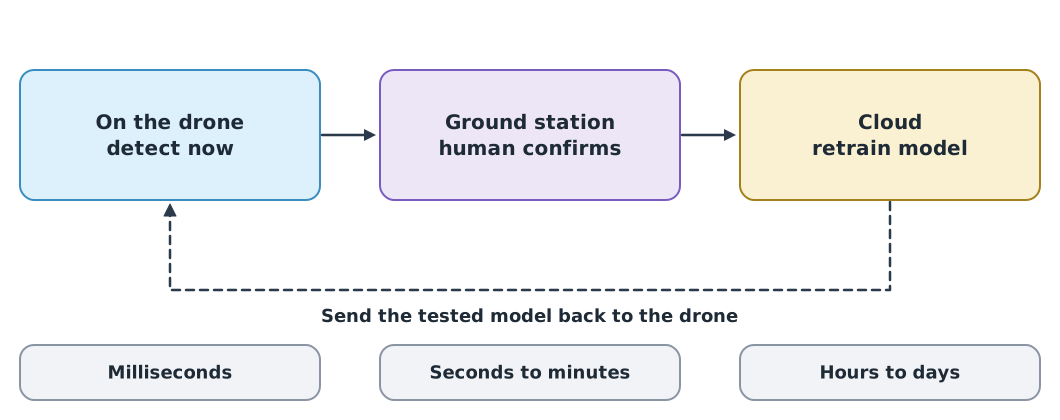
Edge AI runs models on the end device, such as the computer on a drone. Popular hardware includes accelerators such as the Raspberry Pi AI HAT+ at 13 and 26 TOPS for the Raspberry Pi 5, and the NVIDIA Jetson Orin Nano Super, rated at 67 TOPS. These TOPS figures are measured under different conditions (the Jetson figure is sparse INT8, for example), so they cannot be compared directly; always time the actual model on the actual board. Models are often converted to an intermediate format such as ONNX and run with ONNX Runtime, and you must check that results after conversion still match the original.
Tasks that must respond within a fraction of a second belong on the drone, tasks that need human confirmation belong at the ground station, and retraining, which needs heavy resources, belongs in the cloud or on a server.
Example 1 Processing time and the distance a drone moves
A drone flies at 10 m/s and its camera runs at 30 frames per second. The onboard detector takes a median of 35 ms and a p95 of 80 ms.
speed = 10.0
fps = 30
budget_ms = 1000 / fps
for label, latency_ms in [("median", 35), ("p95", 80)]:
    print(f"{label:<6} {latency_ms} ms -> drone moves {speed * latency_ms / 1000:.2f} m, "
          f"within frame budget {budget_ms:.1f} ms: {latency_ms <= budget_ms}")
print(f"frames the detector can keep up with at p95: {1000 / 80:.1f} fps")
median 35 ms -> drone moves 0.35 m, within frame budget 33.3 ms: False
p95 80 ms -> drone moves 0.80 m, within frame budget 33.3 ms: False
frames the detector can keep up with at p95: 12.5 fpsEven the median slightly exceeds the 33.3 ms budget of one frame, and in the slowest 5% of cases the detector takes far longer, so the system must skip frames and the drone moves 0.8 m before a result arrives. Obstacle avoidance must always be designed with this distance included. The drone knowledge hub’s edge benchmark unit explains how to measure, stating the machine, versions and which steps the timing includes.
Evaluating by group
An overall average can hide groups where the model does badly. Training data with many more daytime than night-time images, or more of some kinds of people than others, makes the model biased against the groups with less data.
import pandas as pd

results = pd.DataFrame({"condition": ["day", "night"], "TP": [90, 24], "FN": [10, 16]})
results["recall"] = results["TP"] / (results["TP"] + results["FN"])
print(results.to_string(index=False))
overall = results["TP"].sum() / (results["TP"].sum() + results["FN"].sum())
print(f"overall recall {overall:.3f}")
condition TP FN recall
day 90 10 0.9
night 24 16 0.6
overall recall 0.814An overall recall of 0.81 looks good, but at night only 60% of victims are found. If real searches often happen at night, the overall figure makes decision makers trust the system too much. These are hypothetical figures for practice. Always report results by the conditions that matter, and state in the data card which conditions the data covers.
People in the decision loop
Levels of automation run from human-in-the-loop, where the system proposes and a person decides, through human-on-the-loop, where the system acts but a person watches and can stop it, to full autonomy. Decisions with severe or irreversible consequences should rest with people. AI output from screening disaster imagery should therefore be a list for checking, not a verdict on real conditions, as the knowledge unit on AI for screening disaster imagery explains.
AI ethics and governance frameworks
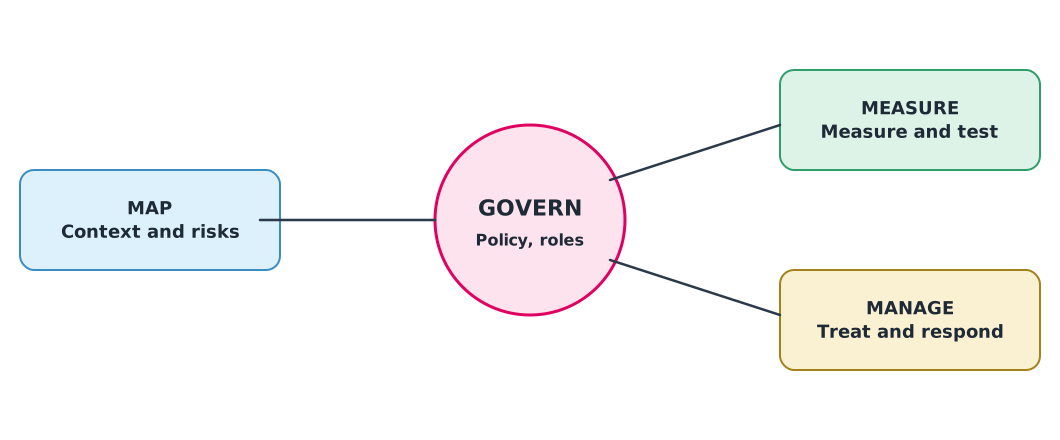
- The NIST AI Risk Management Framework 1.0 (January 2023) manages AI risk through four functions: Govern (policy, roles, accountability), Map (understand context and risks), Measure (measure and test) and Manage (prioritise and treat risks). NIST states that the framework is being revised.
- UNESCO’s Recommendation on the Ethics of AI (November 2021) sets four core values, such as human rights and human dignity, and ten principles, such as proportionality and do no harm, privacy, transparency and explainability, human oversight, and fairness.
- The EU AI Act (Regulation (EU) 2024/1689) entered into force on 1 August 2024 and applies in stages. Bans on certain AI systems began in February 2025, and the European Commission’s page states that the rules for high-risk systems have been postponed to 2027–2028. The timeline can still change, so check the latest version before citing it. The law applies to providers placing systems on the EU market.
- Thailand: ETDA and the Ministry of Digital Economy and Society held a public consultation on draft principles for an AI law in June 2025. At the time of writing, no enacted law was found, so check the latest status. Personal data in images and training data falls under the Personal Data Protection Act B.E. 2562 (2019), covered in UAT 313 module 5.
Data, model and code rights are separate
A library’s licence does not automatically cover model weights or datasets. Many datasets allow only non-commercial use, and some model families are licensed AGPL-3.0, with conditions about releasing source code. Check all three before real deployment or distribution.
Class activity
Activity: assessing an AI system for search and rescue
- Your group receives a proposal for a drone that detects victims with a thermal camera. Using the four NIST AI RMF functions, write at least two questions per function.
- Calculate how far the drone moves during processing at the proposed speed and processing time, and judge whether it is adequate.
- Design a results table broken down by condition, such as day and night, open ground and under canopy, and name the data still missing.
- Discuss which decisions in the mission must be made by people, and what the system should show them to decide well.
Common mistakes
Watch out
- Comparing hardware by TOPS instead of timing the actual model
- Reporting only overall results without breaking down important conditions
- Letting the system decide alone where the harm is severe or irreversible
- Quoting legal timelines from memory, when AI law changes fast
- Checking only the code licence, forgetting model weights and datasets
Summary
- Choose where to process by the response time needed, and time the real model on the real board; distance moved during processing is
- Evaluate results by group to find bias hidden in averages
- Severe-consequence tasks need people in the decision loop; AI output is a list for checking
- Use the NIST AI RMF and UNESCO’s principles as frameworks, and check the current status of the EU AI Act, Thai AI law and the PDPA
Check your understanding
- A drone flies at 15 m/s and the detector takes 60 ms. How far does the drone move before the result arrives?
- What is the time budget per frame for a 25 fps camera?
- Day: TP 45, FN 5. Night: TP 12, FN 8. What is the recall of each group?
- What are the four functions of the NIST AI RMF?
- Why can TOPS figures from two boards not be compared directly?
Answers
- m
- ms
- Day ; night
- Govern, Map, Measure and Manage
- Because they are measured under different conditions, such as number precision (INT8 or INT4) and sparse versus dense, and real speed depends on the model and software used
Key formulas
| Distance moved during processing | |
| Time budget per frame |
Key references
- National Institute of Standards and Technology. (2023). Artificial intelligence risk management framework (AI RMF 1.0) (NIST AI 100-1). link
- UNESCO. (2021). Recommendation on the ethics of artificial intelligence. link
- European Commission. AI Act: Regulatory framework for artificial intelligence (Regulation (EU) 2024/1689). link
- สำนักงานพัฒนาธุรกรรมทางอิเล็กทรอนิกส์ (ETDA). (2568). รับฟังความคิดเห็น (ร่าง) หลักการของกฎหมายว่าด้วยปัญญาประดิษฐ์. link
- NVIDIA. (2024). NVIDIA Jetson Orin Nano developer kit gets a "super" boost. NVIDIA Technical Blog. link
- Raspberry Pi Ltd. (2024). Raspberry Pi AI HAT+ with 13 and 26 TOPS. link
- Microsoft. ONNX Runtime documentation. link
- Ultralytics. Models supported by Ultralytics (YOLO11, YOLO26). Ultralytics documentation. link
- พระราชบัญญัติคุ้มครองข้อมูลส่วนบุคคล พ.ศ. 2562. ราชกิจจานุเบกษา, 136(69 ก), 52–95. link
Further reading
Study the assigned knowledge units in advance, review media and take the module quiz
AI and drones: from images to models
Ethics, privacy and the PDPA in drone work
Edge benchmarking and deployment planning
In class / field
Lecture, case discussion and in-class problem solving
Learning evidence: Quiz results and submitted exercises