Risk and reporting
UAT 362 Unmanned Aircraft Systems Technology for Industrial, Energy and Infrastructure Applications
Lesson
By the end of this module you will be able to
- Assess the risk of inspection flights with a probability–severity matrix following SMS guidance
- Rank asset defects by probability of failure times consequence of failure, following risk-based inspection
- Write inspection reports that can be turned into work orders in a maintenance management system
- Preserve evidence and hand over data that can be traced
Why this matters
This course involves risk at two levels. The first is flight risk, such as a drone hitting a conductor or falling onto a solar array. The second is the asset risk that inspection reveals, such as a joint that may burn out. Both must be managed systematically, and inspection results only have value when they become repair work carried out in priority order. ISO 31000:2018 defines risk as the effect of uncertainty on objectives, which applies at both levels.
Flight risk
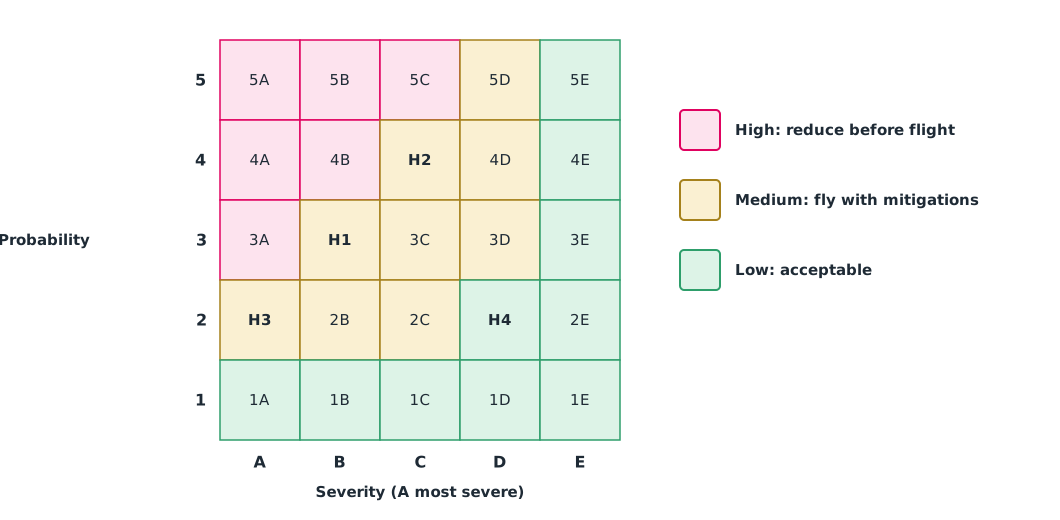
ICAO’s Safety Management Manual (Doc 9859, 4th ed.) gives an example of risk assessment with 5 probability levels (1 extremely improbable to 5 frequent) and 5 severity levels (A catastrophic, B hazardous, C major, D minor, E negligible). ICAO labels this as an example; each organisation must set its own acceptance criteria. This module uses the team’s assumed criteria: A–E are converted to 5–1 and multiplied by probability.
Example 1. Ranking the risks of a power line inspection flight
SEVERITY = {"A": 5, "B": 4, "C": 3, "D": 2, "E": 1}
hazards = [  # code, hazard, probability 1–5, severity A–E
    ("H1", "collision with 22 kV conductor", 3, "B"),
    ("H2", "compass error near transformer", 4, "C"),
    ("H3", "crash onto public road", 2, "A"),
    ("H4", "bird strike in open field", 2, "D"),
]

def band(score):                        # team criteria, not ICAO values
    return "HIGH - reduce before flight" if score >= 15 else ("MEDIUM - mitigate" if score >= 6 else "LOW")

for code, name, p, s in hazards:
    score = p * SEVERITY[s]
    print(f"{code} {p}{s} score {score:>2}: {band(score)} ({name})")
H1 3B score 12: MEDIUM - mitigate (collision with 22 kV conductor)
H2 4C score 12: MEDIUM - mitigate (compass error near transformer)
H3 2A score 10: MEDIUM - mitigate (crash onto public road)
H4 2D score 4: LOW (bird strike in open field)H1, H2 and H3 are at the medium level and need mitigations before flight, such as keeping the distance from the line set by the utility, calibrating the compass away from the transformer, or using a flight mode that does not rely on the compass, followed by reassessment. Any risk that remains high after mitigation means no flight.
Asset risk
Risk-based inspection, under API RP 580 (4th ed., 2023) with the calculation methods of API RP 581, ranks items by probability of failure (PoF) times consequence of failure (CoF). A slightly hot joint on the feeder to a hospital may matter more than a very hot spot on a single solar module, because the consequences differ so much.
Example 2. Turning ranked defects into work orders
PoF and CoF are scored 1–5 by the engineering team according to the organisation’s criteria. Repair deadlines are assumed.
defects = [  # code, description, PoF, CoF
    ("D1", "joint +18 K on feeder to water plant", 4, 5),
    ("D2", "single hot module S2-7", 4, 2),
    ("D3", "string S4 not producing", 5, 3),
    ("D4", "tree 2.2 m from 22 kV line", 3, 4),
    ("D5", "surface rust on tank ladder", 2, 2),
]
DUE_DAYS = [(15, "P1", 7), (8, "P2", 30), (0, "P3", 90)]   # minimum score, level, days to complete

ranked = sorted(defects, key=lambda d: d[2] * d[3], reverse=True)
for code, text, pof, cof in ranked:
    risk = pof * cof
    level, days = next((lv, dd) for lim, lv, dd in DUE_DAYS if risk >= lim)
    print(f"{level} {code} risk {risk:>2} due in {days:>2} days: {text}")
P1 D1 risk 20 due in 7 days: joint +18 K on feeder to water plant
P1 D3 risk 15 due in 7 days: string S4 not producing
P2 D4 risk 12 due in 30 days: tree 2.2 m from 22 kV line
P2 D2 risk 8 due in 30 days: single hot module S2-7
P3 D5 risk 4 due in 90 days: surface rust on tank ladderReports and work orders
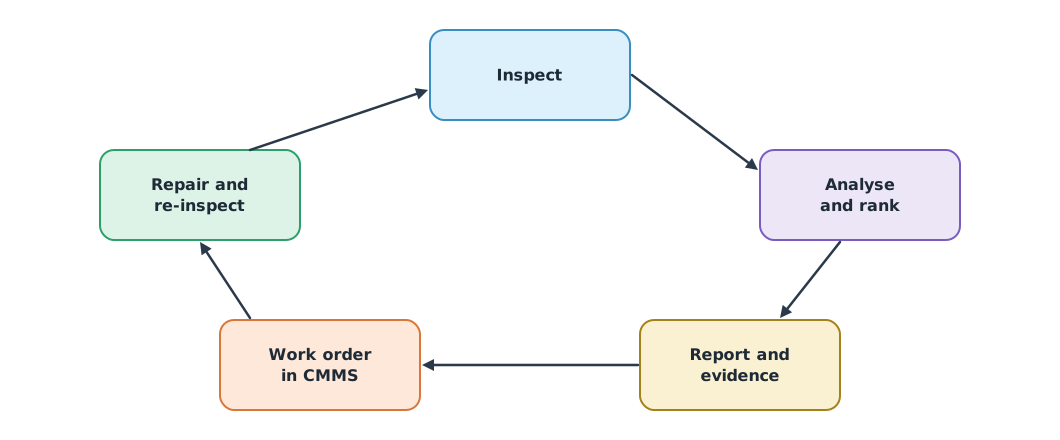
A usable inspection report must convert directly into a work order in a computerized maintenance management system (CMMS). Each defect should carry the asset ID, location (coordinates or pole and module numbers), RGB and thermal images with camera settings, conditions at the time (sunlight, load), the risk level with reasons, and its confirmation status. After repair it must be re-inspected to close the job. This loop is the core of an asset management system under ISO 55001.
Original data must be kept separate from working copies, with a SHA-256 manifest (FIPS 180-4), as in the knowledge unit on preserving evidence and handing over data. The hash confirms that files have not changed, but not that the conclusions are right.
Module lab
Lab: risk plan and inspection report
- Identify at least six hazards for an asset inspection flight at the training site, and assess them with Example 1 before and after mitigation
- Collect defects from modules 2–4, score PoF and CoF with reasons, and rank them with Example 2
- Write one report entry per defect with all the required information
- Build a table that can be imported into a CMMS or the operator’s spreadsheet, with a manifest of the supporting images
- Present to the “asset manager” (the instructor) and adjust the ranking with any additional consequence information received
Common mistakes
Watch out
- Using ICAO’s example matrix as the organisation’s criteria without adapting it
- Ranking by visual severity alone without considering consequences
- Reports without location or asset ID, so the repair team cannot find the defect
- Not re-inspecting after repair, closing jobs without evidence
- Overwriting original files
Summary
- Flight risk uses a probability–severity matrix; acceptance criteria belong to the organisation
- Asset risk uses PoF × CoF to rank repair work; consequences matter as much as visible severity
- Reports must convert into CMMS work orders, and repairs must be re-inspected
- Keep originals separate with a manifest so the work can be traced
Check your understanding
- A hazard with probability 4 and severity B scores what under the team’s criteria, and at which level?
- Which letter does ICAO Doc 9859 use for catastrophic severity?
- Do defects with PoF 2, CoF 5 and PoF 5, CoF 2 have different risk, and what else should be considered?
- What information must a defect report include so the repair team can find it?
- Why must work be re-inspected after repair?
Answers
- , high
- A
- The scores are equal (10), but consider whether an unacceptable consequence exists; a CoF of 5 may need to be handled first
- Asset ID, location, images, camera settings, conditions at the time, risk level and confirmation status
- To confirm the repair worked and close the job with evidence
Key formulas
| Risk index (team criteria) | |
| Asset risk |
Key references
- International Civil Aviation Organization. (2018). Safety management manual (Doc 9859, 4th ed.). link
- International Organization for Standardization. (2018). Risk management – Guidelines (ISO 31000:2018). link
- American Petroleum Institute. (2023). Elements of a risk-based inspection program (API RP 580, 4th ed.). link
- American Petroleum Institute. (2025). Risk-based inspection methodology (API RP 581, 4th ed.). link
- International Organization for Standardization. (2024). Asset management — Asset management system — Requirements (ISO 55001:2024). link
- International Organization for Standardization. (2023). Unmanned aircraft systems — Part 3: Operational procedures (ISO 21384-3:2023). link
- National Institute of Standards and Technology. (2015). Secure hash standard (SHS) (FIPS 180-4). link
Further reading
Study the assigned knowledge units in advance, review media and take the module quiz
Safety management systems (SMS)
Preserving evidence and handing over data
In class / field
Intensive lab and field practice recorded in a lab notebook
Learning evidence: Lab notebook signed by the instructor