BVLOS and risk levels
UAT 402 Advanced UAS Technology and BVLOS Operations
Lesson
By the end of this module you will be able to
- Find the initial ARC from the airspace type using SORA Annex C
- Explain the link between residual ARC and the tactical mitigation performance requirement (TMPR)
- Estimate the rate of encounters with crewed aircraft using a traffic-density model
- Use time-of-day restrictions as a strategic mitigation and compute their effect
Why this matters
UAT 312 explained what BVLOS is, radio horizon, C2 links, Detect and Avoid and Remote ID, and UAT 401 practised ground risk assessment with SORA. This practical course prepares BVLOS missions in earnest. The case used throughout is inspecting a 20 km raw-water pipeline across rural rice fields, an area where crop-spraying aircraft routinely fly low. The drone knowledge base’s unit on beyond-visual-line-of-sight operations covers DAA, observers, C2 and permission procedures, and its unit on BVLOS and risk assessment stresses linking risks, mitigations and evidence. The first module starts with the risk BVLOS raises most clearly: mid-air collision.
Initial ARC from airspace type
SORA 2.5 assesses air risk with the ARC (Air Risk Class). Annex C divides airspace into 12 Airspace Encounter Categories (AECs). For example, an airport environment in class B, C or D airspace gives ARC-d; above 500 ft AGL in controlled airspace gives ARC-d; above 500 ft in uncontrolled airspace gives ARC-c; below 500 ft in controlled airspace or over urban areas gives ARC-c; below 500 ft in uncontrolled airspace over rural areas gives ARC-b; and segregated or atypical airspace gives ARC-a. Annex C Table 2 also lets an applicant lower the ARC by showing that local traffic density is lower than assumed.
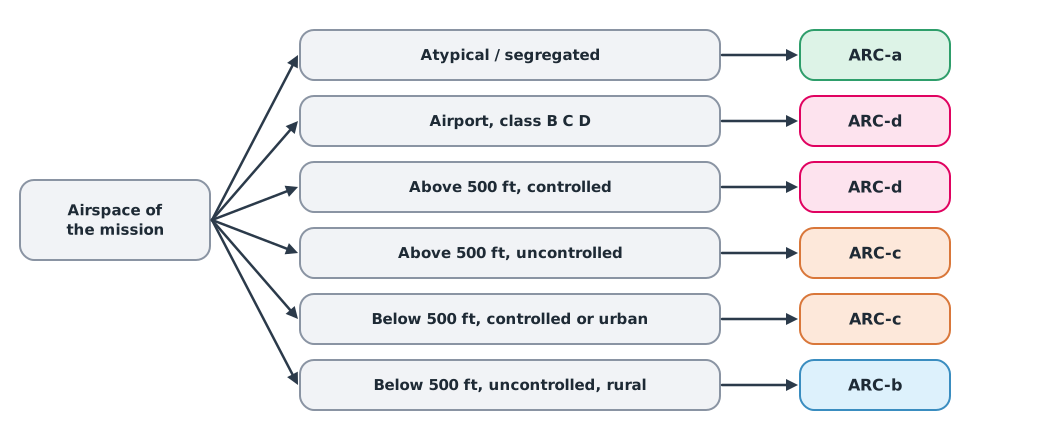
After strategic mitigation, the remaining (residual) ARC sets the TMPR under SORA 2.5 Table 6: ARC-d needs High, ARC-c Medium, ARC-b Low, and ARC-a has no requirement. Visual line of sight counts as an acceptable tactical mitigation at every level, so BVLOS must find something to replace the pilot’s eyes.
The traffic-density model
Weibel and Hansman (2004) estimated the mid-air collision risk of unmanned aircraft from the density of air traffic in each region, and found risk on major airways about a hundred times that off airways. The common underlying idea is the gas model, like counting how often gas molecules collide: encounter rate equals traffic density × the cross-section of the region counted as an encounter × relative speed. The result depends heavily on assumptions, so it is better for comparing options than as an absolute safety figure.
Example 1 The chance of meeting a crop sprayer inside a watch cylinder
On average 0.5 crop sprayers fly low at once over a 10,000 km² area at 0–150 m. An encounter counts when within a 500 m radius and ±100 m in height, at a relative speed of 60 m/s (assumed values).
import math

# gas model: encounter rate = traffic density × cross-section × relative speed
aircraft = 0.5               # average crewed aircraft flying low in the area at once (assumed)
area_km2 = 10000             # area those aircraft use
band_km = 0.15               # height band 0–150 m
rho = aircraft / (area_km2 * band_km)          # aircraft per km³
r_km, h_km = 0.5, 0.1        # watch cylinder: radius 500 m, height ±100 m
cross = 2 * r_km * 2 * h_km  # km² cross-section facing the relative motion
v_rel = 60 * 3.6             # km/h (60 m/s)

rate = rho * cross * v_rel   # per flight hour
print(f"traffic density {rho:.2e} aircraft/km^3")
print(f"encounters inside the cylinder: {rate:.4f} per flight hour"
      f" = one per {1/rate:.0f} h")
hours = 300
p_any = 1 - math.exp(-rate * hours)
print(f"chance of at least one in {hours} flight hours: {p_any:.0%}")
traffic density 3.33e-04 aircraft/km^3
encounters inside the cylinder: 0.0144 per flight hour = one per 69 h
chance of at least one in 300 flight hours: 99%Even though the density is very low, close encounters still occur about once every 69 flight hours, and if the company flies 300 hours a year, at least one is almost certain. Relying on luck is not an option: the chance must be reduced by strategic mitigation, with a way to detect and avoid during the mission.
Strategic mitigation by time of day
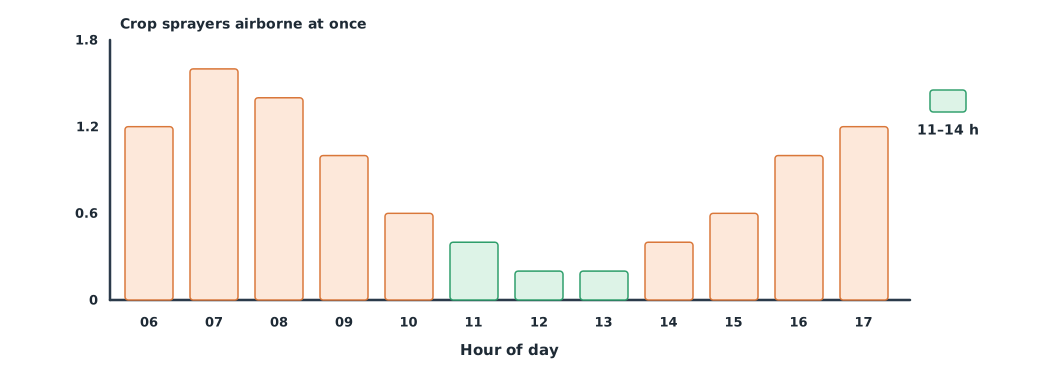
Strategic mitigation reduces encounters before take-off, for example by choosing heights, routes or times with little traffic. Talking with local crop-spraying operators may reveal that they fly most in the calm morning and evening.
Example 2 Flying only around midday
Hypothetical data from a survey of local crop-spraying operators give the average number airborne at once for each hour. Compare flying all day with flying only 11–14 h.
import math

# average crop sprayers flying low at once, by hour (assumed from a survey of local operators)
by_hour = {6: 1.2, 7: 1.6, 8: 1.4, 9: 1.0, 10: 0.6, 11: 0.4, 12: 0.2, 13: 0.2, 14: 0.4, 15: 0.6, 16: 1.0, 17: 1.2}
area_km2, band_km = 10000, 0.15
cross = 2 * 0.5 * 2 * 0.1
v_rel = 60 * 3.6

def rate(n):
    return n / (area_km2 * band_km) * cross * v_rel

all_day = sum(rate(n) for n in by_hour.values()) / len(by_hour)
window = [11, 12, 13]
limited = sum(rate(by_hour[h]) for h in window) / len(window)
print(f"average over 06-18 h: {all_day:.4f} encounters per flight hour")
print(f"flying only 11-14 h:  {limited:.4f} encounters per flight hour")
print(f"reduction factor {all_day/limited:.1f}x")
average over 06-18 h: 0.0235 encounters per flight hour
flying only 11-14 h: 0.0077 encounters per flight hour
reduction factor 3.1xRestricting the time window cuts the encounter rate about threefold. It can support a request to lower the ARC if the traffic data come from a verifiable source, and it must be written as a condition in the operations manual, not merely an intention.
Module lab
Lab: assessing the pipeline’s air risk
- Draw the 20 km pipeline on a map and check airspace classes and nearby aerodromes in Thailand’s AIP
- Find the AEC and initial ARC for each section of the route
- Ask about or find low-level traffic data in the area, such as crop sprayers, small airfields or helicopters, noting source and reliability
- Use Examples 1 and 2 to compare height and time-of-day options
- Summarise the expected residual ARC, the required TMPR and the evidence still missing
Common mistakes
Watch out
- Assuming a rural area has no other aircraft without asking local airspace users
- Using model output as an absolute safety figure
- Claiming a time restriction without writing it into the manual
- Applying the lowest section’s ARC to the whole route
- Forgetting that BVLOS lacks the pilot’s eyes as a tactical mitigation
Summary
- The initial ARC comes from the 12 airspace types in SORA Annex C
- Residual ARC sets the TMPR: d High, c Medium, b Low, a no requirement
- The density model compares options and shows that encounters really happen
- Restricting height, route and time is strategic mitigation that needs evidence
Check your understanding
- Flying below 500 ft in uncontrolled airspace over a rural area gives what initial ARC?
- What TMPR does residual ARC-c require?
- An encounter rate of 0.01 per hour over 100 flight hours gives what chance of at least one?
- If traffic density halves, how does the encounter rate change?
- Why does BVLOS need additional tactical mitigation?
Answers
- ARC-b
- Medium
- It halves
- There are no pilot’s eyes to accept as a tactical mitigation, as there are in VLOS
Key formulas
| Encounter rate (density model) | |
| Chance of at least one |
Key references
- Joint Authorities for Rulemaking on Unmanned Systems. (2024). JARUS guidelines on Specific Operations Risk Assessment (SORA), main body, edition 2.5 (JAR-DEL-SRM-SORA-MB-2.5). link
- Joint Authorities for Rulemaking on Unmanned Systems. (2024). JARUS guidelines on SORA, Annex C: Strategic mitigation – collision risk assessment (Edition 1.0). link
- Weibel, R. E., & Hansman, R. J. (2004). Safety considerations for operation of different classes of UAVs in the NAS. In AIAA 4th Aviation Technology, Integration and Operations (ATIO) Forum (AIAA 2004-6421). link
- Federal Aviation Administration UAS BVLOS Aviation Rulemaking Committee. (2022, March 10). Final report. link
- สำนักงานการบินพลเรือนแห่งประเทศไทย. (2569). ประกาศ กพท. เรื่อง หลักเกณฑ์และวิธีการในการอนุญาตให้ผู้บังคับหรือปล่อยอากาศยานซึ่งไม่มีนักบิน ประเภทอากาศยานที่ควบคุมการบินจากภายนอก ที่มีน้ำหนักไม่เกิน 25 กิโลกรัม ปฏิบัติแตกต่างไปจากเงื่อนไขที่กำหนด พ.ศ. 2569 (มีผล 17 พฤษภาคม 2569). link
Further reading
Study the assigned knowledge units in advance, review media and take the module quiz
Beyond visual line of sight (BVLOS) operations
BVLOS and risk assessment
In class / field
Lab or field practice from worksheets with a safety checklist
Learning evidence: Checked worksheets and quiz results