Law, privacy and unauthorised drones
UAT 454 UAS for Surveillance, Monitoring and Security
Lesson
By the end of this module you will be able to
- Identify aviation and communications law relevant to drone-based security systems
- Design camera restrictions and privacy masking to respect neighbours' privacy
- Explain what private operators may do when an unknown drone appears
- Plan a response to unknown drones that puts people's safety first
Why this matters
A security company must protect its client’s property, but it has no authority above aviation law, communications law or neighbours’ right to privacy. A well-designed system that breaks the law will be shut down or sued, and if staff try to deal with an unknown drone by unlawful means, the harm may exceed the drone’s.
Aviation and communications law
- Flying from an automated dock is a remote operation beyond the pilot’s visual line of sight and needs specific CAAT approval under the CAAT-GM-UAS-PDRA101 guidance, with a risk assessment and operations manual
- The Ministry of Transport notification of 2015 sets conditions for drone flight, including not violating others’ privacy The CAAT notification in force since 17 May 2026 treats flights that depart from the conditions of the 2015 Ministry of Transport notification as Specific category operations, which need a risk assessment and authorisation before flight (CAAT2569).
- The Radio Communications Act B.E. 2498 (1955), section 6, forbids making, possessing, using, importing or trading radio equipment without authorisation. Jammers are radio equipment, so private operators cannot install them against drones, and jamming also disrupts other communications and navigation around the site
- The Personal Data Protection Act B.E. 2562 (2019) makes video that identifies employees, visitors and neighbours personal data, requiring a legal basis, notice of purpose and security (legal bases in detail are in UAT 401)
Neighbours’ privacy
Two fence sections of the distribution centre border homes. A drone patrolling the fence will see into houses and yards unless restrictions are designed in.
Example 1 How much fence needs camera restrictions?
The perimeter patrol is 2,000 m; fence sections beside homes lie at 400–700 m and 1,500–1,650 m along the fence.
# 2,000 m perimeter patrol, fence sections beside homes (m)
patrol = 2000
beside_homes = [(400, 700), (1500, 1650)]   # ranges along the fence

masked = sum(b - a for a, b in beside_homes)
print(f"privacy-restricted fence: {masked} m ({masked / patrol:.1%} of the patrol)")
print("rule: camera points inward, privacy mask on, no zoom outward")
privacy-restricted fence: 450 m (22.5% of the patrol)
rule: camera points inward, privacy mask on, no zoom outward450 m, or 22.5% of the route, needs camera restrictions. There the team requires the camera to point inward only, turns on privacy masks over the homes, forbids zooming outside the fence, and flies below the height from which yards are visible. These restrictions are built into the automated mission rather than left to operator care alone.
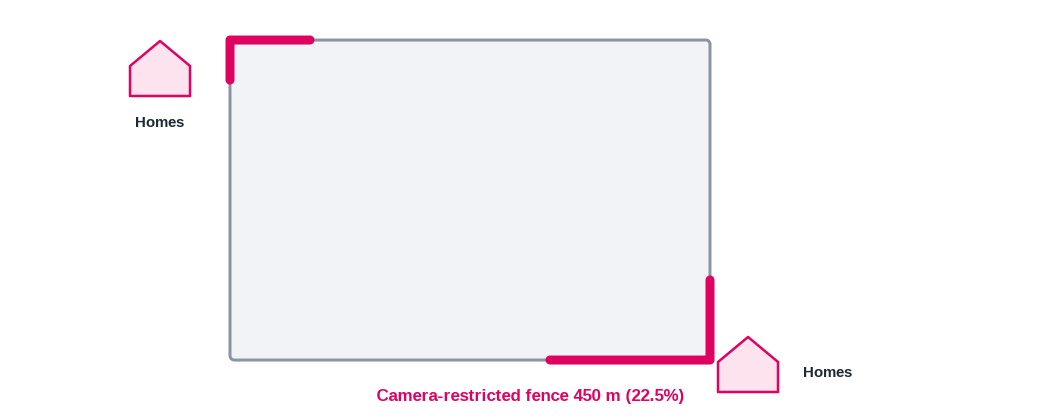
Besides camera restrictions, the team tells the community about drone use, posts video-recording signs, provides a contact channel, and does not follow people outside the fence, except an intruder who has just fled, handed over to the police at once.
Threats from unknown drones
Other people’s drones may be used to scout weaknesses, photograph goods or documents, or in serious cases carry items onto the site. The counter-drone landscape includes radar, radio-frequency and camera detection and various countermeasures, but for private operators in Thailand what is possible is to detect, record, protect people and notify the authorities. Jamming, shooting down or capturing drones is for authorised state agencies.
Example 2 Can the response finish before the unknown drone arrives?
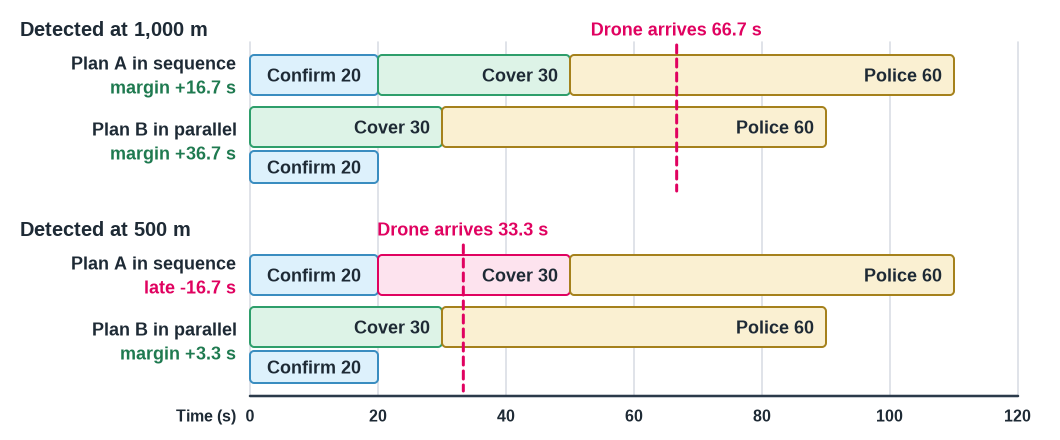
The system detects an unknown drone approaching at 15 m/s. The response plan has three steps: confirm on screen (20 s), move staff under cover (30 s) and notify the police (60 s). Compare two plans at detection ranges of 1,000 m and 500 m. Plan A works in sequence: confirm on screen first, then move staff under cover. Plan B starts moving staff under cover as soon as the drone is detected, while confirmation on screen goes on in parallel.
# unknown drone approaching at 15 m/s; compare two plans at detection ranges of 1,000 and 500 m
v = 15
confirm, cover, police = 20, 30, 60      # duration of each step (seconds)

# plan A in sequence: confirm on screen, then move staff under cover
cover_a = confirm + cover
# plan B in parallel: start moving staff under cover at detection, while confirming on screen
cover_b = cover

for d in (1000, 500):
    eta = d / v
    print(f"detected at {d} m: drone arrives at {eta:.1f} s")
    for name, done in (("A in sequence", cover_a), ("B in parallel", cover_b)):
        margin = eta - done
        verdict = "in time" if margin >= 0 else "TOO LATE"
        print(f"  plan {name}: staff under cover at {done:2d} s, margin {margin:+5.1f} s ({verdict})")
print(f"minimum detection range: A {cover_a * v} m, B {cover_b * v} m")
print(f"police notified after people are safe: A at {cover_a + police} s, B at {cover_b + police} s")
detected at 1000 m: drone arrives at 66.7 s
plan A in sequence: staff under cover at 50 s, margin +16.7 s (in time)
plan B in parallel: staff under cover at 30 s, margin +36.7 s (in time)
detected at 500 m: drone arrives at 33.3 s
plan A in sequence: staff under cover at 50 s, margin -16.7 s (TOO LATE)
plan B in parallel: staff under cover at 30 s, margin +3.3 s (in time)
minimum detection range: A 750 m, B 450 m
police notified after people are safe: A at 110 s, B at 90 sIf detected at 1,000 m, the drone arrives in 66.7 seconds and both plans are in time; plan A finishes cover at 50 seconds, with 16.7 seconds to spare. If detected at 500 m, the drone arrives in 33.3 seconds, and plan A, finishing at 50 seconds, is 16.7 seconds too late: people are still outdoors when the drone arrives, so it does not work. Plan B starts together with confirmation and finishes at 30 seconds, in time, but only 3.3 seconds remain, which is very thin; add more margin, for example by extending the detection range or by rehearsing the shelter route to shorten it.
The minimum detection range is the time needed multiplied by the drone’s speed. Plan A needs (20 + 30) × 15 = 750 m, which leaves 0 seconds of margin, so detection must be even farther out. Plan B needs 30 × 15 = 450 m. The lesson: a long step that protects people should start at once rather than wait for a step that need not finish first. If confirmation shows there is no threat, the shelter move can be called off, which costs less than leaving people too late. Notifying the police follows once people are safe, finishing at 110 seconds (plan A) or 90 seconds (plan B), after the drone arrives in both plans. The order deliberately puts people’s safety first. Meanwhile cameras record the drone and its direction as evidence. The team does not launch its own drone to chase it, because of the risk of a mid-air collision.
Module lab
Lab: privacy plan and unknown-drone response plan
- Identify sensitive areas around your group’s site, compute the share needing camera restrictions with the code in Example 1, and set the restrictions in a simulator mission
- Draft signs and a community notice about drone use and video recording
- Write an unknown-drone response plan and compute timings with the code in Example 2 for detection at 500 and 1,000 m, name any step that is late and revise the plan, then find the minimum detection range of the revised plan
- Run a tabletop exercise with roles for operator, security chief and community representative, then revise the plan
Common mistakes
Watch out
- Installing a dock and flying automatically without approval
- Buying a jammer against drones, which breaks the Radio Communications Act
- Patrolling with the camera facing out towards homes
- Sending your own drone to chase an unknown drone
- Running every response step one after another without comparing with the drone’s arrival time, which at a short detection range may be too late
- Notifying authorities before protecting people on site
Summary
- Flying from a dock needs specific approval, and the 2015 Ministry of Transport notification forbids violating privacy
- Jammers need authorisation under the Radio Communications Act B.E. 2498; private operators may only detect, record, protect people and notify authorities
- Neighbours’ privacy must be designed into missions: restricted camera angles, privacy masks and no zooming beyond the fence
- Unknown-drone response puts people’s safety first and keeps evidence for the authorities
- Always compare every step’s time with the drone’s arrival time. At 15 m/s, confirming for 20 seconds and then moving staff under cover for 30 seconds needs detection beyond 750 m (at exactly 750 m there is no margin); starting cover together with confirmation needs 450 m
Check your understanding
- A 1,600 m route has sections of 200 m and 120 m beside homes. What percentage needs camera restrictions?
- An unknown drone is detected 600 m away at 12 m/s. How many seconds until it arrives? If moving staff under cover takes 40 seconds, how much margin is left?
- Can a security company install a jammer itself? Why?
- Why should you not launch your own drone to chase an unknown drone?
- Besides camera restrictions, what shows transparency to the community?
Answers
- seconds, leaving seconds of margin
- No. A jammer is radio equipment whose possession and use need authorisation under section 6 of the Radio Communications Act B.E. 2498, and it disrupts other communications
- It risks a mid-air collision and falling on people or property, and it is beyond a private operator’s authority
- Telling the community in advance, posting video-recording signs and providing a contact channel
Key formulas
| Share of fence with camera restrictions | |
| Time for an unknown drone to arrive |
Key references
- พระราชบัญญัติคุ้มครองข้อมูลส่วนบุคคล พ.ศ. 2562. ราชกิจจานุเบกษา, 136(69 ก), 52–95. link
- กระทรวงคมนาคม. (2558). ประกาศกระทรวงคมนาคม เรื่อง หลักเกณฑ์การขออนุญาตและเงื่อนไขในการบังคับหรือปล่อยอากาศยานซึ่งไม่มีนักบิน ประเภทอากาศยานที่ควบคุมการบินจากภายนอก พ.ศ. 2558. ราชกิจจานุเบกษา, 132(86 ง), 6–12. link
- พระราชบัญญัติวิทยุคมนาคม พ.ศ. 2498 และที่แก้ไขเพิ่มเติม. link
- สำนักงานการบินพลเรือนแห่งประเทศไทย. (2568). แนวปฏิบัติในการขอปฏิบัติการบินอากาศยานซึ่งไม่มีนักบินโดยใช้การประเมินความเสี่ยงที่เป็นไปตามเงื่อนไขที่กำหนดสำหรับการบินเกินกว่าระยะสายตา (CAAT-GM-UAS-PDRA101 ปรับปรุงครั้งที่ 00). link
- AlTawy, R., & Youssef, A. M. (2017). Security, privacy, and safety aspects of civilian drones: A survey. ACM Transactions on Cyber-Physical Systems, 1(2), Article 7, 1–25. link
- สำนักงานการบินพลเรือนแห่งประเทศไทย. (2569). ประกาศ กพท. เรื่อง หลักเกณฑ์และวิธีการในการอนุญาตให้ผู้บังคับหรือปล่อยอากาศยานซึ่งไม่มีนักบิน ประเภทอากาศยานที่ควบคุมการบินจากภายนอก ที่มีน้ำหนักไม่เกิน 25 กิโลกรัม ปฏิบัติแตกต่างไปจากเงื่อนไขที่กำหนด พ.ศ. 2569 (มีผล 17 พฤษภาคม 2569). link
Further reading
Study the assigned knowledge units in advance, review media and take the module quiz
จริยธรรม ความเป็นส่วนตัว และ PDPA ในงานโดรน
Law and registration
Drone technology landscape: autonomy, AI, target search and tracking, anti-drone, data links and disaster applications
In class / field
Lab or field practice from worksheets with a safety checklist
Learning evidence: Checked worksheets and quiz results