Data management and system security principles
UAT 454 UAS for Surveillance, Monitoring and Security
Lesson
By the end of this module you will be able to
- Compute video storage for a retention period and set a data retention policy
- Export video evidence so it can be traced
- Explain cyber threats to security systems with drones and controls under NIST CSF 2.0
- Detect implausible GNSS positions that may indicate spoofing
Why this matters
Security systems are targets themselves. If intruders can switch off cameras, delete video or take over the drone, the investment becomes a tool for criminals. And stored video is personal data about many employees and visitors. Data management and system security are part of security, not extras.
Storage and retention
Example 1 How much storage for 30 days of video?
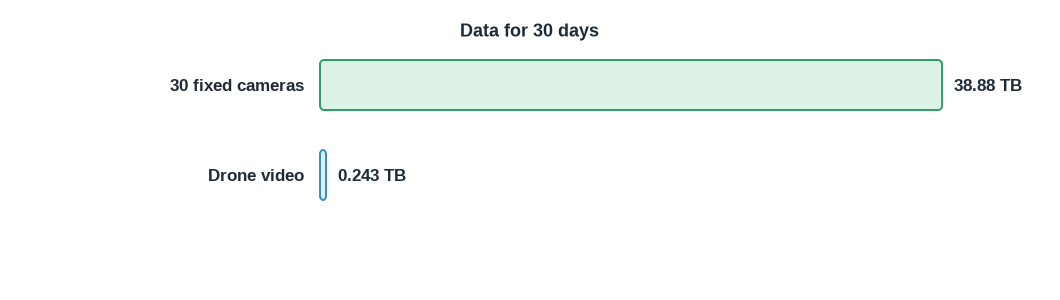
30 fixed cameras at 4 Mb/s each record 24 hours a day, plus drone video at 6 Mb/s for 3 hours a day, kept for 30 days.
# 30 fixed cameras at 4 Mb/s each, recording 24 hours, plus drone video
cams, rate, days = 30, 4.0, 30
drone_rate, drone_h_per_day = 6.0, 3

fixed_tb = cams * rate * 1e6 * 86400 * days / 8 / 1e12
drone_tb = drone_rate * 1e6 * drone_h_per_day * 3600 * days / 8 / 1e12
print(f"fixed cameras {fixed_tb:.2f} TB, drone {drone_tb:.3f} TB for {days} days")
print(f"total {fixed_tb + drone_tb:.2f} TB")
fixed cameras 38.88 TB, drone 0.243 TB for 30 days
total 39.12 TBFixed cameras need 38.88 TB and drone video only 0.243 TB, about 39 TB in total, plus spare capacity and redundancy against disk failure. Cutting retention to 14 days, or recording at full rate only on motion, reduces storage greatly.
Retention should be set by purpose, not by available disk. Thailand’s Personal Data Protection Act B.E. 2562 (2019) requires personal data to be kept only as necessary for its purpose. A common policy:
- General video kept for the set period, then deleted automatically
- Incident video exported as evidence and kept for the life of the case or investigation
- Evidence export with time, camera, exporter and a SHA-256 hash, with a chain-of-custody record, so it can be shown to be unaltered
- Access rights operators may watch live, but reviewing history and exporting are limited to staff with a duty to, and every access is logged
Cyber threats to systems with drones
AlTawy and Youssef (2017) surveyed many threats to civilian drones. Those most relevant to security systems are:
- Hijacking or spoofing commands sending the drone home or somewhere else
- Jamming or spoofing GNSS so the drone loses its position
- Intercepting or cutting video so the intruder sees what the control room sees, or the control room sees a frozen picture
- Breaking into the integration platform or cameras through default passwords or unpatched software
MAVLink 2 supports message signing with a shared secret key and timestamp, so the drone rejects unsigned or replayed commands, but it must be enabled and its keys managed well.
NIST CSF 2.0
Version 2.0 of the NIST Cybersecurity Framework (2024) organises work into six functions, which can be used to plan security for the whole system.
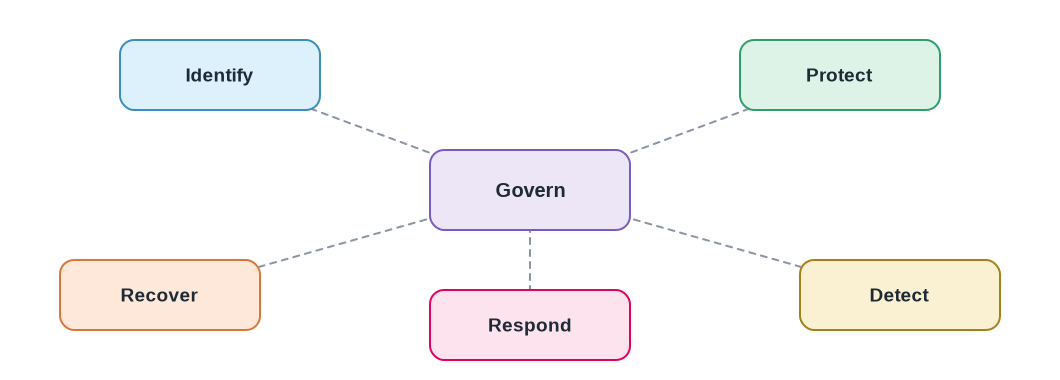
| Function | Example at the distribution centre |
|---|---|
| Govern | Assign ownership, policy and acceptable risk |
| Identify | Inventory every device: cameras, dock, drone, servers |
| Protect | Segment networks, change default passwords, patch software, enable MAVLink signing |
| Detect | Monitor login logs; check for abnormal GNSS positions |
| Respond | Procedure when the drone is suspected to be hijacked, such as landing at once or returning to the dock |
| Recover | Back up configuration, restore systems and review after incidents |
Example 2 An impossible GNSS position
Drone positions every second; this model can fly at most about 20 m/s.
import math
# drone GNSS fixes every 1 s (x, y in metres), maximum plausible speed 20 m/s
fixes = [(0, 0), (11, 2), (22, 4), (33, 6), (95, 40), (106, 42), (117, 44)]
v_max = 20.0

for k in range(1, len(fixes)):
    v = math.dist(fixes[k - 1], fixes[k])      # dt = 1 s
    flag = "  <- implausible jump, suspect spoofing or glitch" if v > v_max else ""
    print(f"t={k} s speed {v:5.1f} m/s{flag}")
t=1 s speed 11.2 m/s
t=2 s speed 11.2 m/s
t=3 s speed 11.2 m/s
t=4 s speed 70.7 m/s <- implausible jump, suspect spoofing or glitch
t=5 s speed 11.2 m/s
t=6 s speed 11.2 m/sAt second 4 the position jumps 70.7 m in one second, which is physically impossible. It may be spoofing or a receiver fault. The system should alert the operator and cross-check other sources, such as inertial sensors or camera imagery. The drone’s own navigation also performs such consistency checks, but a second check in the control room keeps the operator informed.
Module lab
Lab: data policy and security assessment
- Compute your system’s storage with the code in Example 1 for 7, 14 and 30 days’ retention, and propose a retention period justified by purpose
- Export one video clip with its hash and write a chain-of-custody record
- In SITL, enable MAVLink signing and try sending an unsigned command; record the result
- Write a NIST CSF six-function table for your group’s system, with at least one control per function
Common mistakes
Watch out
- Setting retention by disk size rather than purpose
- Exporting evidence without a hash and custody record
- Leaving default passwords on cameras and docks
- Not enabling message signing, or storing keys where anyone can read them
- Having no procedure when the drone may be hijacked or lost
Summary
- Storage ; retention follows purpose and keeps only what is necessary under the PDPA
- Video evidence is exported with hashes, restricted access and custody records
- Main cyber threats are command hijacking, GNSS spoofing, video interception and system break-ins; MAVLink signing and network segmentation help
- NIST CSF 2.0 has six functions: Govern, Identify, Protect, Detect, Respond and Recover
Check your understanding
- 10 cameras at 2 Mb/s each record 24 hours a day for 14 days. How many TB?
- The drone’s position changes from (0, 0) to (30, 40) m in one second. What speed is that, and is it plausible for a drone with a 20 m/s maximum?
- Which threat does MAVLink message signing protect against?
- Which function did NIST CSF 2.0 add as the sixth?
- Why should video retention not be set by disk size?
Answers
- bytes, about 3.02 TB
- m/s, not plausible; suspect spoofing or a fault
- Forged or replayed commands from anyone without the key
- Govern
- Because the PDPA requires personal data to be kept only as necessary for its purpose, not for as long as space allows
Key formulas
| Storage | |
| Speed from two positions |
Key references
- National Institute of Standards and Technology. (2024). The NIST cybersecurity framework (CSF) 2.0. link
- MAVLink Development Team. Message signing (authentication). MAVLink developer guide. link
- AlTawy, R., & Youssef, A. M. (2017). Security, privacy, and safety aspects of civilian drones: A survey. ACM Transactions on Cyber-Physical Systems, 1(2), Article 7, 1–25. link
- พระราชบัญญัติคุ้มครองข้อมูลส่วนบุคคล พ.ศ. 2562. ราชกิจจานุเบกษา, 136(69 ก), 52–95. link
Further reading
Study the assigned knowledge units in advance, review media and take the module quiz
In class / field
Lab or field practice from worksheets with a safety checklist
Learning evidence: Checked worksheets and quiz results