Camera and sensor selection
UAT 454 UAS for Surveillance, Monitoring and Security
Lesson
By the end of this module you will be able to
- Compare EO and thermal cameras for day and night surveillance
- Compute the field of view of one pixel (IFOV) and the ground pixel size at different ranges
- Assess image detail with the DORI criteria
- Select a camera set that meets mission requirements
Why this matters
The camera is one of the most expensive parts of a surveillance system and decides what can really be “seen”. Buying a camera by the resolution on the box, such as 4K or 640 pixels, without computing working range gives beautiful images that cannot answer the mission’s questions. This module uses the 323.1 m slant range from the orbit in module 2 and a 1,500 m long-range view from the ridge patrol.
EO and thermal cameras
| Feature | EO camera (visible light) | Thermal camera (LWIR, about 8–14 µm) |
|---|---|---|
| What it measures | Light reflected from objects | Heat radiation emitted by objects |
| At night | Needs light | Works |
| Thin smoke | Sees through little | Sees through better |
| Resolution | High, with strong zoom | Lower, such as 640 × 512 |
| Strength | Confirming object type, reading detail | Finding hot spots, people and animals in darkness or under smoke |
Vollmer and Möllmann (2017) explain that a thermal camera measures radiation that depends on temperature and the surface’s emissivity. Camera sensitivity is given as NETD: the lower it is, the smaller the temperature difference it can separate (Teledyne FLIR). A fire is hundreds of degrees hotter than its background, so it stands out in a thermal image even when smaller than one pixel. The same principle lets VIIRS detect fires much smaller than its 375 m pixels (Schroeder and colleagues, 2014). Fire work therefore uses the thermal camera to find and the EO zoom to confirm.
IFOV and ground pixel size
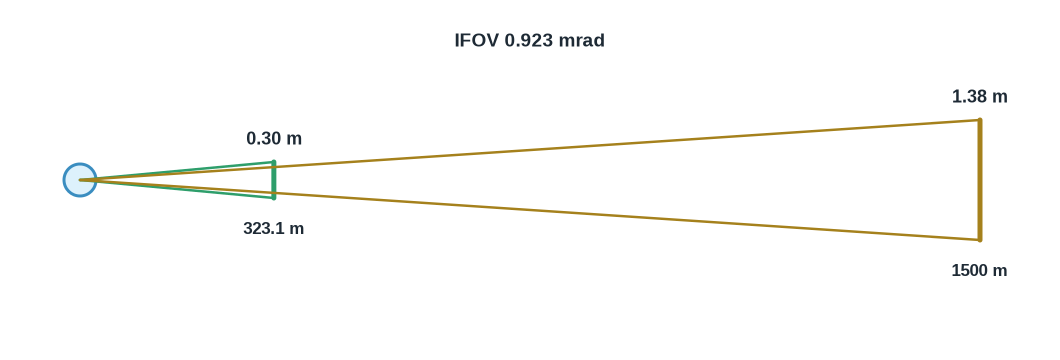
The angle seen by one pixel is the instantaneous field of view (IFOV), equal to pixel pitch divided by focal length . The ground pixel size at range is : double the range, double the ground pixel.
Example 1 How many pixels does a 2 m fire cover?
A thermal camera with 12 µm pixels and a 13 mm lens views a 2 m fire at the 323.1 m orbit range and the 1,500 m long-range view.
# field of view of one pixel (IFOV) of the thermal camera
pitch, f = 12e-6, 0.013
ifov = pitch / f                       # radians
fire = 2.0                             # fire size (m)

print(f"IFOV = {ifov * 1000:.3f} mrad")
for r in (323.1, 1500):                # slant range (m)
    foot = ifov * r
    print(f"range {r:6.1f} m: pixel footprint {foot:.2f} m, {fire / foot:.2f} px across the fire")
IFOV = 0.923 mrad
range 323.1 m: pixel footprint 0.30 m, 6.71 px across the fire
range 1500.0 m: pixel footprint 1.38 m, 1.44 px across the fireAt 323.1 m the ground pixel is 0.30 m and the fire covers almost 7 pixels, so its shape is visible. At 1,500 m the pixel is 1.38 m and the fire covers only about 1.4 pixels. It can still be detected because it is so hot, but its size and shape cannot be judged; the drone must fly closer or zoom the EO camera to confirm.
The DORI criteria
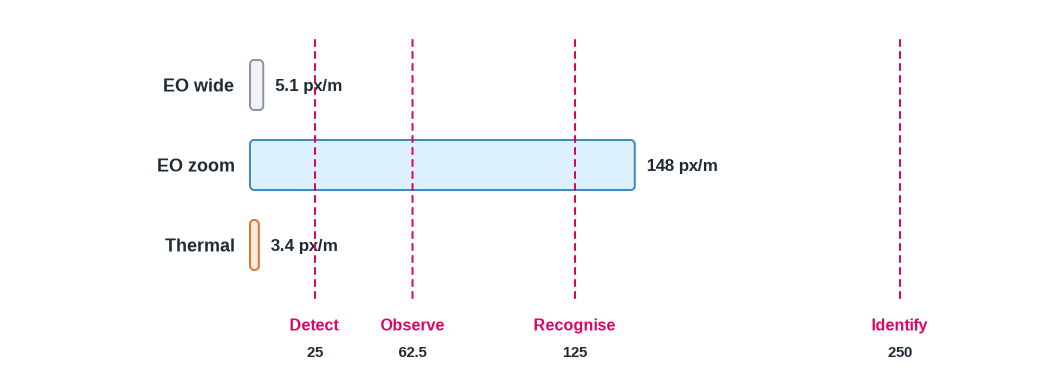
The 2014 edition of the IEC 62676-4 standard for video surveillance systems (IEC 62676-4:2014) uses pixel density on target, in pixels per metre, to define four levels of detail when viewing people, together called DORI. The 2025 edition (Ed. 2.0, published 9 October 2025) replaces them with seven operational requirements (overview 20, outline 40, discern 80, perceive 125, characterise 250, validate 500 and scrutinise 1,500 px/m; Axis Communications, 2026), two of which, perceive and characterise, sit at 125 and 250 px/m like recognise and identify. This course keeps the simpler four-level DORI as a teaching scale; check which edition a client or authority specifies.
| Level | Pixels per metre | What is possible |
|---|---|---|
| Detect | 25 | Knowing a person is there |
| Observe | 62.5 | Seeing posture and activity |
| Recognise | 125 | Telling apart a person seen before |
| Identify | 250 | Establishing who someone is |
The Johnson criteria studied in UAT 301 module 4 use a similar idea: counting detail across the target’s critical dimension. For surveillance of people or vehicles, DORI is easy to communicate to users, and it is also a privacy tool, because the identify level means images that are personal data (module 5).
Example 2 What level of detail does each camera give?
Compare a 60° wide EO camera, the EO zoom at its narrowest 2.3° (both 1,920 pixels wide) and a 32.9°, 640-pixel thermal camera at a slant range of 323.1 m.
import math
# (name, horizontal field of view in degrees, horizontal pixels)
cams = [("EO wide", 60, 1920), ("EO zoom", 2.3, 1920), ("Thermal", 32.9, 640)]
r = 323.1                              # slant range to the target (m)
# DORI thresholds from IEC 62676-4:2014 (pixels per metre)
dori = [("Identify", 250), ("Recognise", 125), ("Observe", 62.5), ("Detect", 25)]

for name, hfov, px in cams:
    width = 2 * r * math.tan(math.radians(hfov / 2))
    ppm = px / width
    level = next((n for n, t in dori if ppm >= t), "below Detect")
    print(f"{name:8s}: width {width:6.1f} m, {ppm:6.1f} px/m -> {level}")
EO wide : width 373.1 m, 5.1 px/m -> below Detect
EO zoom : width 13.0 m, 148.0 px/m -> Recognise
Thermal : width 190.8 m, 3.4 px/m -> below DetectThe wide EO gives only 5.1 px/m, below the level for detecting a person; it suits the overall view and the direction of fire spread. The EO zoom gives 148 px/m, at the recognise level, enough to confirm that people are near the fire and what they are doing, but not to identify them. The thermal camera’s 3.4 px/m is below the DORI thresholds, but those were designed for people in normal light; fire detection relies on temperature contrast, not pixels per metre.
Selecting a camera set against requirements
Steps for selecting cameras from requirements:
- State the target and its critical size, such as a 2 m fire or a person about 1.7 m tall
- State the level of detail needed: the lowest that answers the question, not the highest achievable
- Compute working range from the flight pattern, then the IFOV or field of view needed
- Check weight, power and gimbal stabilisation, since long zoom lenses are sensitive to vibration
- Check night, smoke and haze conditions; if flights are needed at dawn when haze is thick, the thermal camera is the primary sensor
Module lab
Lab: testing camera working range
- Set test targets in the field, such as a 1 m sign and a tray of hot charcoal kept safe by the lecturer
- Fly or place the camera at 50, 100 and 200 m and record EO and thermal images
- Count pixels on the targets in the real images and compare with values computed with the code in Examples 1 and 2
- Conclude at which range the charcoal is still detected and at which the sign’s detail is visible, and explain differences from the computed values
Common mistakes
Watch out
- Looking only at the camera’s pixel count without field of view and range
- Using horizontal distance instead of slant range, overestimating resolution
- Applying DORI to fire, when fire detection depends on temperature contrast
- Always choosing the highest resolution, even when the task does not need to identify people, adding privacy burden
- Forgetting image shake at high zoom, blurring away the computed detail
Summary
- EO gives high detail in normal light; thermal finds hot spots at night and through thin smoke; fire work uses both
- IFOV and the ground pixel grows with range
- DORI splits detail when viewing people at 25, 62.5, 125 and 250 px/m
- Select cameras from the target, the sufficient level of detail and the working range, not from numbers on the box
Check your understanding
- What is the IFOV of a camera with 17 µm pixels and a 19 mm lens?
- With an IFOV of 1 mrad at 500 m, how wide is a ground pixel?
- A 1,920-pixel image covers 16 m. How many px/m is that, and which DORI level?
- Why can a thermal camera detect a fire smaller than one pixel?
- If the mission only needs to know whether anyone is near a fire, which DORI level should be the target?
Answers
- mrad
- m
- px/m, the observe level (above 62.5 but below 125)
- The fire is much hotter than the background, so a pixel only partly filled by fire is still clearly brighter than its neighbours
- Detect (25 px/m); nothing higher is needed
Key formulas
| IFOV | |
| Ground pixel size at range r | |
| Pixel density on target |
Key references
- Vollmer, M., & Möllmann, K.-P. (2017). Infrared thermal imaging: Fundamentals, research and applications (2nd ed.). Wiley-VCH. link
- Teledyne FLIR. Comparing sensitivity of thermal imaging cameras and modules (NETD). link
- International Electrotechnical Commission. (2014). Video surveillance systems for use in security applications – Part 4: Application guidelines (IEC 62676-4:2014, Ed. 1.0; revised by Ed. 2.0 in 2025). link
- International Electrotechnical Commission. (2025). Video surveillance systems for use in security applications – Part 4: Application guidelines (IEC 62676-4:2025, Ed. 2.0). link
- Axis Communications. (2026). Pixel density based on IEC 62676-4:2025 [White paper]. Axis Communications AB. link
- Johnson, J. (1958). Analysis of image forming systems. In Proceedings of the Image Intensifier Symposium (AD 220160). U.S. Army Engineer Research and Development Laboratories. link
- Schroeder, W., Oliva, P., Giglio, L., & Csiszar, I. A. (2014). The new VIIRS 375 m active fire detection data product: Algorithm description and initial assessment. Remote Sensing of Environment, 143, 85–96. link
Further reading
Study the assigned knowledge units in advance, review media and take the module quiz
กล้อง EO/IR และ gimbal
หลักการภาพถ่ายความร้อน
M08 Environmental monitoring: from images of different dates to observations that need a field check
In class / field
Lab or field practice from worksheets with a safety checklist
Learning evidence: Checked worksheets and quiz results