Inventory counting with drones
UAT 459 UAS, Internet of Things and Smart Warehouse Systems
Lesson
By the end of this module you will be able to
- Explain the main warehouse processes, the role of the warehouse management system (WMS) and storage location codes
- Compare annual stocktaking with cycle counting and compute inventory record accuracy (IRA) against per-class tolerances
- Plan counting frequency with ABC classification and compute the counting workload per year and per night
- Analyse which warehouse processes suit drones using weighted scores
Why this matters
The warehouse management system says that 240 units of a part sit on level five, but when a picker gets there the pallet belongs to another item, or the slot is empty. Errors like this are more common than most people think. DeHoratius and Raman (2008) examined nearly 370,000 inventory records from 37 stores of one retailer and found 65% of them inaccurate; they also found that auditing practices were among the factors that reduced the errors. When records are wrong, the ordering system believes stock is available, does not reorder, and a customer’s assembly line may stop for want of a single part.
The trouble is that counting stock on high racks is hard. Staff must ride an order picker, a truck that lifts the operator, from slot to slot. It is slow, carries a fall risk and closes the aisle while it happens. That is why the ETH Zurich white paper (Wawrla et al., 2019) concludes that inventory management is the warehouse task where drones have the greatest potential.
The first part of the course (modules 1–5) follows one fictional case through all of its modules: a high-bay automotive spare-parts warehouse run by a parts distributor in Rayong province, supplying car assembly plants and service centres. It has six aisles (A01 to A06) and racks six levels high, 4,032 storage locations in total. Every pallet carries a GS1-128 logistic label, and the steel returnable containers of some customers carry RFID tags. The company wants drones to count the upper levels at night when no forklifts are working. All figures are fictional. The Python code can be downloaded from /downloads/uat-459/.
Warehouses, the WMS and location codes
A warehouse works as a sequence: receiving checks incoming goods, put-away places each pallet in the location the system assigns, replenishment moves stock from reserve storage to pick faces, picking collects items for orders, and shipping sends them out. Every step is recorded in the warehouse management system (WMS). Bartholdi and Hackman (2019) list basic WMS functions such as receiving, put-away, location tracking, picking and shipping, and note that high-end systems add features such as cycle counting, which is exactly where this course brings in drones.
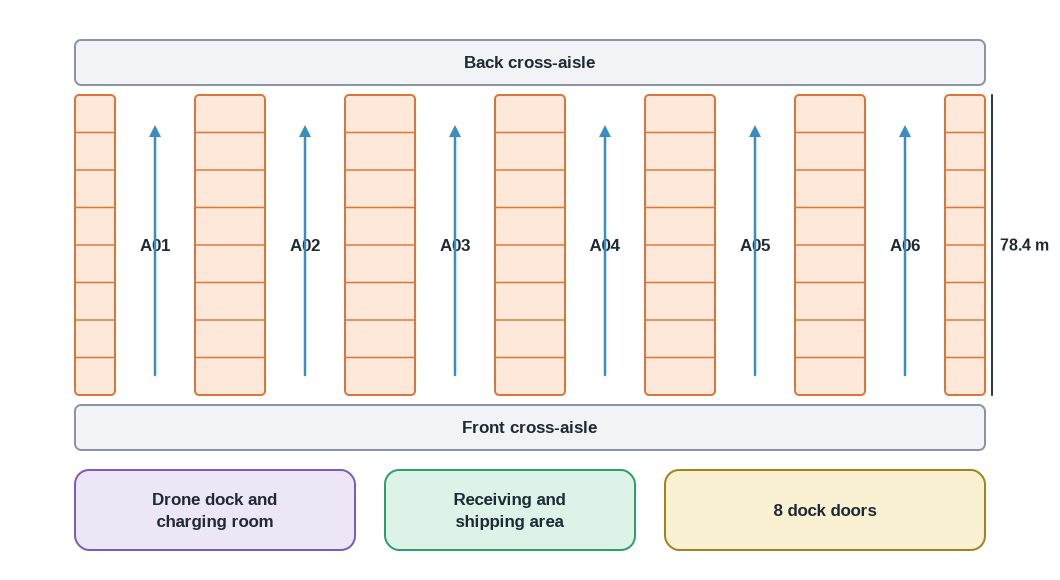
The WMS knows where things are because every rack position has a storage location code. This warehouse uses the pattern aisle-bay-level-slot: A03-27-5-2 means aisle A03, bay 27, level 5, slot 2. Odd-numbered bays are on the left of the aisle when facing in from the front cross-aisle, even-numbered bays on the right. Each aisle has 28 bays per side, each bay 2.8 m wide with two pallet slots and six levels, giving locations.
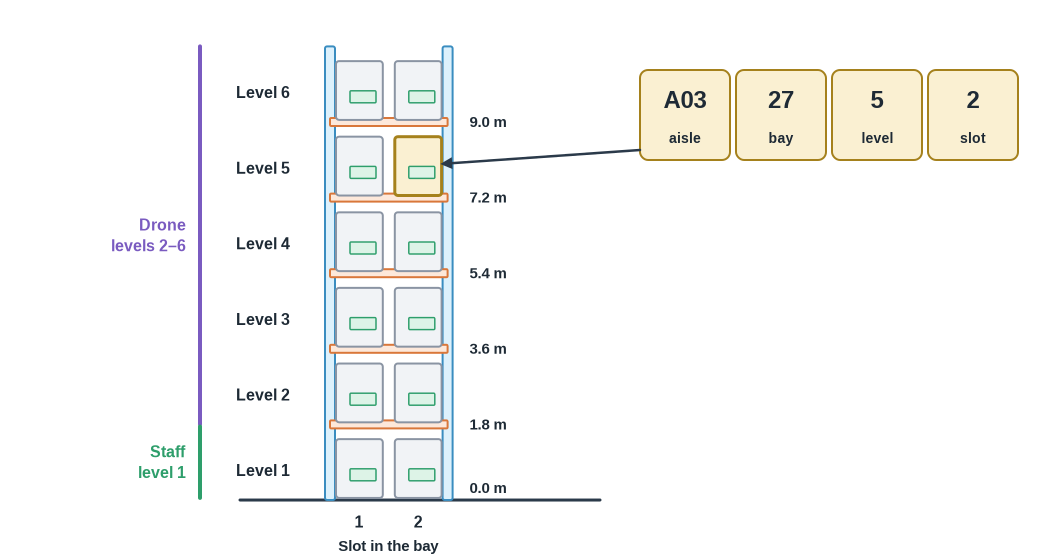
Level 1 is on the floor, and staff can count it easily on foot with handheld scanners. Levels 2 to 6, 3,360 locations, need a lift truck, so they are the drone’s job.
Another key question is what is counted. Each pallet carries a logistic label with an SSCC (serial shipping container code), a unique number for that shipping unit. The GS1 specifications require pallet barcodes to sit between 400 and 800 mm above the pallet base (GS1, 2026). The WMS knows which parts and how many each SSCC holds, so the drone counts at pallet level: it reads which pallet is in which location. If the pallet is still sealed, the unit count follows from the WMS. A pallet that has been opened and partly picked needs a case or unit count, which still takes a person. Separate the two from the start so that nobody expects more than a drone can deliver.
Annual stocktaking and cycle counting
There are two ways to count. An annual stocktake counts every location at once, once a year, and usually stops receiving and shipping for a day or two. Records are accurate the next day and then drift for the rest of the year. Cycle counting counts a portion every day or week until the whole warehouse is covered, then starts again. Errors are found early, causes can be traced while people still remember what happened, and operations keep running. Drones suit cycle counting well because they can fly every night outside working hours.
The measure of how good the records are is inventory record accuracy (IRA):
where is the number of locations counted and the number whose count matches the record within a tolerance. Tolerances usually differ by importance: expensive or critical parts must match exactly, while bolts or washers counted by weight may differ slightly.
Example 1 IRA with per-class tolerances
The team samples 10 locations. Class A must match exactly, class B may differ by up to 2% and class C by up to 5% of the recorded quantity (all values assumed).
# inventory record accuracy (IRA) with a count tolerance per ABC class (all values assumed)
TOL = {"A": 0.00, "B": 0.02, "C": 0.05}          # allowed difference as a fraction of the record
counts = [  # location, class, WMS quantity, counted quantity
    ("A03-27-5-2", "A", 240, 240), ("A03-29-4-1", "A", 120, 118),
    ("A01-12-3-2", "B", 400, 396), ("A02-07-6-1", "B", 60, 57),
    ("A05-33-2-2", "C", 1000, 980), ("A06-18-4-1", "C", 36, 30),
    ("A04-41-3-1", "A", 80, 80), ("A01-02-5-2", "C", 500, 500),
    ("A02-50-2-1", "B", 150, 150), ("A06-09-6-2", "A", 0, 24),
]
hits = 0
for loc, cls, wms, cnt in counts:
    diff = abs(cnt - wms)
    ok = diff == 0 if wms == 0 else diff / wms <= TOL[cls]
    hits += ok
    if not ok:
        print(f"{loc} class {cls}: WMS {wms}, counted {cnt} -> outside tolerance")
print(f"IRA = {hits}/{len(counts)} = {hits / len(counts) * 100:.0f} %")
A03-29-4-1 class A: WMS 120, counted 118 -> outside tolerance
A02-07-6-1 class B: WMS 60, counted 57 -> outside tolerance
A06-18-4-1 class C: WMS 36, counted 30 -> outside tolerance
A06-09-6-2 class A: WMS 0, counted 24 -> outside tolerance
IRA = 6/10 = 60 %Location A01-12-3-2 is 4 short of 400, which is 1% and still within the class B tolerance, while A02-07-6-1 is 3 short of 60, which is 5% and outside it. Note A06-09-6-2: the record says empty but 24 units are there. A percentage cannot be computed when the record is zero, so the code treats this case separately. Stock that has “disappeared” from the system while still sitting in the warehouse is stock the system will reorder for no reason.
The IRA of 60% is low because the team picked problem locations to show every case. A real figure must come from a representative random sample and should be reported with a confidence interval, which module 5 uses.
Prioritising counts with ABC classification
This warehouse holds thousands of part numbers, and counting all of them equally often does not pay. The usual principle is ABC analysis. Bartholdi and Hackman (2019) explain that a small fraction of items usually accounts for most of the activity in a warehouse: class A is the small, most important fraction, class B is moderately important, and class C is the bulk of items with little activity. They also warn that the ranking need not be by sales value; choose the criterion that fits the question. For counting, movement frequency is a sensible choice, because the more often stock is picked, the more chances there are to record it wrongly.
The annual counting workload is , where is the number of locations in class and the number of counts per year.
Example 2 Cycle-count workload for the upper levels
The 3,360 locations on levels 2 to 6 split into 600 class A, 960 class B and 1,800 class C locations. The current policy counts class A monthly, class B quarterly and class C twice a year, on 250 count nights a year. Two staff with a lift truck take 90 seconds per location (assumed values).
# annual cycle-count workload for the upper levels (levels 2 to 6), assumed values
plan = {"A": (600, 12), "B": (960, 4), "C": (1800, 2)}   # class: (locations, counts per year)
nights, sec_per_loc, crew = 250, 90, 2                  # count nights per year, s per location, people
total = 0
for cls, (n, f) in plan.items():
    print(f"class {cls}: {n} locations x {f} = {n * f:,} counts/year")
    total += n * f
locs = sum(n for n, f in plan.values())
print(f"total {total:,} counts/year, {total / nights:.1f} per night")
print(f"manual: {total * sec_per_loc / 3600 * crew:.0f} staff-hours/year")
print(f"weekly drone scan of all {locs:,} upper locations: {locs * 52:,} reads/year "
      f"({locs * 52 / total:.1f} x the manual plan)")
class A: 600 locations x 12 = 7,200 counts/year
class B: 960 locations x 4 = 3,840 counts/year
class C: 1800 locations x 2 = 3,600 counts/year
total 14,640 counts/year, 58.6 per night
manual: 732 staff-hours/year
weekly drone scan of all 3,360 upper locations: 174,720 reads/year (11.9 x the manual plan)The current policy needs about 59 locations a night and 732 staff-hours a year, and class C is checked only twice a year. If drones scan all upper levels every week, the number of checks rises almost twelvefold and every location is checked every seven days whatever its class. Module 4 works out how often it can really be done.
The lesson here is that drones do not simply take over the old job; they change the economics of counting. When reading one location costs very little, ABC ranking shifts from “what to count first” to “which locations a person should recheck first” when the drone’s result disagrees with the record.
Which warehouse processes suit drones?
Wawrla et al. (2019) group warehouse drone uses into inventory management, intralogistics (moving goods inside the warehouse), and inspection and surveillance. A systematic literature review by Malang et al. (2023), a team from Chiang Mai University, found that the factors that most affect drone adoption in warehouses are hardware, such as payload, battery and sensors, and software, such as scheduling, path planning, localization and navigation. These are the subjects of modules 2 to 4.
Processes that suit drones tend to share four traits: they are repetitive, at height or hard to reach, need no handling of goods, and can be done outside working hours. The team scores each process from 1 to 5 on each criterion and combines them into a weighted score , where the weights add up to 1.
Example 3 Ranking processes with weighted scores
The warehouse team scores six processes together (scores and weights assumed).
# which warehouse processes suit a drone? weighted scores 1 to 5 (assumed by the team)
W = {"repetitive": 0.25, "at height": 0.25, "no handling": 0.30, "off-shift": 0.20}
proc = {
    "Cycle count, upper levels":   (5, 5, 5, 5),
    "Rack inspection, high levels": (4, 5, 5, 4),
    "Annual full stocktake":       (2, 5, 4, 2),
    "Inbound check at dock":       (5, 1, 3, 1),
    "Moving parts between zones":  (4, 2, 1, 2),
    "Picking small parts":         (5, 3, 1, 1),
}
score = {p: sum(w * s for w, s in zip(W.values(), v)) for p, v in proc.items()}
for p, sc in sorted(score.items(), key=lambda x: -x[1]):
    print(f"{p:<30} {sc:.2f}")
Cycle count, upper levels 5.00
Rack inspection, high levels 4.55
Annual full stocktake 3.35
Inbound check at dock 2.60
Picking small parts 2.50
Moving parts between zones 2.20Upper-level cycle counting scores full marks, followed by high-level rack inspection; the HSE warehouse safety guide notes that the upper levels of high-bay installations cannot be seen from the ground (Health and Safety Executive, 2007), so a drone genuinely helps. Picking and moving parts score low because they involve handling goods, which forklifts and ground robots do far better.
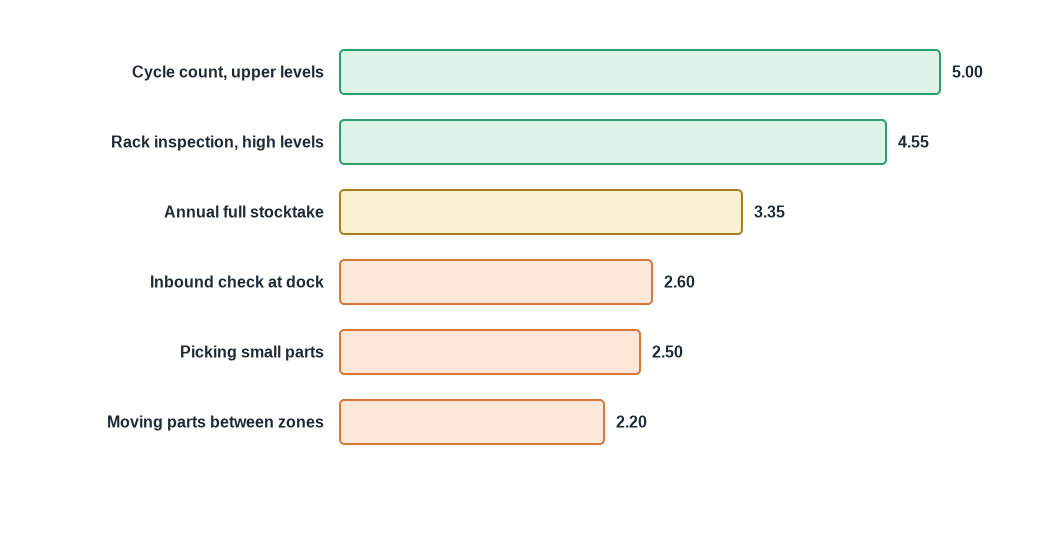
Scores like these are not the final answer, but they force the team to state its reasons and agree where to start. Have the people who do the work, such as the warehouse supervisor and the counters, take part in scoring, and try different weights to see whether the ranking holds.
The drone counting mission at a glance
One night of drone counting is a chain, and each module of this course covers one link.
- The WMS creates count tasks listing tonight’s locations (module 5)
- Plan routes and sorties to cover every location within the time and energy available, and lock aisles against people and forklifts (module 4)
- Fly and read barcodes or tags, recording images (module 2)
- Localize each read to its rack position and inspect the stock (module 3)
- Reconcile with the WMS, send recount tasks to staff when results disagree, and evaluate mission safety and efficiency (module 5)
Indoors there is no GNSS signal, so the drone must find its position another way, for example with UWB, visual markers, or a camera combined with inertial sensors. Indoor navigation and flight control are taught in UAT 458; this course uses their results at application level, such as the position error that must be allowed for.
Module lab
Lab: survey processes and plan the counts
- Study a real or mock warehouse (for example a university store room). Draw the rack layout with aisles, bays and levels, and define a storage location code format
- Extend Example 1 to read count results for at least 30 locations from a CSV file and compute IRA per class A, B, C and overall
- Use Example 2 to compare at least three counting-frequency policies and tabulate the workload per year and per night
- Interview or role-play a warehouse supervisor, score processes with the method of Example 3, then try two other sets of weights and report whether the ranking changes
Common mistakes
Watch out
- Expecting drones to count units, when they read pallet labels; opened pallets still need a person
- Computing IRA without tolerances, or with the same tolerance for every class
- Applying a percentage to locations recorded as empty, so the program divides by zero or misses stock that has vanished from the system
- Reporting IRA from hand-picked locations instead of a representative random sample
- Choosing a process because it looks modern without asking whether it needs handling or can be done off-shift
Summary
- The WMS tracks which pallet is in which location through storage location codes; drones count at pallet level by reading SSCC labels, while unit counts still need people
- Cycle counting suits drones better than annual stocktaking; measure it with against per-class tolerances
- ABC classification sets counting frequency; the annual workload is , and drones allow far more frequent counts
- Processes that are repetitive, at height, handling-free and possible off-shift suit drones best; rank them with
Check your understanding
- 250 locations are counted and 235 are within tolerance. What is the IRA?
- A class B location records 150 units and 146 are counted. Is it within the ±2% tolerance?
- Class A has 500 locations counted 12 times a year, class B 800 locations 4 times, class C 1,500 locations once. What is the workload per year and per night (250 nights)?
- Why does cycle counting suit drones better than an annual stocktake?
- With criterion weights 0.25, 0.25, 0.30, 0.20, a process scores 4, 4, 2, 5. What is its weighted score?
Answers
- , above 2%, so it is outside the tolerance
- counts a year, or locations a night
- Cycle counting covers a portion every night without stopping operations, and drones can fly outside working hours routinely, so errors are found early and records stay accurate all year; an annual stocktake counts everything at once and halts receiving and shipping
Key formulas
| Inventory record accuracy | |
| Annual counting workload | |
| Weighted score |
Key references
- Wawrla, L., Maghazei, O., & Netland, T. (2019). Applications of drones in warehouse operations (White paper). ETH Zurich, D-MTEC, Chair of Production and Operations Management. link
- Malang, C., Charoenkwan, P., & Wudhikarn, R. (2023). Implementation and critical factors of unmanned aerial vehicle (UAV) in warehouse management: A systematic literature review. Drones, 7(2), 80. link
- DeHoratius, N., & Raman, A. (2008). Inventory record inaccuracy: An empirical analysis. Management Science, 54(4), 627–641. link
- Bartholdi, J. J., III, & Hackman, S. T. (2019). Warehouse & distribution science (Release 0.98.1). The Supply Chain & Logistics Institute, Georgia Institute of Technology. link
- GS1. (2026). GS1 general specifications (Release 26.0). link
- Health and Safety Executive. (2007). Warehousing and storage: A guide to health and safety (HSG76, 2nd ed.). HSE Books. link
Further reading
Study the assigned knowledge units in advance, review media and take the module quiz
In class / field
Lab or field practice from worksheets with a safety checklist
Learning evidence: Checked worksheets and quiz results