Multi-UAV architectures and inter-vehicle communication
UAT 461 Autonomous Navigation and Multi-UAV Systems
Lesson
By the end of this module you will be able to
- Distinguish centralised, decentralised and hybrid architectures, and say which functions of a multi-UAV system belong at the centre and which on the aircraft
- Calculate the data load of a drone team under star, broadcast and flooding structures
- Make a link budget to estimate the range of each radio in a cluttered yard
- Calculate the worst data age of a time-division link and convert it into the distance a drone travels without knowing its neighbours' state
- Find single points of failure in a network by simulating node failures
Why this matters
One good drone does not make a team of 12 good. Most problems of multi-UAV systems are not in the aircraft but in how information flows between them: who decides, how old the data used for the decision are, and whether the team can keep working when one communication path fails. This module lays the groundwork for two things that every later module relies on: the architecture (where each function runs) and the inter-vehicle communication (what is sent, over what, and how late).
The second part of the course (modules 6–10) uses one fictional case through all of its modules: a university engineering team helps a container-terminal company on the eastern seaboard (fictional) design a team of 12 inspection drones that work as one team. The container yard is 1,200 m long and 600 m wide. The team inspects the refrigeration units of temperature-controlled containers (reefers) with thermal cameras. The yard is divided into container blocks, 12 blocks per round. The drones leave from 12 docks on the gate line (x = 0), 50 m apart. The control station is in a building at (−400, 100) m. Tall steel stacks block and reflect radio signals, and a round must finish within about 450 s. All numbers, places and companies are invented, and all figures are fictional. The Python code can be downloaded from /downloads/uat-461/.
Real flights by a team like this need authorisation under the CAAT notification in force and under the port’s own conditions (see the CAAT notification of B.E. 2569 and the BVLOS guidance in UAT 401 and UAT 402). This lesson does not claim that one pilot may control several aircraft. The lab of this module is therefore desk work and radio measurements on the ground only.
What a multi-UAV system is, and three architectures
A multi-UAV system is two or more unmanned aircraft that carry out one mission and exchange information. It differs from “several drones flying at once”, where each does its own job without knowing what the others do. A swarm is a special case. The review of swarm robotics by Brambilla et al. (2013) uses criteria such as large numbers, limited ability of each member, and local sensing and communication without a central controller. The survey of aerial swarms by Chung et al. (2018) shows that real systems range from small teams with a centre to swarms with no centre at all. Our 12-drone team has a control station, so it is a “multi-UAV team” more than a “swarm” in the strict sense, but the ideas and tools of this course apply to both.
Architecture answers the question who knows what and who decides what. There are three main types.
- Centralised. Every drone sends its state up to the station, the station computes the plan and sends commands down to every drone. This gives the best overall picture and the best plan, and it is easy to audit. But the station and its link are a single point of failure, a long slow link makes the data at the station old, and every drone needs a link to the station.
- Decentralised (or distributed). Each drone decides from its own data and what it hears from its neighbours. No node is essential to the whole team, so it tolerates link failures and scales to more aircraft. But the overall result may not be optimal, safety is harder to prove, and the data load between aircraft grows with team size.
- Hybrid (or hierarchical). The team is split into small groups. Inside a group the drones talk over short-range radio, and group leaders talk to the station or to other leaders over long-range radio. Real systems use this most often, because it lets you choose the level for each function.
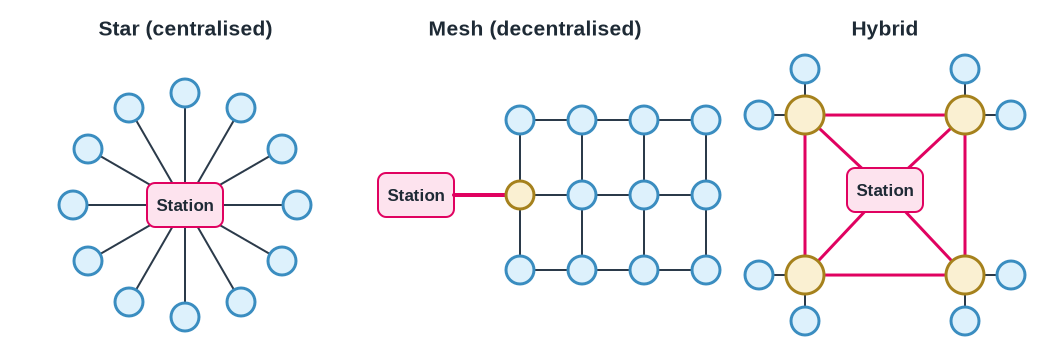
The choice is not right or wrong. It is a matter of placing each function. A rule that works well is to put each decision close to data that are still fresh enough, and keep on the aircraft anything that does harm when late. The table is the team’s proposal for the case. The reasons will become clear once data age is calculated in Example 3.
| Function | Where it runs | Reason |
|---|---|---|
| Mission planning and block allocation (module 7) | Station, repeated when a drone fails | Needs the whole picture; seconds of thinking time are available |
| Holding the formation (module 8) | On the aircraft, using neighbour data | The control loop must be fast and survive link loss |
| Avoiding other team members (module 9) | On the aircraft, own sensors plus neighbour data | Does the most harm when late; must not wait for the station |
| Fleet-state monitoring (module 9) | Station | Needs to see the whole team; second-level delay is acceptable |
| Land or return when the link is lost | On the aircraft, by rules set in advance | Must work when nobody is giving orders |
What to send, and the network to send it over
The team has to exchange three kinds of information: state (position, velocity, attitude, battery and GNSS status, with a timestamp), intent (the block being flown to, the next path) and commands (from the station down to a drone). The MAVLink position message is GLOBAL_POSITION_INT, which has a 28-byte payload (MAVLink Development Team, n.d.-a). A MAVLink 2 message has a 10-byte header, the payload and a 2-byte checksum, and if message signing for authentication is switched on, 13 more bytes (MAVLink Development Team, n.d.-b, n.d.-c). The real size can be smaller because MAVLink 2 truncates trailing zero bytes of the payload, so this lesson uses the full size as a safety allowance.
A decentralised network must decide how one drone’s message reaches the others. If every drone is within radio range of every other, a broadcast reaches all in one hop. If not, messages must be relayed through intermediate drones. Two families of routing are standardised as RFCs: AODV, which finds a route when it is needed (Perkins et al., 2003), and OLSR, which exchanges link-state information periodically so that routing tables are ready (Clausen & Jacquet, 2003). Bekmezci et al. (2013) point out that networks of aircraft (FANETs) differ from ordinary mobile networks in that nodes move fast and the topology changes often, which makes route selection hard. For a team in a yard where the drone positions are known in advance, the simpler and more predictable way is to fix the relay paths according to a hybrid structure.
When messages must pass over several hops, or many drones share one channel, capacity per node falls quickly with network size. Li et al. (2001) studied by simulation and analysis how the capacity of ad hoc networks can be surprisingly low because nodes must forward each other’s packets. Example 1 turns this into numbers.
Data load: star, broadcast and flooding
A star uses n messages up and n messages down per round. A one-hop broadcast uses n messages per round because everyone hears at once. Flooding, where every node repeats every message once, uses about n² messages per round.
Example 1 Load of the three methods as the team grows
Each drone sends its state at 5 Hz in a MAVLink 2 message with a 28-byte payload. The shared channel of the mesh radio gives 1 Mbit/s of usable capacity (assumed, MAC overhead excluded). Calculate the load for teams of 12, 50 and 200 drones.
# bytes of one unsigned MAVLink 2 message: 10 header + payload + 2 checksum (signing adds 13)
HDR, CRC, SIG = 10, 2, 13
PAYLOAD = 28                        # GLOBAL_POSITION_INT payload bytes
RATE = 5                            # Hz, state message rate per drone
CHANNEL = 1_000_000                 # usable shared mesh capacity, bit/s (assumed)

def bits(signed=False):
    return (HDR + PAYLOAD + CRC + (SIG if signed else 0)) * 8

print("bits per message:", bits(), "unsigned,", bits(True), "signed")
print(" n   star(kbit/s)  broadcast  flooding   flooding/channel")
for n in (12, 50, 200):
    star = 2 * n * RATE * bits()    # n state uplinks plus n command downlinks
    bcast = n * RATE * bits()       # every drone transmits once, all hear it (one hop)
    flood = n * n * RATE * bits()   # every message repeated once by each other node
    print(f"{n:3d} {star/1000:12.1f} {bcast/1000:10.1f} {flood/1000:9.1f} {100*flood/CHANNEL:12.0f} %")
bits per message: 320 unsigned, 424 signed
n star(kbit/s) broadcast flooding flooding/channel
12 38.4 19.2 230.4 23 %
50 160.0 80.0 4000.0 400 %
200 640.0 320.0 64000.0 6400 %At 12 drones flooding uses 230.4 kbit/s, or 23% of the channel, which is still acceptable. At 50 drones it needs 4,000 kbit/s, or 400%, four times the capacity, and at 200 drones 6,400%, because the load grows as n² while the star and the broadcast grow only as n. The point where flooding fills the channel exactly is , so n = 25 drones. Message signing makes a message grow from 320 to 424 bits (up 32.5%), which lowers that limit to about 22 drones. The team therefore chooses one-hop broadcast inside small groups and lets only the group leaders forward messages outward.
Link budget: which radio reaches how far
A link budget says that the signal at the receiver must not fall below the receiver’s sensitivity. The allowed loss is the transmit power plus the antenna gains at both ends, minus the receiver sensitivity, minus a margin for fading, . The real loss at distance follows the log-distance model , where is the free-space loss at 1 m and is the path-loss exponent, which is 2 in free space and larger in cluttered surroundings. A yard full of steel stacks gives a high and a large margin.
The sensitivity of LoRa at 125 kHz bandwidth, from the datasheet of the RFM95 module, is −123 dBm at SF7 and −129 dBm at SF9 (HopeRF, n.d.). A higher SF is more sensitive but slower. The 920 MHz frequency in the example is for calculation only. The bands usable on drones must be checked against the NBTC notification in force (Office of the NBTC, n.d.); the April 2026 draft notifications that mention 920–925 MHz were open for public comment until 3 July 2026 and are not confirmed to be in force (Tortermvasana, 2026).
Example 2 2.4 GHz mesh radio versus LoRa in the container yard
Both radios transmit 20 dBm with 2 dBi antennas at both ends. The mesh radio has −90 dBm sensitivity (assumed). Use n = 2.7 and a 15 dB margin (assumed). Find the range and the received power at 100, 300 and 1,000 m.
import math

def fspl_db(d_m, f_mhz):
    # free-space loss, d in metres, f in MHz: 20log10(d_km) + 20log10(f_MHz) + 32.44
    return 20 * math.log10(d_m / 1000) + 20 * math.log10(f_mhz) + 32.44

def path_loss_db(d_m, f_mhz, n):
    # log-distance model referenced to the free-space loss at 1 m
    return fspl_db(1.0, f_mhz) + 10 * n * math.log10(d_m)

radios = {                          # all values assumed except the LoRa sensitivities (datasheet, 125 kHz)
    "2.4 GHz mesh": dict(f=2400, pt=20, g=2, sens=-90),
    "LoRa SF7":     dict(f=920,  pt=20, g=2, sens=-123),
    "LoRa SF9":     dict(f=920,  pt=20, g=2, sens=-129),
}
FADE = 15                           # dB margin for multipath and steel stacks (assumed)
N_EXP = 2.7                         # path-loss exponent over the yard (assumed)
for name, r in radios.items():
    budget = r["pt"] + 2 * r["g"] - r["sens"] - FADE      # allowed path loss in dB
    d_max = 10 ** ((budget - fspl_db(1.0, r["f"])) / (10 * N_EXP))
    row = ", ".join(f"{d} m: {r['pt'] + 2*r['g'] - path_loss_db(d, r['f'], N_EXP):6.1f}" for d in (100, 300, 1000))
    print(f"{name:13s} allowed loss {budget:5.1f} dB, range {d_max:6.0f} m | rx dBm at {row}")
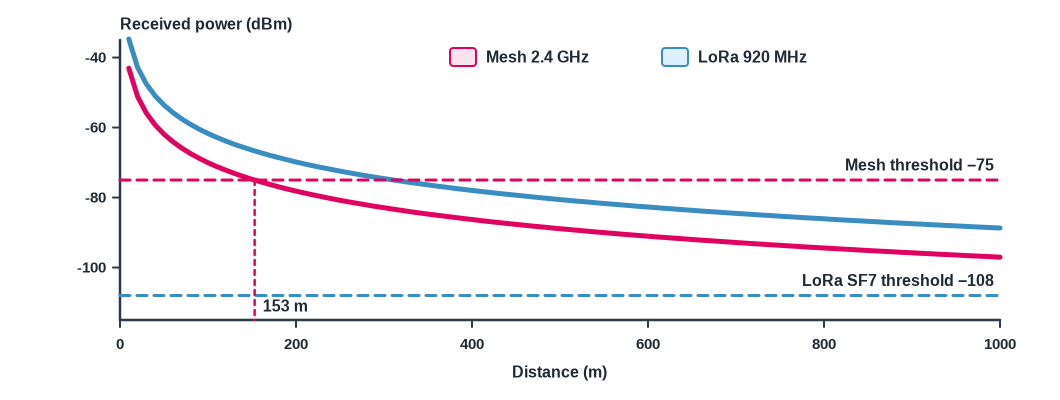
2.4 GHz mesh allowed loss 99.0 dB, range 153 m | rx dBm at 100 m: -70.0, 300 m: -82.9, 1000 m: -97.0
LoRa SF7 allowed loss 132.0 dB, range 5179 m | rx dBm at 100 m: -61.7, 300 m: -74.6, 1000 m: -88.7
LoRa SF9 allowed loss 138.0 dB, range 8639 m | rx dBm at 100 m: -61.7, 300 m: -74.6, 1000 m: -88.7The 2.4 GHz mesh radio can lose 99 dB and reaches only 153 m. LoRa SF7 can lose 132 dB and reaches 5,179 m, and SF9 can lose 138 dB and reaches 8,639 m. In a yard 1,200 m long, with the station another 400 m away, the LoRa link reaches the station from every point with a large margin: at 1,000 m the received power is −88.7 dBm, 34 dB above the SF7 sensitivity and more than the 15 dB margin already set. The mesh radio cannot cross the yard in one hop. It needs about 8 hops, or it is used only within groups no more than 150 m apart. These results are estimates from a model and must be measured in the yard (see the lab).
Time on air and data age
LoRa goes far but sends slowly. A 40-byte message (10 header, 28 payload, 2 checksum) takes a time on air given by the datasheet formulas: symbol time , preamble , and a payload of symbols for the explicit header with CRC on (HopeRF, n.d.). When 12 drones share one channel in turns, called TDMA (time is divided into slots, one per drone), the frame lasts and the oldest latest-data from a neighbour is , because a drone may have sent just after its slot ended, a whole frame earlier.
Data age matters because drones do not stop and wait. If data are seconds old and a neighbour flies at speed , the neighbour’s true position is off by .
Example 3 A 12-drone team on one LoRa channel with TDMA
A 40-byte status message, a 20 ms guard time per slot (assumed), drones flying at 10 m/s. Find the time on air, the frame length, the worst data age and the distance the drone travels in that time, for SF7 to SF10 at 125 kHz.
import math

def lora_airtime(payload_bytes, sf, bw=125_000, cr=1, preamble=8):
    # explicit header, CRC on, no low-data-rate optimisation (valid for SF7 to SF10 at 125 kHz)
    t_sym = 2 ** sf / bw
    n_pay = 8 + math.ceil((8 * payload_bytes - 4 * sf + 44) / (4 * sf)) * (cr + 4)
    return (preamble + 4.25) * t_sym + n_pay * t_sym

PKT = 10 + 28 + 2                   # one state message, bytes
GUARD = 0.020                       # s guard time per TDMA slot (assumed)
V = 10.0                            # m/s drone speed
print("SF   airtime(ms)  slot(ms)  frame(s)  worst age(s)  drift(m)  drift with 1 lost frame(m)")
for sf in (7, 8, 9, 10):
    t_air = lora_airtime(PKT, sf)
    slot = t_air + GUARD
    frame = 12 * slot               # 12 drones share one channel in turn
    age = frame + t_air             # newest data is at most one frame plus airtime old
    print(f"{sf:2d} {1000*t_air:12.1f} {1000*slot:9.1f} {frame:9.2f} {age:12.2f} {V*age:9.1f} {V*(age+frame):17.1f}")
SF airtime(ms) slot(ms) frame(s) worst age(s) drift(m) drift with 1 lost frame(m)
7 82.2 102.2 1.23 1.31 13.1 25.3
8 154.1 174.1 2.09 2.24 22.4 43.3
9 287.7 307.7 3.69 3.98 39.8 76.7
10 534.5 554.5 6.65 7.19 71.9 138.4At SF7 a message takes 82.2 ms, the frame is 1.23 s, the worst data age is 1.31 s, and a drone moves 13.1 m in that time. If one whole frame is lost it is 25.3 m. At SF9 the worst age is 3.98 s or 39.8 m, and at SF10 it is 7.19 s or 71.9 m. The link in Example 2 already has a large margin at SF7, so raising the SF costs data age and buys nothing. Use the lowest SF at which the link is still adequate. The 1.31 s figure is used again in module 8 (the limit on gain when there is delay) and module 9 (the separation needed).
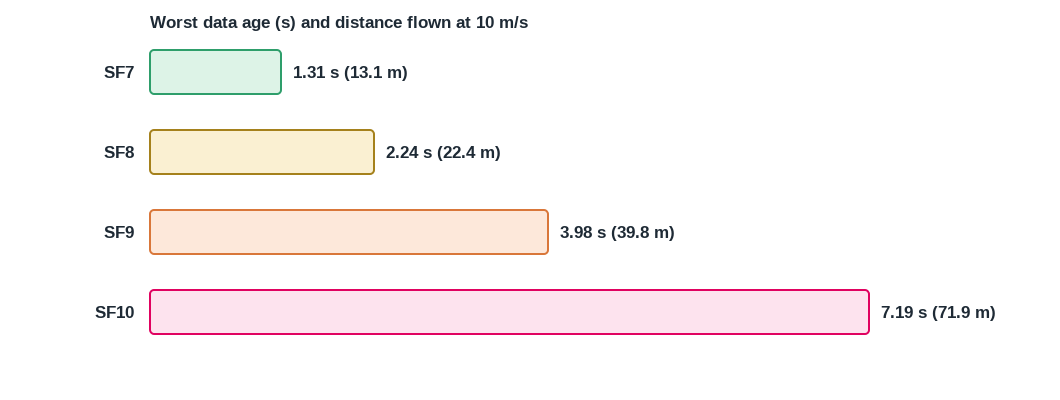
The architectural conclusion is that a single LoRa channel suits status reports and mission-level commands (second-level delay is acceptable) but is not suitable as the only channel for avoiding other team members, which needs a faster short-range radio or the aircraft’s own sensors (module 9).
Network resilience
A good network has no element whose loss breaks the team. This can be tested by simulation: remove the nodes one at a time and count how many drones lose their connection to the station, then remove the station and see whether the drones still hold together. Avizienis et al. (2004) distinguish a fault, which causes an error, which may become a failure of the system. Designing so that a fault in one node does not become a failure of the whole team is what makes the system fault tolerant.
Example 4 Four structures for a 12-drone team
Twelve drones are spread over a 4 × 3 grid 100 m apart, and the station is 400 m to the left (assumed). Compare (1) a star: every drone talks to the station on a long-range radio; (2) a mesh: short-range radio, 150 m, between drones (the value from Example 2), and one gateway drone talks to the station; (3) a hybrid: in each column of 3, the drones talk to their leader on short-range radio, and the 4 leaders talk to each other and to the station on long-range radio; (4) a hybrid with deputies: like (3), but each column has a second leader that also connects to the station.
import numpy as np
from scipy.sparse.csgraph import connected_components

xs, ys = np.meshgrid([0, 100, 200, 300], [0, 100, 200])        # 12 drones on a 100 m grid
pos = np.column_stack([xs.ravel(), ys.ravel()]).astype(float)
pos = np.vstack([pos, [[-400.0, 100.0]]])                       # node 12 is the ground station
GCS, N = 12, 13
D = np.linalg.norm(pos[:, None] - pos[None], axis=2)
cols = [[i for i in range(12) if pos[i, 0] == 100 * c] for c in range(4)]
heads = [c[1] for c in cols]                                    # middle drone of each column
deputies = [c[0] for c in cols]                                 # bottom drone of each column

def adjacency(kind):
    A = np.zeros((N, N), bool)
    if kind == "star":              # long-range radio: every drone talks to the station
        A[GCS, :12] = True
    elif kind == "mesh":            # short-range radio, 150 m, drone to drone; one gateway drone
        A[:12, :12] = (D[:12, :12] < 150) & (D[:12, :12] > 0)
        A[GCS, 3] = True
    else:                           # hybrid: short range inside a column, long range between leaders
        for k, c in enumerate(cols):
            leaders = [heads[k]] + ([deputies[k]] if kind == "hybrid+deputy" else [])
            for i in c:
                for h in leaders:
                    A[i, h] = i != h
        backbone = heads + (deputies if kind == "hybrid+deputy" else [])
        for a in backbone:
            A[GCS, a] = True
            for b in backbone:
                A[a, b] = a != b
    return A | A.T

def components(A, dead):
    keep = [i for i in range(N) if i != dead]
    _, lab = connected_components(A[np.ix_(keep, keep)], directed=False)
    return keep, lab

print("topology        links  cut off by worst drone failure  largest group if station fails")
for kind in ("star", "mesh", "hybrid", "hybrid+deputy"):
    A = adjacency(kind)
    cut = 0
    for dead in range(12):
        keep, lab = components(A, dead)
        g = lab[keep.index(GCS)]
        cut = max(cut, sum(1 for k, i in enumerate(keep) if i < 12 and lab[k] != g))
    keep, lab = components(A, GCS)
    group = np.bincount(lab).max()
    print(f"{kind:14s} {int(A.sum() / 2):5d} {cut:30d} {group:30d}")
topology links cut off by worst drone failure largest group if station fails
star 12 0 1
mesh 30 11 12
hybrid 18 2 12
hybrid+deputy 44 0 12The star never cuts any drone off (0), but if the station fails each drone is alone and none knows the others (largest group 1). The mesh holds together well (largest group 12 when the station fails), but the single gateway is a single point of failure: if it is lost, 11 drones are cut off from the station. The hybrid uses only 18 links, and losing one leader cuts off the other 2 drones in its column. The hybrid with deputies uses 44 links but no single drone cuts anyone off, and when the station fails the drones still form one group of 12. The price of resilience is more links and more data load (Example 1).
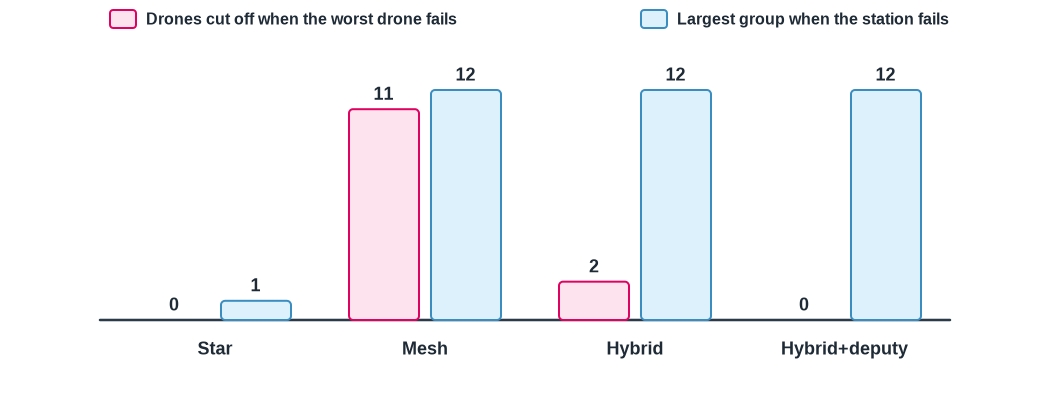
This leads to the team’s design: a hybrid with deputies, with LoRa as the backbone for status reports, short-range radio inside groups for data that must be fast, and rules fixed in advance for what every drone does if contact with the station is lost for longer than a threshold (modules 9 and 10).
Module lab
Lab: link budget and time budget of a drone team
Desk work and ground radio measurements; no drone is flown.
- Choose two radios the department has (for example a 2.4 GHz mesh module and a LoRa module). Record frequency, transmit power, receiver sensitivity and bit rate from the manufacturer’s datasheet, and check that the equipment is permitted to use that band.
- Calculate the allowed loss and the range with the code of Example 2 using the values of these two radios. Try margins of 10, 15 and 20 dB.
- Carry a radio across an open area of the campus at 25, 50, 100, 150 and 200 m from a second, fixed radio. Record at least 20 RSSI readings at each distance and take the median. Plot them against the model and find the exponent from the slope.
- Calculate the TDMA frame and the worst data age of a 12-drone team at your chosen SF with the code of Example 3. Choose one architecture for the team and justify it with your own numbers.
- Hand in: the link-budget table, the plot of RSSI against the model, the measured , and a one-page architecture conclusion.
Common mistakes
Watch out
- Choosing centralised or decentralised by taste. Choose by how much delay each function can tolerate.
- Computing the load of a small team and scaling it linearly. Flooding grows as n². A team that works at 12 drones may not work at 30.
- Using free-space range in a yard of steel stacks. Use a measured path-loss exponent and margin.
- Raising the SF until the link is “very good” without looking at data age. Old data cost metres of drone movement.
- Having one gateway or leader with no deputy. A single point of failure breaks the team.
- Forgetting protocol overhead. Signatures, headers, retransmissions and collisions make the real capacity lower than the datasheet figure.
Summary
- Architecture is the placement of each function at the centre or on the aircraft; a function that does harm when late must be on the aircraft.
- The flooding load grows as , which limits team size, while the star and the broadcast grow as .
- A link budget gives an approximate range for each radio; the path-loss exponent must be measured in the real yard.
- Time division makes the data age grow with team size and SF, and data age converts to distance flown.
- A good network has no single point of failure, which can be tested by removing nodes one by one in a model.
Self-check questions
- A team of 30 drones sends status at 5 Hz in 320-bit messages using flooding. What is the total load, and does it exceed a 1 Mbit/s channel?
- A radio has 14 dBm transmit power, 2 dBi antennas at both ends, −120 dBm sensitivity, a 12 dB margin, 920 MHz and exponent 2.5. What are the allowed loss and the range?
- Use LoRa SF8 with the 12-drone team of Example 3, with drones flying at 8 m/s. By how many metres does the worst data age make a neighbour’s position wrong?
- Why should a mesh with a single gateway not be the only path to the station? What number does Example 4 give?
- By what percentage does switching on MAVLink signing enlarge a message, and how does it affect flooding?
Answers
- bit/s = 1,440 kbit/s, about 44% over the 1 Mbit/s channel.
- dB and m (31.7 dB is the loss at 1 m at 920 MHz).
- The worst age at SF8 is 2.24 s, giving m.
- If the gateway fails or is blocked, the other 11 drones are cut off from the station. A deputy gateway or another long-range path is needed.
- From 40 bytes to 53 bytes, an increase of . The flooding load rises by the same 32.5%, so the team that can be carried shrinks from 25 to about 22 drones.
Key formulas
| Flooding channel load | |
| Log-distance path loss | |
| Allowed path loss | |
| Worst TDMA data age |
Key references
- Chung, S.-J., Paranjape, A. A., Dames, P., Shen, S., & Kumar, V. (2018). A survey on aerial swarm robotics. IEEE Transactions on Robotics, 34(4), 837–855. link
- Brambilla, M., Ferrante, E., Birattari, M., & Dorigo, M. (2013). Swarm robotics: A review from the swarm engineering perspective. Swarm Intelligence, 7(1), 1–41. link
- Bekmezci, İ., Sahingoz, O. K., & Temel, Ş. (2013). Flying ad-hoc networks (FANETs): A survey. Ad Hoc Networks, 11(3), 1254–1270. link
- Li, J., Blake, C., De Couto, D. S. J., Lee, H. I., & Morris, R. (2001). Capacity of ad hoc wireless networks. In Proceedings of the 7th Annual International Conference on Mobile Computing and Networking (MobiCom '01). ACM. link
- Avizienis, A., Laprie, J.-C., Randell, B., & Landwehr, C. (2004). Basic concepts and taxonomy of dependable and secure computing. IEEE Transactions on Dependable and Secure Computing, 1(1), 11–33. link
- Perkins, C., Belding-Royer, E., & Das, S. (2003). Ad hoc on-demand distance vector (AODV) routing (RFC 3561). Internet Engineering Task Force. link
- Clausen, T., & Jacquet, P. (Eds.). (2003). Optimized link state routing protocol (OLSR) (RFC 3626). Internet Engineering Task Force. link
- MAVLink Development Team. Packet serialization. MAVLink developer guide. link
- MAVLink Development Team. MAVLink common message set (common.xml). link
- MAVLink Development Team. Message signing (authentication). MAVLink developer guide. link
- HopeRF. (n.d.). RFM95/96/97/98(W) low power long range transceiver module [Datasheet, section 4.1.1.7 Time on air and Table 56 LoRa sensitivity; copy hosted by SparkFun]. link
- สำนักงาน กสทช. ประกาศและแนวปฏิบัติการขึ้นทะเบียนเครื่องวิทยุคมนาคมสำหรับอากาศยานไร้คนขับ (ตรวจสอบฉบับปัจจุบันก่อนใช้สอน). link
- สำนักงานการบินพลเรือนแห่งประเทศไทย. (2569). ประกาศ กพท. เรื่อง หลักเกณฑ์และวิธีการในการอนุญาตให้ผู้บังคับหรือปล่อยอากาศยานซึ่งไม่มีนักบิน ประเภทอากาศยานที่ควบคุมการบินจากภายนอก ที่มีน้ำหนักไม่เกิน 25 กิโลกรัม ปฏิบัติแตกต่างไปจากเงื่อนไขที่กำหนด พ.ศ. 2569 (มีผล 17 พฤษภาคม 2569). link
- Tortermvasana, K. (2026, June 11). Public feedback sought on new Thai drone rules. Bangkok Post. link
Further reading
Study the assigned knowledge units in advance, review media and take the module quiz
Deep dive: coordinating drone swarms over LoRa mesh networks
การออกแบบ C2 link และ lost-link
พื้นฐานคลื่นวิทยุและ link budget
In class / field
Lab or field practice from worksheets with a safety checklist
Learning evidence: Checked worksheets and quiz results