Deep dive: coordinating drone swarms over LoRa mesh networks
An in-depth look at drone swarm coordination over LoRa mesh networks: the limits of Wi-Fi mesh, a hybrid LoRa + IEEE 802.11s architecture, an emergency monitoring system using LoRaWAN/GNSS, and network security
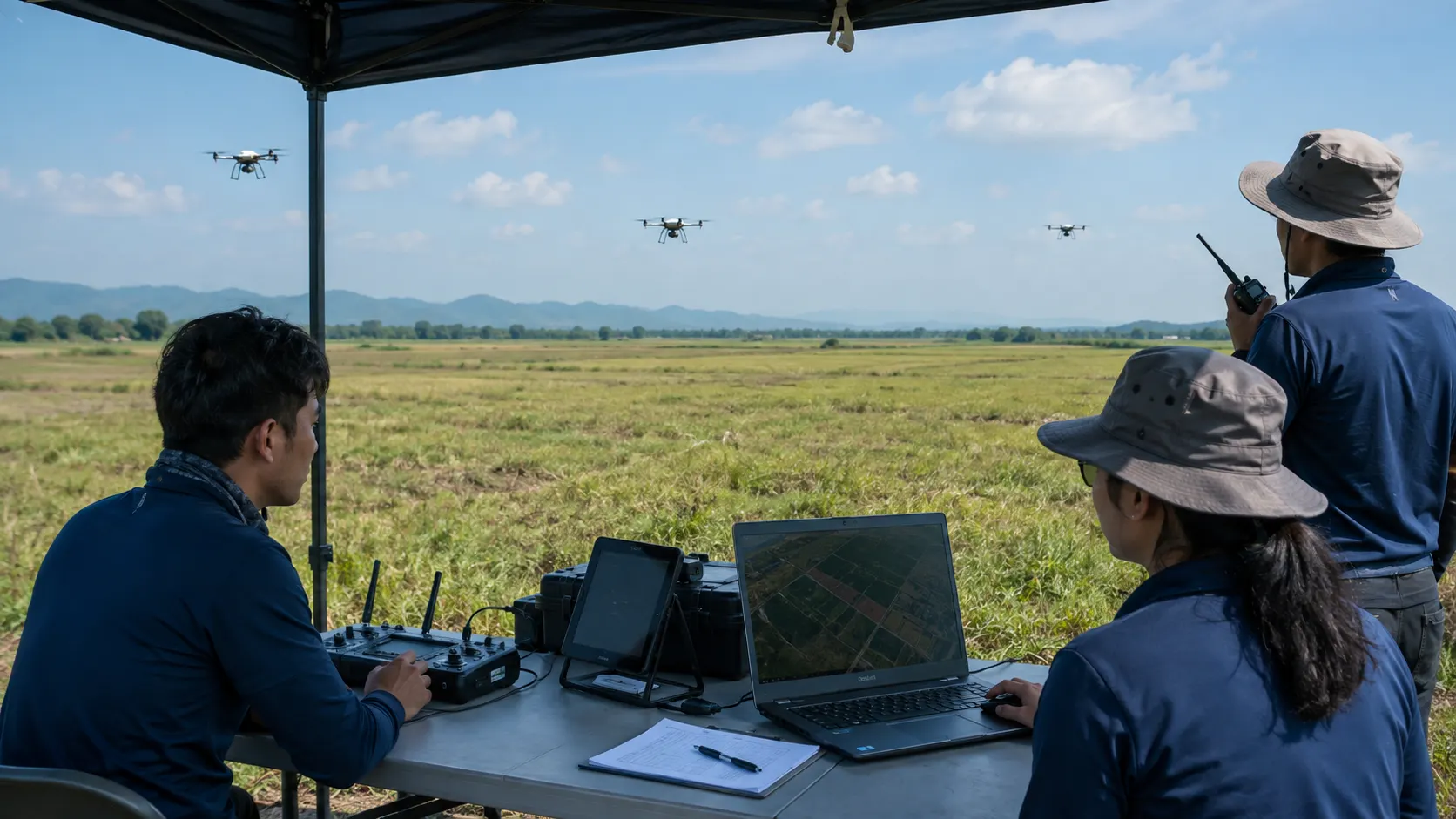
This document expands on the topics of “autonomous control” and “Data Link” from the earlier drone technology landscape document, focusing specifically on where the two meet: coordinating a swarm of many drones (swarm drone) to work together, using LoRa as the main communication network that links each drone. This approach is attracting growing interest in research and in real field work, because drone swarms that must operate over wide areas or Beyond Visual Line-of-Sight can no longer rely on short-range Wi-Fi communication. The content draws on additional research from academic studies, open-source projects on GitHub and related technical documents.
1. Principles of Swarm Coordination
To study light shows whose positions and timing are planned in advance, read Drone Show Fundamentals and Swarm Trajectory Generation together, so as to separate show design from the communication and decision-making of the swarm.
Before discussing communication networks, it is necessary to understand that drone swarms are designed to coordinate according to two main concepts, which directly affect the choice of communication technology.
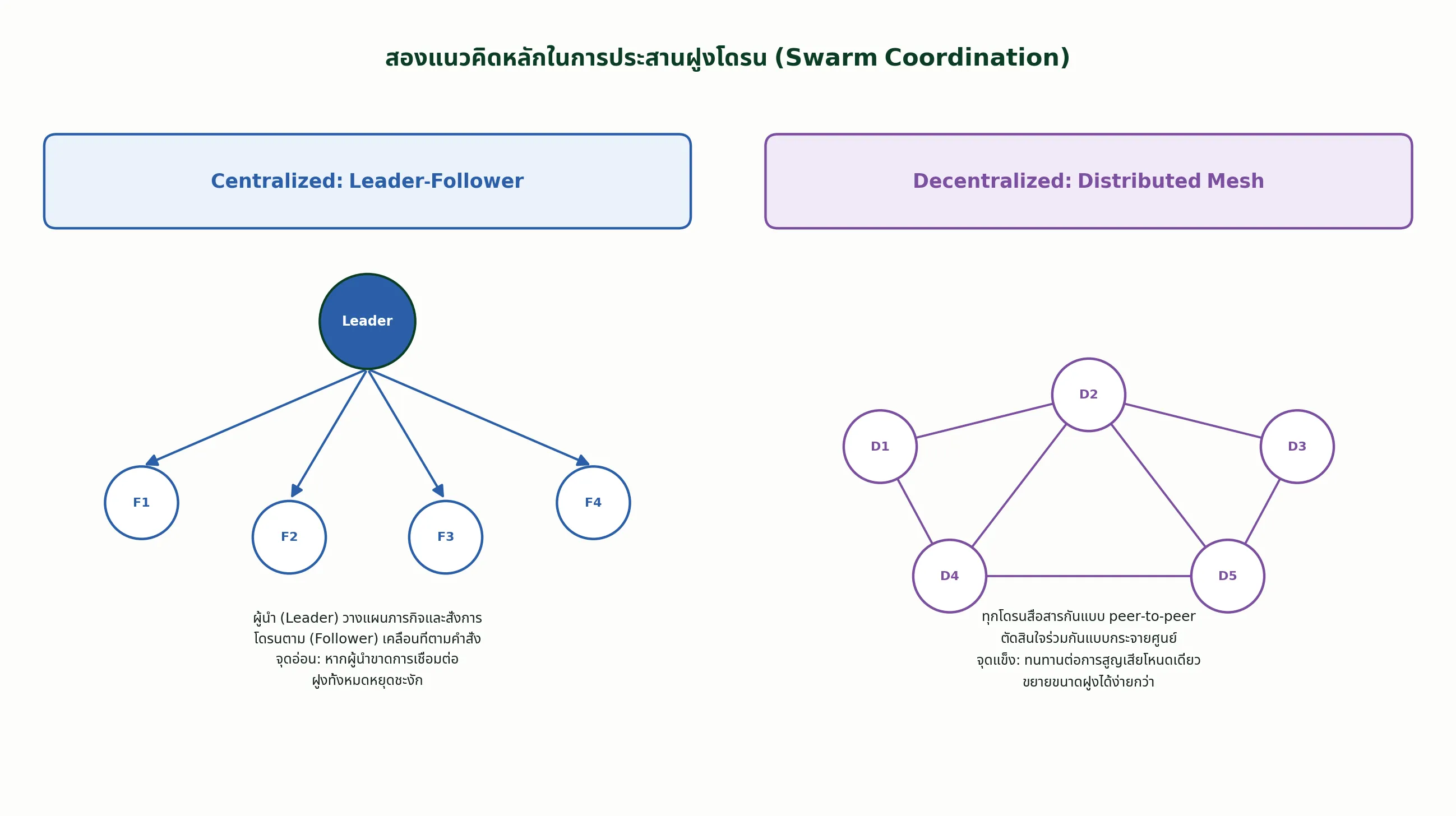
The first concept is Centralized (Leader-Follower) , in which one leader drone plans the mission and commands the follower drones to move in coordination. Its advantages are that it is easy to control and the swarm's behaviour is clearly predictable, but its key weakness is that if the leader drone loses its connection or is destroyed, the whole swarm may stall or lose direction. The second concept is Decentralized (Distributed Mesh) , in which every drone communicates peer-to-peer and decisions are made collectively in a decentralized way. There is no single point of failure, so the swarm tolerates the loss of any one node and is easier to scale up.
In practice, the tools and frameworks used to develop drone swarms are diverse, ranging from ROS 2, the standard robotics framework, and specialized communication middleware such as SwarmNet for distributed multi-robot systems, to multi-agent learning algorithms such as MADDPG (Multi-Agent Deep Deterministic Policy Gradient), which lets each drone learn a joint motion policy through repeated trials, and the Crazyflie firmware, which directly supports decentralized swarm configuration. MAVLink remains the most widely used lightweight messaging protocol for controlling drone swarms, whichever concept is chosen (awesome-swarm-drones)
The key point is that whichever concept is chosen, both depend equally on a reliable communication network; the decentralized approach simply needs a network that is more tolerant of node loss. This leads to the question of which kind of network best meets this need.
2. Why long-range drone swarms need more than an ordinary Wi-Fi mesh
Several studies have tried standard Wi-Fi mesh networks (such as the BATMAN advanced protocol, a proactive routing protocol that works at Layer 2 using MAC Addresses instead of IP Addresses) to test whether they suit drone swarm connectivity. A research team from the University of California, Irvine experimented with five Raspberry Pi 3b boards emulating drones, assigning one as the gateway and the rest as mesh nodes communicating at 2.4GHz. Line-of-sight range tests showed that bandwidth dropped rapidly beyond 70-80 m and fell to only 1.45 kbit/s at 130.43 m. The team concluded that the maximum single-hop routing range of BATMAN adv on a Raspberry Pi is only about 130 m, and that the practical working range is 0-60 m (UCI, Dynamic Mesh Network for Telemetry Propagation)
These figures show a clear limitation of Wi-Fi mesh networks for swarm missions that must spread out over wide areas, such as surveying disaster zones or border surveillance, where the spacing between drones often far exceeds a few hundred metres. This is why LoRa, with its “Long Range, Low Power” characteristics, becomes a far more attractive option for linking widely dispersed drone swarms, even at the cost of much lower bandwidth.
3. Hybrid LoRa + IEEE 802.11s architecture: meeting both range and bandwidth needs
A study that addresses this concretely is the paper “Hybrid LoRa-IEEE 802.11s Opportunistic Mesh Networking for Flexible UAV Swarming”, published in the journal Drones (MDPI), which proposes an architecture that stacks two network layers instead of choosing a single technology.
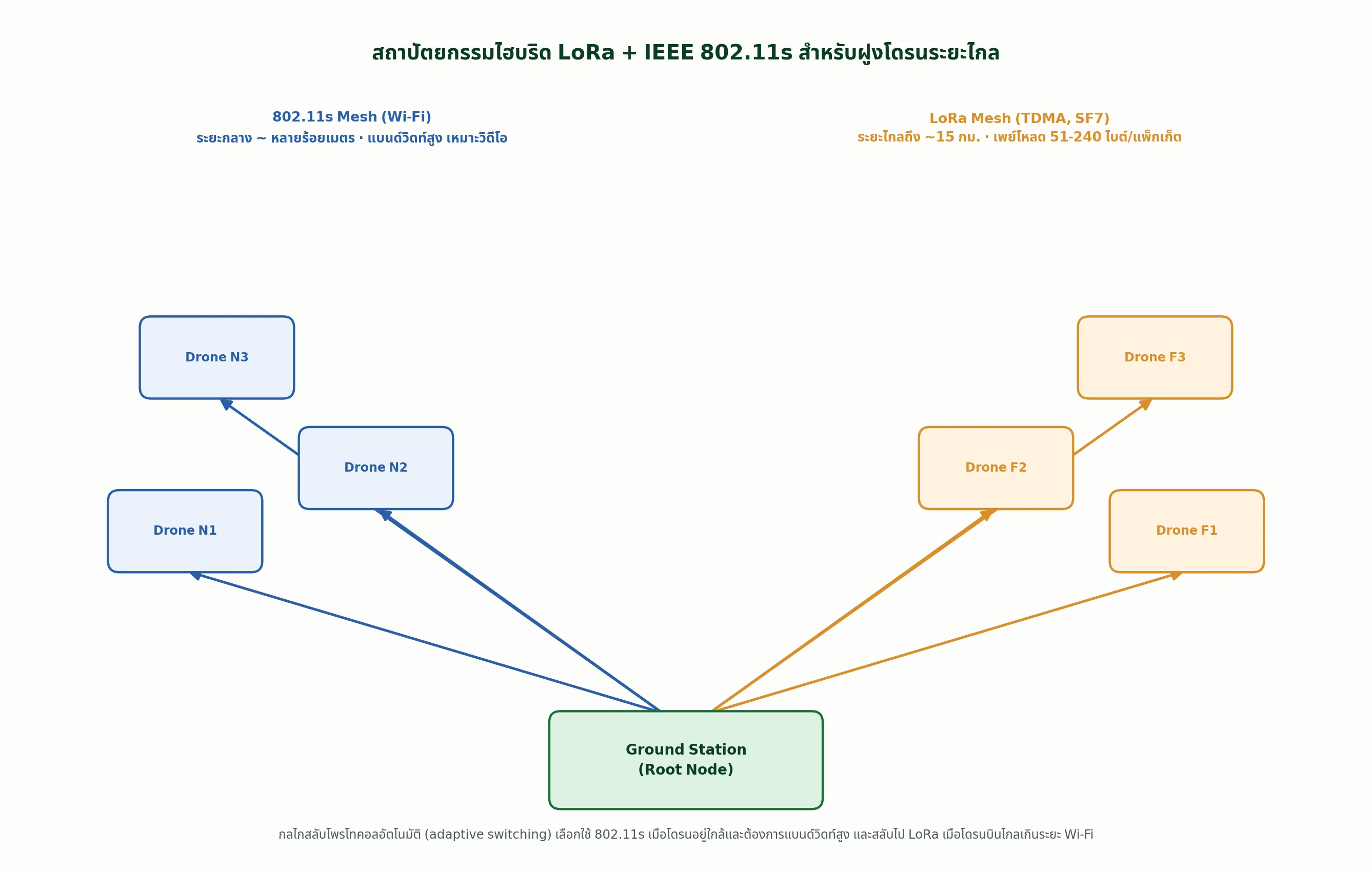
The first layer is IEEE 802.11s Mesh , a Wi-Fi mesh standard supporting medium-range, high-bandwidth communication between drones that are close to each other, suitable for real-time video or large data. The architecture assigns hierarchical roles: a root node connected to ground infrastructure, relaying nodes, and leaf nodes. The second layer is LoRa for long-range drone-to-drone or drone-to-ground communication, using TDMA (Time Division Multiple Access) time allocation and a Spreading Factor of SF7 with inverted polarity to reduce interference with ordinary ground LoRaWAN networks. The system has an automatic protocol-switching mechanism based on signal quality (RSSI) and the proximity of neighbouring nodes to choose which channel to communicate over at any moment (Hybrid LoRa-IEEE 802.11s, MDPI Drones)
Notable technical figures from this study are that the SF7 setting raises the maximum payload size to 222 bytes for LoRaWAN and 240 bytes for plain LoRa, while also mitigating the Doppler Shift caused by the speed of a moving platform. The team ran real field tests with a DJI Phantom 4 drone fitted with a TTGO T-Beam board (a low-cost LoRa board widely used in open-source LoRa projects) and checked performance with The Things Network mapping tools. The results confirmed that IEEE 802.11s supports ranges from a few hundred metres to a few kilometres with high bandwidth, while LoRa extends the range to about 15 km, although the payload is limited to 51-240 bytes depending on the chosen Spreading Factor (Hybrid LoRa-IEEE 802.11s, MDPI Drones)
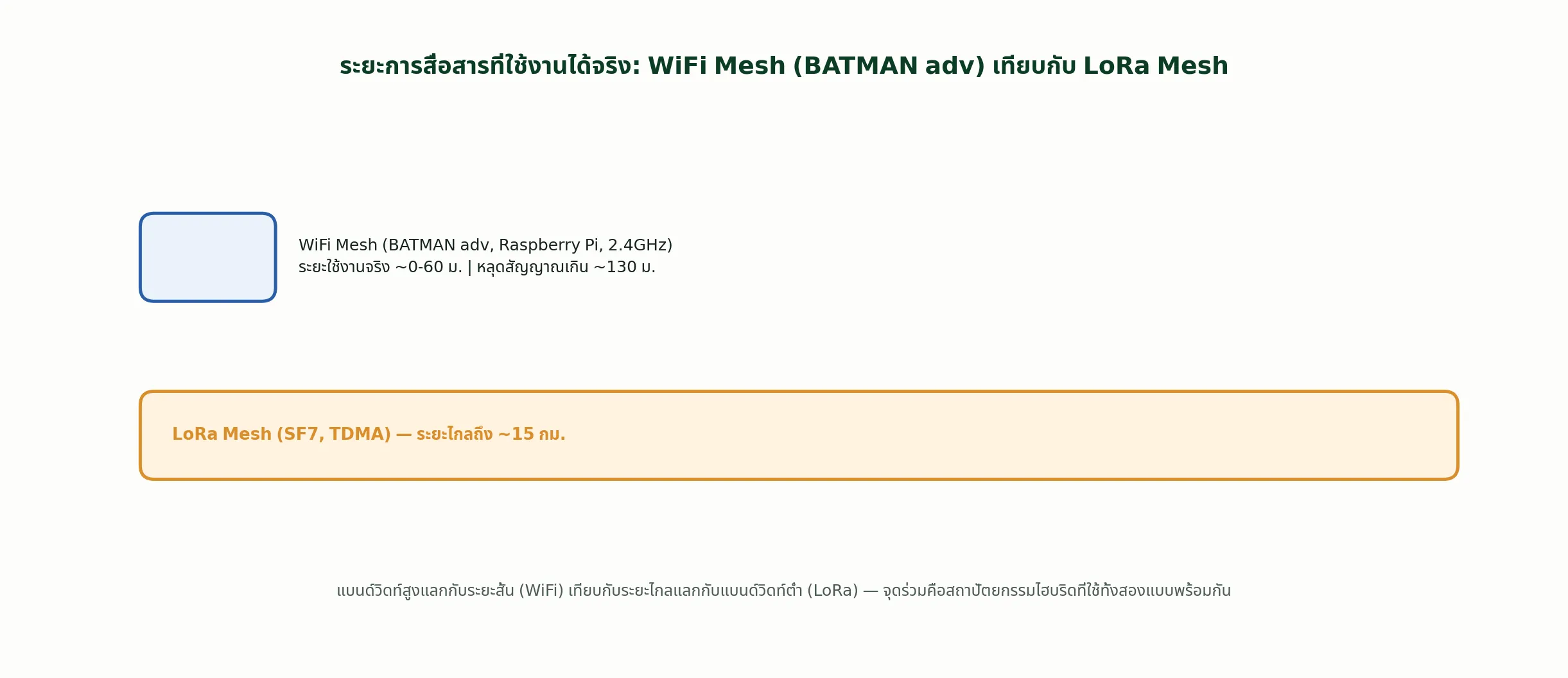
When the figures from both studies are compared, the difference is striking. The practical range of a BATMAN adv Wi-Fi mesh is only tens of metres, while a LoRa mesh reaches more than a thousand times farther. A hybrid architecture is therefore the most sensible solution: use Wi-Fi mesh for groups of drones flying close together that need to transfer large volumes of data, while the LoRa mesh acts as the “backbone” that links drone groups spread far apart, at the cost of carrying only small control and status messages.
4. A real-world example: an emergency monitoring system using LoRaWAN and GNSS
Beyond theoretical research, there are open-source projects that have turned this idea into working systems for emergencies. One project developed an emergency communication infrastructure that combines LoRaWAN with GNSS position tracking, supporting both fixed ground sensor motes and mobile drones, enabling real-time tracking and positioning in areas without mobile network coverage (uav-lorawan-gnss)
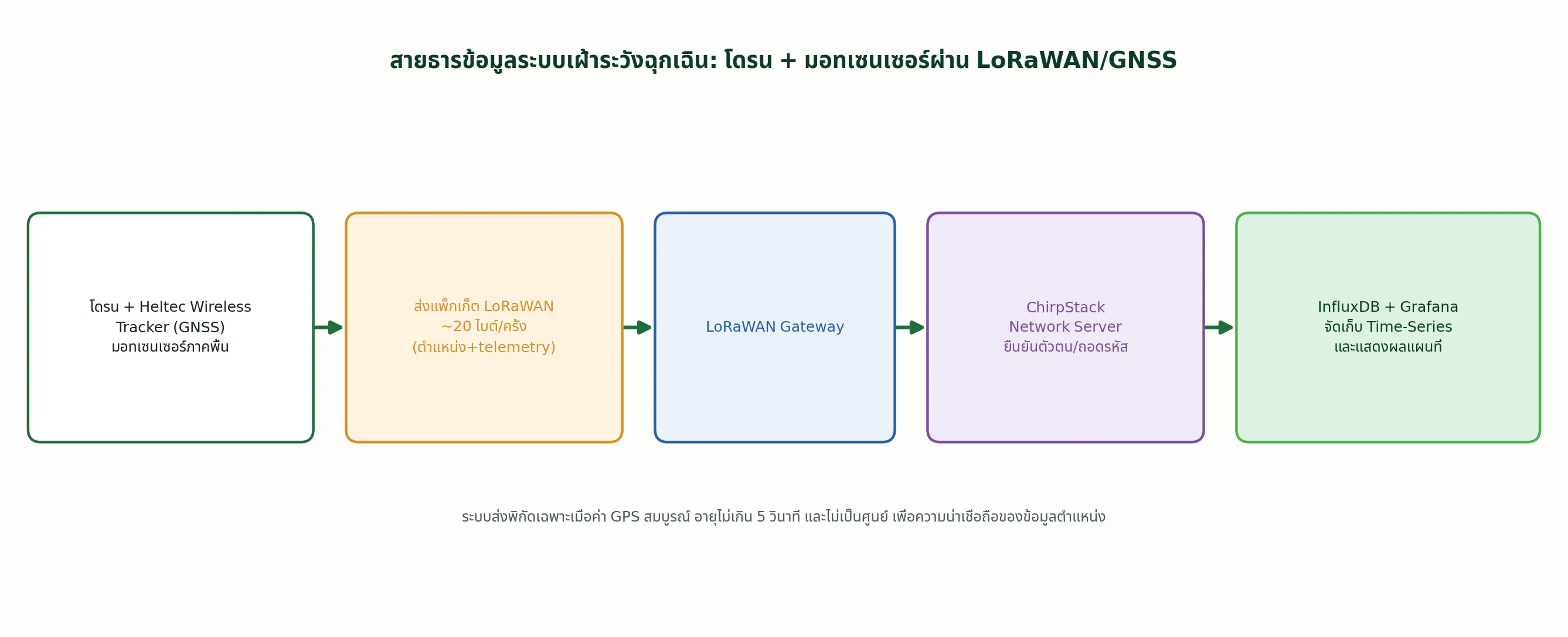
The system architecture starts with a Heltec Wireless Tracker board mounted on a DJI drone. It connects to the drone's own Wi-Fi access point to pull telemetry such as battery level, altitude, speed and flight time, combines it with the received satellite coordinates, and packs everything into a compact packet of only 20 bytes per transmission before sending it over the LoRaWAN network to a gateway. The data then passes through ChirpStack, which acts as the Network Server that authenticates devices and decodes packets, before being stored in the InfluxDB time-series database and displayed in Grafana as a real-time position map.
An interesting engineering point is the system's strict validation of position data: it sends GPS coordinates only when the value is a valid fix, no more than 5 seconds old, and non-zero, and it keeps the GNSS receiver powered throughout boot so that it can lock onto satellites as quickly as possible. This design reflects an important lesson for emergency monitoring systems: the reliability of position data matters more than the transmission rate, because a wrong coordinate in a search for disaster victims can make rescue teams waste time searching in the wrong place.
5. Security of mesh networks for drone swarms
When a drone swarm relies on a wireless communication network as its main lifeline, network security cannot be overlooked, especially in security contexts where the network may become a target of attack. Research on mesh network security for drone swarms has systematically catalogued threats by communication layer (OSI layer), as shown in the diagram below.
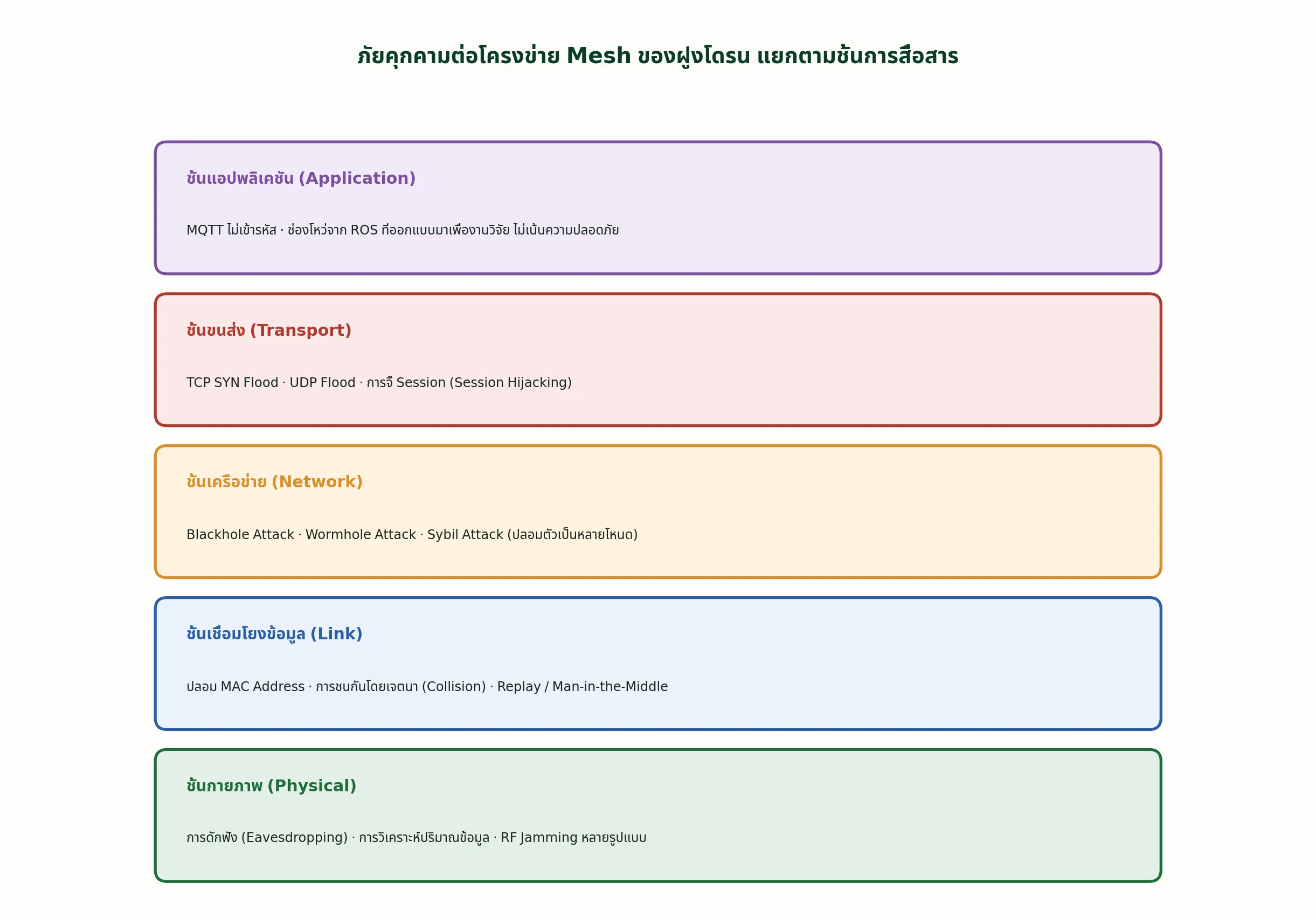
At the physical layer, the main threats are eavesdropping, traffic analysis to infer behaviour, and RF Jamming, which takes several forms: continuous jamming, reactive jamming, and AI-driven jamming that analyses signals before jamming selectively. At the data link layer, threats include MAC Address spoofing, deliberately induced signal collisions, and Replay or Man-in-the-Middle attacks that exploit the absence of frame-level security. At the network layer, serious threats are Blackhole attacks, in which a node attracts and drops data it should forward; Wormhole attacks, which create a covert tunnel to send data across the network by the wrong route; and Sybil attacks, in which one node impersonates many nodes at once to distort the routing process. At the transport layer, the threats are TCP SYN Flood, UDP Flood and session hijacking. At the application layer, the topmost layer, the research points to a worrying limitation: ROS, a robotics framework popular in drone swarm systems, “was designed mainly for research purposes, with no security measures built in from the start of development”, creating vulnerabilities through unencrypted MQTT and malware injection channels (Towards Secure Wireless Mesh Networks for UAV Swarm Connectivity)
To counter threats that span every layer, the research proposes a two-layer security framework. The first is the Network Provisioning Layer, which handles address allocation, neighbour discovery, blocking nodes that behave abnormally, secure routing, quality-of-service management, and the process of readmitting nodes to the network after they have been cut off. The second is the Mesh Security Layer, which handles digital certificate issuance, mutual authentication, access control, reputation-based trust for nodes, lightweight encryption suited to power-constrained devices, and secure QoS tunnels using Deep Learning-based anomaly detection. The research also stresses that even with these defences, a persistent challenge is the extreme mobility of drones, which exceeds the design assumptions of typical standard mesh protocols, together with the risk of GPS spoofing, which requires location-aware security measures (Towards Secure Wireless Mesh Networks for UAV Swarm Connectivity)
6. Linking to real-world use
Putting the four topics together shows clearly that drone swarm coordination over a LoRa mesh network is not merely a theoretical idea but has a clear path to real use: choosing a coordination concept (centralized or decentralized) according to the mission, designing a hybrid communication network that combines medium-range Wi-Fi mesh with long-range LoRa mesh, putting it into practice as an emergency monitoring system combining LoRaWAN with GNSS, and finally reinforcing security across every communication layer, which is indispensable for missions sensitive to national security or human safety, such as the rescue and disaster monitoring work discussed in the earlier drone technology landscape document.
Conclusion
Drone swarm coordination over LoRa mesh networks reflects an important engineering design principle: no single communication technology meets every requirement at once, but a smart combination of several layers of technology, such as the hybrid LoRa and IEEE 802.11s architecture, yields better results than going all-in on one technology. All the research and projects surveyed agree that real communication range in the field is almost always lower than theoretical specifications suggest (as seen in the 130 m figure for BATMAN adv), so real field testing is a step that cannot be skipped before deploying a system. Finally, as drone swarms become critical infrastructure for rescue or security missions, the security of the communication network that links them together is no less important than the drones themselves.
Bibliography
- brandonhimpfen. awesome-swarm-drones: A curated list of tools, research papers, frameworks, and resources for swarm drones. GitHub. https://github.com/brandonhimpfen/awesome-swarm-drones
- “Dynamic Mesh Network for Telemetry Propagation and Communications in Coordinated Drone Swarms.” University of California, Irvine. https://projects.eng.uci.edu/sites/default/files/Dynamic_Mesh_Network_for_Telemetry_Propagation_and_Communications_in_Coordinated_Drone_Swarms%20(revised).pdf
- “Hybrid LoRa-IEEE 802.11s Opportunistic Mesh Networking for Flexible UAV Swarming.” Drones, MDPI. https://www.mdpi.com/2504-446X/5/2/26
- paulageenaro. uav-lorawan-gnss: Infraestructura de comunicaciones de emergencia basada en LoRaWAN y monitorización con UAVs. GitHub. https://github.com/paulageenaro/uav-lorawan-gnss
- “Towards Secure Wireless Mesh Networks for UAV Swarm Connectivity.” arXiv. https://arxiv.org/pdf/2108.13154
Note: This document is an in-depth expansion of the topics “autonomous control” and “Data Link” in the earlier document “Drone Technology Landscape”, combining the two topics into a single subject as requested. All content comes from additional research into academic studies and open-source projects. It is an independent research document.