Inter-aircraft collision avoidance and fleet-state monitoring
UAT 461 Autonomous Navigation and Multi-UAV Systems
Lesson
By the end of this module you will be able to
- Calculate the required separation between aircraft from data age, position error, reaction time and braking distance, and find the closest point of approach of two tracks
- Explain and simulate ORCA, a velocity-obstacle avoidance method in which both aircraft share the burden, and state its deadlock limitation
- Separate paths strategically with altitude layers and with a priority rule that makes one aircraft wait, and compare the costs of the two methods
- Design fleet-state monitoring with state judgement, thresholds, hysteresis and a clear separation of "unknown" from "normal"
- Link monitoring results to the keep-out distance around an aircraft that has gone silent
Why this matters
A team of 12 whose paths were planned never to collide can still collide, because the plan has errors, wind pushes drones off their paths, position data that one aircraft gets from another are several seconds old, and some drones change plan part-way when another fails. This module therefore has two parts that work together. The first is inter-aircraft collision avoidance in two layers: a strategic layer that separates paths at planning time, and a tactical layer that avoids other aircraft in flight. The second is fleet-state monitoring, which lets the operators and the system know whether each aircraft is normal and how old the data they see are. The two parts are tied together by one number, data age.
The case is still the 12-drone yard team. By the function table of module 6, avoiding other team members runs on the aircraft because it does the most harm when late, and monitoring runs at the station because it must see the whole team. This module does not replace the obstacle-avoidance sensors of a single aircraft (see modules 1–5 of this course); it deals with what is added when there are several aircraft. All numbers are invented.
Required separation and closest point of approach
A safe separation is not a constant. It depends on how old the data are. It has five parts: the size of the aircraft ; the position error of both aircraft (, where is the standard deviation of position); the distance the two close while the data are old and while reacting, , where is the closing speed, the data age and the reaction time; and the braking distance of both aircraft, , where is the deceleration available. This is where the 1.31 s of module 6 comes in: data age becomes metres of separation.
The closest point of approach (CPA) tells how close two straight tracks at constant velocity will come. Let be the relative position vector and the relative velocity. The time of closest approach is and the closest distance is . A CPA check must be made along the whole track and not only at waypoints, because two aircraft can be far apart at both the start and the end yet pass each other part-way.
Example 1 Required separation when data are 0.2, 1.3 and 4.0 s old
Two aircraft approach each other at 5 m/s each (closing at 10 m/s), body size 1 m, position error m, reaction time 0.5 s, braking deceleration 4 m/s² (assumed). Find the required separation for three data ages, then check 12 drones flying at random at 5 m/s in a 600 × 300 m patch to see how many pairs will come closer than the separation within 20 s.
import numpy as np

def cpa(p1, v1, p2, v2):
    # time and distance of closest approach for two straight, constant-velocity tracks
    r, v = np.asarray(p2) - p1, np.asarray(v2) - v1
    vv = v @ v
    t = 0.0 if vv < 1e-12 else max(0.0, -(r @ v) / vv)
    return t, float(np.linalg.norm(r + v * t))

def required_separation(v_close, age, v_each=5.0, a=4.0, sigma=1.5, size=1.0, t_react=0.5):
    # size + 2 x 2 sigma position error + distance closed while data are old and while reacting + both drones braking (assumed)
    return size + 4 * sigma + v_close * (age + t_react) + 2 * v_each ** 2 / (2 * a)

print("age (s)  closing speed (m/s)  required separation (m)")
for age in (0.2, 1.3, 4.0):
    print(f"{age:7.1f} {10:20d} {required_separation(10.0, age):24.1f}")

# twelve drones inspecting in a 600 x 300 m patch (positions m, velocities m/s, assumed)
rng = np.random.default_rng(11)
P = np.column_stack([rng.uniform(0, 600, 12), rng.uniform(0, 300, 12)])
ang = rng.uniform(0, 2 * np.pi, 12)
Vel = 5.0 * np.column_stack([np.cos(ang), np.sin(ang)])
HORIZON = 20.0                                         # s look-ahead
print("age (s)  required (m)  pairs in conflict within 20 s")
for age in (0.2, 1.3, 4.0):
    S = required_separation(10.0, age)
    hits = []
    for i in range(12):
        for j in range(i + 1, 12):
            t, d = cpa(P[i], Vel[i], P[j], Vel[j])
            if t <= HORIZON and d < S:
                hits.append(f"D{i+1}-D{j+1} at {t:.1f} s, {d:.1f} m")
    print(f"{age:7.1f} {S:13.1f}  {len(hits):2d}  {hits[:2]}")
age (s) closing speed (m/s) required separation (m)
0.2 10 20.2
1.3 10 31.2
4.0 10 58.2
age (s) required (m) pairs in conflict within 20 s
0.2 20.2 2 ['D1-D5 at 0.0 s, 11.8 m', 'D3-D10 at 1.5 s, 19.2 m']
1.3 31.2 4 ['D1-D5 at 0.0 s, 11.8 m', 'D3-D10 at 1.5 s, 19.2 m']
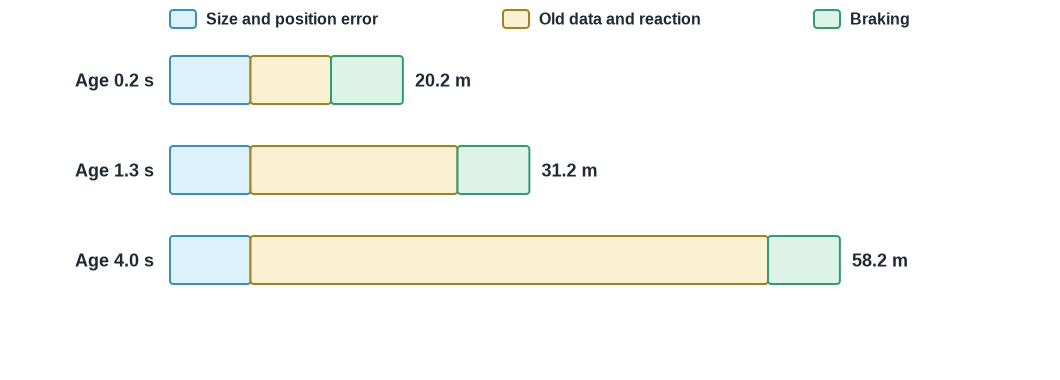
4.0 58.2 9 ['D1-D4 at 6.2 s, 35.3 m', 'D1-D5 at 0.0 s, 11.8 m']Data 0.2 s old need a separation of 20.2 m, at 1.3 s 31.2 m, and at 4.0 s 58.2 m. At 1.3 s the 31.2 m is made up of 1 + 6 + 10 × (1.3 + 0.5) + 6.25, so the part due to old data and reaction time, 18 m, dominates. The number of conflicting pairs in the same patch rises from 2 to 4 and then 9 as the separation grows with data age. Some pairs (D1 and D5) are within the separation from the start (11.8 m), which means the initial plan itself violates the separation. The lesson is that separation must be computed from the data age the team really has, not chosen as a round number.
ORCA: avoiding by sharing the burden
When two aircraft are about to come closer than the separation, they must avoid each other. The velocity obstacle (VO) of aircraft A with respect to B is the set of relative velocities that would lead to a collision within a look-ahead time . If A picks a velocity outside that set it will not collide within . The problem with the classical VO is that if both aircraft avoid at full effort they oscillate. ORCA (optimal reciprocal collision avoidance) of van den Berg et al. (2011) solves this by making each aircraft take half of the avoidance burden. Each aircraft gets a half-plane of allowed velocities for each neighbour and picks the velocity closest to its preferred velocity inside all the half-planes by solving a linear program. The result is that if every aircraft uses ORCA and a solution exists at every step, they do not collide. Alonso-Mora et al. (2015) extend the velocity-obstacle idea to aerial vehicles in three dimensions where size, dynamics and aggressiveness differ between aircraft.
ORCA does not guarantee progress. If two or more aircraft are exactly symmetric, avoid equally and none yields, the team can get stuck in a deadlock. Example 2 shows both sides of this.
Example 2 Twelve drones swapping places on a circle, with and without ORCA
Twelve drones are spaced on a circle of radius 60 m and must fly to the opposite point at 5 m/s. Each has a radius of 4 m (including margin, so they must stay at least 8 m apart), a look-ahead time of 5 s, and sees neighbours within 100 m. Try three cases: no avoidance, ORCA with exactly opposite goals, and ORCA with the goals turned by 20 degrees.
def det(a, b):
    return a[0] * b[1] - a[1] * b[0]

def orca_line(pA, vA, pB, vB, R, tau, dt):
    # ORCA half-plane of agent A with respect to B (van den Berg et al., 2011); returns (point, direction)
    rel_p, rel_v = pB - pA, vA - vB
    d2, R2 = rel_p @ rel_p, R * R
    if d2 > R2:                                        # no contact yet
        w = rel_v - rel_p / tau
        w2, dot1 = w @ w, w @ rel_p
        if dot1 < 0 and dot1 ** 2 > R2 * w2:           # closest point lies on the cut-off circle
            wl = np.sqrt(w2)
            uw = w / wl
            direction = np.array([uw[1], -uw[0]])
            u = (R / tau - wl) * uw
        else:                                          # closest point lies on a leg of the cone
            leg = np.sqrt(d2 - R2)
            if det(rel_p, w) > 0:
                direction = np.array([rel_p[0] * leg - rel_p[1] * R, rel_p[0] * R + rel_p[1] * leg]) / d2
            else:
                direction = -np.array([rel_p[0] * leg + rel_p[1] * R, -rel_p[0] * R + rel_p[1] * leg]) / d2
            u = (rel_v @ direction) * direction - rel_v
    else:                                              # already closer than R: push apart within one time step
        w = rel_v - rel_p / dt
        wl = np.linalg.norm(w)
        uw = w / wl
        direction = np.array([uw[1], -uw[0]])
        u = (R / dt - wl) * uw
    return vA + 0.5 * u, direction                     # each agent takes half of the avoidance

def best_velocity(lines, v_pref, vmax):
    # closest velocity to v_pref inside every half-plane and the speed limit (exact, by candidates)
    def ok(v, tol=1e-9):
        return np.linalg.norm(v) <= vmax + tol and all(det(d, v - p) >= -tol for p, d in lines)
    cands = [v_pref, v_pref * vmax / max(np.linalg.norm(v_pref), 1e-9)]
    for i, (p, d) in enumerate(lines):
        cands.append(p + d * ((v_pref - p) @ d))       # projection on the line
        b = p @ d                                      # intersections with the speed circle
        disc = b * b - (p @ p - vmax * vmax)
        if disc >= 0:
            cands += [p - d * b + d * s * np.sqrt(disc) for s in (-1, 1)]
        for q, e in lines[i + 1:]:
            m = np.array([[d[0], -e[0]], [d[1], -e[1]]])
            if abs(np.linalg.det(m)) > 1e-12:
                s = np.linalg.solve(m, q - p)
                cands.append(p + d * s[0])
    feasible = [c for c in cands if ok(c)]
    if feasible:
        return min(feasible, key=lambda c: np.linalg.norm(c - v_pref)), True
    worst = lambda c: max([det(d, p - c) for p, d in lines] + [0])
    return min(cands, key=worst), False                # infeasible: least violation (RVO2 solves a 3-D LP here)

def simulate(avoid, turn=0.0, n=12, radius_circle=60.0, speed=5.0, r=4.0, tau=5.0, dt=0.25, t_end=60.0, view=100.0):
    ang = 2 * np.pi * np.arange(n) / n
    p = radius_circle * np.column_stack([np.cos(ang), np.sin(ang)])
    c, s = np.cos(np.radians(turn)), np.sin(np.radians(turn))
    goal = -p @ np.array([[c, s], [-s, c]])            # opposite side, turned by `turn` degrees
    v = np.zeros((n, 2))
    dmin, fails, arrive, spd = 1e9, 0, np.full(n, np.nan), []
    for k in range(int(t_end / dt)):
        pref = goal - p
        dist = np.linalg.norm(pref, axis=1, keepdims=True)
        pref = np.where(dist > speed * dt, pref / np.maximum(dist, 1e-9) * speed, pref / dt)
        new = pref.copy()
        if avoid:
            for i in range(n):
                lines = [orca_line(p[i], v[i], p[j], v[j], 2 * r, tau, dt)
                         for j in range(n) if j != i and np.linalg.norm(p[j] - p[i]) < view]
                new[i], ok = best_velocity(lines, pref[i], speed)
                fails += not ok
        v = new
        p = p + v * dt
        D = np.linalg.norm(p[:, None] - p[None], axis=2) + np.eye(n) * 1e9
        dmin = min(dmin, D.min())
        done = (np.linalg.norm(goal - p, axis=1) < 1.0) & np.isnan(arrive)
        arrive[done] = (k + 1) * dt
        spd.append(np.linalg.norm(v, axis=1).mean())
    return dmin, fails, arrive, np.mean(spd[-40:]), np.linalg.norm(goal - p, axis=1).mean()

print("case                       closest (needed 8.00)  infeasible  arrived  last arrival  speed in last 10 s  distance left")
for avoid, turn, label in ((False, 0, "no avoidance"), (True, 0, "ORCA, exact antipodes"), (True, 20, "ORCA, goals turned 20 deg")):
    dmin, fails, arrive, spd, left = simulate(avoid, turn)
    done = int((~np.isnan(arrive)).sum())
    last = "none" if done == 0 else f"{np.nanmax(arrive):.1f} s"
    print(f"{label:26s} {dmin:14.2f} m {fails:12d} {done:5d}/12 {last:>13s} {spd:12.2f} m/s {left:13.1f} m")
case closest (needed 8.00) infeasible arrived last arrival speed in last 10 s distance left
no avoidance 0.00 m 0 12/12 24.0 s 0.00 m/s 0.0 m
ORCA, exact antipodes 8.00 m 0 0/12 none 0.00 m/s 75.5 m
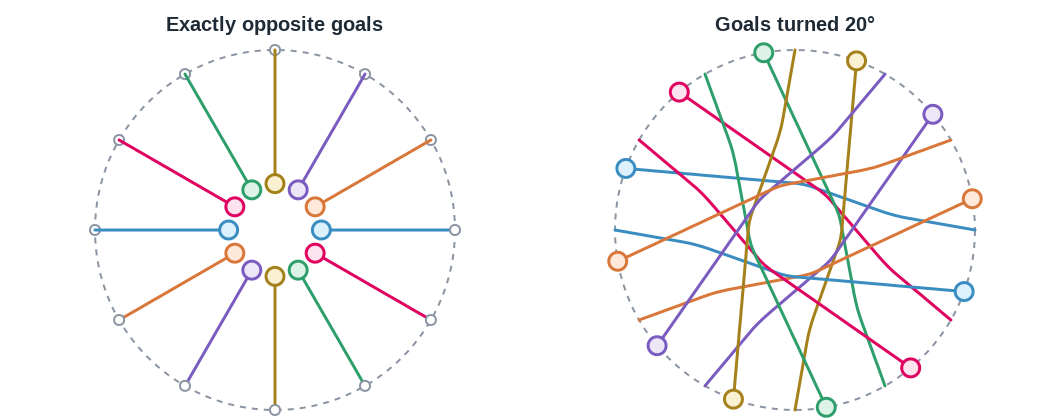
ORCA, goals turned 20 deg 8.00 m 0 12/12 24.5 s 0.00 m/s 0.0 mWith no avoidance every drone arrives in 24 s but they pass through the centre and the closest distance is 0.00 m, that is, they collide. With ORCA and exactly opposite goals there is no collision at all (closest distance 8.00 m as required), but no drone reaches its goal at 60 s: the mean speed in the last part is 0.00 m/s and 75.5 m remains on average. All the drones stop in a ring around the centre, exactly 8 m apart, because symmetry leaves no drone a better way through than the others. When the goals are turned by 20 degrees the symmetry is broken, and ORCA takes every drone to its goal in 24.5 s without any collision. What this shows is that ORCA gives safety but not progress, and a mechanism to break symmetry is needed, for example priority for the lower-numbered drone, or a slight perturbation of the goals.
Strategic separation: altitude layers and priority
Avoiding in flight (ORCA) is the last line. The first line is to make paths cross as little as possible from the start. Hönig et al. (2018) plan the trajectories of a quadrotor swarm in advance, accounting for the downwash of the aircraft above, which allows tightly packed flight. Here we look at two simple mechanisms that can be used together.
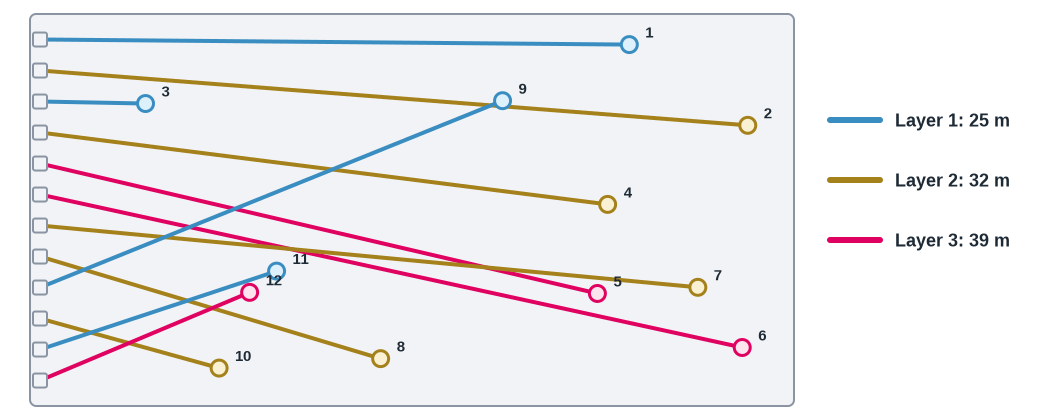
The first is altitude layers. Legs that cross in plan view are harmless if flown at different altitudes. Choosing the fewest layers so that conflicting legs are not on the same layer is a graph colouring problem on the conflict graph. This example uses a layer spacing of 7 m in a band from 25 to 60 m (assumed; real vertical separation must exceed the horizontal because of downwash and must be tested with that aircraft). The second mechanism is priority. The aircraft with the right of way flies at once and the others wait at their docks until their legs are clear. The example uses the rule that the longer leg has priority.
Example 3 Altitude layers against waiting by priority
Twelve drones fly from the gate docks to the 12 blocks of the first round at 10 m/s and need at least 30 m horizontal separation between legs. Compare two allocation plans: “list order” (dock i goes to block i) and the “minimum sum” plan from module 7. Count the conflicting leg pairs, the number of layers needed (both greedy and the true minimum by backtracking), and the total waiting time under the priority rule.
import itertools
from scipy.optimize import linear_sum_assignment

# transit legs from the gate docks (x = 0) to the twelve first-wave blocks (plan view, m, assumed)
rng = np.random.default_rng(486)
docks = np.column_stack([np.zeros(12), np.linspace(25, 575, 12)])
zones = np.column_stack([rng.uniform(150, 1150, 24), rng.uniform(30, 570, 24)])[:12]
cost = np.linalg.norm(docks[:, None] - zones[None], axis=2)
S_PLAN, V = 30.0, 10.0                                 # horizontal separation wanted between legs, m; speed, m/s

def seg_dist(a0, a1, b0, b1):
    # minimum distance between two plan-view segments (they may cross)
    def cross(o, p, q):
        return det(p - o, q - o)
    if cross(a0, a1, b0) * cross(a0, a1, b1) < 0 and cross(b0, b1, a0) * cross(b0, b1, a1) < 0:
        return 0.0
    def point_seg(p, s0, s1):
        t = np.clip((p - s0) @ (s1 - s0) / ((s1 - s0) @ (s1 - s0)), 0, 1)
        return np.linalg.norm(p - (s0 + t * (s1 - s0)))
    return min(point_seg(a0, b0, b1), point_seg(a1, b0, b1), point_seg(b0, a0, a1), point_seg(b1, a0, a1))

def conflict_matrix(goal):
    conf = np.zeros((12, 12), bool)
    for i, j in itertools.combinations(range(12), 2):
        conf[i, j] = conf[j, i] = seg_dist(docks[i], goal[i], docks[j], goal[j]) < S_PLAN
    return conf

def colour(conf):
    order = sorted(range(12), key=lambda v: -conf[v].sum())    # busiest drones first
    c = {}
    for v in order:
        used = {c[u] for u in np.flatnonzero(conf[v]) if u in c}
        c[v] = next(k for k in itertools.count() if k not in used)
    return c

def colourable(conf, k, v=0, assign=None):
    assign = {} if assign is None else assign
    if v == 12:
        return True
    for col in range(k):
        if all(assign.get(u) != col for u in np.flatnonzero(conf[v])):
            assign[v] = col
            if colourable(conf, k, v + 1, assign):
                return True
            del assign[v]
    return False

def launch_delays(goal, step=2.0):
    # priority rule: the longest leg goes first; the others wait at their dock until their leg is clear
    L = np.linalg.norm(goal - docks, axis=1)
    unit = (goal - docks) / L[:, None]
    T = np.arange(0, 400, 0.5)
    def track(i, delay):
        s = np.clip((T - delay) * V, 0, L[i])
        return docks[i] + unit[i] * s[:, None]
    delay = {}
    for i in sorted(range(12), key=lambda i: -L[i]):
        d = 0.0
        while any((np.linalg.norm(track(i, d) - track(j, delay[j]), axis=1) < S_PLAN).any() for j in delay):
            d += step
        delay[i] = d
    return np.array([delay[i] for i in range(12)]), L

plans = {"list order": zones, "min-sum plan": zones[linear_sum_assignment(cost)[1]]}
print("plan          conflicting pairs  worst drone  layers (greedy/exact)  waiting (s, total)  last arrival (s)")
for name, goal in plans.items():
    conf = conflict_matrix(goal)
    greedy_layers = max(colour(conf).values()) + 1
    exact_layers = next(k for k in range(1, 13) if colourable(conf, k))
    wait, L = launch_delays(goal)
    print(f"{name:13s} {int(conf.sum() // 2):10d} of 66 {int(conf.sum(1).max()):11d} {greedy_layers:12d} /{exact_layers:2d} {wait.sum():18.0f} {(wait + L / V).max():16.1f}")

conf = conflict_matrix(plans["list order"])
c = colour(conf)
DZ, FLOOR, CEIL = 7.0, 25.0, 60.0                      # layer spacing, lowest and highest allowed altitude, m (assumed)
print("band", FLOOR, "to", CEIL, "m holds", int((CEIL - FLOOR) // DZ) + 1, "layers at", DZ, "m spacing")
print("altitudes (m):", {i + 1: FLOOR + DZ * c[i] for i in range(12)})
print("every conflicting pair is on different layers:", all(c[i] != c[j] for i, j in itertools.combinations(range(12), 2) if conf[i, j]))
plan conflicting pairs worst drone layers (greedy/exact) waiting (s, total) last arrival (s)
list order 13 of 66 6 3 / 3 28 115.9
min-sum plan 2 of 66 1 2 / 2 4 114.2
band 25.0 to 60.0 m holds 6 layers at 7.0 m spacing
altitudes (m): {1: 25.0, 2: 32.0, 3: 25.0, 4: 32.0, 5: 39.0, 6: 39.0, 7: 32.0, 8: 32.0, 9: 25.0, 10: 32.0, 11: 25.0, 12: 39.0}
every conflicting pair is on different layers: TrueThe list-order plan has 13 conflicting pairs out of 66, with one drone conflicting with as many as 6 others, and needs 3 layers (greedy equals the true minimum). The band from 25 to 60 m holds 6 layers, so there is room to spare. The minimum-sum plan from module 7 is left with only 2 conflicting pairs and uses 2 layers, because an allocation with the smallest total distance tends to make the legs not cross, a side benefit of good allocation. With the priority rule the list-order plan has drones waiting 28 s in total and the last drone arrives at 115.9 s, only 1.7 s later than the minimum-sum plan (114.2 s, with only 4 s of waiting in total), because the long legs go first and the drones that wait have short legs that do not set the mission time. In short, layers cost no time but use up altitude range and need climbing and descending, while waiting uses no altitude range but costs time. The team uses the minimum-sum plan as its main plan and keeps both mechanisms as backups.
Fleet-state monitoring
The station must know whether each aircraft is normal, from telemetry (battery, GNSS satellites, radio signal) and from heartbeats. In the MAVLink protocol each component sends a HEARTBEAT at about 1 Hz on a radio link and the other side considers it disconnected if four or five messages are not received; the exact values depend on the channel and are not defined by MAVLink (MAVLink Development Team, n.d.). The design of monitoring follows four principles.
- Have a “lost” state separate from “normal”. Not receiving a message is not a message that all is well, and a screen frozen on an old value is more dangerous than a screen that says “unknown”.
- Show an age with every value. The operator must see how many seconds old a value is.
- Have two threshold levels, warning (WARN) and critical (CRIT), so that there is time to decide before the critical level.
- Use hysteresis. The threshold for clearing a state is higher than the one for raising the warning, so the state does not flicker when a value sits near the threshold.
Avizienis et al. (2004) separate a fault, the cause, an error, an incorrect internal state, and a failure, which the user sees. Monitoring is detecting the error in time before it becomes a failure.
Example 4 Telemetry from 12 drones over 120 s with four injected anomalies
The 1 Hz telemetry of 12 drones (assumed data) has four injected anomalies: D03’s link is down for 16 s, D07’s battery drains twice as fast, D09’s GNSS drops to 5 satellites from 70 s, and D11 goes silent for good from 90 s. The rules: lost when no message for 5 s; warning when the battery is below 35% or fewer than 8 satellites; critical when the battery is below 25%; the warning clears only when the values are 5 points above the thresholds. Then, when a drone is lost, calculate the distance the others must keep around its last known position.
# telemetry at 1 Hz for twelve drones, 120 s, with four injected faults (assumed rules and data)
rng = np.random.default_rng(4)
T_END, N = 120, 12
data = {}
for d in range(N):
    batt = 100 - 0.45 * np.arange(T_END) + rng.normal(0, 0.3, T_END)
    sats = np.clip(rng.normal(16, 1.0, T_END), 0, None).round()
    rssi = rng.normal(-70, 3, T_END)
    up = np.ones(T_END, bool)
    data[d] = dict(batt=batt, sats=sats, rssi=rssi, up=up)
data[2]["up"][40:56] = False                           # D03: link drops for 16 s
data[6]["batt"] = 100 - 0.95 * np.arange(T_END)        # D07: battery drains twice as fast
data[8]["sats"][70:] = 5                               # D09: GNSS degrades from t = 70 s
data[10]["up"][90:] = False                            # D11: silent for good

LOST_AFTER = 5                                         # s without a message (four or five missed heartbeats)
WARN_B, CRIT_B, HYST = 35.0, 25.0, 5.0                 # battery %, clear threshold is HYST higher
state = {d: "OK" for d in range(N)}
last = {d: 0 for d in range(N)}
log = []

def judge(d, t):
    if t - last[d] >= LOST_AFTER:
        return "LOST"
    b, g = data[d]["batt"][last[d]], data[d]["sats"][last[d]]
    if b < CRIT_B:
        return "CRIT"
    if b < WARN_B or g < 8:
        return "WARN"
    if state[d] in ("WARN", "CRIT") and (b < WARN_B + HYST or g < 10):
        return "WARN"                                  # hysteresis: do not clear until well above the limit
    return "OK"

for t in range(T_END):
    for d in range(N):
        if data[d]["up"][t]:
            last[d] = t
        new = judge(d, t)
        if new != state[d]:
            log.append((t, d + 1, state[d], new))
            state[d] = new
for t, d, a, b in log:
    print(f"t={t:3d} s  D{d:02d}  {a:4s} -> {b}")
counts = {s: sum(1 for v in state.values() if v == s) for s in ("OK", "WARN", "CRIT", "LOST")}
age_max = max(T_END - 1 - last[d] for d in range(N))
print("fleet at t = 119 s:", counts, "oldest data age", age_max, "s")
print(f"keep-out radius around the last known position of a lost drone (10 m/s closing): {required_separation(10.0, age_max):.0f} m")
t= 44 s D03 OK -> LOST
t= 56 s D03 LOST -> OK
t= 69 s D07 OK -> WARN
t= 70 s D09 OK -> WARN
t= 79 s D07 WARN -> CRIT
t= 94 s D11 OK -> LOST
fleet at t = 119 s: {'OK': 9, 'WARN': 1, 'CRIT': 1, 'LOST': 1} oldest data age 30 s
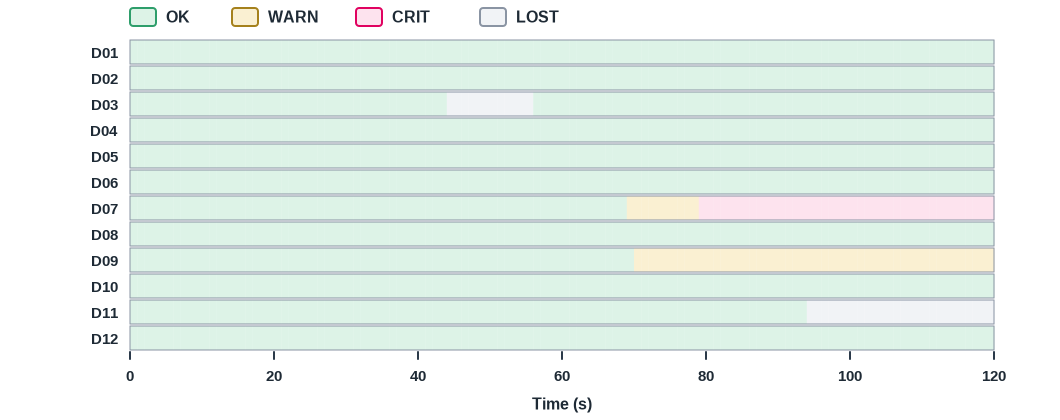
keep-out radius around the last known position of a lost drone (10 m/s closing): 318 mThe system detects all four anomalies. D03 becomes LOST at 44 s (5 s after the last message at 39 s) and returns to OK at 56 s when the link comes back. D07 warns at 69 s and goes critical at 79 s, in line with a battery falling 0.95% per second. D09 warns at 70 s as soon as the satellites drop, and D11 is LOST at 94 s. At 119 s the team has 9 drones normal, 1 warning, 1 critical and 1 lost, with the oldest data 30 s old. The most interesting line is the last one. A drone that has been lost for 30 s may be as much as 300 m from its last known position, so a keep-out radius of 318 m (by the formula of Example 1 with an age of 30 s) is needed around that position. Without this rule other drones could fly close to the silent one without knowing. In practice a drone that loses contact must have a behaviour defined in advance, such as hovering or returning along its own path and layer, which reduces the size of this keep-out zone.
Hazard analysis of the multi-UAV mission
Separation, ORCA, altitude layers and monitoring each answer one hazard. Before trusting them, the team must list what can go wrong, because a safety claim is only as good as the list behind it. The NASA guide to probabilistic risk assessment describes risk as a set of triplets, scenarios, likelihoods and consequences, found by asking what can go wrong, how likely it is and what the consequences are (Stamatelatos & Dezfuli, 2011). Failure modes and effects analysis (FMEA) does this for each part and function: IEC 60812 describes it as establishing how items or processes might fail, with the effects locally and globally, and prioritising the failure modes, where the ranking of criticality involves at least the severity of the consequences (International Electrotechnical Commission, 2018). The JARUS SORA applies to one or several aircraft, advises examining common-mode failures when many aircraft operate relative to each other, and states that collisions between two unmanned aircraft are not yet in its scope and that such operations are expected to have a deconfliction strategy of their own (Joint Authorities for Rulemaking on Unmanned Systems [JARUS], 2024). So the aircraft-to-aircraft hazards must be in the team’s own log.
A hazard log has one row per hazard: its severity and likelihood per mission (each 1 to 5), the mitigation, the likelihood after the mitigation, and the kind of evidence that can show the mitigation works. Two course rules (assumed) keep it honest. Rank by severity first, because a product buries a rare catastrophe under common nuisances. A hazard stays open until , and a severity-5 hazard stays open until is shown by evidence.
Example 5 A hazard log for the 12-drone yard team
Rate eight hazards of the team (all ratings assumed). The mitigations are the ones built in earlier modules: separation, ORCA and layers for H1, monitoring and return rules for H2 and H7, timestamps and gain limits for H3, min-consensus on battery for H5, reallocation for H6 and signed messages for H8. H4 is a common-cause fault (module 10), which redundancy does not help. Rank the log both ways, list what is still open, and sort the hazards by where the evidence can come from.
# hazard log of the 12-drone yard team; every rating is assumed (severity 1-5, likelihood per mission 1-5)
# (id, hazard, severity, likelihood, likelihood after the mitigation, where the mitigation is shown to work)
log = [
    ("H1", "two team drones come within the required separation", 5, 3, 1, "SITL"),
    ("H2", "one drone loses its link to the station",             3, 4, 2, "SITL"),
    ("H3", "stale neighbour data make the formation oscillate",   4, 3, 2, "simulation"),
    ("H4", "same firmware fault in all drones at once",           5, 1, 1, "ground test"),
    ("H5", "a battery runs low unnoticed",                        3, 3, 1, "simulation"),
    ("H6", "blocks left unattended after a drone is lost",        2, 3, 2, "simulation"),
    ("H7", "the station fails",                                   4, 2, 1, "SITL"),
    ("H8", "a forged command reaches a drone",                    5, 1, 1, "ground test"),
]
order_sl = [h[0] for h in sorted(log, key=lambda h: -h[2] * h[3])]               # severity x likelihood
order_sev = sorted(log, key=lambda h: (-h[2], -h[3]))                            # severity first, then likelihood
print("id  S  L  SxL  rank by SxL  rank by severity first")
for i, h in enumerate(order_sev, 1):
    print(f"{h[0]}  {h[2]}  {h[3]}  {h[2] * h[3]:>3}  {order_sl.index(h[0]) + 1:>11}  {i:>22}")
for h in order_sev:
    if h[2] * h[4] >= 8 or (h[2] == 5 and h[4] > 1):
        print("still open after mitigation:", h[0], h[1])
stage = {}
for h in log:
    stage.setdefault(h[5], []).append(h[0])
print("evidence needed:", "; ".join(f"{k}: {', '.join(v)}" for k, v in stage.items()))
id S L SxL rank by SxL rank by severity first
H1 5 3 15 1 1
H4 5 1 5 7 2
H8 5 1 5 8 3
H3 4 3 12 3 4
H7 4 2 8 5 5
H2 3 4 12 2 6
H5 3 3 9 4 7
H6 2 3 6 6 8
still open after mitigation: H3 stale neighbour data make the formation oscillate
evidence needed: SITL: H1, H2, H7; simulation: H3, H5, H6; ground test: H4, H8By the two rare catastrophes, H4 and H8, rank 7th and 8th; severity first puts them 2nd and 3rd, where they get attention. After the mitigations one hazard is still open: H3 has , so stale neighbour data need a stronger mitigation or more evidence. The last line groups the evidence the plan relies on: multi-vehicle SITL for H1, H2 and H7, numerical simulation for H3, H5 and H6, and ground tests for H4 and H8. Module 10 turns this grouping into a staged test plan.
Module lab
Lab: separation, ORCA and monitoring in simulation
Desk work with simulation code; no drone is flown.
- Set your team’s values (position error, braking deceleration, reaction time) from the data of a drone the department has, and calculate the required separation at data ages of 0.5, 1.3 and 4.0 s with the function of Example 1.
- Build a random 12-drone scenario and count the pairs that come closer than the separation within 20 s. Change the data age and compare.
- Run the ORCA of Example 2 with exactly opposite goals and with goals turned by 5, 10 and 20 degrees. Record the number of drones that arrive and the closest distance. Design one symmetry-breaking mechanism and test it.
- Allocate with the two methods of module 7, and count the conflicting leg pairs and the number of layers of each plan as in Example 3.
- Inject three anomalies into your own fictional telemetry, tune the thresholds and hysteresis until nothing flickers, and calculate the keep-out zone around a lost drone.
- Hand in: the separation table, the ORCA results table, the table of layers and waiting, the monitoring event log, and a one-page proposal.
Common mistakes
Watch out
- Choosing the separation as a round number without thinking of data age. At 4 s old data 58 m is needed, not 20 m.
- Checking distance only at waypoints. Check the CPA along the whole track.
- Believing ORCA always gets everyone there. Safety does not mean progress; symmetry must be broken.
- Using the same vertical separation as horizontal. Downwash disturbs the aircraft below; test with that aircraft.
- Displaying old values as normal. Have a lost state and show data age.
- Setting warning thresholds with no hysteresis. The state flickers until operators stop believing it.
- Forgetting the keep-out distance around a silent aircraft. Others may fly toward where it might be.
Summary
- The required separation grows with data age (31.2 m at 1.3 s), and CPA is checked along the whole path.
- ORCA has each aircraft take half the avoidance burden and gives no collisions, but not progress; symmetry causes deadlock.
- Altitude layers are graph colouring, while priority uses time in place of altitude; good allocation reduces conflicts from the start.
- Monitoring must separate “lost” from “normal”, show data age, and use two threshold levels with hysteresis.
- The data age of a silent drone sets the keep-out zone around its last known position.
Self-check questions
- With the values of Example 1 but data 0.5 s old, what is the required separation?
- Aircraft A is at (0, 0) flying at (5, 0) m/s and B is at (100, 20) flying at (−5, 0) m/s. At what time and distance does the CPA occur?
- A drone has been out of contact for 12 s. Using the formula of Example 1 (closing at 10 m/s), what is the radius of the keep-out zone?
- Why does ORCA with exactly opposite goals not collide but not reach the goals, and how can this be fixed?
- Why does the battery warning threshold need hysteresis?
Answers
- m
- Relative position and relative velocity give s and distance m.
- m
- Symmetry makes every drone avoid equally until they stop in a ring exactly 8 m apart. Fix it with a symmetry-breaking mechanism such as priority or a slight perturbation of the goals.
- A value that wobbles around the threshold makes the warning flicker. Hysteresis clears the state only when the value is clearly above the threshold.
Key formulas
| Closest point of approach (CPA) | |
| Required separation | |
| ORCA velocity half-plane |
Key references
- van den Berg, J., Guy, S. J., Lin, M., & Manocha, D. (2011). Reciprocal n-body collision avoidance. In Robotics research (Springer Tracts in Advanced Robotics, Vol. 70, pp. 3–19). Springer. link
- Alonso-Mora, J., Naegeli, T., Siegwart, R., & Beardsley, P. (2015). Collision avoidance for aerial vehicles in multi-agent scenarios. Autonomous Robots, 39(1), 101–121. link
- Hönig, W., Preiss, J. A., Kumar, T. K. S., Sukhatme, G. S., & Ayanian, N. (2018). Trajectory planning for quadrotor swarms. IEEE Transactions on Robotics, 34(4), 856–869. link
- MAVLink Development Team. Heartbeat/connection protocol. MAVLink developer guide. link
- Avizienis, A., Laprie, J.-C., Randell, B., & Landwehr, C. (2004). Basic concepts and taxonomy of dependable and secure computing. IEEE Transactions on Dependable and Secure Computing, 1(1), 11–33. link
- Stamatelatos, M., & Dezfuli, H. (2011). Probabilistic risk assessment procedures guide for NASA managers and practitioners (NASA/SP-2011-3421, 2nd ed.). National Aeronautics and Space Administration. link
- International Electrotechnical Commission. (2018). Failure modes and effects analysis (FMEA and FMECA) (IEC 60812:2018). link
- Joint Authorities for Rulemaking on Unmanned Systems. (2024). JARUS guidelines on Specific Operations Risk Assessment (SORA), main body, edition 2.5 (JAR-DEL-SRM-SORA-MB-2.5). link
Further reading
Study the assigned knowledge units in advance, review media and take the module quiz
In class / field
Lab or field practice from worksheets with a safety checklist
Learning evidence: Checked worksheets and quiz results