Safety, rights and duties, personal data and work logs
UAT 496 Preparation for Work-Integrated Learning and Co-operative Education
Lesson
By the end of this module you will be able to
- Explain the safety and health rights and duties of someone working at a workplace under the Occupational Safety, Health and Environment Act B.E. 2554 and the 2022 CWIE notification
- Assess the risk of a job as likelihood times severity and choose controls by the hierarchy of controls
- Analyse an ethical problem with a set procedure and a professional code, and take responsibility for your own decisions
- Handle confidential work information and personal data under the Personal Data Protection Act B.E. 2562, and use digital tools safely
- Plan work with a critical path, and keep work logs and reports regularly
Why this matters
Pim has been accepted by company A (module 2). Before her first week she needs to know what safety rights and duties she has, how to assess the risk of a job, what information must not be disclosed, how to use digital tools without leaking data, how to plan the work she is given, and how to write down what she does each day. These match what clause 4.2.2 of the CWIE notification asks the workplace to provide (a working environment and safety provisions, an orientation, safety training) and what clause 4.2.3 asks the student to do (daily and weekly reports). This is the most basic module of the course, because not every mistake can be fixed afterwards. Many of the topics are used again in full in UAT 497 modules 2 and 3.
Safety and health: rights and duties
The Occupational Safety, Health and Environment Act B.E. 2554 (Royal Gazette volume 128, part 4 a, 17 January 2011) places duties on both sides. The points that matter most to a student are these.
- Definition of employee. Section 4 defines an employee to include a person who is permitted to work or to perform benefit for or in the employer’s establishment, by whatever name they are called. A co-op student who works like an employee (CWIE notification clause 4.2.2) should therefore treat themselves as holding the same safety rights and duties as staff. If the status is unclear, ask the co-op centre and the workplace’s human resources staff.
- The employer must keep the premises and working conditions safe and hygienic (section 6); must give safety training to every employee, and before work starts when taking on a new employee, changing work or location, or changing machinery or equipment in ways that could harm employees (section 16); must post hazard warning signs and a statement of the rights and duties of employer and employee where they are easy to see (section 17); and must provide personal protective equipment and see that employees wear it (section 22).
- The employee must cooperate with the employer on safety (section 6); must look after the working environment to the standards, within the work and area they are responsible for, and, if they find a defect or damage they cannot fix themselves, must report it to the safety officer, supervisor or manager (section 21); and must wear and maintain personal protective equipment. If an employee does not wear it, the employer must order them to stop that work until they do (section 22).
Beyond the safety law, a co-op student’s rights and duties come from the CWIE notification and the three-party agreement.
| Issue | What to know and check | Source |
|---|---|---|
| Safety and training | You receive an orientation on the organisation and its rules, and safety training before or during the placement | CWIE notification clause 4.2.2 |
| Assigned work | The work or project must match the student’s field, and the student works like a temporary full-time employee | CWIE notification clause 4.2.2 |
| Pay and benefits | The institution agrees this with the workplace as appropriate, for example housing, meals, transport, so read the three-party agreement in full | CWIE notification clause 4.2.1 |
| Intellectual property | Work the student creates may give rise to intellectual property; the agreement should deal with naming and benefits | CWIE notification clause 4.2.1 |
| Student duties | Report to the mentor, write daily and weekly reports, send progress reports, and follow the workplace’s rules | CWIE notification clause 4.2.3 |
The main hazards Pim will meet at company A are chemicals, propellers, lithium polymer (LiPo) batteries and heat in the sun. Factory work has moving machinery and electricity. The rule that matters on day one is: report near misses like accidents, because the OSHA guide to job hazard analysis (OSHA, 2002) points out that near misses are signs that existing controls may not be adequate.
Risk management
The OSHA guide (OSHA, 2002) defines a hazard as the potential for harm, and a job hazard analysis as a technique that looks at job tasks to find hazards before they occur, by examining the relationship between the worker, the task, the tools and the work environment. It stresses involving the people who do the job, because they know it best, and giving priority to jobs that could cause severe injury and to jobs that are new or have changed. The British Health and Safety Executive (HSE, n.d.) sums risk management up as five steps: identify hazards, assess the risks, control the risks, record the findings, and review the controls.
This course assesses risk the same way as UAT 497 module 2, with the risk score , where is likelihood and is severity, each from 1 to 5, and with bands of low (1 to 4), medium (5 to 9) and high (10 and above). Each workplace sets its own bands, so always use your workplace’s.
Controls are chosen by the hierarchy of controls (NIOSH, 2024), from most to least effective: eliminate the hazard, substitute something safer, engineering controls (change equipment or isolate the hazard), administrative controls (change the way of working, for example reduce exposure time) and personal protective equipment (PPE), which works only when it is worn correctly and consistently. Consider them from the top down, because the top three depend less on people’s behaviour.
Example 1 Ranking the hazards of company A’s spraying job
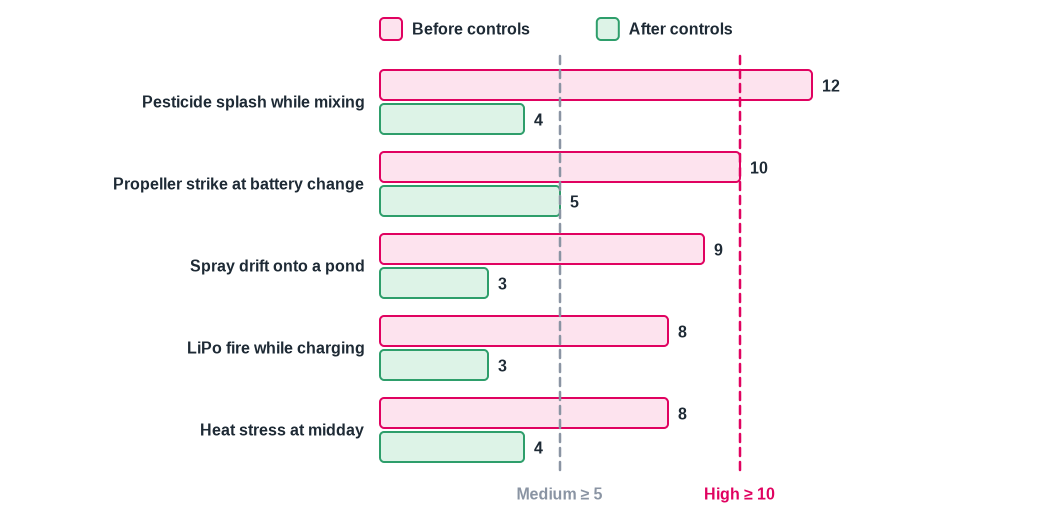
Pim joins the group in listing five hazards of the spraying job (assumed data), with the control and the scores before and after.
# Risk score R = L x S (likelihood L and severity S, scale 1-5). Bands: 1-4 low, 5-9 medium, 10 and above high
def band(r):
    return "high" if r >= 10 else "medium" if r >= 5 else "low"

hazards = [   # hazard, (L, S) before controls, type of control, (L, S) after controls (assumed data)
    ("pesticide splash while mixing", (3, 4), "engineering + PPE", (1, 4)),
    ("propeller strike at battery change", (2, 5), "administrative", (1, 5)),
    ("LiPo fire while charging", (2, 4), "engineering", (1, 3)),
    ("heat stress at midday", (4, 2), "administrative", (2, 2)),
    ("spray drift onto a pond", (3, 3), "administrative", (1, 3)),
]
for name, (l0, s0), control, (l1, s1) in sorted(hazards, key=lambda h: -h[1][0] * h[1][1]):
    r0, r1 = l0 * s0, l1 * s1
    print(f"{name:<36} {r0:>2} {band(r0):<6} -> {r1:>2} {band(r1):<6} {control}")
pesticide splash while mixing 12 high -> 4 low engineering + PPE
propeller strike at battery change 10 high -> 5 medium administrative
spray drift onto a pond 9 medium -> 3 low administrative
LiPo fire while charging 8 medium -> 3 low engineering
heat stress at midday 8 medium -> 4 low administrativeThe hazard to deal with first is the chemical splash during mixing (, high). A closed transfer system (engineering) with PPE cuts the likelihood from 3 to 1, but severity stays at 4 because the product is as harmful as before, leaving 4 (low). The propeller strike at battery change () falls to 5, medium, because the control is administrative (switch off before changing) and severity stays at 5. That residual 5 is the highest after controls, so the workplace mentor should acknowledge it before work starts, which agrees with the example in UAT 497 module 2.
Looking at the type of control, only two of the five are engineering controls and the rest are administrative, so the next question is whether any can move up the hierarchy, for example using propellers with guards instead of relying on procedure alone.
Professional ethics and accountability
Professional ethics is the principle of what a professional should do when the interests of several parties conflict. Accountability is being ready to explain and answer for your decisions, with records to back them. The code of ethics for engineers of the US National Society of Professional Engineers (NSPE, 2019) sets six fundamental canons. The ones that matter most to a student are: hold paramount the safety, health and welfare of the public (canon 1); perform services only in areas of competence (canon 2); and avoid deceptive acts (canon 5). The rules of practice add that if an engineer’s judgement is overruled in circumstances that endanger life or property, the engineer must notify the employer (II.1.a), and that engineers must not reveal facts, data or information without the prior consent of the client or employer (II.1.c). A student is not a professional engineer, but can use the same thinking.
When you meet an ethical problem, use six steps: (1) state the facts; (2) identify who is affected; (3) identify the rules, procedures and codes that apply; (4) list the options; (5) choose and act, which often means stop, ask or report; (6) record what you decided and why.
Example 2 The wind is over the limit but the client wants it finished today
A spraying mission that the workplace mentor has asked Pim to help with. The field edge is 20 metres from a fish pond. The company’s operating procedure forbids spraying when the wind is above 12 km/h. The anemometer at the field edge reads 18 km/h. Another pilot says, “Rain is coming tonight, so just do the edge quickly first” (all data assumed).
| Step | Pim’s analysis |
|---|---|
| 1 Facts | Wind 18 km/h exceeds the 12 km/h limit; the field edge is 20 m from the pond; spray could drift to the pond |
| 2 Who is affected | The pond owner and aquatic life, neighbours, the company (reputation and liability), the client |
| 3 Rules | The company’s operating procedure, the product label, and putting public safety and welfare first (NSPE canon 1) |
| 4 Options | Keep spraying, skip the part of the edge near the pond, wait for the wind to drop, or postpone the job |
| 5 Action | Tell the workplace mentor the number and the rule involved; propose waiting or postponing; do not spray the edge until the wind is below the limit; if the mentor still orders spraying while the risk remains, tell the company’s safety lead |
| 6 Record | Write the time, the wind reading, who was told and the decision in the work log |
A student does not have to argue with others in front of the client, but must not stay silent. Stating the fact as a number and asking to stop that work is both taking responsibility and protecting the company.
Confidentiality and personal data
Real work has two kinds of information that must be kept apart. Business confidential information is what the company or its client does not want disclosed, such as prices, work procedures and client names, usually covered by a non-disclosure agreement (NDA). The NSPE code (2019) likewise sets the principle of not revealing information without the consent of the employer or client. Personal data falls under the Personal Data Protection Act B.E. 2562 (Royal Gazette, 27 May 2019), whose main principles are these.
- Personal data is information about a person that makes it possible to identify them, directly or indirectly (section 6). Aerial images showing faces, number plates or the owner’s house can therefore be personal data.
- A data controller is the person with power to decide on the collection, use or disclosure of personal data (section 6). It needs consent before or at the time, unless the law allows otherwise, and must state the purpose (section 19); it may collect only what is necessary (section 22).
- Sensitive data, such as health data, disability, genetic data and biometric data, may not be collected without explicit consent, except in the cases listed (section 26).
- Security. A controller must have appropriate security measures, must have a system to delete or destroy data when the retention period ends or it is no longer needed, and must notify a personal data breach to the Office without delay and within 72 hours of becoming aware of it where practicable, unless the breach is unlikely to put people’s rights and freedoms at risk (section 37).
The exemption in section 4(1) is limited to collecting and using data for personal or family purposes only, so do not assume your own use of work data falls under it; ask whoever is responsible for data at the company. The table helps classify the information in one working day.
| Item | Business confidential | Personal data | How to handle |
|---|---|---|---|
| Client name and job price | Yes | No (if the client is a company) | Use a job code in records; do not take it outside company systems |
| Field photo showing the owner or house number | Possibly | Yes | Limit access, do not post, delete after the period the company sets |
| GPS position of an individual farmer’s plot | Yes | Possibly, if it can be tied to a person | Treat as personal data until told otherwise |
| Staff names and phone numbers | Yes | Yes | Use only as far as the work needs |
| The company’s operating procedures and mixing recipes | Yes | No | Follow the agreement; do not disclose |
| A staff member’s medical certificate | No | Yes, and sensitive | Keep no more copies than needed; follow company policy |
| Weather data from a public source | No | No | May be shared |
The rule a student can apply at once is: collect only what is needed, keep it where the company says, do not send it through personal apps, and report at once when data is lost, leaked or sent to the wrong person, because time that passes before the responsible person knows is taken from the time the organisation has to meet the law.
Example 3 The 72-hour clock when a laptop goes missing
Pim finds that the laptop holding field photographs went missing at 8:30 and tells the workplace mentor at 9:00 the same day (assumed data). For practice, count conservatively from the moment anyone on the team knows; when the organisation legally becomes aware is a question for the company’s data protection lead or legal staff.
from datetime import datetime, timedelta
# Assumed: a laptop holding field photographs is found missing, then the mentor is told
found = datetime(2026, 11, 3, 8, 30)
told_mentor = datetime(2026, 11, 3, 9, 0)
limit = timedelta(hours=72)                # PDPA section 37(4): within 72 hours of becoming aware, where practicable
deadline = found + limit
print(f"deadline {deadline:%d %b %Y %H:%M}")
print(f"time used before the mentor knew: {(told_mentor - found).total_seconds() / 3600:.1f} h")
print(f"time left for the organisation: {(deadline - told_mentor).total_seconds() / 3600:.1f} h")
deadline 06 Nov 2026 08:30
time used before the mentor knew: 0.5 h
time left for the organisation: 71.5 hTelling the mentor within 30 minutes leaves the organisation 71.5 hours to assess and report. If the student stays silent for two days, only 24 hours remain. That is why the student’s rule is to tell at once and not wait to be sure.
Digital workplace tools
Clause 4.2.2 of the CWIE notification asks the workplace to provide tools and technology for students to use appropriately, and clause 4.2.3 asks students to prepare digital skills. The table summarises common tools and how to use them safely.
| Type | Examples | Using them safely |
|---|---|---|
| Communication | Chat, email, online meetings | Use the accounts the company gives; check the recipient before sending; do not send client data through personal apps |
| Documents and files | Shared drive, company storage | Keep files where told; name them year-month-day_job_version, for example 2026-11-05_job12_report_v02, so they sort by time |
| Tasks and schedule | Task boards, work schedules | Update status daily; warn early when something will be late |
| Data and code | Spreadsheets, Python, GIS, version control | Use version control for code and scripts (Schnell, 2015); record how each result was produced |
| Flying and flight records | Ground control software, flight log apps | Use the versions and settings the company specifies; do not change parameters yourself |
The US Cybersecurity and Infrastructure Security Agency (CISA, n.d.) recommends four basic behaviours for everyone: avoid and report phishing scams, use strong passwords, use multifactor authentication and a password manager, and update software. One more for the workplace: before putting work data into any online tool, including an external artificial-intelligence tool, ask what the company’s policy is, because what you type in may be confidential or personal data as described above.
Planning work or a project
Good planning starts by breaking the large job into smaller tasks, a work breakdown structure (WBS), as defined by GAO (2015). A reliable schedule must include all the work in the WBS, sequence and link tasks by their dependencies, and identify the critical path, the path of longest duration through the sequence of activities. That path determines the earliest finish of the whole job. A task that is not on the critical path has float, the time it can slip before the finish date is affected.
If is the duration of task , the earliest start is the largest earliest finish among the tasks that must come before it, and . Float is , where is the latest start that does not delay the finish.
Example 4 Pim plans her first job from preparation to report
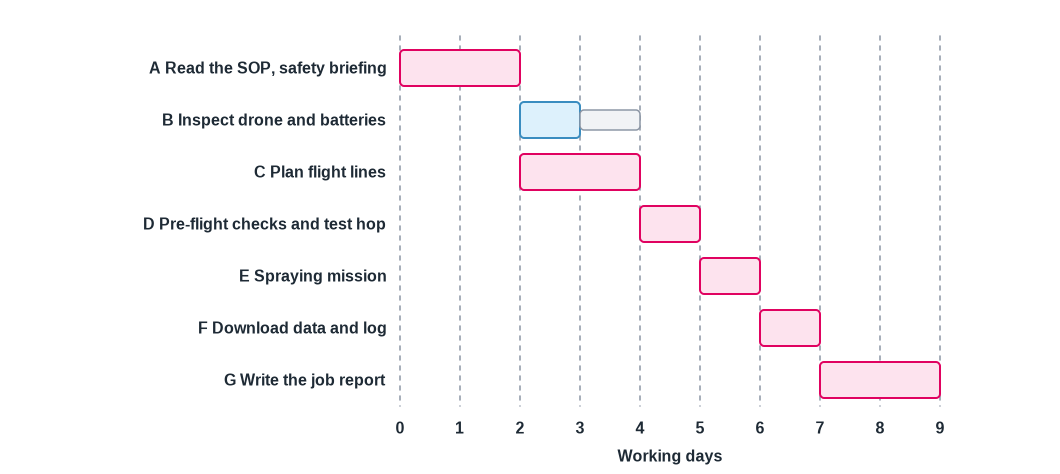
The workplace mentor asks Pim to follow the first spraying job from preparation to report (as an assistant, not as the pilot). Pim breaks it into seven tasks (assumed data).
tasks = {   # task: (duration in days, tasks that must finish first), in an order that can be done (assumed data)
    "A": (2, []), "B": (1, ["A"]), "C": (2, ["A"]), "D": (1, ["B", "C"]),
    "E": (1, ["D"]), "F": (1, ["E"]), "G": (2, ["F"]),
}
es, ef = {}, {}                                        # earliest start and finish (forward pass)
for t, (d, pre) in tasks.items():
    es[t] = max((ef[p] for p in pre), default=0)
    ef[t] = es[t] + d
end = max(ef.values())
ls = {}                                                # latest start that does not delay the end (backward pass)
for t in reversed(tasks):
    succ = [s for s, (d, pre) in tasks.items() if t in pre]
    ls[t] = min((ls[s] for s in succ), default=end) - tasks[t][0]
for t in tasks:
    print(f"{t}: day {es[t]} to {ef[t]}, float {ls[t] - es[t]}")
critical = [t for t in tasks if ls[t] == es[t]]
print("critical path:", " > ".join(critical), f"= {end} days")
A: day 0 to 2, float 0
B: day 2 to 3, float 1
C: day 2 to 4, float 0
D: day 4 to 5, float 0
E: day 5 to 6, float 0
F: day 6 to 7, float 0
G: day 7 to 9, float 0
critical path: A > C > D > E > F > G = 9 daysThe whole job takes 9 days. The critical path is A > C > D > E > F > G, because C (planning flight lines, 2 days) takes longer than B (inspecting the drone and batteries, 1 day). So B has 1 day of float: if B slips a day the finish date does not change, but if C slips a day the whole job finishes a day late. Pim must therefore watch C more closely than B, and when any task is about to slip she must tell the workplace mentor before the deadline (module 2).
UAT 497 module 3 uses this idea again when writing the project charter. Habits to begin now: write a weekly plan every Friday, check which tasks are on plan or behind, and tell the workplace mentor early when a task on the critical path will slip.
Work logs and reporting
Clause 4.2.3 of the CWIE notification asks students to write daily and weekly reports that give their opinions and feelings during the work in a reflective-analysis form set by the institution, to send progress reports to the workplace mentor and the supervising lecturer as agreed, and to send a complete (draft) report before the placement ends.
The daily log should be short but checkable. It has the date, task, hours, tools used, result, problems or what was learned, and the workplace mentor’s signature each week. Schnell’s (2015) rules for a research notebook carry over to co-op logs: every entry has a date, subject and protocol (rule 5); record how every result was produced (rule 6); use version control for code (rule 7); and protect your notebook (rule 10). For co-op, the last one means using a job code instead of the client’s name and real coordinates, and keeping the log where the company says.
The weekly reflective report uses the six stages of Gibbs’ (1988) reflective cycle: description, feelings, evaluation, analysis, conclusion and action plan. The stage most often missing is analysis, meaning why the result happened and how it connects to what was learned in class. In Pim’s week-3 entry (assumed) she describes helping check 6 batteries and finding that one sagged in voltage quickly; says she felt worried about reporting late; evaluates that she reported at once; analyses that the fast voltage sag may come from internal resistance rising as the battery ages; concludes that the battery should be set aside; and plans to ask next week to see the charge-cycle records of every battery. An entry that says only “checked batteries today” is a work log, not a reflection.
Example 5 Cumulative hours against the plan
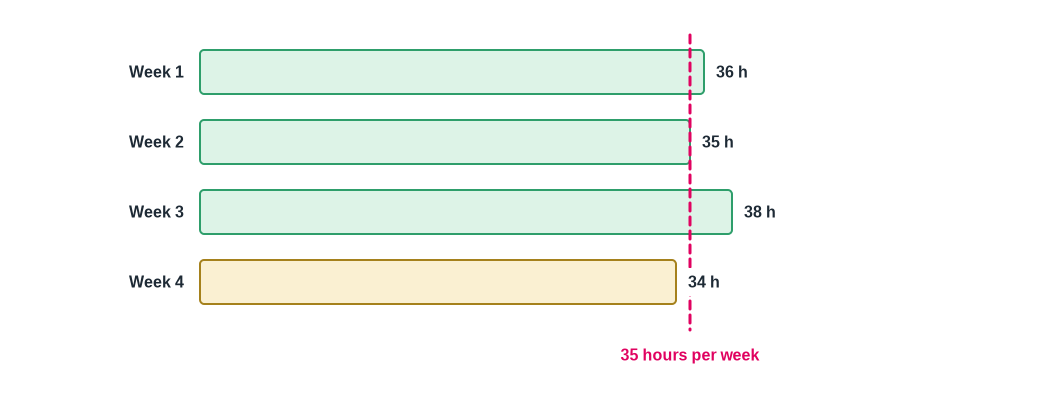
The hours Pim logged and had signed by the workplace mentor in her first four weeks are 36, 35, 38 and 34 (assumed data). The UAT 497 plan is 560 hours over 16 weeks (Example 1 of module 1).
planned_total = 35 * 16                   # plan from UAT 497: 560 hours (Example 1 of module 1)
logged = [36, 35, 38, 34]                 # hours logged and signed by the mentor, weeks 1-4 (assumed)
cum = 0
for week, h in enumerate(logged, start=1):
    cum += h
    on_plan = planned_total * week / 16
    print(f"week {week}: {h} h, total {cum} h ({cum / planned_total:.1%}), plan {on_plan:.0f} h, difference {cum - on_plan:+.0f} h")
week 1: 36 h, total 36 h (6.4%), plan 35 h, difference +1 h
week 2: 35 h, total 71 h (12.7%), plan 70 h, difference +1 h
week 3: 38 h, total 109 h (19.5%), plan 105 h, difference +4 h
week 4: 34 h, total 143 h (25.5%), plan 140 h, difference +3 hAfter week 4 Pim has 143 hours (25.5% of 560) against a plan of 140 hours (25%), so she is on plan. Checking like this every week shows a delay at the start, not in the last week.
The sequence of reports through the placement is: daily log, weekly reflective report, progress report to the workplace mentor and supervising lecturer, draft report before the end, and the complete report with a presentation afterwards (clause 4.2.3), which UAT 497 module 5 teaches. Before any report is released, have the workplace mentor check that it contains no confidential or personal data.
Module lab
Lab: getting ready for the first week
- Read a sample three-party agreement, or the one your lecturer gives you, and summarise the student’s safety rights and duties in half a page, noting what the agreement does not mention and what you must ask about
- Choose one job of the workplace you studied (or the one your lecturer assigns) and, with your group, list at least five hazards. Score and before and after controls with the code in Example 1, and say which level of the hierarchy each control sits on and how many could move up
- Analyse one ethical problem with the six steps in Example 2, and say whom you would tell and in what words
- Classify the information in one working day, at least eight items, into business confidential and personal data, write how to handle each, and practise computing the reporting deadline with the code in Example 3 using times your lecturer gives
- Set up a folder structure and file names for the co-op, turn on multifactor authentication on your institution account, and review how to deal with phishing under your institution’s policy (desk work, no flying)
- Break the first week’s work into at least six tasks with durations and dependencies, and find the critical path and float with the code in Example 4
- Keep a daily log for five days in the format you are given, write a one-page reflective report using Gibbs’ cycle, and compute cumulative hours against the plan with the code in Example 5
Common mistakes
Watch out
- Skipping safety steps because others skip them. Follow the procedure and ask when unsure
- Not reporting near misses for fear of being blamed
- Assuming controls always reduce severity, when many only reduce likelihood, and trusting PPE more than controls higher in the hierarchy
- Staying silent under pressure to break procedure, instead of stating the fact as a number and asking to stop or report
- Sending client images or data through personal apps, or posting site photos without permission
- Waiting to be sure before reporting lost data, so the company’s time runs out
- Writing the log weeks later, so details are forgotten, and entries that only describe, with no analysis
Summary
- Section 4 of the safety act includes in “employee” anyone permitted to work, by whatever name. Employers must provide safe conditions, train before work starts and supply PPE; employees must cooperate, report defects they cannot fix and wear PPE
- Assess risk with , choose controls down the hierarchy (eliminate, substitute, engineer, administer, PPE), and report near misses
- Analyse ethical problems in six steps, put public safety first, and record the decision
- Separate business confidential information from personal data, collect only what is needed, and report a leak at once because the law gives the organisation 72 hours
- Use digital tools under company policy and follow the four basic security behaviours
- Plan with a WBS, critical path and float, and keep daily logs and weekly six-stage reflective reports
Check your understanding
- A job has likelihood 4 and severity 3. What is its risk score and what band is it in under the bands in this module?
- Under section 21 of the safety act, whom must an employee tell about a defect they cannot fix themselves?
- A data breach is discovered at 10:00 on a Monday. If the 72 hours are counted from that time, when does the deadline fall?
- Task P takes 3 days. Task Q takes 2 days and must follow P. Task R takes 4 days and must follow P. Task S takes 1 day and must follow Q and R. What is the critical path, how many days does it take, and which task has how many days of float?
- The hours logged in the first five weeks are 36, 35, 38, 34 and 33, against a plan of 560 hours over 16 weeks. What is the cumulative total, and how far is it from the week-5 plan?
Answers
- , high (10 and above)
- The safety officer, a supervisor or a manager
- 72 hours is 3 days, so the deadline is 10:00 on Thursday
- The critical path is P > R > S, taking days. Task Q has days of float
- The total is hours. The week-5 plan is hours, so the difference is +1 hour
Key formulas
| Risk score | |
| Earliest start and finish of task i | |
| Float | |
| Deadline for reporting a data breach |
Key references
- พระราชบัญญัติความปลอดภัย อาชีวอนามัย และสภาพแวดล้อมในการทำงาน พ.ศ. 2554. (2554). ราชกิจจานุเบกษา, 128(4 ก). link
- คณะกรรมการมาตรฐานการอุดมศึกษา. (2565). ประกาศคณะกรรมการมาตรฐานการอุดมศึกษา เรื่อง หลักเกณฑ์และแนวปฏิบัติเพื่อส่งเสริมการจัดหลักสูตรสหกิจศึกษาและการศึกษาเชิงบูรณาการกับการทำงาน พ.ศ. 2565. link
- Occupational Safety and Health Administration. (2002). Job hazard analysis (OSHA 3071, revised). U.S. Department of Labor. link
- National Institute for Occupational Safety and Health. (2024). About hierarchy of controls. Centers for Disease Control and Prevention. link
- Health and Safety Executive (HSE). (n.d.). Steps needed to manage risk [Web page]. HSE, Great Britain. link
- National Society of Professional Engineers (NSPE). (2019). NSPE code of ethics for engineers (rev. July 2019). NSPE. link
- พระราชบัญญัติคุ้มครองข้อมูลส่วนบุคคล พ.ศ. 2562. ราชกิจจานุเบกษา, 136(69 ก), 52–95. link
- Cybersecurity and Infrastructure Security Agency (CISA). (n.d.). Secure Our World [Web page]. U.S. Department of Homeland Security. link
- U.S. Government Accountability Office (GAO). (2015). Schedule assessment guide: Best practices for project schedules (GAO-16-89G). link
- Gibbs, G. (1988). Learning by doing: A guide to teaching and learning methods. Further Education Unit, Oxford Polytechnic. link
- Schnell, S. (2015). Ten simple rules for a computational biologist's laboratory notebook. PLOS Computational Biology, 11(9), e1004385. link
- สำนักงานการบินพลเรือนแห่งประเทศไทย. (2569). ประกาศ กพท. เรื่อง หลักเกณฑ์และวิธีการในการอนุญาตให้ผู้บังคับหรือปล่อยอากาศยานซึ่งไม่มีนักบิน ประเภทอากาศยานที่ควบคุมการบินจากภายนอก ที่มีน้ำหนักไม่เกิน 25 กิโลกรัม ปฏิบัติแตกต่างไปจากเงื่อนไขที่กำหนด พ.ศ. 2569 (มีผล 17 พฤษภาคม 2569). link
Further reading
Study the assigned knowledge units in advance, review media and take the module quiz
In class / field
Lab or field practice from worksheets with a safety checklist
Learning evidence: Checked worksheets and quiz results