Applications, CV, interviews and workplace communication
UAT 496 Preparation for Work-Integrated Learning and Co-operative Education
Lesson
By the end of this module you will be able to
- Write a CV that rests on evidence and numbers, and audit its statements with a check you can repeat
- Prepare job application documents and give only the personal data that is needed
- Answer behavioural interview questions with the STAR structure and understand how a panel scores
- Communicate clearly at work, work in a team through the stages of group development, and behave professionally
Why this matters
Pim has chosen company A (module 1). The next step is to make the company choose her. Application documents are the first evidence the company sees, interview answers are the second, and her first week of work is the last, confirming that the first two were true. The skills in this module are not only for applying. Clear communication, teamwork and professionalism are what a workplace mentor watches from day one, and they are three of the eight career-readiness competencies summarised by NACE (n.d.). Clause 4.2.3 of the CWIE notification asks students to prepare a job application and CV, and to prepare emotional, social, language and teamwork skills before the placement. This module covers all of them.
Application documents
A co-op application package usually has a CV (or resume), a short cover letter, the application form of the workplace or the co-op centre, a transcript, referees who have already agreed, and a portfolio if there is one.
Writing a CV that reads fast and carries evidence
The career-centre guide of Harvard College (Harvard FAS Mignone Center for Career Success, n.d.) sets out principles that apply widely.
- Keep it concise and easy to skim; order the headings by importance and the entries under each heading from newest to oldest
- Start each statement with an action verb, and keep the language specific and plain
- Quantify and show results, because “not demonstrating results” is a common mistake
- Tailor the content to the role, and proofread spelling and grammar closely, which is among the top mistakes
- Keep the cover letter to one page
The same guide advises leaving out a photo, age and gender, which is that university’s own advice. Customs differ by country and by organisation. If the form from a workplace or from the co-op centre asks for something, follow that form, but do not give more than is asked.
Think about your own personal data too. Under the Personal Data Protection Act B.E. 2562, a data controller may collect only what is necessary for a lawful purpose (section 22) and must tell the data subject the purpose (section 23). So before sending documents, ask what they will be used for; do not send an identity card copy or other important documents before they are really needed; and do not list a referee’s name and phone number without permission.
Example 1 Auditing the statements in Pim’s CV
Pim wrote seven statements in her first CV and audited them with two simple checks: does it start with an action verb, and does it contain a number (all data assumed).
import re
# CV statement checks: (1) starts with an action verb (2) contains a number
ACTION = {"built", "led", "tested", "wrote", "surveyed", "reduced", "presented", "measured", "planned"}
before = [
    "Responsible for drone project",
    "Hard-working and team player",
    "Built a hexacopter frame for a class project",
    "Helped with testing",
    "Wrote Python script to log battery voltage",
    "Good communication skills",
    "Surveyed a 12-rai plot with a drone",
]
after = [   # rewritten from evidence; adjectives without evidence removed (assumed numbers)
    "Led a team of 4 to build a hexacopter for a class project",
    "Tested the frame in 20 flights and logged battery voltage with a Python script",
    "Surveyed a 12-rai plot with a drone and delivered a map at 3 cm per pixel",
    "Wrote a pre-flight checklist of 15 items used by the whole class",
    "Reduced image blur by setting the shutter to 1/1000 s",
    "Presented project results to 30 classmates and 2 lecturers",
]

def flags(text):
    return text.split()[0].lower() in ACTION, bool(re.search(r"\d", text))

for b in before:
    v, m = flags(b)
    print(f"[{'v' if v else '-'}{'n' if m else '-'}] {b}")
for name, bullets in (("before", before), ("after", after)):
    rows = [flags(b) for b in bullets]
    n = len(rows)
    both = sum(v and m for v, m in rows)
    print(f"{name:<6} {n} bullets: action verb {sum(v for v, m in rows)}, number {sum(m for v, m in rows)}, both {both} ({both / n:.0%})")
[--] Responsible for drone project
[--] Hard-working and team player
[v-] Built a hexacopter frame for a class project
[--] Helped with testing
[v-] Wrote Python script to log battery voltage
[--] Good communication skills
[vn] Surveyed a 12-rai plot with a drone
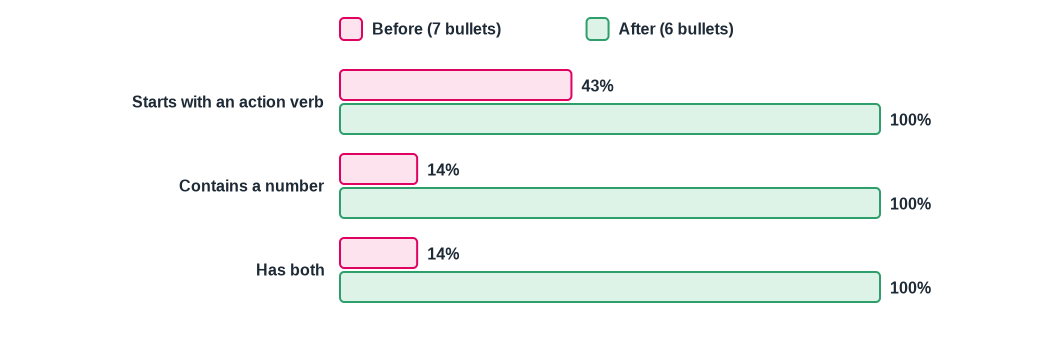
before 7 bullets: action verb 3, number 1, both 1 (14%)
after 6 bullets: action verb 6, number 6, both 6 (100%)Only one of the seven first-draft statements (14%) passes both checks. Most of the others are adjectives such as “Hard-working” and “Good communication skills”, which a reader cannot check, so they were removed. Statements that describe real activity but have no number, such as “Helped with testing”, were rewritten to say what was done, how many, and with what result. The revised version passes 6 of 6.
The number check in the code is crude: any digit passes, so “year 3” would pass even though it is not a result. A person must still judge whether the number means something and is true. Pim must be able to explain every number in the interview, so she must never write a number she cannot defend.
Job interviews
Interviews come in several forms: by phone, online or in person, one to one or in front of a panel, sometimes with a skills test. What you can prepare for every form is the following.
- Study the organisation, using the information collected in module 1
- Review what you wrote in your CV; you must be able to explain every line and every number
- Prepare questions to ask back, such as who the workplace mentor is and how experienced, what a typical week involves, what the safety procedures are, whether students fly and under whose licence, and how the evaluation works
- Rehearse and prepare equipment; for an online interview test the camera, microphone and connection first, and arrive early
Behavioural questions and the STAR structure
A question that begins “Tell me about a time when…” asks how you handled a situation in the past. The Career & Internship Center of the University of Washington (n.d.) recommends the STAR structure, which is also the one used in UAT 497 module 1.
- S (Situation): enough context to understand the example, without every detail
- T (Task): the goal or problem you were responsible for; keep it brief
- A (Action): the specific steps you took yourself, even if you worked in a team
- R (Result): the outcome, ideally with a number or something measurable, and what you learned
The guide suggests a rough time split of about 20% for S, 10% for T, 60% for A and 10% for R, because Action is what interviewers most want to hear.
Example 2 A two-minute STAR answer about a swollen battery
Question: “Tell me about a time you found a safety problem.” Pim’s answer (assumed data):
S Last year in a practical course, before our team’s practice flight, I was packing batteries and saw that one LiPo battery was swollen. T I was responsible for checking the team’s six batteries before flight. A I put that one in a fire-safe bag, labelled it not to be used, told the lecturer straight away, and proposed adding “check for swollen batteries” to the pre-flight checklist. R The team switched to a spare battery and carried on flying with no incident. The room’s pre-flight checklist grew from 14 to 15 items. I learned to look at the physical condition before looking at the voltage numbers.
For an answer of 2 minutes (120 seconds), the time divides according to the suggested split.
total = 120                                       # a two-minute answer (seconds)
share = {"Situation": 0.20, "Task": 0.10, "Action": 0.60, "Result": 0.10}   # suggested split
for part, f in share.items():
    print(f"{part:<9} {f:>4.0%} = {total * f:.0f} s")
Situation 20% = 24 s
Task 10% = 12 s
Action 60% = 72 s
Result 10% = 12 sAction gets 72 seconds, enough to describe three actions. Situation and Task together take 36 seconds. If Pim spends more than half a minute on the situation, she has less time for the part the interviewer wants most.
How a panel scores
Research on structured interviews, which generally ask applicants the same set of questions and score them on set scales, is reviewed by Levashina and colleagues (2014), covering situational versus past-behaviour questions, rating scales and the reduction of bias, among other topics. What a student can use is this: interviewers usually have criteria and weights already, and the score on each criterion comes from the examples you give, not from a general impression.
Example 3 Pim’s interview scores at company A
A panel of three scores her from 1 to 5 on four criteria whose weights total 100 (assumed data).
weights = {"technical knowledge": 30, "communication": 25, "teamwork": 25, "safety awareness": 20}
scores = {   # each interviewer's scores, 1-5 (assumed data)
    "interviewer 1": {"technical knowledge": 4, "communication": 3, "teamwork": 4, "safety awareness": 3},
    "interviewer 2": {"technical knowledge": 3, "communication": 4, "teamwork": 4, "safety awareness": 1},
    "interviewer 3": {"technical knowledge": 4, "communication": 3, "teamwork": 5, "safety awareness": 3},
}
n = len(scores)
for k in weights:
    vals = [s[k] for s in scores.values()]
    note = "  <- panel disagrees, ask why" if max(vals) - min(vals) >= 2 else ""
    print(f"{k:<20} mean {sum(vals) / n:.2f}  spread {max(vals) - min(vals)}{note}")
total = sum(w * sum(s[k] for s in scores.values()) / n for k, w in weights.items()) / sum(weights.values())
print(f"weighted mean {total:.2f} of 5 ({total / 5:.1%})")
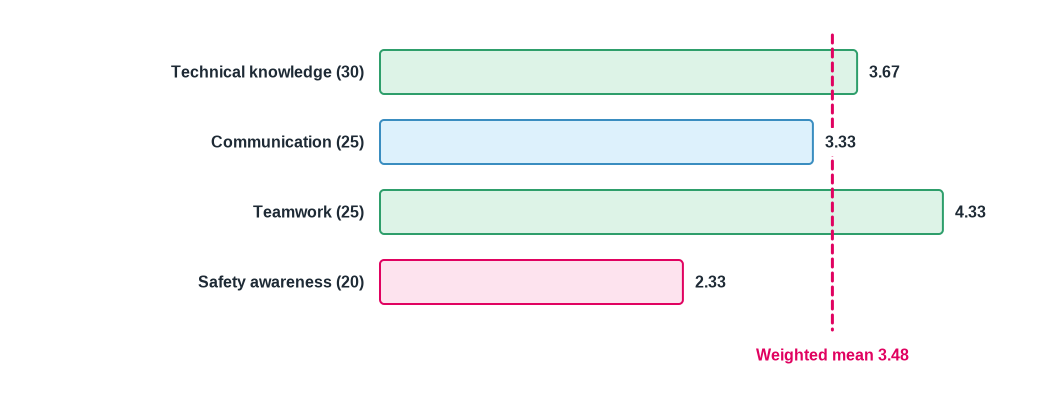
technical knowledge mean 3.67 spread 1
communication mean 3.33 spread 1
teamwork mean 4.33 spread 1
safety awareness mean 2.33 spread 2 <- panel disagrees, ask why
weighted mean 3.48 of 5 (69.7%)The weighted total is 3.48 out of 5 (69.7%). The lowest criterion is safety awareness (2.33), and it is the only one on which the interviewers differ by much (scores of 3, 1 and 3). Data like this says Pim answered the safety question without a clear enough example, so one interviewer scored it lowest. The fix is to prepare one STAR story about safety, such as the swollen battery in Example 2, and to learn the safety tools in module 3.
Workplace communication
NACE (n.d.) describes communication as clearly and effectively exchanging information, ideas, facts and perspectives with people inside and outside an organisation. Three things need practice in a real workplace.
Choose the channel to fit the job
| Channel | Good for | Watch out for |
|---|---|---|
| Face to face or phone | Urgent matters, safety, sensitive topics | No record; follow up in writing |
| Chat | Short questions, status | Important decisions made in chat and then lost |
| Formal messages, records, attachments | A wrong recipient or attachment is a data leak (module 3) | |
| Meeting | Joint decisions | No agenda and nobody recording decisions |
Write so the reader can decide quickly. The US government’s plain-language guidance starts from the same principle: write for the specific audience (Digital.gov, n.d.). A workplace mentor has other work too, so put the conclusion or the request first, follow with the facts, and close with what you need from the reader and by when.
Example 4 Reporting a delay, before and after
Before (assumed message): “Hi, I think I might not finish the report in time. There is a small problem with the image data.”
After: “Hi, the flight report for the 12th will be 1 day late: tomorrow 10:00 instead of today 16:00, because the data from flight 2 has not finished loading. I will update you again at 14:00. If it really must go today, I need one person to check the report.”
The revised message says first what has happened and how late it will be, gives the reason as a fact, says when the next update will come, and says what is needed. The mentor can decide at once without asking anything back.
Listen and ask back. When given an instruction, repeat what you heard (for example, “So I check all 6 batteries before flight and report to you at 9:00?”). If unsure, ask before acting; asking first always costs less than fixing work afterwards. When you receive feedback, listen to the end, note the points, and ask for an example if you do not follow, before you respond. For safety matters, speak at once by the fastest channel; do not wait until the job is finished.
Teamwork
NACE (n.d.) defines teamwork as building and maintaining collaborative relationships to work towards common goals while appreciating diverse viewpoints and shared responsibilities. A team is not good the moment it is formed. Tuckman (1965) proposed that small groups pass through forming, storming, norming and performing, and Tuckman and Jensen (1977) later added adjourning.
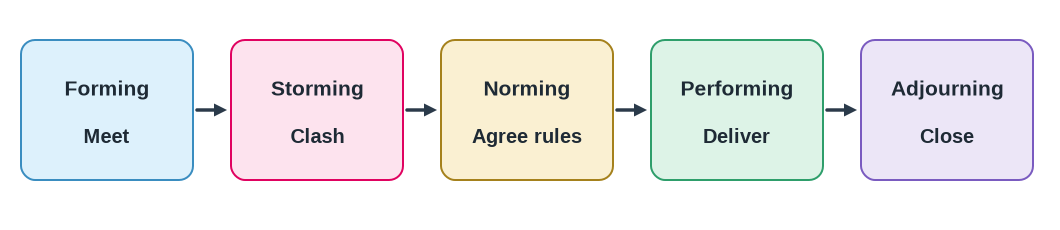
In a field team, forming means nobody yet knows who does what; storming means arguing over who has the right to say “clear to fly”; norming means agreeing the callouts and how they are repeated back; performing means working to the agreed rhythm; and adjourning means handing over, noting lessons and thanking each other. Talking about the rules from the start helps a team pass through storming faster.
Another important idea is psychological safety. Edmondson (1999) defined it as a shared belief among team members that the team is safe for interpersonal risk taking, and found in work teams at a manufacturer that it was associated with the teams’ learning behaviour. In practice, a student will dare to ask questions and to report near misses only if the team makes asking feel like no fault.
Example 5 A one-page team agreement for a three-person flight crew
A three-person flight crew at company A writes a short agreement (assumed data).
| Topic | Agreement |
|---|---|
| Roles | Pilot, observer and data keeper, rotated weekly with the team leader’s approval |
| Commands and read-back | The pilot announces “taking off”; the observer repeats “taking off” before the start; every change of plan is repeated back |
| Decisions | The team leader decides; anyone may call a stop when they see danger |
| Disagreements | Talk to the person involved first; if unresolved, take it to the team leader |
| Handover | Every flight has a short note on what was done and what is left |
Professionalism and personal presentation
NACE (n.d.) describes professionalism as knowing that work environments differ greatly, understanding and demonstrating effective work habits, and acting in the interest of the larger community and workplace. The personal impression a mentor forms is the sum of small behaviours every day, not appearance alone.
| Area | Expected behaviour |
|---|---|
| Time | Be punctual; if you will be late or absent, tell the mentor in advance and say when you will arrive |
| Dress | Neat and suited to the site; in the field always wear the protective equipment the company requires |
| Speech and manners | Greet politely, listen before speaking, address colleagues in the way the workplace does |
| Honesty | Never invent figures, admit mistakes early, say “I do not know” when you do not |
| Responsibility | Deliver on time; if it will be late, say so before the deadline, with the reason |
| Social media | Do not post workplace images or information without permission (module 3) |
| Receiving feedback | Listen to the end, thank the person and adjust, do not defend yourself at once |
| Respect for diversity | Treat everyone equally, because NACE treats it as a competency of its own |
A mentor’s trust is built from these behaviours repeated from the first week, in the same spirit as the section “Doing routine work that earns trust” in UAT 497 module 3.
Module lab
Lab: application pack and mock interview
- Choose one real co-op posting (or the one your lecturer assigns), write a one-page CV, and audit its statements with the code in Example 1 until every statement passes (if the CV is in Thai, apply the same checks by hand)
- Write a cover letter of no more than one page, and a list of the personal data you will and will not give on the form, with reasons
- Prepare three STAR answers: a job that went off plan, teamwork, and safety. Time each to two minutes using the split in Example 2
- Hold mock interviews in groups of three: one answers, two score on the four criteria with the same weights. Summarise with the code in Example 3 and find any criterion where scores differ by 2 or more, then discuss why
- Together write a one-page team agreement (roles, channels, decisions, disagreements, handover), and write one message reporting a delay with the conclusion first. Ask a classmate whether they could decide at once or would have to ask back
Common mistakes
Watch out
- A CV full of adjectives such as “hard-working, responsible” with no checkable work
- Writing numbers you cannot explain, then being asked about them in the interview
- Answering every behavioural question with “we”, so the interviewer cannot tell what you did
- Spending too long on the situation, leaving too little time for what you did and the result
- Reporting a delay vaguely, or only once the deadline has arrived
- Staying silent when you see danger for fear of looking ignorant
Summary
- Application documents need evidence: CV statements start with an action verb, carry numbers you can defend, and give only the personal data that is needed
- Answer behavioural questions with STAR, putting most time (about 60%) on Action and ending with a measurable result
- Panels often score by criteria and weights, ; a criterion on which scorers differ widely shows that your example was unclear
- Choose the channel to fit the job, put the conclusion first, and repeat instructions back
- Teams pass through forming, storming, norming, performing and adjourning; a team agreement and psychological safety help them reach performing sooner
- Professionalism is small behaviours repeated daily: be punctual, honest and responsible, and listen to feedback
Check your understanding
- A CV has 8 statements and 6 pass both checks. What percentage passes?
- A STAR answer lasts 150 seconds, split 20%, 10%, 60%, 10%. How many seconds should Action take?
- Two criteria have weights 40 and 60, and the panel’s mean scores are 3 and 4. What is the weighted score?
- In which Tuckman stage is conflict most common, and what helps a team get through it faster?
- What should a message reporting a delay begin with?
Answers
- seconds
- Storming. Agreeing the team’s rules from the start, such as roles, commands and how decisions are made, helps it pass faster
- The conclusion: what is late and by how long, with what you need from the reader, followed by the reason and the time of the next update
Key formulas
| Share of CV statements that pass | |
| Time for part j of a STAR answer | |
| Weighted interview score |
Key references
- คณะกรรมการมาตรฐานการอุดมศึกษา. (2565). ประกาศคณะกรรมการมาตรฐานการอุดมศึกษา เรื่อง หลักเกณฑ์และแนวปฏิบัติเพื่อส่งเสริมการจัดหลักสูตรสหกิจศึกษาและการศึกษาเชิงบูรณาการกับการทำงาน พ.ศ. 2565. link
- National Association of Colleges and Employers (NACE). (n.d.). Career readiness competencies: Career readiness defined [Web page]. NACE. link
- Harvard FAS Mignone Center for Career Success. (n.d.). Harvard College guide to creating a strong resume [Web page]. Harvard University. link
- University of Washington Career & Internship Center. (n.d.). STAR method of interviewing [Web page]. University of Washington. link
- Levashina, J., Hartwell, C. J., Morgeson, F. P., & Campion, M. A. (2014). The structured employment interview: Narrative and quantitative review of the research literature. Personnel Psychology, 67(1), 241–293. link
- Digital.gov. (n.d.). Plain language guide series [Web page]. U.S. General Services Administration. link
- Tuckman, B. W. (1965). Developmental sequence in small groups. Psychological Bulletin, 63(6), 384–399. https://doi.org/10.1037/h0022100 link
- Tuckman, B. W., & Jensen, M. A. C. (1977). Stages of small-group development revisited. Group & Organization Studies, 2(4), 419–427. https://doi.org/10.1177/105960117700200404 link
- Edmondson, A. (1999). Psychological safety and learning behavior in work teams. Administrative Science Quarterly, 44(2), 350–383. link
- พระราชบัญญัติคุ้มครองข้อมูลส่วนบุคคล พ.ศ. 2562. ราชกิจจานุเบกษา, 136(69 ก), 52–95. link
Further reading
Study the assigned knowledge units in advance, review media and take the module quiz
In class / field
Lab or field practice from worksheets with a safety checklist
Learning evidence: Checked worksheets and quiz results