Pre-placement preparation
UAT 497 Work-Integrated Learning in Unmanned Aircraft Systems and Automation Technology
Lesson
By the end of this module you will be able to
- Explain cooperative and work-integrated education (CWIE) and the four learning-outcome domains
- Choose a placement with clear, weighted criteria
- Write a personal learning plan linking work to the course CLOs
- Prepare documents and legal conditions before starting, such as drone flight rules, confidentiality and personal data
Why this matters
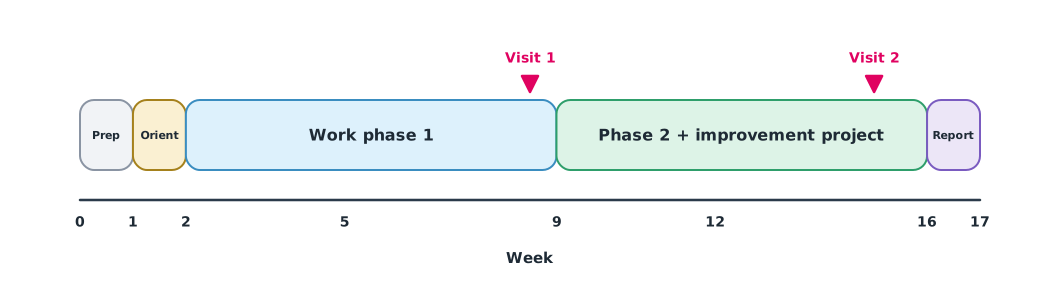
A workplace placement is the first time students apply classroom knowledge to real work, with real clients, real deadlines and real risks. Poor preparation means the first weeks go on paperwork, or on work that does not match what needs to be learned. This course uses one hypothetical case throughout: a student on a 16-week placement at a drone survey services company. All numbers and names are hypothetical. The Python code can be downloaded from /downloads/uat-497/.
CWIE and learning outcomes
Thailand’s Higher Education Act B.E. 2562 (2019), sections 35–36, has institutions work with the public and private sectors so students learn through real work, and allows part of a study programme to be spent at a workplace. The Ministry of Higher Education (MHESI) uses the umbrella term Cooperative and Work-Integrated Education (CWIE), following WACE, the world association, which covers every form of experiential learning from co-op and internships to service learning. In Thailand, the Thai Association for Cooperative Education is the professional network.
The placement must be assessed against the four learning-outcome domains of the Ministerial Regulation on Higher Education Qualification Standards B.E. 2565 (2022): knowledge, skills, ethics and character. This course has three CLOs: applying knowledge to real work, working to safety and quality standards, and communicating and reflecting professionally.
Choosing a placement
A good placement is not just a well-known company: it needs work that matches the programme, a mentor with time to teach and a safety system that is actually used. A weighted scoring table supports a reasoned decision that can be explained to the lecturer.
Example 1 Choosing between three companies
Scores of 1–5 from interviews and site visits (hypothetical companies).
criteria = {                        # criterion: weight
    "UAS work relevance": 0.30,
    "mentor availability": 0.20,
    "safety system in use": 0.20,
    "travel and cost": 0.15,
    "improvement project chance": 0.15,
}
scores = {
    "SurveyAir Co.": [5, 3, 4, 3, 4],
    "AgriDrone Ltd.": [4, 5, 3, 4, 3],
    "City Inspections": [3, 4, 5, 5, 2],
}
assert abs(sum(criteria.values()) - 1) < 1e-9
w = list(criteria.values())
for name, s in sorted(scores.items(), key=lambda kv: -sum(a * b for a, b in zip(w, kv[1]))):
    total = sum(a * b for a, b in zip(w, s))
    weakest = min(zip(s, criteria), key=lambda x: x[0])[1]
    print(f"{name:<17} score {total:.2f} / 5, weakest: {weakest}")
SurveyAir Co. score 3.95 / 5, weakest: mentor availability
AgriDrone Ltd. score 3.85 / 5, weakest: safety system in use
City Inspections score 3.75 / 5, weakest: improvement project chanceThe top two scores are close, as often happens in real decisions. Look at each option’s weakest point too, and ask whether it can be fixed during the placement; an unavailable mentor is harder to fix than a long commute.
A personal learning plan
Before starting, write a plan of what you will learn, through which work, and how it will be measured. Use SMART goals: specific, measurable, achievable, relevant and time-bound, for example “by week 6, process aerial images independently end to end on at least 3 jobs”. Then check that the plan covers every CLO and every learning-outcome domain.
Example 2 Checking plan coverage
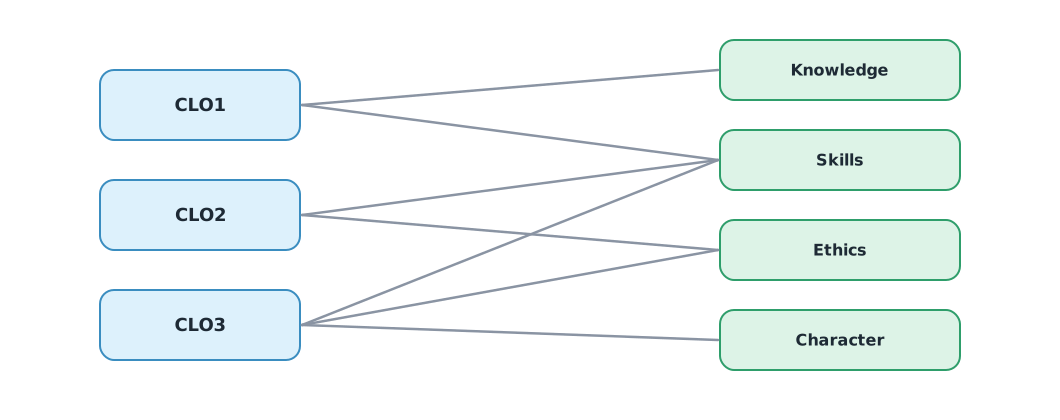
Planned tasks, each with the CLOs and domains it is expected to develop; every item needs at least two tasks.
plan = [
    ("process aerial images end to end", ["CLO1"], ["knowledge", "skills"]),
    ("pre-flight checks and risk briefing", ["CLO2"], ["skills", "ethics"]),
    ("battery maintenance log", ["CLO2"], ["skills"]),
    ("weekly report to mentor", ["CLO3"], ["skills", "character"]),
    ("client data handling under NDA", ["CLO2"], ["ethics"]),
    ("process improvement project", ["CLO1", "CLO3"], ["knowledge", "skills", "character"]),
]
MIN_TASKS = 2
for label, keys, idx in (("CLO", ["CLO1", "CLO2", "CLO3"], 1),
                         ("domain", ["knowledge", "skills", "ethics", "character"], 2)):
    for k in keys:
        n = sum(k in task[idx] for task in plan)
        print(f"{label:<6} {k:<10} {n} task(s) {'ok' if n >= MIN_TASKS else '<- add a task'}")
CLO CLO1 2 task(s) ok
CLO CLO2 3 task(s) ok
CLO CLO3 2 task(s) ok
domain knowledge 2 task(s) ok
domain skills 5 task(s) ok
domain ethics 2 task(s) ok
domain character 2 task(s) okEvery item meets the minimum, but CLO1, CLO3, knowledge, ethics and character have only two tasks each; if one task is cancelled, coverage breaks. Add backup tasks, such as presenting work to the team or reviewing client data handling, before the mentor and lecturer sign the plan.
Documents and conditions before starting
- Drone flight rules: the CAAT announcement of B.E. 2569 on permitting pilots of drones up to 25 kg applies from 17 May 2569 (2026). News summaries say it requires an approved course, drone registration, flight permission through the UAS Portal and insurance. Read the full announcement and check with the company who is responsible for permissions before every flight.
- Client confidentiality: companies often ask for a non-disclosure agreement (NDA), which limits what can go into the report.
- Personal data: aerial images may show people and number plates; follow Thailand’s Personal Data Protection Act B.E. 2562 (2019) and company policy.
- Accident insurance, the placement agreement and contact channels with the supervising lecturer.
Pre-placement activity
Activity: preparation folder
- Interview or visit at least two placements and score them using the criteria in Example 1.
- Write at least six SMART learning goals and check coverage with Example 2.
- Read the current CAAT announcement and summarise on one page what must be in place before flying.
- Prepare a CV and cover letter naming skills relevant to the company’s work.
- Put all documents in a folder for the lecturer to check before the start date.
Common mistakes
Watch out
- Choosing a placement on reputation alone.
- Writing vague goals that cannot be measured.
- Not checking that the plan covers every CLO.
- Flying before knowing who holds the permissions.
- Keeping client data on personal devices without permission.
Summary
- CWIE links study to real work under the Higher Education Act 2019 and is assessed on four learning-outcome domains.
- Use a weighted scoring table to choose a placement, and weigh the weakest point too.
- A SMART learning plan must cover every CLO and every domain.
- Check flight rules, confidentiality and personal data before starting work.
Check your understanding
- What are the four learning-outcome domains of the 2022 qualification standards?
- Weights 0.5, 0.3, 0.2 and scores 4, 2, 5 give what total?
- Is “become good at drones” a SMART goal? Why?
- From when does the B.E. 2569 CAAT announcement on drone pilot permission apply?
- Why do aerial images involve the PDPA?
Answers
- Knowledge, skills, ethics and character.
- No; it is not specific, measurable or time-bound.
- 17 May 2569 (2026).
- Images may show people, faces or number plates, which are personal data.
Key formulas
| Weighted score |
Key references
- พระราชบัญญัติการอุดมศึกษา พ.ศ. 2562. (2562). ราชกิจจานุเบกษา, 136(57 ก). link
- สำนักงานปลัดกระทรวงการอุดมศึกษา วิทยาศาสตร์ วิจัยและนวัตกรรม. สหกิจศึกษาและการศึกษาเชิงบูรณาการกับการทำงาน (CWIE). link
- World Association for Cooperative Education. What is WACE and CWIE. link
- สมาคมสหกิจศึกษาไทย (Thai Association for Cooperative Education). link
- กฎกระทรวง มาตรฐานคุณวุฒิระดับอุดมศึกษา พ.ศ. 2565. (2565). ราชกิจจานุเบกษา. link
- สำนักงานการบินพลเรือนแห่งประเทศไทย. (2569). ประกาศ กพท. เรื่อง หลักเกณฑ์และวิธีการในการอนุญาตให้ผู้บังคับหรือปล่อยอากาศยานซึ่งไม่มีนักบิน ประเภทอากาศยานที่ควบคุมการบินจากภายนอก ที่มีน้ำหนักไม่เกิน 25 กิโลกรัม ปฏิบัติแตกต่างไปจากเงื่อนไขที่กำหนด พ.ศ. 2569 (มีผล 17 พฤษภาคม 2569). link
- พระราชบัญญัติคุ้มครองข้อมูลส่วนบุคคล พ.ศ. 2562. ราชกิจจานุเบกษา, 136(69 ก), 52–95. link
Further reading
Study the assigned knowledge units in advance, review media and take the module quiz
In class / field
Workplace practice under a supervisor
Learning evidence: Work log endorsed by the supervisor