Orientation and standards
UAT 497 Work-Integrated Learning in Unmanned Aircraft Systems and Automation Technology
Lesson
By the end of this module you will be able to
- Read and follow the organisation's standard operating procedures (SOPs) and safety management system
- Identify hazards in drone work and assess risk with a likelihood-impact matrix
- Choose controls according to the hierarchy of controls
- Check checklist compliance from records and find what needs improving
Why this matters
The first week of a placement is about learning how the organisation works: its standard procedures, its incident reporting channels and who is responsible for what. Students on placement face higher risk than permanent staff, because they do not yet know the site or the equipment, so understanding the safety system from day one matters most.
SOPs and safety management systems
Standard operating procedures (SOPs) say how each job is done, who approves it and what is recorded. A safety management system (SMS), as in ICAO Doc 9859, has four components: policy, safety risk management, safety assurance and safety promotion, including a culture where near misses can be reported without punishment.
In law, Thailand’s Occupational Safety, Health and Environment Act B.E. 2554 (2011) sets the safety duties of employers and employees, and many organisations use ISO 45001:2018 as their management system. Drone flying must follow the current CAAT announcement.
The hierarchy of controls
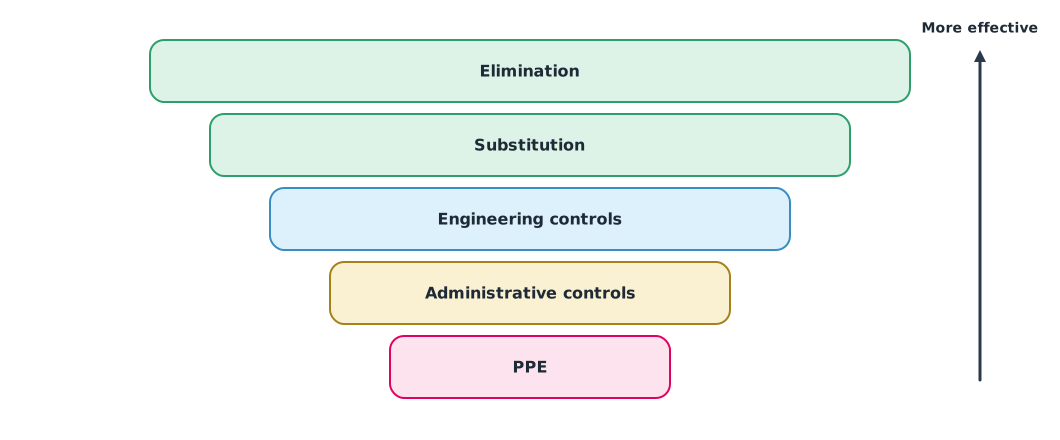
NIOSH ranks the hierarchy of controls from most to least effective: eliminate the hazard, substitute something less hazardous, engineering controls, administrative controls and personal protective equipment (PPE). The lower a control sits, the more it depends on people’s behaviour, so PPE is a last line of defence, not the only one.
Example 1 Risk register for survey flights
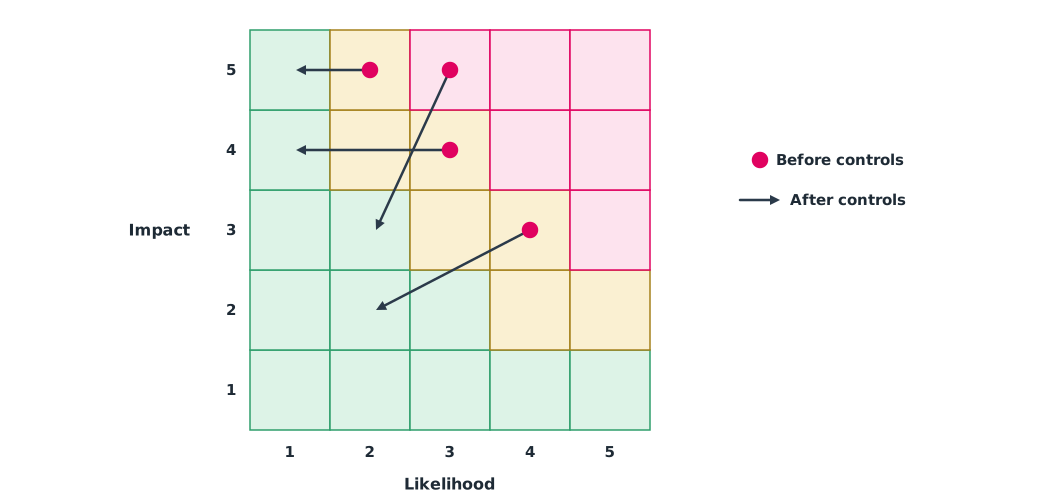
Assessed before and after controls (hypothetical values agreed by the team), with thresholds high ≥ 15, medium 8–14, low < 8.
risks = [   # hazard, L before, I before, control, control level, L after, I after
    ("propeller strike", 3, 4, "prop guards and 15 m keep-out zone", "engineering", 1, 4),
    ("battery fire while charging", 3, 5, "fireproof charging box", "engineering", 2, 3),
    ("injury to bystanders", 2, 5, "cordon and flight over empty area", "administrative", 1, 5),
    ("heat stress of crew", 4, 3, "shade, water and work-rest schedule", "administrative", 2, 2),
]

def level(r):
    return "HIGH" if r >= 15 else "MEDIUM" if r >= 8 else "LOW"

for name, l0, i0, control, kind, l1, i1 in risks:
    r0, r1 = l0 * i0, l1 * i1
    print(f"{name:<28} {r0:>2} {level(r0):<6} -> {r1:>2} {level(r1):<6} via {kind}: {control}")
admin_only = [r[0] for r in risks if r[4] in ("administrative", "PPE")]
print("relies on people's behaviour:", ", ".join(admin_only))
propeller strike 12 MEDIUM -> 4 LOW via engineering: prop guards and 15 m keep-out zone
battery fire while charging 15 HIGH -> 6 LOW via engineering: fireproof charging box
injury to bystanders 10 MEDIUM -> 5 LOW via administrative: cordon and flight over empty area
heat stress of crew 12 MEDIUM -> 4 LOW via administrative: shade, water and work-rest schedule
relies on people's behaviour: injury to bystanders, heat stress of crewEvery control lowers the risk, but two depend on administration, which works only if everyone follows it, so checks that it is really done are needed. Harm to bystanders keeps the highest impact even with lower likelihood, so it must be reviewed every time the flight site changes.
Checking that checklists are really followed
Example 2 Pre-flight checklist over 12 flights
Items skipped on each flight, from a 10-item checklist (hypothetical data).
from collections import Counter

ITEMS = 10
skipped = [[], ["compass check"], [], ["NOTAM/airspace check", "compass check"], [], [],
           ["compass check"], [], ["battery temperature"], ["compass check"], [], ["NOTAM/airspace check"]]
done = sum(ITEMS - len(s) for s in skipped)
print(f"compliance {done}/{ITEMS * len(skipped)} = {done / (ITEMS * len(skipped)):.1%}")
print(f"flights with every item done: {sum(not s for s in skipped)}/{len(skipped)}")
for item, n in Counter(x for s in skipped for x in s).most_common():
    print(f"skipped {n}x: {item}")
compliance 113/120 = 94.2%
flights with every item done: 6/12
skipped 4x: compass check
skipped 2x: NOTAM/airspace check
skipped 1x: battery temperatureThe overall rate looks high, but half the flights skipped something, and the compass check was skipped most. Ask the team why, for example whether the step is too slow or seems unnecessary, and propose a fix, which could become the improvement project topic in Module 4.
Orientation activity
Activity: learning the organisation’s system
- Read the flight and safety SOPs and ask the mentor to explain anything unclear.
- Identify at least five hazards of your assigned work and assess them with Example 1.
- Check which level of the hierarchy existing controls sit at, and propose higher-level controls.
- Ask for checklist records without client data and analyse them with Example 2.
- Ask about the channels for reporting incidents and near misses and record them in the logbook.
Common mistakes
Watch out
- Thinking PPE alone is enough.
- Being afraid to report near misses.
- Ticking checklists without really checking.
- Reusing a risk assessment from one site at another.
- Flying without knowing whether CAAT permission is in place.
Summary
- SOPs say how work is done; an SMS per ICAO Doc 9859 manages safety across the system.
- Assess risk as L × I before and after controls.
- Choose controls from the top of the NIOSH hierarchy downwards.
- Check checklist compliance from real records and find the items most often skipped.
Check your understanding
- What is the NIOSH hierarchy of controls from most to least effective?
- A risk of L 3, I 5 is reduced to L 2, I 3. How does the score change?
- Which Thai law sets occupational safety duties?
- A 10-item checklist over 5 flights has 4 items skipped in total. What is the compliance rate?
- Why do administrative controls need follow-up checks?
Answers
- Elimination, substitution, engineering, administrative, PPE.
- From 15 to 6.
- The Occupational Safety, Health and Environment Act B.E. 2554 (2011).
- They work only when people follow them; without checks, nobody may actually do them.
Key formulas
| Risk score | |
| Checklist compliance |
Key references
- International Civil Aviation Organization. (2018). Safety management manual (Doc 9859, 4th ed.). link
- National Institute for Occupational Safety and Health. (2024). About hierarchy of controls. Centers for Disease Control and Prevention. link
- พระราชบัญญัติความปลอดภัย อาชีวอนามัย และสภาพแวดล้อมในการทำงาน พ.ศ. 2554. (2554). ราชกิจจานุเบกษา, 128(4 ก). link
- International Organization for Standardization. (2018). Occupational health and safety management systems — Requirements with guidance for use (ISO 45001:2018). link
- สำนักงานการบินพลเรือนแห่งประเทศไทย. (2569). ประกาศ กพท. เรื่อง หลักเกณฑ์และวิธีการในการอนุญาตให้ผู้บังคับหรือปล่อยอากาศยานซึ่งไม่มีนักบิน ประเภทอากาศยานที่ควบคุมการบินจากภายนอก ที่มีน้ำหนักไม่เกิน 25 กิโลกรัม ปฏิบัติแตกต่างไปจากเงื่อนไขที่กำหนด พ.ศ. 2569 (มีผล 17 พฤษภาคม 2569). link
Further reading
Study the assigned knowledge units in advance, review media and take the module quiz
Professional practice in the workplace
Safety management systems (SMS)
In class / field
Workplace practice under a supervisor
Learning evidence: Work log endorsed by the supervisor