Planning the data lifecycle before drone imaging
Define the purpose, required data, who has access, onward transfer and retention review points so that they can be audited.
G03 · Core lesson 60 minutes · Computer-based practice

Define the purpose, required data, who has access, onward transfer and retention review points so that they can be audited.
Goals and preparation
Core lesson G03 takes 60 minutes: reading 15, drawing the flow 20, practising transfer checks 15 and review 10 minutes. Use the hypothetical data in G03-data-flow.csv ; do not upload real images to external services. By the end you must be able to explain who each dataset is for, who can access it and when its retention must be reviewed.
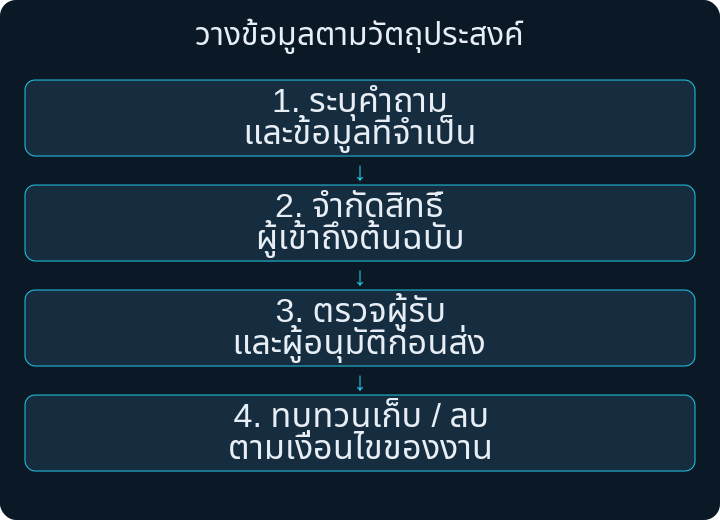
Start from the question to be answered
If the task is to assess impassable routes, the recipient may need road-segment codes, locations, recording times and confidence levels rather than every original frame. Having captured the data does not mean that everyone needs to receive all of it.
Separate the access-restricted originals from the analysis results for the recipient and the data approved for publication . The three may differ in coordinates, resolution or retention period according to purpose. Blurring images does not guarantee that individuals cannot be identified, because coordinates, time, context or metadata may link back to them.
Draw the flow and name the owners
- Identify the data intake point, such as a memory card from the camera or a folder from the client, and record the sender, time and data version
- Write down where it will be stored, who views the originals, who edits and who approves onward transfer. Use task-specific roles instead of “everyone in the team” access.
- Identify the data to be removed or reduced in detail before sending, such as not attaching images unrelated to the task and not including identifying data the recipient does not need
- Define triggers for reviewing retention, such as the work being accepted or the purpose changing, and name the decision-maker according to the policies and requirements applicable to the case. Do not set a number of days as a general legal rule.
- If there is an evidence preservation order or conflicting requirements, suspend deletion and refer the matter to the responsible person with authority, recording the reasons
In real work, the responsible person must assess the legal basis and duties under the law applicable to the case. The exercise does not decide that consent or another basis can always be used, and does not assume that data from public missions can all be disclosed.
Hands-on: three datasets
In G03-data-flow.csv there are original images, a road table and images for communication. Fill in the purpose, required data, who has access, who approves sending, and the triggers for retention/deletion review. Draw at least 4 boxes and use arrows to explain the transfers.
Inject: a new data requester wants all the original images with coordinates to create a public-relations post. Answer whether this request matches the original purpose, who must check it, and which version of the data would be more appropriate. Do not send real files during the exercise.
Example of verifiable reasoning: “The recipient needs a route-condition report, so the reviewed road-segment code table is sent, while the originals remain restricted to the work reviewers. Publishing images must go through the approver with additional checks of context/metadata.”
Assess the work
Score purpose/necessity 30, access/approver 25, retention and review 25, handling the inject 20. The target is 75/100, and every dataset must have an owner and a review trigger. Do not write that blurred images can definitely be published.
Further reading and bibliography
- Disaster management and data
- NIST. (n.d.). Privacy Framework. Used for the concept of privacy risk management in data processing; this voluntary framework does not replace Thai law.
- Office of the Personal Data Protection Committee. Official website. Used to check notifications and guidelines according to context before using real personal data.
Retrieved 8 September 2026. The exercise is a process design using synthetic data; it is not certification of PDPA compliance or a determination of the legal basis.