Linking the drone system to verification evidence
Separate subsystems, write measurable requirements, then match them with verification methods and evidence with clearly defined scope
G04 · 30-minute core lesson · computer-based practice
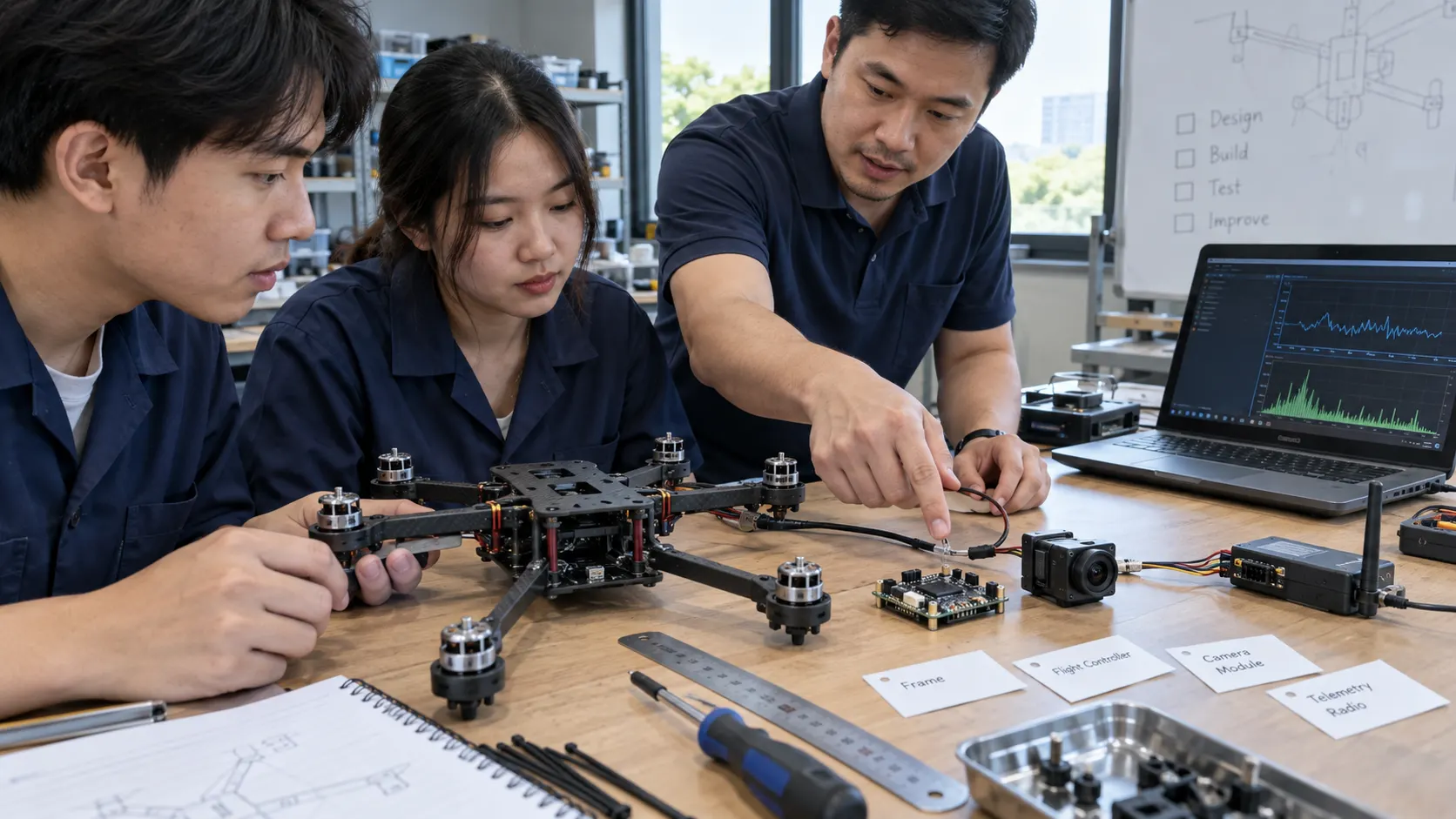
Separate subsystems, write measurable requirements, then match them with verification methods and evidence with clearly defined scope
Goals and preparation
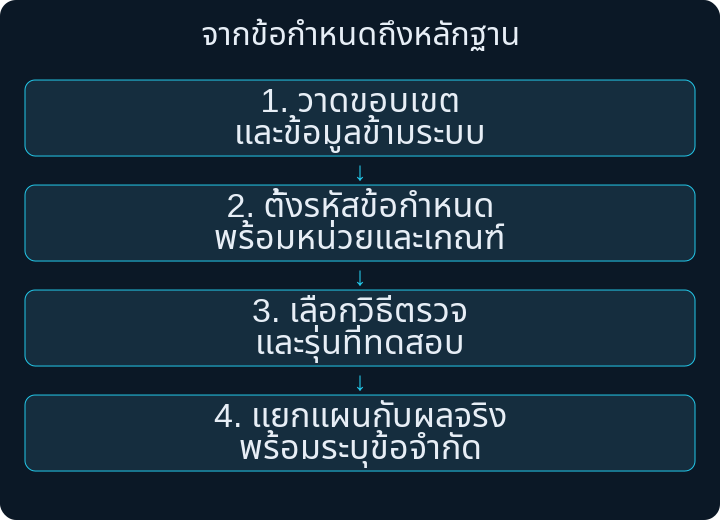
Core lesson G04 takes 30 minutes: 5 minutes reading, 5 drawing the system, 15 writing the table, and 5 tracing back. Use G04-verification.csv on a computer. By the end you must have 5 measurable requirements and be able to separate a “test plan” from “results already tested”. Equipment stations or long-duration simulation in each track's plan remain additional activities.
A camera detection does not mean the drone has responded
Draw the flight controller, sensor/camera, C2 communication system, processing computer, and data recipient as separate parts. Arrows should state the type of data or command, such as images from the camera to processing, or status from the controller to the ground station. Do not assume that images and control commands travel the same way in every system.
When the computer can display object bounding boxes, we have evidence only for that image processing. Other interfaces must still be checked before concluding that data reached the recipient or that the response was correct. The example image in this lesson is a concept image, not a wiring diagram for any aircraft model.
Turning broad statements into verifiable ones
“Report quickly” does not state a start and end time. Change it to a hypothetical example: “when a test image is read into the script, write the result JSON within 200 ms per image, on the specified machine and dataset”. You must then specify the timing method, number of runs, and the value reported. The 200 ms criterion is a practice figure, not a drone standard.
Each row has an ID such as R01, the requirement, unit/criterion, verification method, system version, evidence, and status. Reuse the same ID when referencing across documents. If a requirement is revised, record the revision so that old results are not automatically used to certify the new requirement.
Verification asks whether the work conforms to the requirements, whereas validation asks whether the result meets the user's need in the intended context. A JSON file that conforms to the schema may pass verification, but if the user needs coordinates and the file contains only image IDs, it still does not meet the need of that job.
Hands-on work and traceback
- Draw 5 system boxes and data arrows. Open the CSV containing 5 broad requirements.
- Write verifiable requirements for the file format, image IDs, handling of unreadable images, timing, and version recording. State hypothetical criteria openly.
- Choose a verification method, such as file inspection, testing with normal input, or testing error cases. Record the name of the evidence you intend to collect.
- Set the status to
planneduntil it is actually done; if there is no log file, do not writepassed - Have a peer pick one row and ask whether this evidence still covers it if a different machine model or another kind of input is used
Example R03: “when an image file cannot be opened, the program must report the file name and the failure reason without writing fake detection results”. Test with a file name that does not exist in the practice environment, keep the message and program version, and state that a camera failure during a mission has not yet been tested.
Checking the deliverable and bibliography
Scores: system diagram 20, 5 requirements 35, verification methods/evidence 30, versions and limitations 15. Target 75/100, and plans must not be presented as actual test results.
- Drone testing and results verification
- NASA. (2023). Appendix D: Requirements Verification Matrix. Supports unique IDs, requirement sources, and verification methods; mission examples are not copied as drone criteria.
- NASA. (2023). Appendix I: Verification and Validation Plan Outline. Used to help lay out evidence and the scope of verification.
Retrieved 8 September 2026 (B.E. 2569). Criteria and PC-based scenarios are designed for practice and do not replace inspection of real flight systems.