Checking roles and evidence before mission planning
Separate the person, the aircraft, the mission and the training provider, then record which requirements are confirmed and which need further checking at the original source
G01 · 60-minute core lesson · computer-based practice

Separate the person, the aircraft, the mission and the training provider, then record which requirements are confirmed and which need further checking at the original source
Objectives and preparation
Core lesson G01 uses a 60-minute time frame: 15 minutes of reading, 30 minutes checking the case, and 15 minutes explaining the work. Use a browser and a program that opens CSV files; no registration or personal data entry is required. The goal is to build a requirements-check table covering 4 areas, with the source, check date and a status that matches the evidence.
One mission raises questions on several fronts
People: Who is the project owner, the remote pilot and the evidence checker, and what conditions must each role check? Aircraft and equipment: Which model is it, and has the payload or radio been changed? Mission: Where, when and what will be done, and which area/flight conditions must be checked? Training provider: Is the document issued merely proof of attendance, a skills assessment, or some type of certification?
Seeing a single training certificate therefore cannot answer all four questions. Read the title and scope of the document as stated. Do not turn the words “completed training” into “authorized for every mission” without evidence.
How to check sources step by step
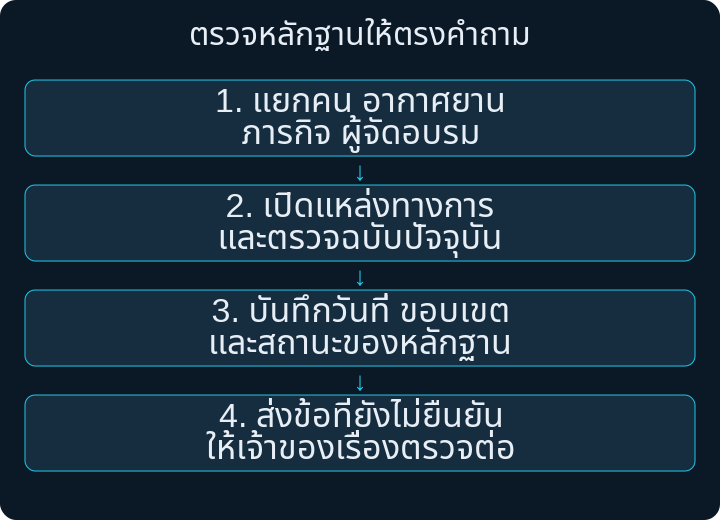
- Start from the CAAT drone menu and choose the category that matches the type of activity. Do not use a search result that quotes a single sentence as your conclusion.
- Open the document or announcement page linked from the original source. Check the issuer, the announcement date, the effective date, the scope and the amendment version. If you cannot read the full file, state that the check is incomplete.
- Keep the URL and the section/clause that supports the summary statement, together with our check date. Keep the check date separate from the announcement date.
- Compare the case data with the conditions in the document. If the weight, model, area or type of flight is not yet known, record what is missing and who will check further.
- Use UAS Portal as the entry point to the official system when you reach the stage of actual registration. This exercise studies public information only.
The statuses in the worksheet are supported (supported by evidence within the scope checked), pending (incomplete), out_of_scope (the evidence does not cover the question) and conflicting (conflicting statements found that need checking). These statuses are tools for practising evidence management, not authorization decisions from the authority.
Hands-on: a hypothetical survey team
A training unit wants to survey a sample area next month. It has the learners' training attendance certificates, a drone data sheet from the vendor, and a map with no flight date specified yet. The training provider says only “you can use the knowledge to work”, with no further certification.
Open G01-evidence.csv in the ZIP, then add questions covering all 4 areas. Check at least two official URLs, and record which questions can be answered from the web page and which require documents or a specialist reviewer. Do not submit real requests during the exercise.
An example of a good row: “Mission, no confirmed date/coordinates yet, pending, the area coordinator must provide the data before checking which announcement applies to this case” is more useful than marking “done”, because it states the next task.
Checking the deliverable and review
Submit the 4-area table and a one-paragraph conclusion stating what is known, what is not yet known and who will check further. Have a peer or the instructor randomly pick one item and open the URL to see whether the source really supports the summary statement.
Practice criteria: all 4 areas covered 25 points, citing source/date/scope 35, separating statuses 25, naming the next checker 15. Target 75/100, and a training attendance certificate must not be claimed as automatic flight authorization. Show the suggested answer after completing the worksheet. The point values are the project's own design.
Further reading and bibliography
- Aviation law in the knowledge base
- CAAT. (n.d.). Quick menu for unmanned aircraft and UAS Portal. Used as the source for looking up current requirements and services
- CAAT. (2569). Practice criteria differing from the conditions. An example showing that the type/scope and announcements linked on the page must be checked; this lesson is not a substitute for reading the conditions of a real case
Retrieved 8 September 2569 (2026). This lesson teaches evidence management; it does not conclude flight authorization, fees or case-specific exemptions. Unconfirmed claims keep their status until there is sufficient evidence.