Matching drone missions to problems
Practise choosing between doing it in-house, contracting a service or adapting the current method in two hypothetical scenarios, and write a proposal whose reasoning and figures can be traced back
Prototype lesson · 120 minutes · computer-based practice

Practise choosing between doing it in-house, contracting a service or adapting the current method in two hypothetical scenarios, and write a proposal whose reasoning and figures can be traced back
What this lesson enables you to do
By the end, you will be able to write the problem and the required deliverables, compare three options, and explain why the decision changes when the job frequency or team readiness changes. No drone or programming is needed; use a spreadsheet program that can open CSV files, or calculate on paper
Designed duration 120 minutes: reading and discussion 30 minutes, practice 75 minutes, assessment and reflection 15 minutes. It has not yet been timed with real learners
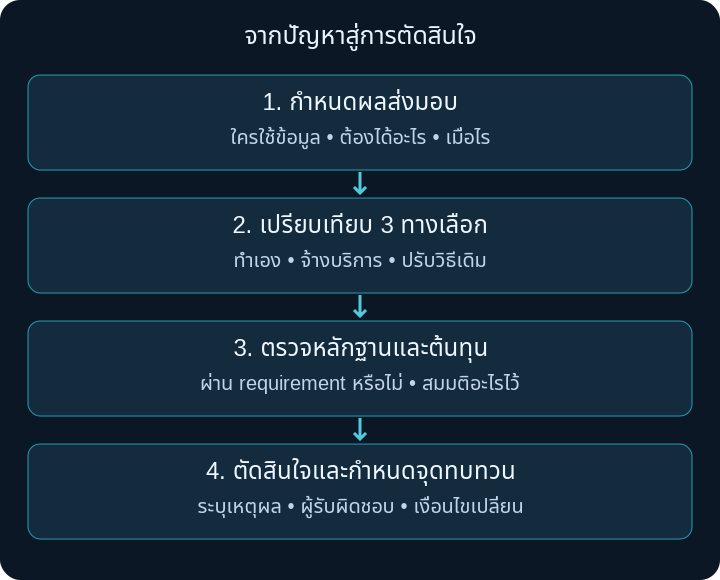
Start with the data user's problem
Hypothetical scenario: an agency must survey damage after a flood, then deliver a map with coordinates and timestamps within 24 hours. The data recipient needs it to plan site inspections, not merely to have attractive images
Before opening the figures, write down who will use the data, what decisions it will support and what an acceptable deliverable is. Example criteria are delivery time, the specified coordinates/reference system, completeness of area coverage, and identification of parts the imagery cannot yet confirm
Separate what the brief gives , such as the number of jobs, from assumptions , such as our team being able to deliver on time, and items needing further checks , such as staff skills or data usage rights. Owning a drone does not confirm that the deliverable will pass
Open the practice set and read the table
Extract the ZIP, then open executive-decisions/alternatives.csv . There are two scenarios:
frequent: 24 surveys per yearoccasional: 4 surveys per year
Both cases use a 3-year period and compare in_house in-house, service contracted service and existing_method current method. The column meets_delivery_requirement states the assumption that in-house and contracting can meet the delivery conditions, whereas the current method cannot yet fully do so
All figures are synthetic data for learning , not market prices or real procurement data. The currency unit is baht: setup_baht is paid once, annual_fixed_baht per year, and per_job_baht per mission
Calculate, then keep asking
Add a total cost column using the formula:
3-year cost = initial cost + 3 × fixed cost per year + 3 × jobs per year × cost per jobExample for in-house in frequent: 240000 + 3 × 90000 + 3 × 24 × 2000 = 654000 baht
If you open the columns as in the original file, in row 2 write the spreadsheet formula =E2+C2*F2+C2*B2*G2 and drag it down to every row. Check that the number of jobs has not been counted twice
Then compare only the options that can meet the deliverables. Choosing the current method because it is cheapest requires explaining how the missing outputs will be filled or how the requirement will be renegotiated. This cost model does not yet account for taxes, the time value of money, resale value or the cost of mission failure
Write a proposal and try changing the decision
- Open
decision-brief.mdand state the problem and the data recipient - Compare the three options on at least four criteria, such as deliverables, cost, staff readiness and continuity
- Choose an option for each scenario, with reasons and items needing further checks
- Change the number of jobs and one more value, either the cost per job or the fixed cost, then recalculate
- State when the proposal must be reviewed or stopped, for example if the team cannot produce deliverables to specification
If working in groups, swap the proposer and reviewer roles and ask each other, “What evidence would make us change our decision?” Individual learners write at least two objections to their own proposal
Check your work before opening the model answer
The deliverable includes the table for both scenarios, a proposal with four criteria and the results when assumptions change. Open answers.md after finishing to compare your calculations
The draft score of 100 is divided into calculation 25, comparative reasoning 25, evidence/assumptions 25, review conditions 15 and communication 10. The target is at least 75, without presenting hypothetical figures as real data. This score is for practice and will be adjusted after trial teaching
Answers may differ from the model answer if the conditions and supporting evidence are explained. Self-assessment is not an instructor's assessment or a drone manager qualification
Further reading and bibliography
- Drone technology landscape to understand options and limitations
- Defining requirements and verifying results to write measurable conditions
- Law and the roles of agencies to identify conditions that need further checking
- Carnegie Mellon University, Eberly Center. (n.d.). Align Assessments, Objectives, Instructional Strategies. Used for the principle of aligning objectives, activities and assessment; tables or images from the source are not copied
- FAA. (n.d.). Public Safety Toolkit. A source for studying how public safety programmes are set up in the US; not used in place of Thai law
- ICAO. (n.d.). Safety Management Manual, Chapter 9. A reference framework for linking accountability, risk and monitoring
Retrieved 8 September B.E. 2569 (2026). The case, figures, simplified formula and scoring criteria were designed by PK-Research for learning and are not requirements of the referenced organisations
Back to the curriculum plan for executives and policymakers →