Delivering medical supplies and essentials
Design everything from the request and cargo constraints through to handover, assessing both the quality of the goods and the evidence of delivery to the recipient
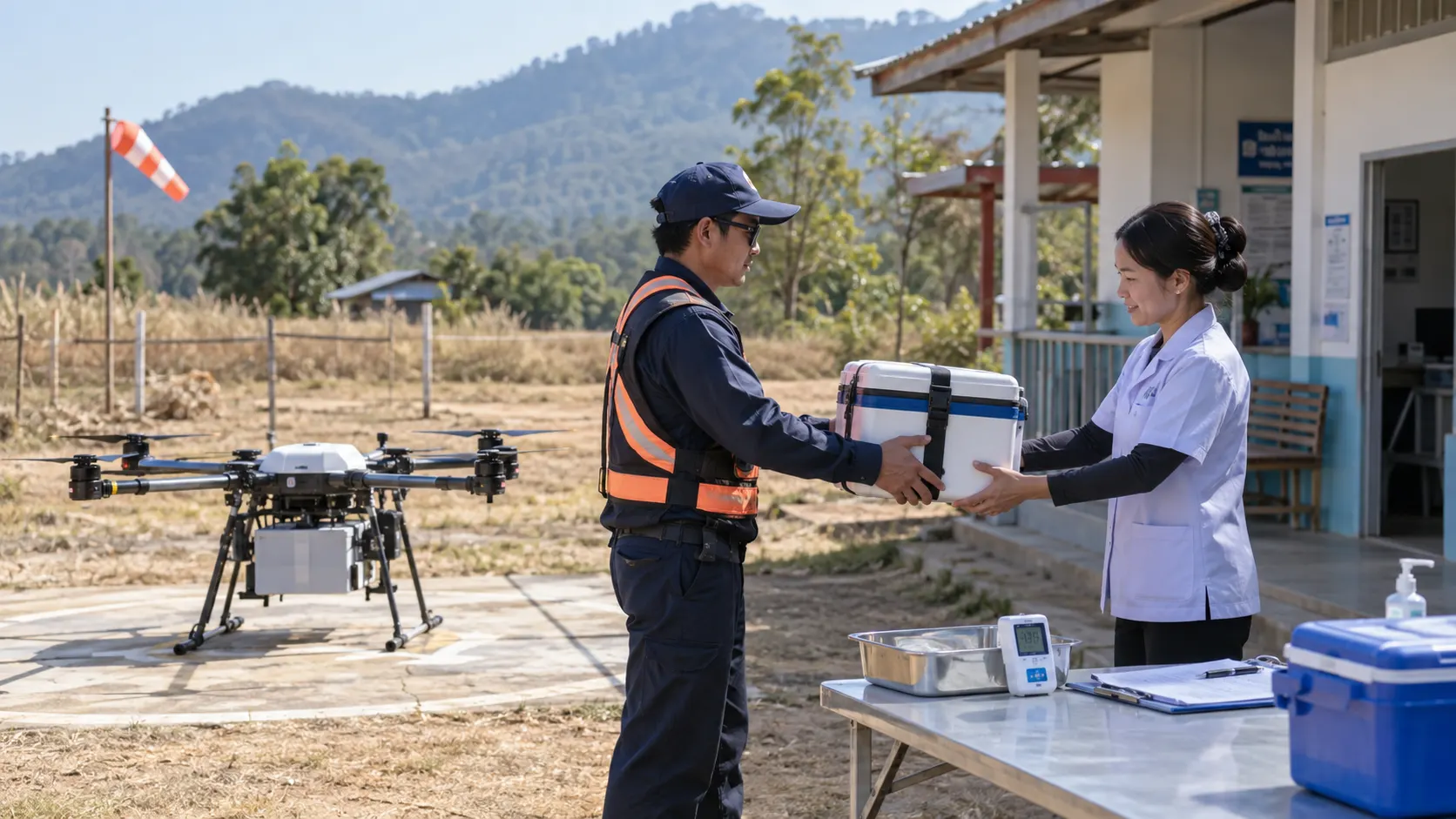
Start from the goods that must reach the recipient
A delivery mission must answer what is being sent, how much, where the recipient is, and what the storage conditions are. Some medicines or vaccines require temperature control, so reaching the destination does not by itself confirm that the goods are ready for use; the responsible recipient must inspect their condition and confirm according to procedure.
UNICEF reported delivering vaccines by drone in Vanuatu in 2018 using temperature-maintaining containers and tracking devices. This case is remote-area public health work that can be studied for its process; it is not evidence of delivery during a disaster UNICEF case
Check both the aircraft and the delivery chain
| Aspect | Information required |
|---|---|
| Goods | Total weight including container, dimensions, and conditions from the person responsible for the goods |
| Payload system | Manufacturer specifications, attachment points and centre of gravity |
| Destination | Recipient, contact channel and a coordinated handover area |
| En route | Status tracking and a plan for when the flight cannot continue |
| Closing the job | Time, condition of goods and evidence from the recipient |
The maximum payload figure from advertising is not the flight-range answer for every mission; use data from the actual system and tested conditions. Read about mass and centre-of-gravity concepts in Payload and the centre-of-gravity tool
Use drones when they suit the whole system
UNICEF has guidance on assessing whether drones suit a supply chain. Compare urgency, access, cost and service continuity rather than starting from the assumption that drones are best in every case Drones to reach the last mile
This practice uses mock boxes and a request table; it does not give guidance on handling specific medicines or on dropping items from aircraft.
Diagram to aid understanding
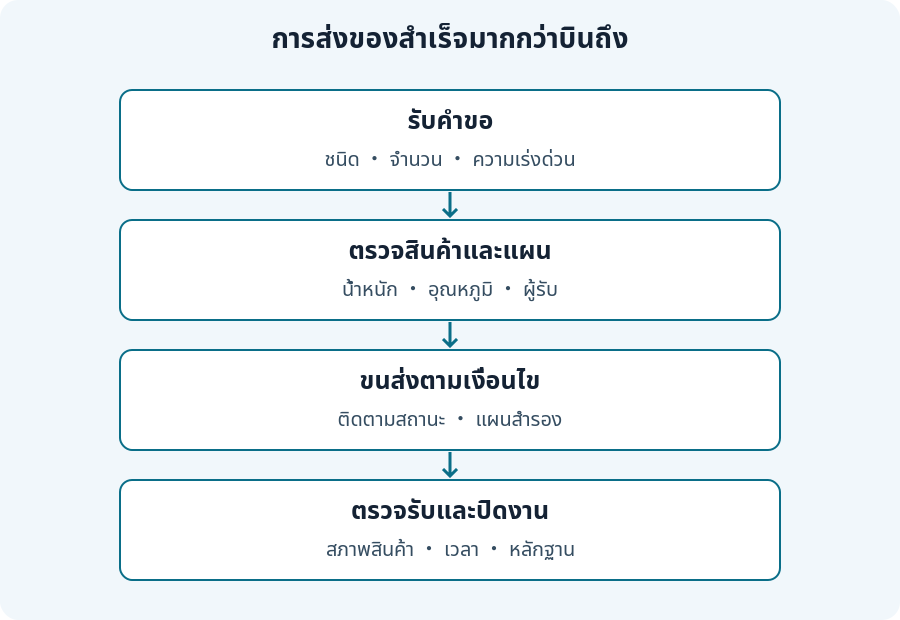
This diagram summarises the chapter’s concepts and accompanies the steps and limitations explained above. Click the image to enlarge it.
Try it on a computer
- Create two mock box delivery requests with different weights and conditions.
- List the information still missing before assessing transport, without guessing the flight range.
- Simulate a case where the recipient cannot be reached, and record the notification/suspension steps according to the plan.
Deliverables: a request form and an acceptance checklist for the mock box
Check results: the total weight including container is complete, there is a recipient and a contingency plan, and arrival is not used as evidence of handover
Further study and practice resources
Open related chapters → · Open scenario practice sets and downloadable files →
Bibliography and further reading
-
Suspended loads, winches and placement delivery: learn the physics and design experiments before extending to delivery missions
-
UNICEF: delivering vaccines by drone in Vanuatu, 2018. Retrieved 8 September 2569 (2026)
-
UNICEF: Drones to reach the last mile. Retrieved 8 September 2569 (2026)
The content and exercises were compiled from the sources above; the realistic images are simulated illustrations, not evidence of mission results or equipment test results.
F36: How many trips, and how long does a full cycle take?
This synthetic accounting model finds a lower bound on the number of trips from mass, and the time for one aircraft working sequentially, with no queues or failed trips. It is not a certified capability of any aircraft.
nmin = ceil(Mtotal/Musable)
Tcycle = Tout + Tservice + Treturn + Tturnaround; Tall = nminTcycle
| Variable | Meaning and units | Range and source of values |
|---|---|---|
| M_total | Net mass of goods to carry, excluding packaging, kg; input | ≥0 finite, from the weighing list; may be split into lots in the exercise |
| M_usable | Net cargo capacity per trip, kg; input | >0 finite; packaging and trip constraints already deducted; assumed constant |
| n_min | Minimum number of trips, trips; output | Integer ≥0; ceil rounds up |
| T_out, T_service | Time to fly out and verify handover, min; input | ≥0, from route and acceptance assumptions |
| T_return, T_turnaround | Time to return and prepare the next trip, min; input | ≥0; the final cycle also includes restoring to ready-for-use condition |
| T_cycle, T_all | Cycle time and time to finish all cycles, min; output | ≥0; for one aircraft working continuously, with no overlapping tasks in the exercise |
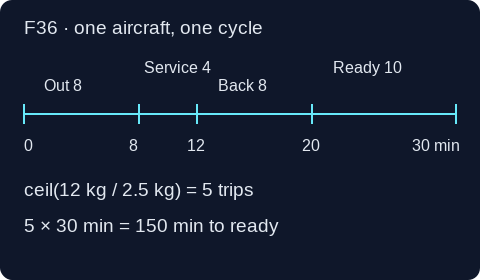
Image description: one cycle totals 8+4+8+10=30 min; each trip carries at most 2.5 kg, so carrying 12 kg takes at least five trips
Worked example and conditions that make it invalid
M_total=12 kg and M_usable=2.5 kg give ceil(12/2.5)=ceil(4.8)=5 trips , split as 2.5, 2.5, 2.5, 2.5 and 2 kg. With T_cycle=8+4+8+10=30 min , the return and preparation of all five cycles finish at 150 min . If the end is defined as the handover of the last trip, it is 4×30+8+4=132 min . The end point must be specified before comparing times.
The mass in both the numerator and the denominator must be on the same net-goods basis. Per-trip packaging has already been deducted from the capacity in M_usable and is not added again to M_total. The 2.5 kg value is an assumption of the exercise, not the manufacturer’s payload rating; a separate actual gross-mass budget must be prepared when checking aircraft limitations.
The number of trips from mass is only a lower bound. If boxes cannot be split, are too large for the cargo bay, or have CG, temperature, energy or differing-destination constraints, more trips may be needed. Charging queues and recipient staffing mean that several aircraft do not reduce time in direct proportion. For last-mile context and system assessment, read UNICEF: Drones to reach the last mile (P2A03) , checked 26 September 2569 (2026); the formulas and example times are an account built by the author, not UNICEF test results.
Practice changing the turnaround time
Try changing values in the delivery cycle calculator , which separates the last handover time, the return time and the time ready for a new cycle. The tool’s example uses a different set of times from this chapter, and likewise starts when the first trip is loaded and ready at t=0.
Keeping the mass and the other times the same, T_turnaround increases from 10 to 15 min. What are the time to complete all cycles and the time of the last handover?
F36 answer
Still 5 trips; T_cycle=35 min; T_all=5×35=175 min, and the last handover=4×35+8+4=152 min. ±0.001 min accepted; the number of trips must be the exact integer.
Download the applied formula practice set (CSV/JSON with answers) · synthetic data for practising calculations and checking units
Experiment with the number of trips and delivery time
Calculates in the browser without sending data off the device. Change one value at a time and compare with the formula in the lesson.
Assumes one drone, divisible goods, and consecutive cycles of equal duration, with timing starting when the first trip is ready to depart. Usable mass is the net goods after allowing for packaging and other constraints. There are no waiting queues, extended charging, changing winds or cancelled trips. The result is an exercise, not the capability of any model.
Example: ceil(12/2.5) = 5 trips, each cycle 4 + 2 + 4 + 5 = 15 minutes; the last trip is handed over at 66 minutes, returns to base at 70 minutes, and is fully ready again at 75 minutes. Counting the end point differently gives different answers.