Suspended loads, winches and item delivery
Understand tension and swing, select cable and load data, and follow an experiment sequence before adding a winch or ground contact
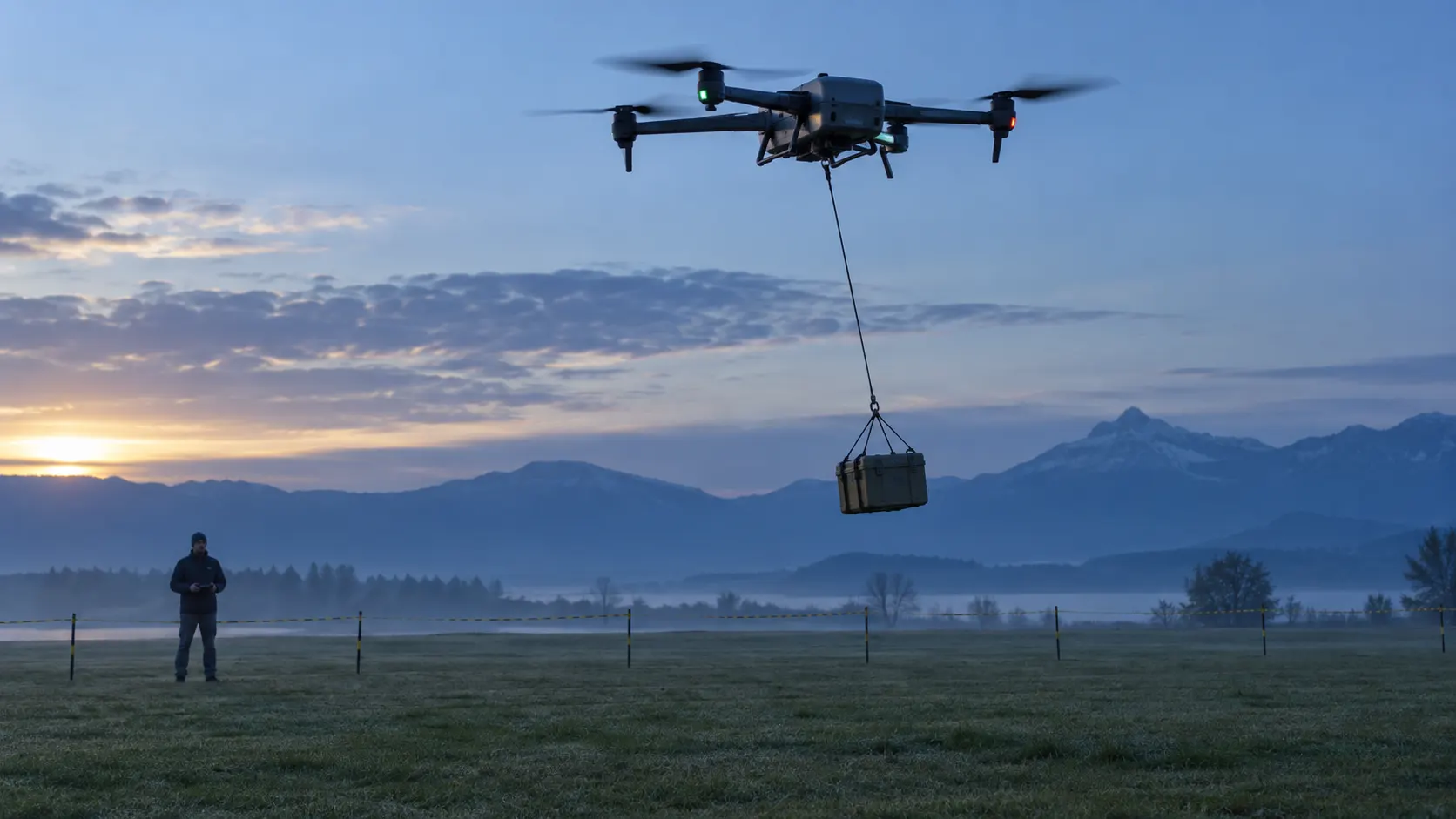
A suspended load is a body that moves separately from the aircraft
When the drone accelerates or stops, the suspended box may keep moving and swing back. Simply adding mass to the airframe therefore does not represent the behaviour of the line and the load. The mass, line length, attachment point, drag, and the assumption of whether the line stays taut or can go slack must be specified.
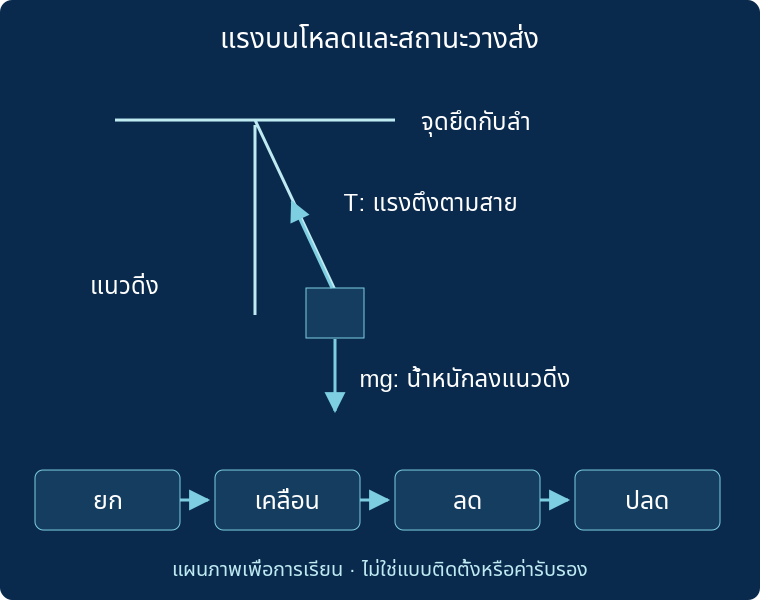
Data to prepare
| Data | Unit or format | What it explains |
|---|---|---|
| Box mass and size | kg, m | Weight and wind exposure |
| Line length and attachment point | m, coordinates on the aircraft | Geometry and swing |
| Line type | Always taut / allowed to go slack | Limitations of the model |
| Winch/release state | Time and state | When the load changes |
| Ground contact | Model and parameters | How the box stops, slides or bounces |
A model that treats the line as massless and of fixed length suits a different kind of question from a winch that changes length during flight. State the assumptions before comparing results.
Start experimenting with ArduPilot SITL
The ArduPilot documentation explains slung payload simulation using SIM_SLUP_ENABLE and the line length, mass and drag values from SIM_SLUP_LINELEN, SIM_SLUP_WEIGHT and SIM_SLUP_DRAG respectively. Complete the script preparation and firmware version steps in the documentation before use; do not just change four values and assume the system is ready.
- Start with a no-load scene that gives repeatable results, then keep the baseline configuration.
- Enable a supported load model and test moving and stopping along the same route.
- Change the line length one value at a time, recording the maximum swing angle and the time to return within the defined settling criterion.
- Add wind after you can explain the no-wind case, and only then study the winch and the ground.
If Gazebo is also used, specify which system computes the forces from the load so that weight or tension is not counted twice in two systems. Seeing the winch servo output does not yet confirm that the line and ground contact are being simulated.
Deliverables and extensions
Use the experiment log form , recording the physics backend, timestep and revision every time. If the load swings differently, check the settings before concluding that it is an effect of line length. The deliverable passes when it has a baseline, controlled variables and a rationale for the settling criterion.
Multi-aircraft cooperative lifting is an advanced topic. Study FSC Lab to understand the model, but the older toolchain and migration work must be checked separately. Read about mission use in Delivery for public disasters
Bibliography and original sources
Documents checked 23 September 2569 (2026)
- ArduPilot. Adding Simulated Peripherals: Slung Payload / Winch
- FSC Lab / Longhao Qian. px4_command: tethered payload flight control
- ArduPilot. ardupilot_gazebo: plugin and installation guide
F32: Pendulum period with a stationary suspension point
| Variable | Meaning and units, input → output | Range/source of values |
|---|---|---|
| l | Length from the pivot to the point mass (input) m | >0; taut, inextensible line |
| g | Specified gravitational acceleration (input) m/s² | >0; example 9.81 |
| θ | Deflection angle from vertical (condition) rad | Angle small enough that sinθ≈θ is appropriate for the problem |
| T | Time for one cycle (output) s | >0; not the time for the swing to stop |
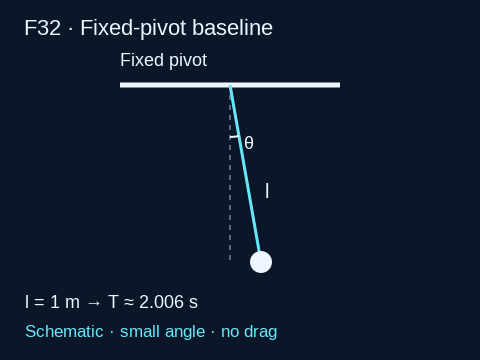
Advanced level · learning model · Question: if the line is lengthened, how does the swing period of a simple pendulum change?
T ≈ 2π√(l/g)
Use a stationary suspension point, a massless, inextensible line that stays taut, a point mass, small angles and no drag. Under sinθ≈θ, the equation θ̈+(g/l)θ=0 gives the period above, with sqrt(m/(m/s²))=s. There is no universal angle threshold that makes the approximation as accurate as required for every task; the acceptable error level must be specified.
A suspension point on a drone that accelerates or moves does not match this assumption and requires coupled dynamics and control data. This formula is not a limit on swing angle, does not give the time for the swing to stop, and is not to be used to choose a line length to certify a flight.
Worked example
l=1 m, g=9.81 m/s² gives T=2π√(1/9.81)=2.006066681 s. One complete swing returns to the original position and direction of motion; it is not from the far left to the far right.
Practice with changed values
Change l to 4 m, keeping g and the same assumptions. By what factor does the period increase?
Show F32 answer
T=2π√(4/9.81)=4.012133361 s, a doubling; ±0.000001 s accepted. It is not four times, because the period depends on the square root of the length.
Reference: OpenStax University Physics Volume1 §15.4 Pendulums (P4A05); checked 26 September 2569 (2026); all numbers are synthetic exercises
Download the advanced navigation and mission practice set (CSV/JSON with answers) · synthetic model with assumptions and limitations