Exercise: measuring trajectory error
Compare self-generated error values and explain the limitations of the metrics
Use the same data as the previous exercise
Run trajectory-lab.py and open summary.json . The program computes the position RMSE from time-matched pairs without alignment, and computes the RMSE of the displacement differences between consecutive points.
Check against values known in advance
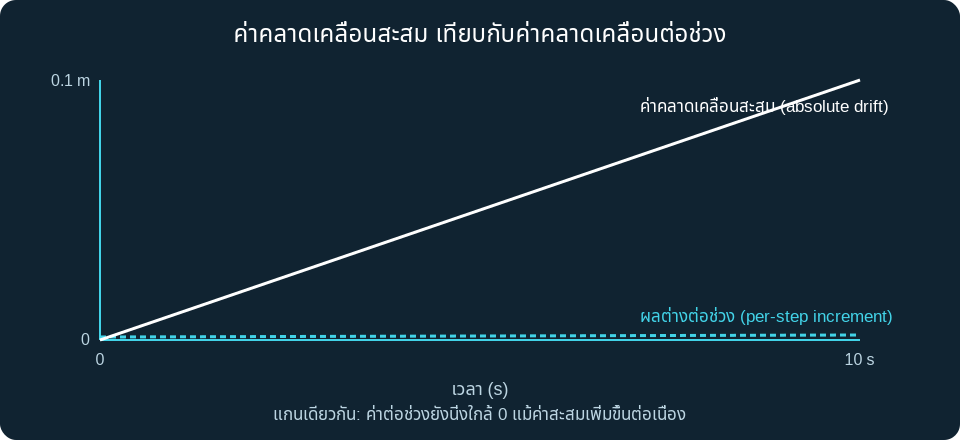
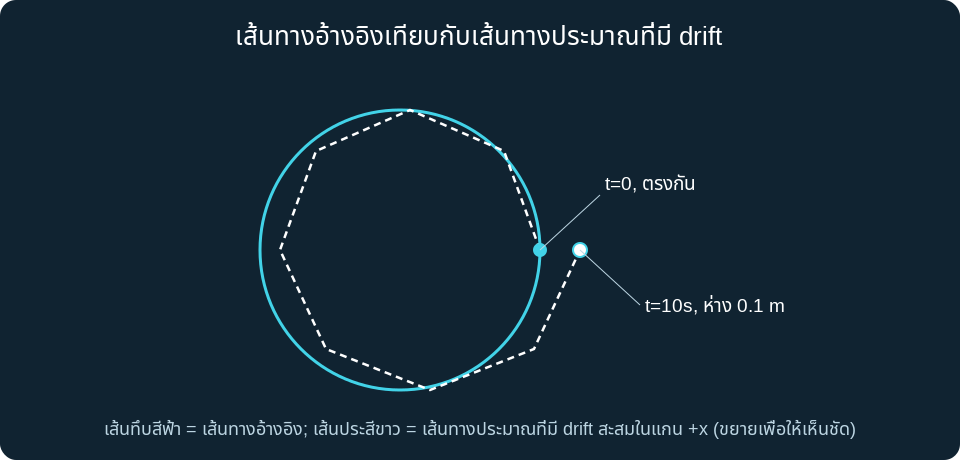
When a drift of 0.01 m/s is applied on the x axis for 10 seconds, the final error is 0.1 m and the position RMSE is about 0.057879 m, while the error of the differences between points 0.1 s apart is about 0.001 m in every interval.
- Change
DRIFT_PER_SECONDto 0 and check that both errors are zero within numerical precision. - Change it to 0.02 and check that the RMSE doubles.
- Restore the original value and write why a low per-interval relative metric can still have accumulated drift.
Scope of the results
These are simple position metrics, not full SE(3) APE/RPE, and they do not assess orientation, calibration or tracking loss. Use evo and real data as the next step, always stating the association and alignment.
Submit a table of the values from all three experiments with an explanation of units, calculation method and limitations. Do not conclude which estimator is best from this self-generated dataset.
Licence for the exercise files
Download the licence LICENSE.txt, the Python code uses MIT; the forms use CC BY 4.0, credit PK-Research
References and scope
Sources checked 7 September 2569 (2026); compiled to accompany knowledge kindly provided by DTI