Batteries and safety
UAT 203 Electrical and Electronic Systems for UAS
Lesson
By the end of this module you will be able to
- Calculate a battery pack's voltage, capacity and energy from series and parallel cell arrangements
- Explain the C rating and find the maximum discharge current the manufacturer claims
- Calculate voltage sag and heating from internal resistance at high current
- Compare LiPo and Li-ion batteries and state the safety principles of use
Why this matters
The battery is at once the drone’s energy source, its heaviest part and its most dangerous part. Too small a pack overheats and sags until a failsafe triggers during a climb; too large a pack adds weight until flight time stops improving. This module is about choosing a pack that fits the job, and understanding what the label numbers do and do not say. Charging, storage and transport in detail were covered in UAT 321.
Building packs from cells
Packs are written xSyP: 6S1P, for example, is six cells in series, one string.
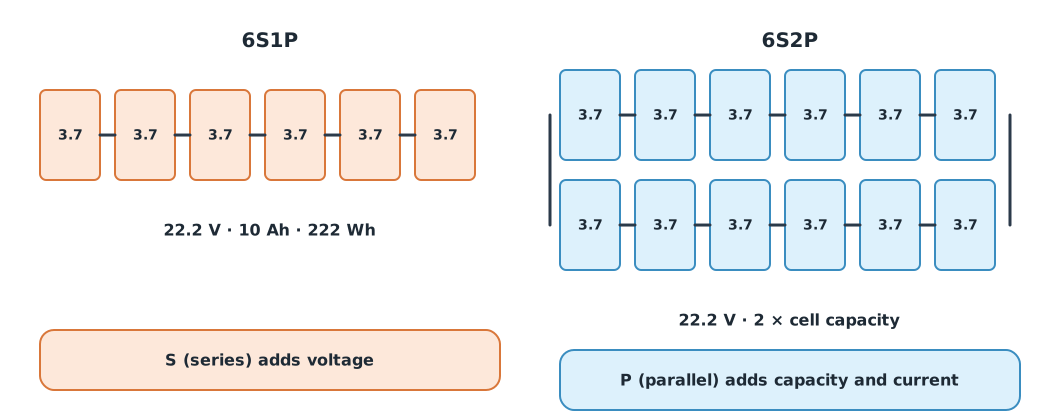
- Series (S) adds voltage: one LiPo cell is 3.7 V nominal, 4.2 V fully charged
- Parallel (P) adds capacity and deliverable current
- Energy equals nominal voltage times capacity
C rating and maximum current
In Grepow’s explanation, the C rating is discharge current divided by capacity, so a 10 Ah pack rated 25C can deliver A continuously, as the manufacturer claims. Grepow itself warns that some sellers quote C ratings from short pulse discharges, so the number is a manufacturer’s claim: use it with margin and check the pack’s actual temperature.
Internal resistance
Every battery has an internal resistance . Drawing current lowers the terminal voltage by and generates heat inside the pack. Heat grows with the square of current: double the current, four times the heat.
Example 1 A 6S 10 Ah pack in hover and climb
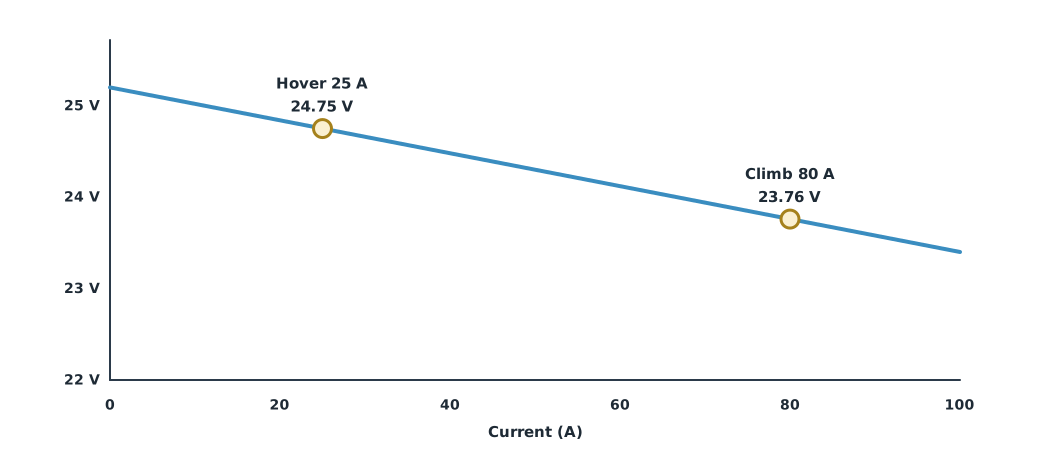
A hypothetical 6S1P 10000 mAh 25C pack with 18 mΩ total resistance, starting fully charged.
cells, cap_ah, c_rate, r_pack = 6, 10.0, 25, 0.018
v_nominal, v_full = 3.7 * cells, 4.2 * cells
print(f"{cells}S: nominal {v_nominal:.1f} V, full {v_full:.1f} V, energy {v_nominal * cap_ah:.0f} Wh, "
      f"claimed max {c_rate * cap_ah:.0f} A")
for label, amps in (("hover", 25), ("climb", 80)):
    drop = amps * r_pack
    print(f"{label:<5} {amps:>3} A: drop {drop:.2f} V -> {v_full - drop:.2f} V at the terminals, "
          f"heat {amps ** 2 * r_pack:.1f} W inside the pack")
6S: nominal 22.2 V, full 25.2 V, energy 222 Wh, claimed max 250 A
hover 25 A: drop 0.45 V -> 24.75 V at the terminals, heat 11.2 W inside the pack
climb 80 A: drop 1.44 V -> 23.76 V at the terminals, heat 115.2 W inside the packIn an 80 A climb, the pack heats about ten times more than in a hover, and the voltage drops almost 1.5 V. If the battery is already nearly empty, this momentary sag can trigger the low-voltage failsafe. Internal resistance rises as batteries age or get cold, so measure it and record it in the battery register.
LiPo or Li-ion
- LiPo delivers high current well, suiting hard acceleration or heavy lifting. For example, a Tattu 4S 10000 mAh pack holds 148 Wh at 935 g, about 158 Wh/kg for the whole pack
- Cylindrical Li-ion, such as the Molicel P45B 21700 cell, holds 4.5 Ah and 16.2 Wh, delivers 45 A continuously (10C) and reaches 242 Wh/kg for the bare cell, suiting long flights at moderate current
These two figures cannot be compared directly, because the first includes the pack’s wiring and casing and the second is a bare cell. A real choice compares finished packs under the actual current.
Safety every time
Charge with a charger set to the right chemistry and cell count, in balance mode, on a non-flammable surface under supervision. Never use a pack that is swollen, punctured or abnormally hot, and never short the terminals. For storage and air transport, see UAT 321 module 5.
Module lab
Lab: measuring internal resistance and choosing a pack
- Read the labels of the lab’s packs and calculate voltage, energy and the manufacturer’s claimed maximum current.
- Measure internal resistance with a supporting charger, or from the voltage drop at two currents on a test load (under the instructor’s supervision).
- Use the code in Example 1 with the measured values to calculate sag and heating in hover and climb for the training drone.
- Compare a commercially available LiPo pack and Li-ion pack from their datasheets, using energy per mass of the finished pack.
- Conclude which pack our survey drone should use, with reasons.
Common mistakes
Watch out
- Trusting the label C rating without margin
- Forgetting that heat grows with the square of current
- Comparing the specific energy of a bare cell with a finished pack
- Connecting packs in parallel at different voltages, so current rushes violently from one to the other
- Continuing to use a swollen pack
Summary
- Series adds voltage, parallel adds capacity, and energy is nominal voltage times capacity
- The C rating gives the maximum current as claimed by the manufacturer; use it with margin
- Internal resistance causes an voltage sag and heating
- LiPo delivers high current well; Li-ion gives high energy per mass; choose by the job
Check your understanding
- A 4S2P pack uses 3.7 V 5 Ah cells. What are its voltage, capacity and energy?
- A 5 Ah pack is rated 40C. What maximum current does the manufacturer claim?
- With 20 mΩ and 50 A, what are the voltage drop and heat?
- If current rises from 25 to 50 A, by how many times does pack heating increase?
- Why can the P45B cell’s 242 Wh/kg not be compared directly with a LiPo pack’s 158 Wh/kg?
Answers
- V, Ah, Wh
- A
- V and W
- Four times
- The first is a bare cell; the second includes the pack’s wiring, connectors and casing
Key formulas
| Pack voltage and capacity | |
| Maximum current from C rating | |
| Voltage sag and heating |
Key references
- Grepow. What is the C rating on a LiPo battery? link
- Grepow. What is the voltage of a LiPo battery? link
- Molicel. INR-21700-P45B lithium-ion cell specification. link
- PX4 Autopilot. Battery estimation tuning. PX4 user guide. link
- International Air Transport Association. (2026). Lithium batteries: Passenger guidance. link
Further reading
Study the assigned knowledge units in advance, review media and take the module quiz
In class / field
Lab or field practice from worksheets with a safety checklist
Learning evidence: Checked worksheets and quiz results