LoRa mesh and field networks
UAT 207 Communication and Data Network Systems
Lesson
By the end of this module you will be able to
- Explain LoRa parameters, namely spreading factor, bandwidth and coding rate
- Compute LoRa time on air and the maximum message count under a duty-cycle limit
- Compute end-to-end delivery probability in a mesh by hop count and retries
- Explain throughput limits of multi-hop networks and the rules for the 920–925 MHz band
Why this matters
There is no mobile coverage in the mangroves, so the team must build its own network to bring sensor data and people’s positions back to the station. LoRa reaches far on little power but trades that for very low data rates, and a mesh lets each node relay data onwards. The drone knowledge base’s deep-dive units on LoRa/Mesh and on swarm coordination over LoRa mesh give an overview of real use; this module goes into the numbers used for design.
LoRa parameters
LoRa uses spread-spectrum modulation. The spreading factor (SF), 7 to 12, sets how long each symbol lasts: one step up doubles the symbol length, reaching farther and resisting noise better, but taking longer on air. The SX1276 datasheet, section 4.1.1.7, gives the time-on-air formula in the formula box, where is the payload in bytes, the coding rate (1 = 4/5), = 1 without a header and = 1 with low data rate optimisation on.
Thailand uses the AS923-1 channel plan in 920–925 MHz under the LoRa Alliance’s LoRaWAN Regional Parameters (RP002). For NBTC rules in this band, the Telecommunications Association of Thailand summarises that IoT devices may use up to 500 mW e.i.r.p. without a licence and that the band maximum is 4 W e.i.r.p. This comes from a secondary source and must be checked against the NBTC announcement in the Royal Gazette before real use. The 10% duty cycle in the example is Meshtastic’s setting for the TH region, not a requirement checked against the announcement.
Example 1 Time on air and messages per hour
A 20-byte position message, BW 125 kHz, CR 4/5, preamble 8, CRC on, explicit header, and DE on at SF11–12.
import math

def time_on_air(pl, sf, bw=125e3, cr=1, n_pre=8, crc=1, ih=0):
    de = 1 if sf >= 11 else 0
    t_sym = 2 ** sf / bw
    n_pay = 8 + max(math.ceil((8 * pl - 4 * sf + 28 + 16 * crc - 20 * ih) / (4 * (sf - 2 * de))) * (cr + 4), 0)
    return (n_pre + 4.25) * t_sym + n_pay * t_sym

for sf in range(7, 13):
    t = time_on_air(20, sf)
    per_hour = {dc: int(dc * 3600 / t) for dc in (0.10, 0.01)}
    print(f"SF{sf:<2}: {t * 1000:7.1f} ms, max {per_hour[0.10]:>5} msgs/h at 10% duty, {per_hour[0.01]:>4} at 1%")
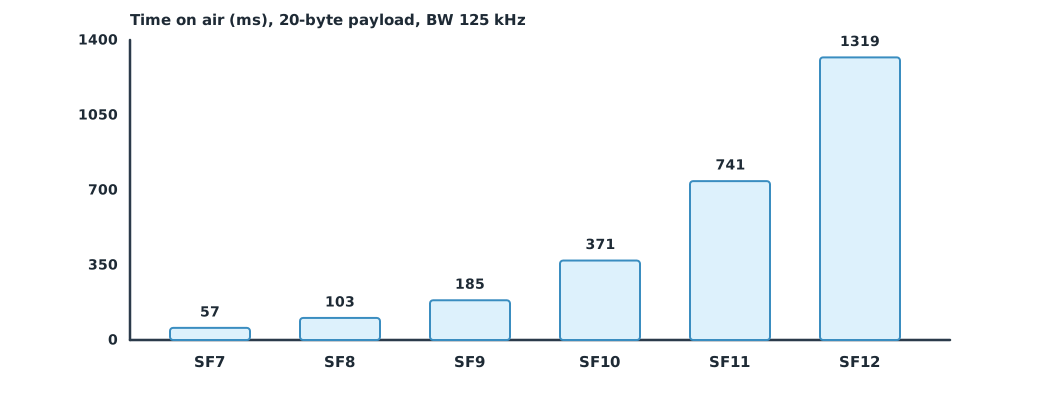
SF7 : 56.6 ms, max 6363 msgs/h at 10% duty, 636 at 1%
SF8 : 102.9 ms, max 3498 msgs/h at 10% duty, 349 at 1%
SF9 : 185.3 ms, max 1942 msgs/h at 10% duty, 194 at 1%
SF10: 370.7 ms, max 971 msgs/h at 10% duty, 97 at 1%
SF11: 741.4 ms, max 485 msgs/h at 10% duty, 48 at 1%
SF12: 1318.9 ms, max 272 msgs/h at 10% duty, 27 at 1%SF12 takes over twenty times as long as SF7. If 20 people in the field each send a position every minute at SF12, that is 1,200 messages an hour, more than one channel can carry even at a 10% duty cycle. Reduce the reporting rate, lower SF where the signal is good, or split channels.
Mesh networks
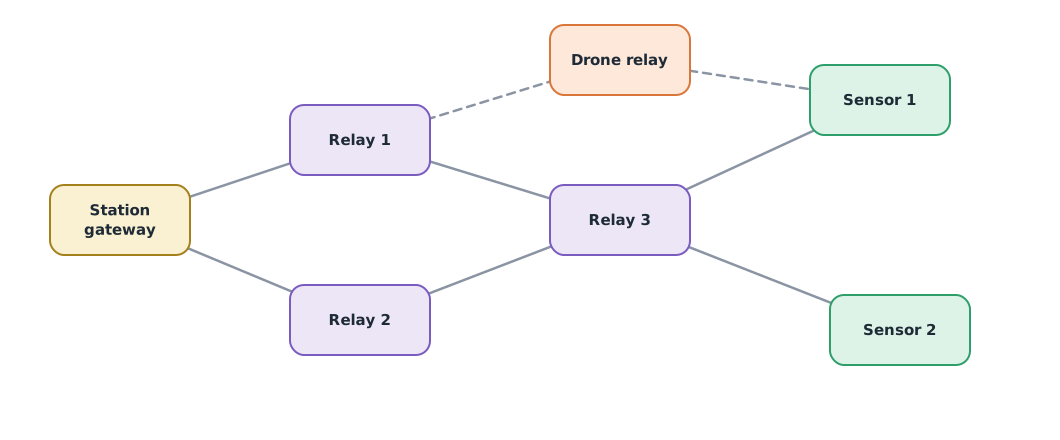
In a mesh, nodes pass messages along until they reach the gateway; each pass is one hop. Meshtastic sets a default hop limit of 3, with a maximum of 7. A drone can act as a temporary airborne relay, but every hop adds loss and delay and reuses the same channel.
Li et al. (2001) analysed chains of wireless nodes on one channel and found that in the ideal case a long chain carries only about 1/4 of a single link’s throughput, and about 1/7 in 802.11 simulations, because relaying nodes interfere with each other.
Example 2 What share reaches the destination
Each hop succeeds 90% of the time independently, using SF9 and a 20-byte message; on failure each hop may retry up to R times.
P_HOP, TOA_S = 0.90, 0.185                 # success chance per hop, SF9 time on air

for hops in (1, 2, 3, 5):
    row = []
    for retries in (0, 2):
        hop_ok = 1 - (1 - P_HOP) ** (retries + 1)
        tries = sum((1 - P_HOP) ** k for k in range(retries + 1))      # mean attempts per hop
        row.append(f"R={retries}: {hop_ok ** hops:6.1%}, airtime {hops * tries * TOA_S:.2f} s")
    print(f"{hops} hop(s): " + " | ".join(row))
1 hop(s): R=0: 90.0%, airtime 0.18 s | R=2: 99.9%, airtime 0.21 s
2 hop(s): R=0: 81.0%, airtime 0.37 s | R=2: 99.8%, airtime 0.41 s
3 hop(s): R=0: 72.9%, airtime 0.55 s | R=2: 99.7%, airtime 0.62 s
5 hop(s): R=0: 59.0%, airtime 0.93 s | R=2: 99.5%, airtime 1.03 sWithout retries, fewer than three in five messages survive five hops. Two retries deliver almost every message while adding only about 11% airtime. This does not yet include collisions, which increase as the network gets busier and cut real throughput, as Li et al. showed.
Module lab
Lab: designing a field network
- Use the code from Example 1 to choose an SF and position rate for a team of 20, using no more than half of the configured duty cycle.
- Set up three LoRa nodes (for example Meshtastic) in the TH region and measure delivery over one and two hops.
- Compare with Example 2 and explain the differences.
- Have a hovering drone carry a relay node and watch messages change route.
- Check the actual NBTC rules for 920–925 MHz and record transmit power and settings that comply.
Common mistakes
Watch out
- SF12 on every node, filling the channel.
- A high hop limit without considering collisions and delay.
- The wrong region or frequency for Thailand.
- Assuming mesh throughput equals a single link.
- Sending personal data over an open network unencrypted.
Summary
- One SF step nearly doubles time on air, reaching farther but carrying fewer messages.
- Thailand uses AS923-1 in 920–925 MHz; check power and conditions against the NBTC announcement.
- Delivery probability falls exponentially with hop count; retries help a lot.
- A single-channel chain carries only a fraction of a single link’s throughput (about 1/4 ideally).
Check your understanding
- What is the symbol time at SF10 and BW 125 kHz?
- A message takes 0.5 s on air with a 1% duty cycle. How many messages per hour at most?
- Each hop succeeds 80% of the time; three hops without retries succeed how often?
- What is Meshtastic’s default hop limit?
- Why does a single-channel chain of wireless nodes carry less than a single link?
Answers
- ms
- messages
- 3
- Relaying nodes share one channel, so they cannot transmit at the same time and interfere with each other.
Key formulas
| LoRa symbol time | |
| Payload symbol count | |
| Time on air |
Key references
- Semtech Corporation. (2015). SX1276/77/78/79 – 137 MHz to 1020 MHz low power long range transceiver (Datasheet Rev. 4). link
- LoRa Alliance. (2021). RP002-1.0.3 LoRaWAN regional parameters. link
- สมาคมโทรคมนาคมแห่งประเทศไทย. การใช้งาน IoT และ RFID ย่าน 920–925 MHz (สรุปประกาศ กสทช.). link
- Meshtastic. LoRa configuration. Meshtastic documentation. link
- Li, J., Blake, C., De Couto, D. S. J., Lee, H. I., & Morris, R. (2001). Capacity of ad hoc wireless networks. In Proceedings of the 7th Annual International Conference on Mobile Computing and Networking (MobiCom '01). ACM. link
Further reading
Study the assigned knowledge units in advance, review media and take the module quiz
Deep dive: Internet of Military Things, LoRa/mesh networks and field applications
Deep dive: coordinating drone swarms over LoRa mesh networks
In class / field
Lab or field practice from worksheets with a safety checklist
Learning evidence: Checked worksheets and quiz results