UAS architecture
UAT 301 Unmanned Aircraft Systems Technology
Lesson
By the end of this module you will be able to
- Decompose a UAS into subsystems and identify interfaces with an N-squared matrix
- Classify UAS under the US DoD framework, EASA and Thai registration conditions
- Compare multirotor, fixed-wing and VTOL architectures at system level
- Read the specification of an off-the-shelf system and break it into subsystems
Why this matters
UAT 311 gave an overview of what a UAS contains. This course goes to the depth of an engineer who must select and be accountable for a real system. The whole course uses one case: a provincial disaster prevention centre wants a UAS to map 4 km² of flooded land and to search for people at night. Before comparing any products, the system must be broken into comparable parts, and you must know which group each system falls into under the rules and standards. The drone knowledge base’s unit on UAV/UAS fundamentals recommends separating the system components before trying missions. The numbers in this module are hypothetical.
Subsystems and interfaces
Fahlstrom and colleagues and Austin divide a UAS into the air vehicle, payload, ground control station, data links, launch and recovery equipment, support equipment and people (pilots and operators). Most problems are not inside one subsystem but at the interfaces between them. The NASA Systems Engineering Handbook uses the N-squared matrix to show interfaces: place the subsystems on the diagonal and write what passes between them in the cells where they meet.
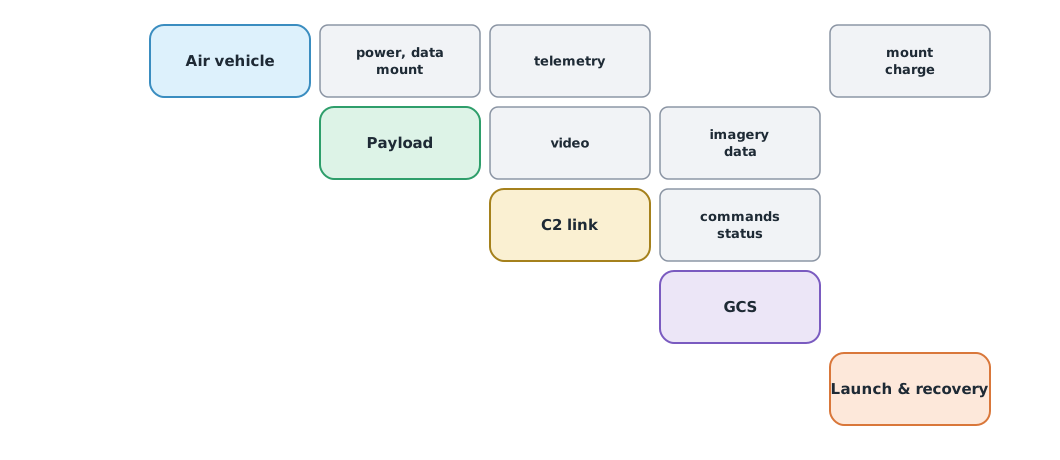
Example 1 Which subsystem is most connected?
from itertools import combinations

subsystems = ["air vehicle", "payload", "C2 link", "GCS", "launch & recovery"]
interfaces = {
    ("air vehicle", "payload"): "power, data, mount",
    ("air vehicle", "C2 link"): "telemetry",
    ("payload", "C2 link"): "video",
    ("C2 link", "GCS"): "commands, status",
    ("air vehicle", "launch & recovery"): "mount, charging",
    ("payload", "GCS"): "imagery, data",
}
n = len(subsystems)
possible = len(list(combinations(subsystems, 2)))
print(f"{len(interfaces)} of {possible} possible pairs are used (n(n-1)/2 = {n * (n - 1) // 2})")
degree = {s: sum(s in pair for pair in interfaces) for s in subsystems}
for s, d in sorted(degree.items(), key=lambda kv: -kv[1]):
    print(f"{s:<18} {d} interfaces")
changed = "C2 link"
retest = sorted({x for pair in interfaces if changed in pair for x in pair} - {changed})
print(f"if the {changed} is replaced, retest the interfaces with: {', '.join(retest)}")
6 of 10 possible pairs are used (n(n-1)/2 = 10)
air vehicle 3 interfaces
payload 3 interfaces
C2 link 3 interfaces
GCS 2 interfaces
launch & recovery 1 interfaces
if the C2 link is replaced, retest the interfaces with: GCS, air vehicle, payloadThe air vehicle, payload and C2 link each have three interfaces, the most of any subsystem. These are where a change has the widest effect. For example, replacing the C2 radio means retesting its interfaces with every connected subsystem, not just the radio itself.
Classifying a UAS
Rules and standards group UAS differently for different purposes, so several frameworks are needed.
- The US Department of Defense divides UAS into five groups (Group 1–5) by maximum take-off weight, operating altitude and airspeed (Unmanned Systems Integrated Roadmap FY2011–2036). If any one attribute exceeds a group, the system belongs to the higher group. A 2024 Congressional Research Service report notes the chart is still used in US joint doctrine.
- EASA divides operations into open, specific and certified under Regulation (EU) 2019/947. The open category requires a mass below 25 kg, visual line of sight and a height of no more than 120 m. Regulation (EU) 2019/945 defines aircraft classes, for example C0 below 250 g, C1 below 900 g, C2 below 4 kg and C3/C4 below 25 kg. Classes also carry technical requirements beyond mass.
- Thailand: the CAAT general conditions require visual line of sight, daytime flight, a height of no more than 90 m, and a horizontal distance from people, vehicles and buildings of 30 m for drones up to 2 kg or 50 m for heavier ones (CAAT-GM-UAS-002). Every drone with a camera, and any drone without a camera over 2 kg, must be registered; drones over 25 kg fall under a separate notification.
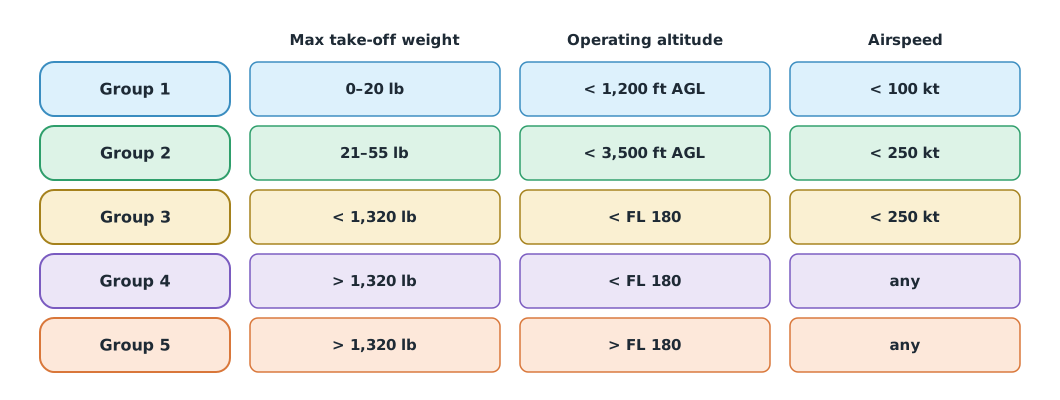
Example 2 Classifying systems on the market under three frameworks
KG_LB, M_FT, MS_KT = 2.20462, 3.28084, 1.94384
DOD = [(1, 20, 1200, 100), (2, 55, 3500, 250), (3, 1320, 18000, 250), (4, float("inf"), 18000, float("inf"))]

def dod_group(kg, alt_m, speed_ms):
    lb, ft, kt = kg * KG_LB, alt_m * M_FT, speed_ms * MS_KT
    for g, max_lb, max_ft, max_kt in DOD:
        if lb <= max_lb and ft < max_ft and kt < max_kt:
            return g
    return 5

def easa_class(kg):                       # by mass only; real classes have other requirements too
    for limit, c in ((0.25, "C0"), (0.9, "C1"), (4, "C2"), (25, "C3/C4")):
        if kg < limit:
            return c
    return "not open category"

def thai_rule(kg, camera):
    if kg > 25:
        return "separate regulation (> 25 kg)"
    return "must register" if camera or kg > 2 else "no registration"

systems = [   # name, mass kg, operating altitude m, speed m/s, camera
    ("mini quad", 0.85, 90, 15, True),
    ("mapping VTOL", 3.6, 90, 16, True),
    ("long-range fixed-wing", 20, 1500, 30, True),
    ("spraying drone (full tank)", 42, 10, 7, False),
]
for name, kg, alt, v, cam in systems:
    print(f"{name:<27} DoD Group {dod_group(kg, alt, v)} | EASA {easa_class(kg):<17} | Thailand: {thai_rule(kg, cam)}")
mini quad DoD Group 1 | EASA C1 | Thailand: must register
mapping VTOL DoD Group 1 | EASA C2 | Thailand: must register
long-range fixed-wing DoD Group 3 | EASA C3/C4 | Thailand: must register
spraying drone (full tank) DoD Group 3 | EASA not open category | Thailand: separate regulation (> 25 kg)The spraying drone with a full tank exceeds 25 kg, so it falls under the separate notification, and it is Group 3 in the US framework even though it flies low and slowly, because it weighs more than 55 lb. The long-range fixed-wing weighs 44 lb, within the Group 2 weight limit, but flies at about 4,900 ft, above 3,500 ft, so it is Group 3; in Europe it would not be in the open category at that height even though its mass fits class C3/C4. The actual take-off mass including payload decides the class, not the empty mass.
Three air vehicle architectures
| Aspect | Multirotor | Fixed-wing | VTOL |
|---|---|---|---|
| Take-off and landing | Vertical, small area | Needs a runway, catapult or parachute | Vertical, small area |
| Hover | Yes | No | Yes, but with high power |
| Endurance per unit energy | Low | High | Medium |
| Complexity | Low | Medium | High (two propulsion sets, transitions) |
(Summarised from Fahlstrom and colleagues and Barnhart and colleagues.) Module 2 calculates the endurance of all three with the same battery.
Module lab
Lab: break down one off-the-shelf system
- Choose one off-the-shelf system from the manufacturer’s specification and break it into all its subsystems
- Draw an N-squared matrix, fill in what passes in each cell, and use Example 1 to find the most connected subsystem
- Classify the system with Example 2 using the maximum take-off mass including payload
- Check the latest CAAT registration and flight conditions on the UAS Portal
- Open SITL and QGroundControl and identify which subsystems in Figure 1 are visible on the GCS screen
Common mistakes
Watch out
- Looking only at the air vehicle and forgetting the GCS, links, launch equipment and people
- Classifying by empty mass instead of maximum take-off mass
- Assuming one country’s framework applies everywhere
- Not listing interfaces, so the effect of changing one part is unknown
- Reading rules from old sources instead of the latest version
Summary
- A UAS has many subsystems, and problems usually sit at interfaces, which an N-squared matrix makes visible
- subsystems have at most interface pairs
- The US DoD framework uses mass, altitude and speed; EASA uses operation categories and aircraft classes; Thailand sets registration by camera and mass
- Multirotor, fixed-wing and VTOL trade take-off ability, hover, endurance and complexity
Check your understanding
- How many interface pairs can 6 subsystems have at most?
- Which DoD group is a 15 kg drone flying at 300 m and 20 m/s?
- Must a 1.5 kg drone without a camera be registered with CAAT?
- What mass and height limits apply to the EASA open category?
- Why does the most connected subsystem need special care?
Answers
- pairs
- 33.1 lb, 984 ft and 38.9 kt, so Group 2 because the mass exceeds 20 lb
- No, because it has no camera and is not over 2 kg
- Mass below 25 kg and height no more than 120 m
- A change affects many interfaces and needs retesting in many places
Key formulas
| Number of possible interface pairs | |
| Unit conversions |
Key references
- Fahlstrom, P. G., Gleason, T. J., & Sadraey, M. H. (2022). Introduction to UAV systems (5th ed.). Wiley. link
- Austin, R. (2010). Unmanned aircraft systems: UAVS design, development and deployment. Wiley. link
- Barnhart, R. K., Marshall, D. M., & Shappee, E. (Eds.). (2021). Introduction to unmanned aircraft systems (3rd ed.). CRC Press. link
- U.S. Department of Defense. (2011). Unmanned systems integrated roadmap FY2011–2036. link
- Congressional Research Service. (2024). Defense primer: Categories of uncrewed aircraft systems (IF12797). link
- European Commission. (2019). Commission Implementing Regulation (EU) 2019/947 on the rules and procedures for the operation of unmanned aircraft. link
- European Commission. (2019). Commission Delegated Regulation (EU) 2019/945 on unmanned aircraft systems and on third-country operators of unmanned aircraft systems. link
- สำนักงานการบินพลเรือนแห่งประเทศไทย. (2565). เอกสารแนวทาง CAAT-GM-UAS-002 (ปรับปรุงครั้งที่ 00). link
- สำนักงานการบินพลเรือนแห่งประเทศไทย. (2568). Important things to know before using drones [อินโฟกราฟิก]. link
- National Aeronautics and Space Administration. (2016). NASA systems engineering handbook (NASA/SP-2016-6105 Rev 2). link
Further reading
Study the assigned knowledge units in advance, review media and take the module quiz
UAV/UAS fundamentals and flight simulation
Topic 1: Safety and flight fundamentals
In class / field
Lab or field practice from worksheets with a safety checklist
Learning evidence: Checked worksheets and quiz results