Research concepts and research questions
UAT 309 Introduction to Research in Unmanned Aircraft Systems and Automation Technology
Lesson
By the end of this module you will be able to
- Explain how research differs from developing a product, and classify types of technology research
- Write a research question that meets the FINER criteria from a problem in drone and automation work
- Identify independent, dependent and control variables, and write testable hypotheses
Why this matters
Drone and automation work changes fast, and vendor claims or team beliefs are rarely enough to decide on. Does the new propeller really fly longer? How ready are local officials to use drones? Research answers such questions systematically, in ways others can check and repeat. This course prepares you for the final-year project (UAT 491 in the four-year programme, or UAT 493 in the continuing programme) and for reading other people’s research.
The course follows two hypothetical studies. The first is an experiment: how does payload affect the flight time of a small drone? The second is a survey: how ready are local government officials in one province to use drones in their work? The Python code for the course can be downloaded from /downloads/uat-309/.
What research is, and how it differs from development
Building a prototype drone that flies is development; the goal is a working product. Research aims at trustworthy knowledge that others can build on. Real work often mixes the two, such as a project that develops a system and then tests systematically whether it is really better. Creswell and Creswell’s Research Design groups approaches into three kinds.
| Approach | Main data | Drone example |
|---|---|---|
| Quantitative | Numbers, measured and tested statistically | Measuring flight time at different payloads |
| Qualitative | Words, observations, documents | Interviewing officials about why they do not yet use drones |
| Mixed methods | Both | A questionnaire survey followed by in-depth interviews with a few respondents |
By purpose, basic research seeks to understand principles, applied research solves a specific problem, and research and development (R&D) creates something new and proves its effect. Most work in this programme is applied research or R&D.
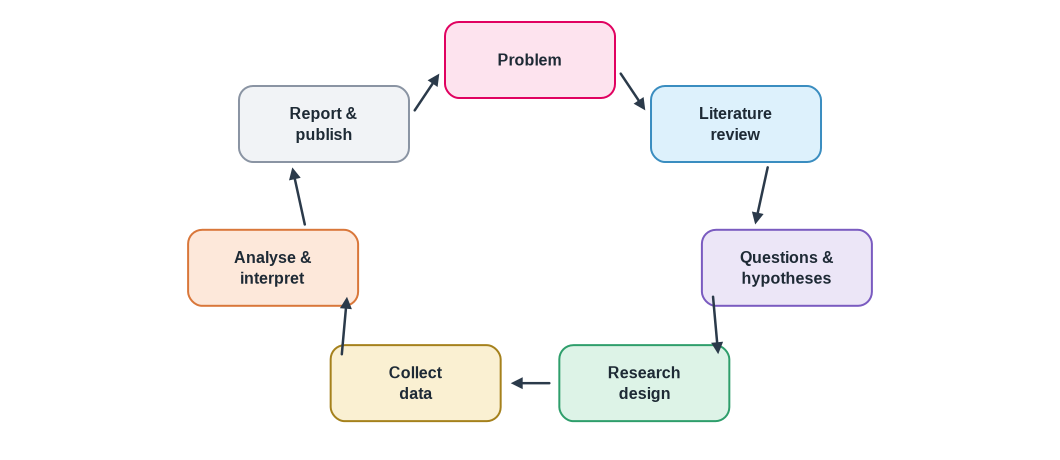
From problem to research question
A problem is a gap between what is and what should be, for example “the survey team has to change batteries too often when carrying a heavy camera”. A problem is still too broad to answer with one round of data collection. A research question must be narrow and clear and say what will be measured, for example “By how much does this drone’s flight time fall for every extra 100 g of payload?”
Hulley and colleagues proposed the FINER criteria for checking a research question.
| Criterion | Check | Payload experiment |
|---|---|---|
| F (Feasible) | Enough time, equipment, skills and budget? | One drone, test weights and the university field |
| I (Interesting) | Do the researcher and users want the answer? | The survey team needs it for mission planning |
| N (Novel) | Does it add to what is known? | The maker quotes flight time only with no payload |
| E (Ethical) | Safe and respectful of those involved? | Fly in a permitted area with nobody under the flight path |
| R (Relevant) | Can the result be used? | To set camera weight limits and battery numbers |
Example 1 Improving a question
A student’s first question: “Are drones suitable for local government work?” It is too broad, says nothing about what to measure, and “suitable” is vague.
The revised question: “What is the level of readiness to use drones among local government officials in this province, and how are knowledge, organisational support and attitude to technology related to that readiness?”
The new question names the population (local officials in the province), what is measured (readiness) and the variables expected to matter, so a questionnaire can be designed from it.
Variables and hypotheses
A variable is something whose value can change and be measured. The independent variable is what the researcher expects to be a cause, the dependent variable is the outcome measured, and a control variable is something that could affect the outcome and is therefore held constant. Box, Hunter and Hunter stress in Statistics for Experimenters that without control or randomisation, the effects of such variables get mixed up with the effect being studied.
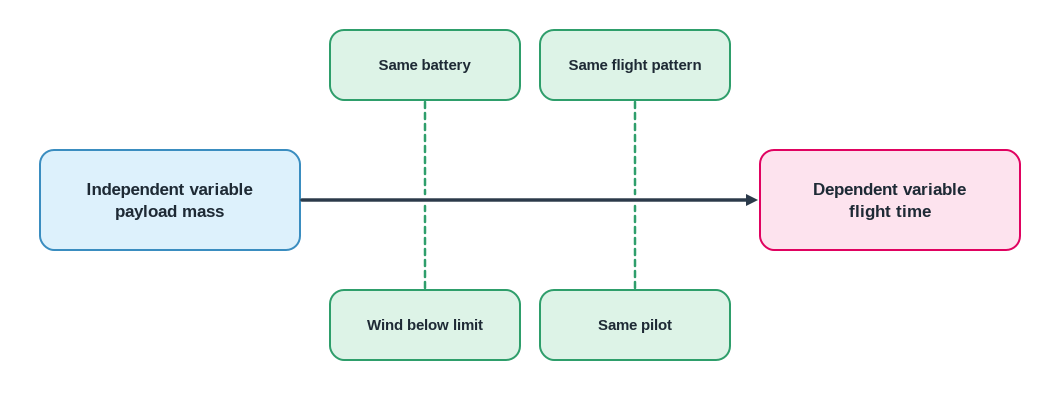
A hypothesis is an answer stated in advance that data can confirm or refute. For a statistical test it is written as a pair: the null hypothesis (no relationship) and the alternative hypothesis . If is the slope of flight time against payload:
Example 2 Variables in the survey
In the local government survey the researcher cannot set the variables, so the expected causes are called predictors: knowledge of drones, organisational support and attitude to technology. The outcome is readiness to use drones. One hypothesis is “Officials who receive more organisational support are more ready”. A finding like this shows an association but does not prove cause and effect.
Class activity
Activity: from problem to hypothesis
- Each group picks a real problem it has met in drone or automation work.
- Write one research question and check it against each FINER criterion.
- Name the independent variable or predictors, the dependent variable, and at least three control variables.
- Write testable and .
- Swap with another group and critique whether the question is narrow and measurable enough.
Common mistakes
Watch out
- Questions that are too broad, such as “Are drones good?”, with nothing to measure
- Vague words such as suitable, good or efficient, with no definition of how they are measured
- Forgetting control variables, so the effect of payload is mixed with wind or battery wear
- Treating an association from a survey as cause and effect
- Setting hypotheses after seeing the data and reporting them as if set in advance
Summary
- Research aims at knowledge others can check and repeat; development aims at a working product.
- Research approaches are quantitative, qualitative and mixed methods.
- A good research question is narrow, clear, measurable and meets the FINER criteria.
- Identify independent, dependent and control variables, and write and before collecting data.
Check your understanding
- How does building a prototype drone differ from research?
- In “Does flight altitude affect image resolution?”, what are the independent and dependent variables?
- Which qualities of a good research question does “Are drones suitable for farming?” lack?
- Why can a survey that finds knowledgeable people are more ready not conclude that knowledge is the cause?
- Write for the question “Does propeller B give longer flights than propeller A?”
Answers
- Development aims at a working product; research aims at trustworthy knowledge, using methods others can check and repeat
- The independent variable is flight altitude; the dependent variable is image resolution (for example GSD)
- It is neither clear nor measurable: “suitable” is vague and it names no population or measure, so feasibility (F) and relevance (R) cannot be judged
- The data were collected once without setting the variables, so another variable, such as organisational support, may raise both knowledge and readiness
- : mean flight time with propeller B equals that with propeller A ()
Key formulas
| Null and alternative hypotheses |
Key references
- Creswell, J. W., & Creswell, J. D. (2022). Research design: Qualitative, quantitative, and mixed methods approaches (6th ed.). SAGE. link
- Hulley, S. B., Cummings, S. R., Browner, W. S., Grady, D. G., & Newman, T. B. (2013). Designing clinical research (4th ed.). Lippincott Williams & Wilkins. link
- Box, G. E. P., Hunter, J. S., & Hunter, W. G. (2005). Statistics for experimenters: Design, innovation, and discovery (2nd ed.). Wiley. link
Further reading
Study the assigned knowledge units in advance, review media and take the module quiz
In class / field
Lecture, case discussion and in-class problem solving
Learning evidence: Quiz results and submitted exercises