Literature review and conceptual framework
UAT 309 Introduction to Research in Unmanned Aircraft Systems and Automation Technology
Lesson
By the end of this module you will be able to
- Search the literature systematically with keywords, Boolean operators and inclusion and exclusion criteria
- Report the selection of sources with a flow diagram following PRISMA 2020
- Write research objectives and a conceptual framework linking the variables to the research question
- Cite sources in APA 7th edition style
Why this matters
Before collecting a single data point, a researcher must know how far others have already answered the question, with which methods, and what is still missing. A literature review avoids repeating work already done, helps choose measures accepted in the field, and is the source of the conceptual framework. This lesson continues the local government drone readiness survey from module 1. All figures are hypothetical.
Searching systematically
A good search must be repeatable: someone else using the same terms and databases should get similar results. The main steps are:
- Break the question into concepts, such as (drones) (local government) (technology adoption).
- Find synonyms for each concept in Thai and English, such as drone, UAV, unmanned aircraft.
- Combine with Boolean operators: OR within a concept and AND between concepts, for example
("drone" OR "UAV" OR "unmanned aircraft") AND ("local government" OR "municipal") AND ("adoption" OR "readiness"). - Choose databases, such as Scopus and IEEE Xplore for international work and ThaiJO for Thai journals.
- Set inclusion and exclusion criteria in advance, for example published from 2015, in Thai or English, with data from real users.
- Record the search date, the terms and the number of hits in each database in the report.
Reporting selection with a PRISMA diagram
The PRISMA 2020 guideline of Page and colleagues is the standard for reporting systematic reviews. The part useful even at undergraduate level is the flow diagram, which shows why the number of sources falls at each stage, so readers can see that the researcher did not simply pick the studies that support their beliefs.
Example 1 Counting sources at each stage
found = {"Scopus": 142, "IEEE Xplore": 96, "ThaiJO": 38}      # hits in each database (hypothetical)
duplicates = 61                                               # duplicates across databases
excluded_title_abstract = 158                                 # excluded on title and abstract
not_retrieved = 4                                             # full text not retrieved
excluded_full_text = {"not UAS": 12, "no field data": 17, "not in English or Thai": 3}

identified = sum(found.values())
screened = identified - duplicates
sought = screened - excluded_title_abstract
assessed = sought - not_retrieved
included = assessed - sum(excluded_full_text.values())
for label, n in (("identified", identified), ("after duplicates removed", screened),
                 ("full text sought", sought), ("full text assessed", assessed), ("included", included)):
    print(f"{label:<26} {n:>4}")
identified 276
after duplicates removed 215
full text sought 57
full text assessed 53
included 21Of 276 records, 21 are included in the review. The numbers at every stage must add up exactly; if they do not, a stage has been recorded wrongly.
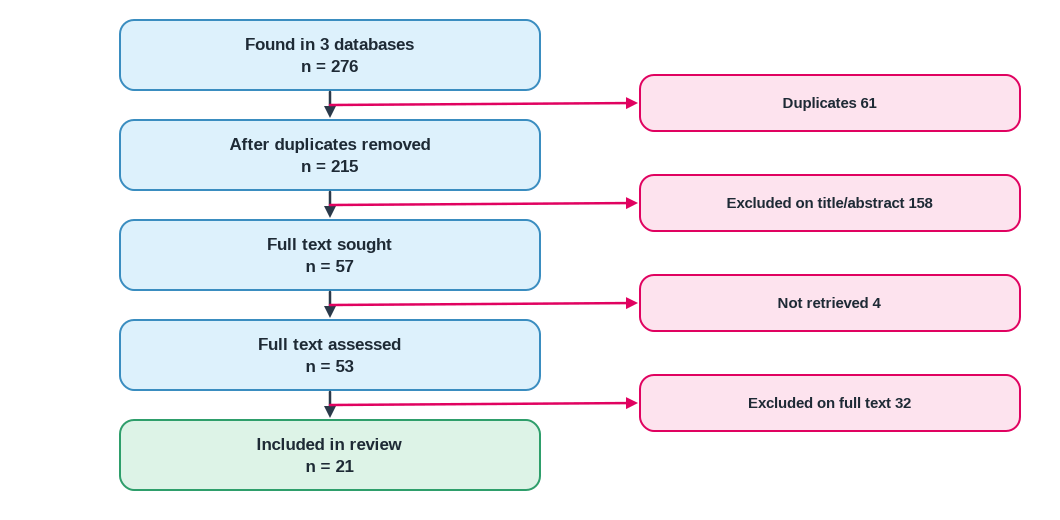
Once the sources are chosen, summarise them all in one table. Common columns are authors and year, country, sample, measures, main findings and limitations. Then write the review as a synthesis, grouped by theme, for example “Most studies found that training is associated with technology adoption, but none has examined local government in Thailand”, rather than describing one study after another.
Objectives and conceptual framework
Research objectives turn the research questions into actions, starting with a measurable verb such as to determine the level of, to compare, or to examine the relationship between. Creswell and Creswell recommend that each objective match one research question and one method of analysis.
Example 2 Objectives of the local government survey
- To determine the level of readiness to use drones among local government officials in the province (analysed with means and standard deviations).
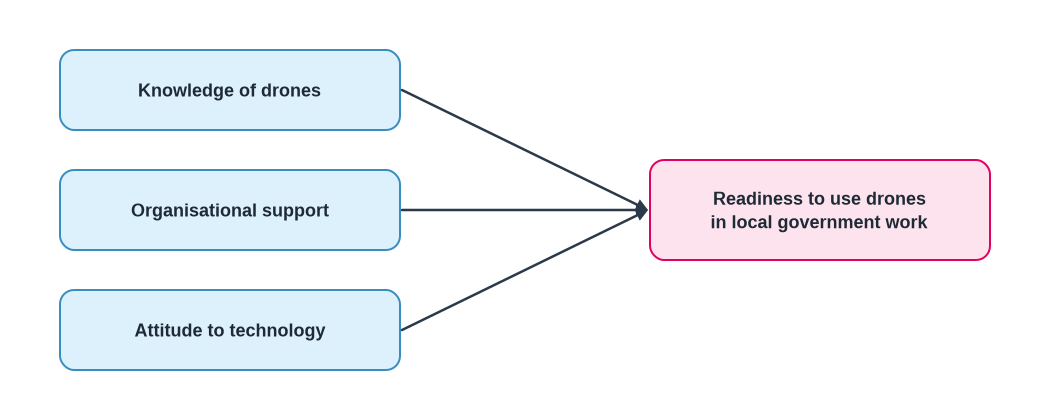
- To examine the relationships of knowledge, organisational support and attitude to technology with readiness to use drones (analysed with correlation and regression).
A conceptual framework is a diagram showing which variables the researcher expects to be related. It must come from the literature, not from intuition; every arrow should be supported by at least one source.
Citing in APA 7 style
The APA Publication Manual, 7th edition, uses author–date citations. In the text write (Author, year), such as (Krejcie & Morgan, 1970); for three or more authors write the first author followed by et al., such as (Page et al., 2021). The reference list is ordered by the first author’s surname, with DOIs written as URLs where available. Every source cited in the text must be in the reference list, and every entry in the list must be cited. When you paraphrase or summarise someone else’s work you must still cite it, however much you change the wording.
Class activity
Activity: search and synthesise
- Break your group’s research question from module 1 into concepts, with Thai and English synonyms.
- Write a Boolean search string, search at least two databases, and record the date and number of hits.
- Screen with your criteria and draw your group’s PRISMA diagram.
- Summarise the included sources in a table, then write one synthesis paragraph.
- Draw a conceptual framework with a reference attached to every arrow.
Common mistakes
Watch out
- Searching one database with one term and concluding nobody has studied the topic
- Not recording search terms and dates, so the search cannot be repeated or updated
- Describing one study after another instead of synthesising by theme
- A conceptual framework with no basis in the literature
- Paraphrasing without citing, or citing sources you have not read
Summary
- Search systematically with concepts, synonyms, Boolean operators and inclusion and exclusion criteria, and record everything so it can be repeated.
- A PRISMA 2020 flow diagram shows why sources drop out at each stage, and its numbers must add up exactly.
- Objectives match questions and analyses; a conceptual framework must come from the literature.
- Cite in APA 7 style, keeping in-text citations and the reference list consistent.
Check your understanding
- A search finds 180 records; 40 are duplicates and 100 are excluded on title and abstract. How many full texts are sought?
- In a Boolean search, should drone and UAV be joined with OR or AND, and why?
- How does a synthesis differ from describing studies one by one?
- How do you cite a 2023 work by four authors in the text in APA 7 style (the first author is Lee)?
- What should each arrow in a conceptual framework be based on?
Answers
- OR, because they are synonyms for the same concept and you want sources containing either word
- A synthesis groups findings by theme, compares what studies agree or disagree on, and points to the gap your work will fill
- (Lee et al., 2023)
- The literature reviewed; every arrow should be supported by at least one source
Key formulas
| Counts at each PRISMA stage |
Key references
- Page, M. J., McKenzie, J. E., Bossuyt, P. M., et al. (2021). The PRISMA 2020 statement: An updated guideline for reporting systematic reviews. BMJ, 372, n71. link
- Creswell, J. W., & Creswell, J. D. (2022). Research design: Qualitative, quantitative, and mixed methods approaches (6th ed.). SAGE. link
- American Psychological Association. (2020). Publication manual of the American Psychological Association (7th ed.). American Psychological Association. link
Further reading
Study the assigned knowledge units in advance, review media and take the module quiz
In class / field
Lecture, case discussion and in-class problem solving
Learning evidence: Quiz results and submitted exercises