Power and propulsion
UAT 311 Advanced Unmanned Aircraft Systems Technology and System Architecture
Lesson
By the end of this module you will be able to
- Compare multirotor, fixed-wing, hybrid VTOL and helicopter aircraft in energy use and mission fit
- Calculate fixed-wing power required from the lift-to-drag ratio
- Estimate endurance from specific energy and battery mass fraction
- Explain battery-electric, hybrid and fuel-cell propulsion architectures
- Choose a power system to meet mission requirements
- Compare airframe configurations and materials, and check a frame arm with cantilever bending stress and deflection
Energy decides what a drone can do
The first question users always ask is “how long can it fly?” The answer depends on two things: how much power the aircraft needs to fly and how much energy it can carry. This module compares aircraft types and energy sources so you can choose a system for a mission on sound grounds.
Aircraft types and power use
| Type | Strengths | Limitations | Suited missions |
|---|---|---|---|
| Multirotor | Vertical take-off, hover, easy control | Very high power, short endurance | Close inspection, single-point imaging |
| Fixed-wing | Low power, long endurance and range | Needs a runway or launcher; cannot hover | Wide-area survey, long linear patrols |
| Hybrid VTOL | Vertical take-off plus efficient wing-borne cruise | Complex, heavier from two systems, risky transition | Wide-area survey without a runway |
| Single-rotor helicopter | Better hover efficiency than multirotor, heavy lift | Complex mechanics, heavy maintenance | Agricultural spraying, heavy lift |
The key difference is how lift is produced. A multirotor must push air down continuously to support its weight (momentum theory can be reviewed in UAT 102 in the four-year programme). A fixed-wing aircraft gets lift from forward motion, so its propeller only has to overcome drag.
Fixed-wing power required
In level flight, lift equals weight and thrust equals drag. The lift-to-drag ratio () measures wing efficiency, so
Example 1. Comparing power use
A 3 kg fixed-wing aircraft with flies at 15 m/s.
- Drag N
- Mechanical power W
- With combined propeller and motor efficiency 0.6, electrical power W
Compare the 2 kg multirotor using about 237 W in hover (see UAT 102 Module 4 in the four-year programme): the heavier fixed-wing uses roughly a third of the power. That is why wide-area survey favours fixed-wing or VTOL aircraft.
Energy sources
Specific energy () is energy per unit mass, in Wh/kg. The higher it is, the more energy you carry for the same weight.
| Energy source | Approximate specific energy | Note |
|---|---|---|
| LiPo battery (whole pack) | about 150–200 Wh/kg | Delivers high current well; common in multirotors |
| Li-ion battery (whole pack) | about 200–250 Wh/kg | More energy but lower current capability; suits fixed-wing |
| Gasoline (fuel only) | about 12 000 Wh/kg | Small engines convert only a small share to work |
| Hydrogen (fuel only) | about 33 300 Wh/kg | High-pressure tanks are heavy and bulky |
The hydrogen and gasoline figures are lower heating values from U.S. Department of Energy documents. They look far higher than batteries, but the comparison needs care: they are fuel only, excluding engines, tanks and conversion efficiency. At system level the gap narrows a lot; hydrogen’s advantage is clearest on missions lasting several hours.
Estimating endurance from battery mass
where is battery mass, specific energy and the usable fraction (often set to 0.8).
Example 2. Fixed-wing endurance
The aircraft in Example 1 carries a 1.0 kg Li-ion pack at 200 Wh/kg.
- Energy Wh
- Endurance hours
Raise the battery to 1.5 kg and total mass rises, so power required rises too; endurance does not grow by 50%. Designers must find a balanced battery mass fraction.
Propulsion architectures
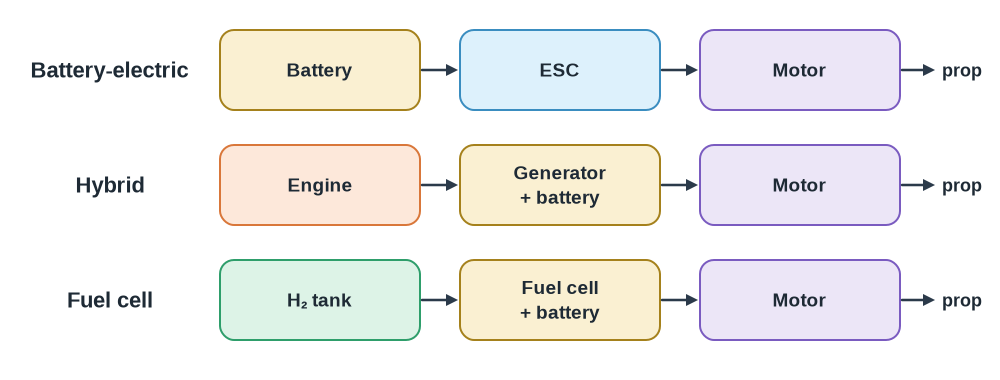
- Battery-electric is simple, quiet and low-maintenance, the most common type, but limited by battery specific energy.
- Hybrid uses an engine to drive a generator; the battery supplies peak power for take-off. Endurance is far longer, at the cost of noise, vibration and engine maintenance.
- Hydrogen fuel cell converts hydrogen straight to electricity, quietly and for long durations, but requires handling high-pressure tanks and a hydrogen supply, with its own safety requirements.
Power-system compatibility
When choosing power-system parts, check several things together:
- Voltage: battery, ESC and motor must support the same cell count.
- Current: ESCs and wiring must carry peak current with margin, and the battery must deliver it (C-rating).
- Thrust: enough thrust-to-weight for control and wind.
- Heat: ESCs, motors and battery must shed heat in Thailand’s hot climate.
- Weight and centre of gravity of the installed system.
Airframe structure: configurations, materials and design
The airframe is the part that carries every load on the aircraft. It holds the motors and propellers in the right alignment, protects the autopilot, battery and payload, and must be as light as possible, because every gram of structure is a gram that energy has to lift. Fahlstrom and colleagues’ Introduction to UAV Systems treats loads and structures as part of air-vehicle design rather than something separate from the power system, since a heavier structure raises the power required through the formulas in the sections above.
Airframe configurations by aircraft type
| Type | Main structural parts | What the designer must consider |
|---|---|---|
| Multirotor | A centre plate carrying the equipment, arms reaching out to the motors, landing gear | Number and layout of arms (X, H, six or eight arms, or coaxial rotors), spacing between propellers, and arm stiffness |
| Fixed-wing | Fuselage, wing, tail (or a tailless flying wing) | The wing carries all the lift and passes it into the fuselage at the wing root; a pusher or twin-boom layout leaves the nose free for a camera |
| Hybrid VTOL | A fixed-wing airframe plus booms carrying lift motors, or a tilting-rotor mechanism | The booms carry both hover thrust and wing loads in cruise, and the lift motors are dead weight in cruise |
ArduPilot’s multicopter design guidance recommends sizing the frame for the largest propellers you might ever use, because larger propellers are usually more efficient and an X layout normally fits the largest ones. Allow about an extra half inch of clearance from prop tip to the next prop and to the centre plate, use a small single round tube for each arm, since a round tube presents about half the prop-wash area of a square tube of the same size, and keep the weight as close to the centre as possible.
Materials
| Material | Strengths | Limits | Where it is used |
|---|---|---|---|
| Carbon-fibre reinforced plastic (CFRP) | Very stiff and strong for its weight | Brittle, shatters on impact, hard to machine and glue, conducts electricity and blocks radio | Multirotor arms and centre plates, tail booms, wings of high-performance aircraft |
| Glass-fibre reinforced plastic (GFRP) | More shatter-resistant, easier to machine and glue, transparent to radio | Heavier than carbon for the same strength | Antenna covers, fixed-wing fuselages |
| Aluminium alloy such as 6061-T6 | Bends before it breaks, so damage is visible; easy to repair and buy | Heavier than composites | Low-cost frame arms, brackets and joints |
| Engineering plastics and 3D-printed parts | Quick to make; good for prototypes and equipment mounts | FDM prints are not equally strong in every direction and are weak across the layers | Camera mounts, covers, prototypes |
| Foam (EPO, EPP) and balsa | Light and cheap; foam survives impact | Low stiffness; degrades with sun and moisture | Fixed-wing trainers and light work |
The brittleness of carbon and the shatter resistance of glass fibre come from the ArduPilot documentation, and the directional strength of FDM parts comes from the experiments of Ahn and colleagues (2002), who found that the strength of printed ABS depends on the direction of the printed roads relative to the load. The point to remember is that the best material depends on the part’s job: a box with an antenna inside should not be made of carbon.
Structural design principles
1 Define the loads. The largest load expected in real service is the limit load, for example maximum motor thrust, gust loads and landing impact. Multiply it by a factor of safety to get the ultimate load the structure must carry without failing. The US rules for transport aircraft (14 CFR 25.303) use 1.5, a sensible starting value for drones when no specific requirement applies.
2 Check both strength and stiffness. A multirotor arm is like a ruler clamped to a desk at one end and pressed at the other, a cantilever. Hibbeler’s mechanics of materials gives:
Here is the second moment of area of the tube cross-section (how well it resists bending), and are the outer and inner diameters, is the bending stress at the arm root, is how far the arm tip deflects, and is the material’s elastic modulus. Note that depends on diameter to the fourth power, so a slightly larger hollow tube is much stiffer for little extra weight.
3 Watch vibration. An arm that is too flexible vibrates with the propellers and passes that vibration to the autopilot. The ArduPilot documentation states that excessive vibration can throw off the position and altitude estimates and lead to very bad performance in modes that rely on them; levels below 30 m/s² are normally acceptable.
4 Design for repair. Arms that can be replaced individually (the modular idea from module 1) mean that after a hard landing only the damaged arm is changed, not the whole frame.
Example 3 Choosing the arm tube for a 2 kg multirotor
A four-arm multirotor has a take-off mass of 2.0 kg, a thrust-to-weight ratio of 2 and 0.20 m arms. Compare two tube sizes and two materials. The aluminium 6061-T6 values are = 68.9 GPa and density 2,700 kg/m³ from the ASM data sheet, and a yield stress of 240 MPa, the specified minimum for extruded tube (EN 755-2, as listed in a supplier data sheet); typical tested material is stronger, about 276 MPa in the ASM sheet, but design should use the minimum. The carbon tube values are assumed, because they depend on each maker’s fibre lay-up.
import math
g = 9.81
m, tw, n_arms = 2.0, 2.0, 4          # take-off mass (kg), thrust-to-weight ratio, number of arms
L = 0.20                              # arm length from the centre plate to the motor (m)
F = tw * m * g / n_arms               # limit load: maximum thrust of one motor (N)
Fu = 1.5 * F                          # ultimate load with a factor of safety of 1.5

materials = {                         # E (Pa), density (kg/m^3), strength (Pa)
    "aluminium 6061-T6": (68.9e9, 2700, 240e6),
    "carbon tube (assumed)": (100e9, 1550, 600e6),
}
print(f"limit load {F:.2f} N, ultimate load {Fu:.2f} N")
for D, d in [(0.016, 0.014), (0.010, 0.008)]:     # outer and inner diameter (m)
    I = math.pi * (D**4 - d**4) / 64              # second moment of area
    A = math.pi * (D**2 - d**2) / 4               # cross-section area
    stress = Fu * L * (D / 2) / I                 # bending stress at the root
    for name, (E, rho, strength) in materials.items():
        defl = F * L**3 / (3 * E * I)             # tip deflection at limit load
        print(f"{D*1000:.0f}/{d*1000:.0f} mm {name:22s} mass {rho*A*L*1000:5.1f} g  "
              f"stress {stress/1e6:5.1f} MPa  strength/stress {strength/stress:5.1f}  tip deflection {defl*1000:.2f} mm")
limit load 9.81 N, ultimate load 14.71 N
16/14 mm aluminium 6061-T6 mass 25.4 g stress 17.7 MPa strength/stress 13.6 tip deflection 0.29 mm
16/14 mm carbon tube (assumed) mass 14.6 g stress 17.7 MPa strength/stress 33.9 tip deflection 0.20 mm
10/8 mm aluminium 6061-T6 mass 15.3 g stress 50.8 MPa strength/stress 4.7 tip deflection 1.31 mm
10/8 mm carbon tube (assumed) mass 8.8 g stress 50.8 MPa strength/stress 11.8 tip deflection 0.90 mmEvery option carries the ultimate load easily (strength at least 4.7 times the stress), which means thrust in normal flight does not set the arm size. What really differs is weight and stiffness. The 10/8 mm aluminium tube is about 10 g lighter per arm than the 16/14 mm tube (about 40 g per aircraft) but deflects about 4.6 times more, following the ratio of : . A more flexible arm tends to vibrate more. The load that usually breaks arms in practice is crash impact, where aluminium bends and carbon may shatter. The choice therefore weighs weight, stiffness, vibration and repair, not strength alone.
Class activity
Case study
- Compare the specifications of three survey drones (multirotor, fixed-wing, VTOL) from maker documents. Calculate area surveyed per flight at equal GSD.
- Using eCalc or a spreadsheet, estimate endurance as battery mass varies from 0.5 to 2.0 kg, and find where gains start to shrink.
- Discuss whether your organisation should invest in hydrogen drones, considering fuel supply, safety and lifecycle cost.
- Inspect the frame of one drone (a real one in the lab or from maker documents), name its configuration and the material of each part, then measure the arm tube and compute stress and deflection with the code of Example 3.
Common mistakes
Watch out
- Comparing fuel specific energy directly with whole battery packs, ignoring system weight and conversion efficiency.
- Assuming endurance grows in proportion to battery added.
- Choosing aircraft type from familiarity rather than mission requirements.
- Forgetting heat in hot weather.
- Sizing arms for strength alone without checking stiffness and vibration, or enclosing an antenna in carbon.
Summary
- Multirotors use high power because rotors support the weight continuously; fixed-wing power is much lower.
- VTOL combines both strengths at the cost of complexity and weight.
- Battery packs offer about 150–250 Wh/kg; fuels are far higher but must be assessed at system level.
- Endurance , and extra battery gives diminishing returns.
- Power systems must match in voltage, current, thrust, heat and centre of gravity.
- The structure must carry the ultimate load (limit load times 1.5) and be stiff enough not to vibrate; choose materials by the part’s job, and remember a tube’s grows with diameter to the fourth power.
Check your understanding
- A 5 kg aircraft with flies at 18 m/s. What mechanical power does it need?
- At 0.55 overall efficiency, what electrical power does question 1 need?
- A 1.2 kg battery at 180 Wh/kg, 80% usable, powers question 2. How many minutes can it fly?
- If an arm tube changes from 16/14 mm to 10/8 mm in the same material, how many times larger is the tip deflection under the same load?
- Which aircraft type suits inspecting cracks under a bridge, and why?
Answers
- N, N, W
- W
- Wh, h, about 77 minutes
- , so it grows by times
- A multirotor, because it must hover close to the structure and move slowly and precisely
Key formulas
| Level-flight power (fixed-wing) | |
| Electrical power | |
| Battery energy | |
| Endurance | |
| Second moment of area of a hollow tube | |
| Cantilever bending stress and tip deflection |
Key references
- Fahlstrom, P. G., Gleason, T. J., & Sadraey, M. H. (2022). Introduction to UAV systems (5th ed.). Wiley. link
- Anderson, J. D. (2016). Introduction to flight (8th ed.). McGraw-Hill.
- Quan, Q. (2017). Introduction to multicopter design and control. Springer Singapore. link
- U.S. Department of Energy. (n.d.). Hydrogen storage. Energy.gov. link
- Leishman, J. G. (2006). Principles of helicopter aerodynamics (2nd ed.). Cambridge University Press.
- ArduPilot Dev Team. Advanced multicopter design. ArduPilot Copter documentation. link
- Hibbeler, R. C. (2023). Mechanics of materials (11th ed.). Pearson. link
- ASM Aerospace Specification Metals, Inc. (n.d.). Aluminum 6061-T6 [Material data sheet]. MatWeb. link
- Aalco Metals Ltd. (n.d.). Aluminium alloy 6061-T6 extrusions [Data sheet]. link
- Ahn, S.-H., Montero, M., Odell, D., Roundy, S., & Wright, P. K. (2002). Anisotropic material properties of fused deposition modeling ABS. Rapid Prototyping Journal, 8(4), 248–257. link
- ArduPilot Dev Team. Measuring vibration. ArduPilot Copter documentation. link
- Factor of safety, 14 C.F.R. § 25.303 (2026). link
Further reading
Study the assigned knowledge units in advance, review media and take the module quiz
In class / field
Lecture, case discussion and in-class problem solving
Learning evidence: Quiz results and submitted exercises