SMS and risk
UAT 313 Regulations, Safety, Risk Management and Ethics for Unmanned Aircraft Systems
Lesson
By the end of this module you will be able to
- Define hazard, safety and safety risk as in ICAO Annex 19
- Explain the four components and twelve elements of a safety management system (SMS)
- Explain the Swiss cheese model and the difference between active failures and latent conditions
- Identify hazards with checklists, what-if, a HAZID workshop and the bow-tie diagram
- Assess risk with the ICAO Doc 9859 matrix and propose mitigations
- Calculate a simple safety performance indicator
Why this matters
Good safety does not come from waiting for accidents and then fixing things. It comes from finding hazards before events happen and managing them systematically across the organisation. A safety management system (SMS) is how aviation has done this for decades, and it is now reaching drone operations.
ICAO Annex 19 Amendment 2, applicable from 26 November 2026, extends SMS requirements to certified RPAS operators authorised for international operations. In Thailand, the 2026 CAAT notification lets CAAT request a “risk-management manual” with a Specific Category application. Organisations that fly drones regularly should have an SMS scaled to their size.
An SMS is like a hospital’s health programme. It does not just treat patients who walk in; it runs check-ups, keeps statistics, looks for common causes and trains staff, to reduce illness for everyone.
Definitions from ICAO Annex 19
| Term | Definition (summarised from Annex 19) |
|---|---|
| Hazard | A condition or object with the potential to cause or contribute to an aircraft incident or accident |
| Safety risk | The predicted probability and severity of the consequences of a hazard |
| Safety | The state in which risks of aviation activities are reduced and controlled to an acceptable level |
Note that safety does not mean “no risk”; it means risk is controlled to an acceptable level.
The four SMS components
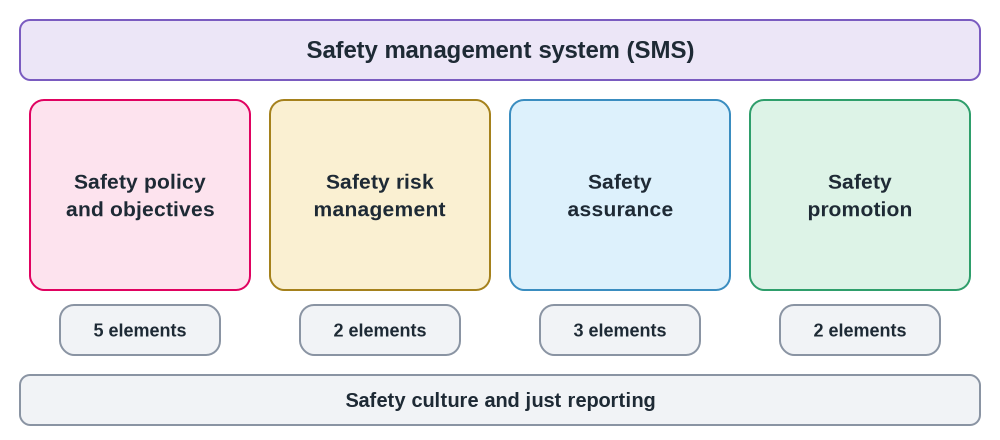
| Component | Elements (ICAO Doc 9859, 4th ed.) | Example in a drone unit |
|---|---|---|
| 1 Policy and objectives | 1.1 Management commitment 1.2 Safety accountability and responsibilities 1.3 Appointment of key safety personnel 1.4 Coordination of emergency response planning 1.5 SMS documentation | The unit head signs the policy and appoints a safety lead |
| 2 Safety risk management | 2.1 Hazard identification 2.2 Safety risk assessment and mitigation | A hazard register for every mission |
| 3 Safety assurance | 3.1 Safety performance monitoring and measurement 3.2 Management of change 3.3 Continuous improvement of the SMS | Event statistics; review when aircraft or software change |
| 4 Safety promotion | 4.1 Training and education 4.2 Safety communication | Monthly lessons-learned meetings |
Why accidents happen: the Swiss cheese model
James Reason described an organisation as having many layers of defence, each with “holes” that shift over time. An accident happens when the holes in every layer line up and a hazard passes straight through.
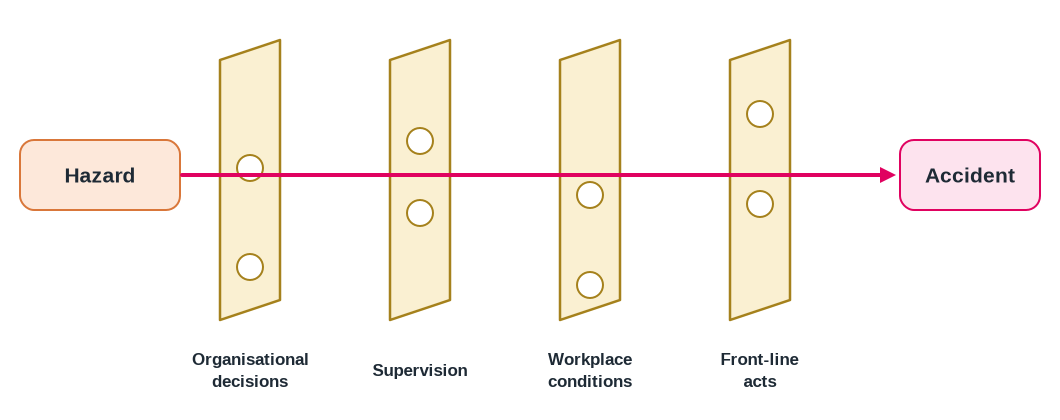
- Active failures are unsafe acts by front-line staff, such as skipping the compass check. Their effect is immediate
- Latent conditions arise from decisions higher up, such as over-tight schedules, insufficient maintenance budget or no recurrent training. They lie hidden until they combine with a front-line error
The key lesson: punishing the last person in the chain does not close the holes in the other layers. Good investigations look for latent conditions too.
Hazard identification techniques
The risk matrix in the next section can only assess hazards that have already been found. A hazard nobody thought of never enters the register and has no mitigation. Hazard identification (SMS element 2.1) is therefore the most important step of risk management. ICAO Doc 9859 asks for hazards to be found from both reactive sources, events and reports that have already happened such as flight logs and occurrence reports, and proactive sources that look before anything happens, such as site surveys, audits and analysis before a new type of operation or a change of aircraft.
Before choosing a technique, write the hazard correctly. Under the Annex 19 definition a hazard is a condition or object, not a bad outcome: “high-voltage transmission towers 30 m from the flight line” is a hazard, while “the drone crashes” is a possible consequence. If the team writes only outcomes, it will not know which cause to fix.
IEC 31010:2019, the standard that collects risk assessment techniques, groups several techniques for identifying risk, including checklists and classifications, failure modes and effects analysis (FMEA), HAZOP, scenario analysis and the structured what-if technique (SWIFT), and places the bow-tie diagram among techniques for analysing controls. Drone units use the following four most often.
Checklists and hazard categories
The team goes through a list of known hazards category by category so that nothing already known is forgotten. Useful categories for drone work include aircraft and equipment; environment (wind, rain, heat, terrain, obstacles, radio interference); airspace and other aircraft; people and property on the ground; the crew (the SHELL model in module 4); and the organisation. The strength is speed and repeatability for every mission; the weakness is that a checklist only finds what is on the list, so it should not be the only technique for a new type of operation.
Asking “what if…?” (what-if and SWIFT)
Break the mission into steps and ask of each one, “what if…?”. OSHA’s job hazard analysis guide suggests asking, for each step, what can go wrong, what the consequences are, how it could arise, what other contributing factors there are, and how likely it is. SWIFT differs from asking at random by using the same set of prompts at every step, for example timing (too early, too late), weather, equipment failure, a step done wrongly or a miscommunication, so it is systematic and can be reviewed.
Hazard identification workshop (HAZID)
Industry often calls a structured hazard identification meeting a HAZID (hazard identification study). People who see the work from different angles sit together, for example the pilot, a maintenance technician, the payload operator, the safety manager and a representative of the landowner, led by a facilitator who does not own the work. Checklists and what-if prompts are used to stimulate ideas, and every hazard goes straight into the register. IEC 31010 places brainstorming among techniques for eliciting views from experts; the benefit is that people in different roles see hazards the others miss.
The bow-tie diagram
A bow-tie places the top event in the centre: the undesired system state when control of a hazard is lost. On the left are the threats, the possible direct causes, blocked by preventive controls. On the right are the consequences, blocked by recovery controls. There are also escalation factors, conditions such as fatigue that weaken the controls. These are the definitions used by the UK Civil Aviation Authority, which promotes bow-tie models as a proactive risk assessment tool. One picture shows immediately which threats have no control or only a single layer, linking back to the idea of several slices of cheese in the previous section.
| Technique | Suits | Produces |
|---|---|---|
| Checklist | Routine, well-known work | Known hazards not forgotten |
| what-if / SWIFT | A new mission or a changed procedure | Hazards step by step, with causes |
| HAZID | Large jobs, new sites, several parties | A register built from many viewpoints |
| Bow-tie | Major hazards where you must check that controls are enough | Places where a control is missing or single |
Example 1 Identifying hazards for a road inspection mission
The same unit as in Example 2 will inspect a 3 km stretch of road. One part passes under a footbridge and another runs parallel to high-voltage transmission towers.
Step 1 what-if by step (extract)
| Step | What if… | Hazard found |
|---|---|---|
| Set up the take-off point | What if cars park near the take-off point? | Metal and uninvolved people close to the take-off point |
| Fly past the towers | What if the compass is disturbed? | Magnetic field from the lines near the flight path |
| Fly under the footbridge | What if satellite signals are blocked? | The bridge blocks the sky above the flight path |
| Fly back | What if the headwind is stronger than forecast? | The battery reserve is not enough for the real wind |
Step 2 bow-tie Top event: “loss of position control of the drone over the road”
| Threat | Preventive controls | Number |
|---|---|---|
| Compass disturbed near the towers | Compass calibration before flight, flight line offset from the towers | 2 |
| GNSS degraded under the footbridge | (none yet) | 0 |
| Battery exhausted before return | Battery threshold from RTL energy, pre-flight battery check | 2 |
The consequences are falling onto a vehicle on the road or falling onto the verge. The recovery controls are a flight line that does not lie over the traffic lanes and a pilot with the aircraft in sight taking manual control. An escalation factor is pilot fatigue after several flights in a row, which slows manual recovery.
Step 3 read the result The bow-tie shows at once that GNSS degradation under the footbridge has no control at all. The team adds two layers: moving the flight line to pass beside the bridge instead of under it, and setting an EKF failsafe action that suits the area (UAT 312 module 2). It records the item in the register as “Because the footbridge blocks the sky above the flight path, loss of position may happen, resulting in the drone drifting off the line over the road”, and then assesses each item with the matrix as in Example 2.
Assessing risk with a matrix
ICAO Doc 9859 provides example tables for risk assessment (ICAO labels them examples; organisations may adapt them).
| Probability | Value | Meaning |
|---|---|---|
| Frequent | 5 | Likely to occur many times |
| Occasional | 4 | Likely to occur sometimes |
| Remote | 3 | Unlikely, but possible |
| Improbable | 2 | Very unlikely; not known to have occurred |
| Extremely improbable | 1 | Almost inconceivable |
| Severity | Code | Example consequences |
|---|---|---|
| Catastrophic | A | Aircraft or equipment destroyed; multiple deaths |
| Hazardous | B | Large reduction in safety margins; serious injury; major equipment damage |
| Major | C | Significant reduction in safety margins; serious incident; injury |
| Minor | D | Nuisance; use of emergency procedures; minor incident |
| Negligible | E | Few consequences |
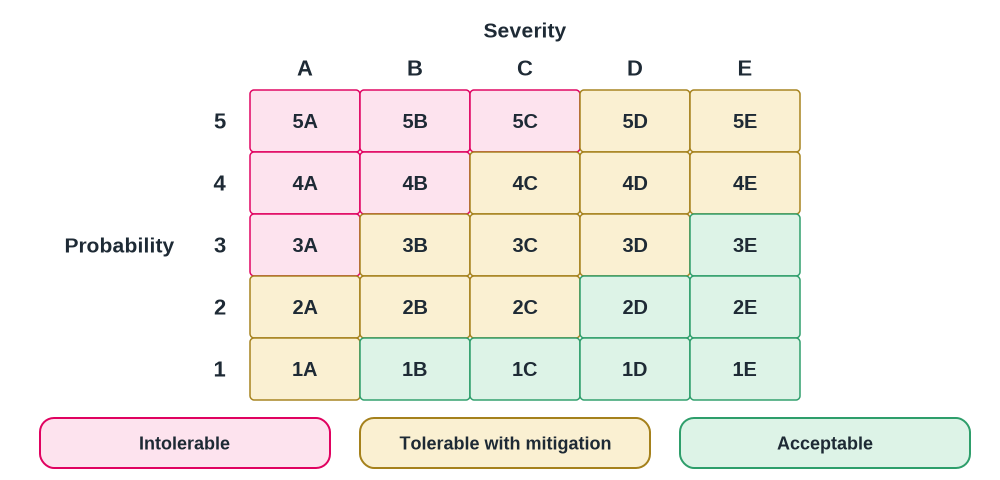
- Intolerable: take immediate action to mitigate or stop the activity
- Tolerable: can be tolerated based on mitigation; may need a management decision to accept
- Acceptable: acceptable as is
Example 2 Assessing and reducing risk
A unit inspects a road corridor near high-voltage transmission towers. The hazard is compass interference causing a flyaway. The unit’s records show this occurring sometimes, and if it happens the drone could fall onto moving traffic.
- Probability: occasional = 4; severity: hazardous = B; index 4B, intolerable. Stop or mitigate first
- Probability mitigations: calibrate and check the compass before every flight, route away from the towers, set a geofence (UAT 312 module 2). With evidence that they work, reassess probability as improbable = 2: 2B, tolerable
- Severity mitigation: shift the route so it is not over the traffic lanes; severity drops to major = C: 2C, still tolerable. Management must decide to accept the residual risk and record it
The ISO 31000 risk management process
ISO 31000:2018 defines risk broadly as “effect of uncertainty on objectives”. Its process is: scope, context and criteria → risk assessment (identification, analysis, evaluation) → risk treatment → monitoring and review, with communication, consultation, recording and reporting throughout. Aviation SMS applies the same principles with a safety focus, while SORA (UAT 312 module 5) assesses one type of operation for authorisation. The three complement each other; none replaces another.
Measuring whether safety is improving
Safety assurance needs safety performance indicators (SPIs), such as link-loss events per 100 flight hours:
Example 3 An indicator before and after improvement
In the first quarter a unit flew 240 hours with 3 link-loss events. After raising the station antenna and revising procedures, it flew 310 hours the next quarter with 2 events.
- First quarter events per 100 hours
- Next quarter events per 100 hours
The rate nearly halved, but the counts are very small and the difference may be chance. Track several quarters before concluding, and use leading indicators too, such as the share of flights with a completed checklist.
Class activity
Activity: Hazard register and matrix
Use core lesson G02 “Writing risks and deciding together” and exercise B02 “Evidence-based risk assessment” from the drone knowledge hub.
- Identify hazards in your group’s mission with a checklist and step-by-step what-if, draw a bow-tie for one major hazard as in Example 1, then write at least 5 risks in the form “Because… … may happen, resulting in…”.
- Assess each index with the matrix in Figure 3 before and after mitigation, with owners and evidence.
- Analyse one accident report chosen by the instructor with the Swiss cheese model, separating front-line failures from latent conditions.
- Propose two SPIs for your group’s unit.
Common mistakes
Watch out
- Thinking safety means zero risk
- Writing outcomes instead of hazards, such as “the drone crashes” instead of the condition behind it, and using a checklist as the only technique for a new type of operation
- Lowering risk indices on paper without evidence that mitigations work
- Looking only for the last person at fault, not latent conditions in the organisation
- Using another organisation’s matrix without adapting its definitions to your own work
- Drawing trends from a handful of events
Summary
- Annex 19 defines safety as risk controlled to an acceptable level, not zero
- An SMS has 4 components and 12 elements: policy (5), risk management (2), assurance (3) and promotion (2)
- The Swiss cheese model separates front-line failures from latent conditions; accidents happen when holes in every layer line up
- Hazards are identified from reactive and proactive sources with checklists, what-if/SWIFT, HAZID workshops and bow-ties, which show which threats still lack a control
- The ICAO Doc 9859 matrix combines probability 1–5 with severity A–E into intolerable, tolerable and acceptable regions
- SPIs such as events per 100 flight hours track whether safety is improving
Check your understanding
- According to ICAO, how does a hazard differ from a safety risk?
- Which is correctly written as a hazard: (a) “the drone falls onto a car on the road” or (b) “a footbridge blocks the sky above the flight path”? And in a bow-tie, what should you do about a threat with 0 preventive controls?
- Which region of the matrix is index 3A in?
- A unit flew 500 hours and recorded 4 GNSS anomalies. What is the rate per 100 hours?
- A roster that makes pilots work until fatigued: active failure or latent condition?
Answers
- A hazard is a condition or object that could cause an event; safety risk is the predicted probability and severity of the consequences of that hazard
- (b) is a hazard (a condition that could cause an event); (a) is a possible consequence. A threat with no control needs a preventive control before flight, such as changing the flight line, and the item is then recorded in the register and reassessed
- Intolerable
- per 100 hours
- A latent condition, because it comes from an organisational decision and lies hidden until it combines with a front-line error
Key formulas
| Risk index (ICAO Doc 9859): probability followed by severity code | |
| Events per 100 flight hours |
Key references
- International Civil Aviation Organization. (2025). Annex 19 to the Convention on International Civil Aviation: Safety management (3rd ed., incorporating Amendment 2, applicable 26 November 2026). ICAO. link
- International Civil Aviation Organization. (2018). Safety management manual (Doc 9859, 4th ed.). link
- Reason, J. (1997). Managing the risks of organizational accidents. Ashgate.
- Reason, J. (2000). Human error: Models and management. BMJ, 320(7237), 768–770. link
- International Organization for Standardization. (2018). Risk management – Guidelines (ISO 31000:2018). link
- Joint Authorities for Rulemaking on Unmanned Systems. (2024). JARUS guidelines on Specific Operations Risk Assessment (SORA), main body, edition 2.5 (JAR-DEL-SRM-SORA-MB-2.5). link
- สำนักงานการบินพลเรือนแห่งประเทศไทย. (2569). ประกาศ กพท. เรื่อง หลักเกณฑ์และวิธีการในการอนุญาตให้ผู้บังคับหรือปล่อยอากาศยานซึ่งไม่มีนักบิน ประเภทอากาศยานที่ควบคุมการบินจากภายนอก ที่มีน้ำหนักไม่เกิน 25 กิโลกรัม ปฏิบัติแตกต่างไปจากเงื่อนไขที่กำหนด พ.ศ. 2569 (มีผล 17 พฤษภาคม 2569). link
- International Electrotechnical Commission. (2019). Risk management: Risk assessment techniques (IEC 31010:2019, Ed. 2.0). link
- Occupational Safety and Health Administration. (2002). Job hazard analysis (OSHA 3071, revised). U.S. Department of Labor. link
- UK Civil Aviation Authority. (n.d.). CAA strategy for bowtie risk models (CAP 1329). link
- UK Civil Aviation Authority. (n.d.). Bowtie elements. Bowtie safety risk management. link
Further reading
Study the assigned knowledge units in advance, review media and take the module quiz
ระบบบริหารความปลอดภัย (SMS)
ระเบียบวิธี SORA
Writing risks and deciding as a team
Evidence-based risk assessment
In class / field
Lecture, case discussion and in-class problem solving
Learning evidence: Quiz results and submitted exercises