Industry and infrastructure
UAT 362 Unmanned Aircraft Systems Technology for Industrial, Energy and Infrastructure Applications
Lesson
By the end of this module you will be able to
- Explain asset management under ISO 55000 and the role of drone inspection
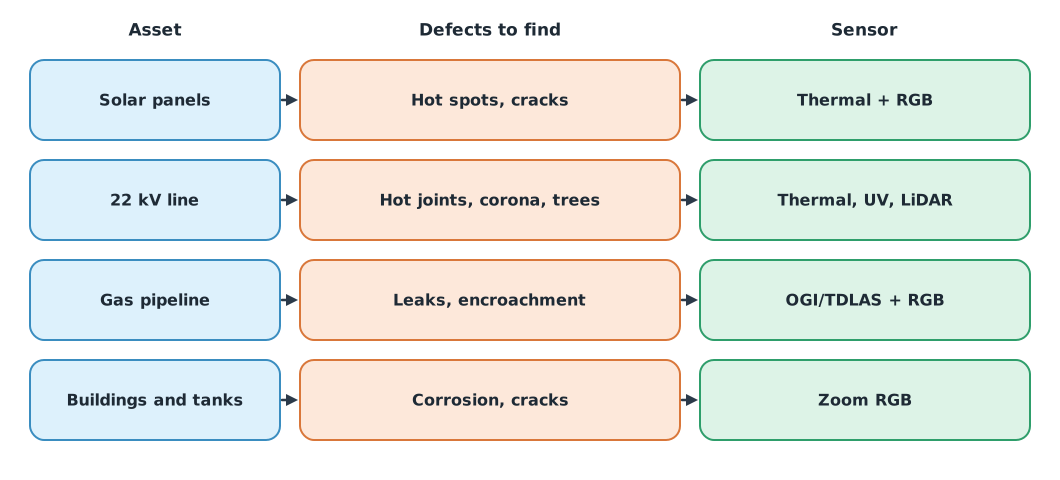
- Define the inspection question, defects to find and suitable sensors for each asset type
- Compute the maximum flight speed that keeps motion blur within limits
- Plan patrol flights along linear assets and identify hazardous-area requirements
Why this matters
Factories and energy systems hold high-value assets that cannot simply be stopped. One failed solar module reduces the output of a whole string, an overheating line joint can black out an entire industrial estate, and a gas pipeline leak endangers lives. Inspecting by hand means climbing poles, shutting down equipment or walking kilometres of pipeline. Drones help a great deal, but inspection results only have value when they feed maintenance decisions, not merely when they produce thousands of images.
The whole course follows one hypothetical case: the utilities department of an industrial estate, responsible for a 1 MW solar farm, a 22 kV power line and a 3 km gas pipeline. All numbers are synthetic training data. The Python code for every module can be downloaded from /downloads/uat-362/.
Asset management
ISO 55000:2024 defines asset management as “coordinated activity of an organization to realize value from assets”, and ISO 55001:2024 sets the requirements for an asset management system. Inspection is therefore not an end in itself; it provides the information to decide whether to repair, replace or keep monitoring, and when.
A good inspection question starts from the decision, such as “which modules must be replaced before the hot season?” or “which spans need tree trimming before the rains?”, and then asks which defects must be seen, and with which sensor.
Motion blur and flight speed
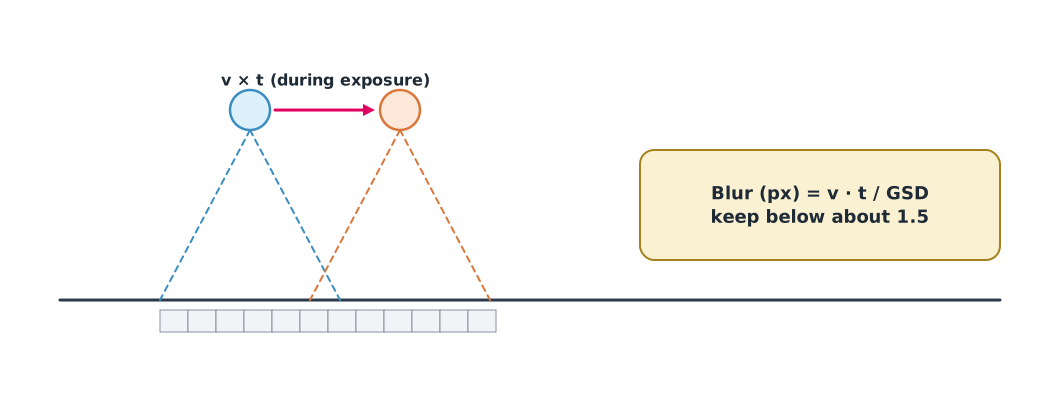
Inspection uses a much finer GSD than mapping, so motion blur becomes a major issue. O’Connor and colleagues (2017) give the blur in pixels as the distance the drone travels during the exposure divided by the GSD, and advise keeping it below about 1.5 pixels.
Example 1. Maximum speed by GSD and shutter
BLUR_LIMIT = 1.5                                  # pixels
for gsd_cm in (0.5, 1.0, 2.0):
    speeds = [BLUR_LIMIT * gsd_cm / 100 * shutter for shutter in (250, 500, 1000)]
    print(f"GSD {gsd_cm} cm: max speed at 1/250 s {speeds[0]:.2f}, "
          f"1/500 s {speeds[1]:.2f}, 1/1000 s {speeds[2]:.2f} m/s")
GSD 0.5 cm: max speed at 1/250 s 1.88, 1/500 s 3.75, 1/1000 s 7.50 m/s
GSD 1.0 cm: max speed at 1/250 s 3.75, 1/500 s 7.50, 1/1000 s 15.00 m/s
GSD 2.0 cm: max speed at 1/250 s 7.50, 1/500 s 15.00, 1/1000 s 30.00 m/sAt 0.5 cm GSD and a 1/250 s shutter the drone must fly slower than 2 m/s, which is very slow. Fine inspection therefore needs a fast shutter, which in turn needs enough light, or stopping to hover for each image.
Patrolling linear assets
Pipelines and power lines stretch for kilometres. The US rule 49 CFR 192.705 is an example that requires gas pipeline operators to patrol the right-of-way for leaks and activities that could affect the pipe, allowing walking, driving, flying or other appropriate means. The frequency depends on the class location (module 3). In Thailand, the requirements of the regulator and the pipeline owner apply.
Example 2. Patrol time for a 3 km pipeline
import math

ROUTE_M, SPEED, USABLE_MIN = 3000, 8.0, 20      # m, m/s, usable flight minutes per battery
fly_min = 2 * ROUTE_M / SPEED / 60               # out and back to the take-off point
batteries = math.ceil(fly_min / USABLE_MIN)
print(f"out and back {fly_min:.1f} min -> {batteries} battery per patrol")
for patrols in (2, 4, 12):
    print(f"{patrols:>2} patrols/year = {patrols * fly_min / 60:.1f} flight hours/year")
out and back 12.5 min -> 1 battery per patrol
2 patrols/year = 0.4 flight hours/year
4 patrols/year = 0.8 flight hours/year
12 patrols/year = 2.5 flight hours/yearHazardous areas and stand-off distances
Industrial sites have specific hazards: high-voltage lines, magnetic fields near transformers that disturb the compass, areas with flammable vapour, and stacks with hot plumes. EGAT warns the general public to stay 4 m away from high-voltage lines, but that article does not set a distance for drones. Safe flying distances must therefore come from the asset owner, the risk assessment (module 5) and the CAAT announcements in force, some of which temporarily restrict flights around energy sites. ISO 21384-3 sets out drone operational procedures that can serve as a framework (a 2026 revision may be pending; check).
Module lab
Lab: an asset inspection plan
- Choose three types of asset on campus or at the training site, and write the decision the owner must make for each
- Build a table like Figure 1: defects to find, the smallest size, and the chosen sensor with reasons
- Use Example 1 with the lab camera to choose the shutter and speed for the required GSD
- Obtain safe distances and restricted areas from the asset owner and record them as flight plan conditions
- Take test images at three speeds, compare the real blur with the calculation, and record it in the lab notebook
Common mistakes
Watch out
- Starting by flying and collecting images without knowing what decision they support
- Flying too fast for a fine GSD, producing blurred images
- Using the public safety distance as the drone flying distance
- Ignoring magnetic fields and hot plumes near electrical equipment and stacks
- Not coordinating with the asset owner on restricted areas and shutdowns
Summary
- Asset management (ISO 55000) realises value from assets; inspection informs decisions to repair, replace or monitor
- Choose sensors from the defects to be found, not from the equipment at hand
- Blur = v·t/GSD should stay below about 1.5 pixels; fine work needs slow flight or a fast shutter
- Safe distances and restricted areas come from the asset owner, the risk assessment and the rules in force
Check your understanding
- At 1 cm GSD, a 1/500 s shutter and 5 m/s, how many pixels of blur occur?
- Using question 1, what is the maximum speed for no more than 1.5 pixels of blur?
- How does drone inspection relate to asset management?
- How many minutes does a 5 km pipeline take out and back at 10 m/s?
- Why can EGAT’s 4 m public warning not be used as a drone flying distance?
Answers
- pixel
- m/s
- It provides asset condition information for decisions to repair, replace or monitor
- minutes
- It is a warning for the general public, not a distance set for drones; flying distances must come from the asset owner and a risk assessment
Key formulas
| Motion blur | |
| Maximum speed for a blur limit |
Key references
- International Organization for Standardization. (2024). Asset management — Vocabulary, overview and principles (ISO 55000:2024). link
- International Organization for Standardization. (2024). Asset management — Asset management system — Requirements (ISO 55001:2024). link
- O'Connor, J., Smith, M. J., & James, M. R. (2017). Cameras and settings for aerial surveys in the geosciences: Optimising image data. Progress in Physical Geography, 41(3), 325–344. link
- Transmission lines: Patrolling, 49 C.F.R. § 192.705. link
- การไฟฟ้าฝ่ายผลิตแห่งประเทศไทย. (2566). ความปลอดภัยจากสายไฟฟ้าแรงสูง [บทความเผยแพร่]. link
- สำนักงานการบินพลเรือนแห่งประเทศไทย. (2569). ประกาศ กพท. เรื่อง หลักเกณฑ์และวิธีการในการอนุญาตให้ผู้บังคับหรือปล่อยอากาศยานซึ่งไม่มีนักบิน ประเภทอากาศยานที่ควบคุมการบินจากภายนอก ที่มีน้ำหนักไม่เกิน 25 กิโลกรัม ปฏิบัติแตกต่างไปจากเงื่อนไขที่กำหนด พ.ศ. 2569 (มีผล 17 พฤษภาคม 2569). link
- International Organization for Standardization. (2023). Unmanned aircraft systems — Part 3: Operational procedures (ISO 21384-3:2023). link
Further reading
Study the assigned knowledge units in advance, review media and take the module quiz
In class / field
Intensive lab and field practice recorded in a lab notebook
Learning evidence: Lab notebook signed by the instructor