Drone delivery
UAT 363 Unmanned Aircraft Systems Technology for Transportation and Smart Warehousing
Lesson
By the end of this module you will be able to
- Analyse a delivery mission, covering weight, size, distance, time and recipient needs
- Compare landing, tether lowering and release delivery mechanisms, with their legal requirements
- Compute hover power from momentum theory and the effect of payload on flight time
- Estimate the swing period of a tethered load and the limits of the model
Why this matters
Provincial hospitals send medicines, vaccines and blood samples between the hospital and sub-district health promoting hospitals (health centres) every day. Some roads are long detours or flood in the rainy season. A drone flies straight and faster, but every extra gram costs energy, every delivery method has safety and legal limits, and a sustainable service must be better value than the existing option. This course designs that service step by step.
The whole course follows one hypothetical case: a provincial hospital delivering medical supplies by drone to 4 health centres, and using a drone to count stock in its central medical store. All numbers are synthetic training data. The Python code for every module can be downloaded from /downloads/uat-363/.
Mission analysis
The survey by Otto and colleagues (2018) gathers research on civil drone applications, including delivery. Before choosing a drone, the team must answer:
- The goods: how heavy, how large, temperature-controlled or not, fragile or hazardous?
- Distance and time: how far, how quickly must it arrive, how many trips a day?
- Hand-over points: is there space to land, who receives it, and how?
- Environment: wind, rain, obstacles and communities under the route
Stolaroff and colleagues (2018) estimate that small multicopters with current batteries have a practical range of about 4 km, and use less energy per package-kilometre than trucks. Once the extra warehouse and depot energy is included, however, the advantage depends on package weight and the electricity source.
Delivery mechanisms
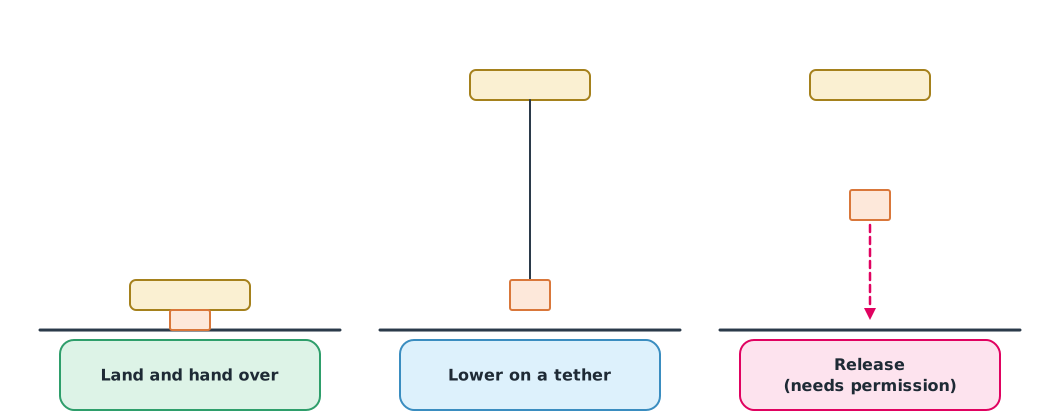
- Landing is simplest, but needs a safe landing area and brings the drone close to people
- Tether lowering: Wing lowers the package on a tether from a hovering drone, needing an area about the size of a picnic blanket. Zipline P2 hovers more than 300 ft up and lowers a delivery unit on a tether, so the aircraft never comes close to people
- Release: Civil Aviation Board Regulation No. 94, clause 13, prohibits aircraft from dropping objects unless permitted, and clause 16 prohibits towing or suspending objects without permission. The regulation applies to all aircraft, including remotely piloted aircraft, so lowering or releasing goods requires permission (check the version currently in force together with CAAT announcements)
Hover power and payload
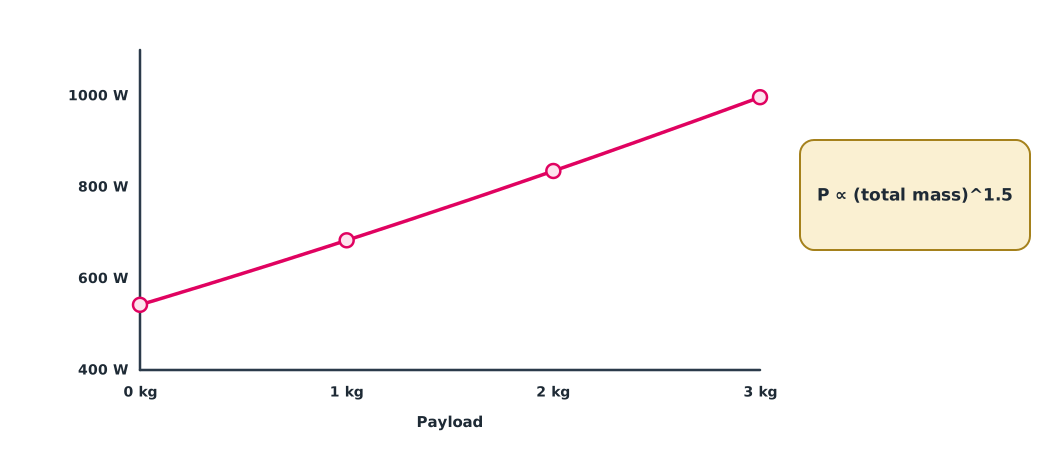
Momentum theory gives the ideal hover power of a rotor as , where is the thrust required (equal to the total weight), the air density and the total rotor disc area. Real rotors have losses, so the result is divided by a figure of merit () below 1. The key point is that power rises with total mass to the power 1.5, not in direct proportion.
Example 1. Payload and hover time
Assumed drone: 6 kg including battery, four 0.5 m rotors, 500 Wh battery with 80% usable, FM = 0.6.
import math

RHO, G = 1.225, 9.81                      # kg/m³, m/s²
ROTOR_D, N_ROTORS, FM = 0.5, 4, 0.6
EMPTY_KG, BATTERY_WH, USABLE = 6.0, 500, 0.8
area = N_ROTORS * math.pi * (ROTOR_D / 2) ** 2

for payload in (0, 1, 2, 3):
    thrust = (EMPTY_KG + payload) * G
    power = thrust ** 1.5 / math.sqrt(2 * RHO * area) / FM
    minutes = BATTERY_WH * USABLE / power * 60
    print(f"payload {payload} kg: hover {power:.0f} W, hover time {minutes:.1f} min")
payload 0 kg: hover 543 W, hover time 44.2 min
payload 1 kg: hover 684 W, hover time 35.1 min
payload 2 kg: hover 835 W, hover time 28.7 min
payload 3 kg: hover 997 W, hover time 24.1 minAdding 3 kg (half the aircraft’s mass) nearly doubles the power and cuts hover time by almost half. The model excludes electronics, wind and forward flight, so it shows the trend only; real values must be measured in test flights.
Tethered loads
A load on a tether swings like a pendulum. The knowledge unit on suspended loads gives the approximate period , valid when the attachment point is still, the line does not stretch and the swing angle is small. When the drone accelerates or meets wind, these assumptions fail, and a model coupling drone and load dynamics is needed (such as the slung payload model in ArduPilot SITL).
Example 2. Swing period by tether length
import math

for length in (5, 10, 15):
    period = 2 * math.pi * math.sqrt(length / 9.81)
    print(f"tether {length:>2} m: period about {period:.2f} s")
tether 5 m: period about 4.49 s
tether 10 m: period about 6.34 s
tether 15 m: period about 7.77 sA longer tether swings more slowly. If the controller or wind excites the load near this period, the swing grows, so the drone should hover until the swing dies down before setting the load on the ground.
Module lab
Lab: analysing a medical delivery mission
- Interview pharmacy or health centre staff (or use the hypothetical case) and tabulate the goods to deliver, their weight, size, temperature conditions and urgency
- Apply Example 1 to the lab drone’s specifications to find the maximum payload that still gives the required flight time
- Measure real power while hovering with two payloads, compare with the calculation and explain the difference
- Choose a delivery mechanism for each destination with safety and legal reasons
- Try lowering a load in SITL or on a short tether in an enclosed area, and compare the swing period with Example 2
Common mistakes
Watch out
- Assuming power rises linearly with weight
- Using the manufacturer’s flight time, measured without payload
- Releasing or lowering goods without permission
- Setting the load down before it stops swinging
- Forgetting the goods’ conditions, such as vaccine temperature
Summary
- Analyse goods, distance, hand-over points and environment before choosing a drone
- Landing, tether lowering and release each have advantages; dropping or suspending objects requires permission
- Hover power scales with total mass to the power 1.5, so payload greatly reduces flight time
- A tethered load swings with a period of about 2π√(l/g) when the attachment point is still
Check your understanding
- If total mass doubles, by what factor does ideal hover power increase?
- With 800 W hover power and 400 Wh usable battery energy, how many minutes can the drone hover?
- What is the approximate swing period on a 4 m tether?
- What does clause 13 of CAB Regulation No. 94 cover?
- What is the advantage of tether lowering over landing?
Answers
- times
- minutes
- s
- It prohibits aircraft from dropping objects, releasing liquids or gases, or allowing parachuting, unless permitted
- The drone does not come close to people and needs only a small delivery area
Key formulas
| Ideal hover power (momentum theory) | |
| Approximate real power | |
| Simple pendulum period |
Key references
- Otto, A., Agatz, N., Campbell, J., Golden, B., & Pesch, E. (2018). Optimization approaches for civil applications of unmanned aerial vehicles (UAVs) or aerial drones: A survey. Networks, 72(4), 411–458. link
- Stolaroff, J. K., Samaras, C., O'Neill, E. R., Lubers, A., Mitchell, A. S., & Ceperley, D. (2018). Energy use and life cycle greenhouse gas emissions of drones for commercial package delivery. Nature Communications, 9, 409. link
- Kumar, S. Momentum theory (lecture notes). HeliAeroNotes. link
- Leishman, J. G. (2006). Principles of helicopter aerodynamics (2nd ed.). Cambridge University Press.
- Wing. Technology: How Wing delivers. link
- Zipline. (2023, March 15). Zipline unveils new autonomous system capable of quiet, fast and precise home delivery [Press release]. link
- คณะกรรมการการบินพลเรือน. (2558). ข้อบังคับของคณะกรรมการการบินพลเรือน ฉบับที่ 94 ว่าด้วยกฎจราจรทางอากาศ. ราชกิจจานุเบกษา. link
- สำนักงานการบินพลเรือนแห่งประเทศไทย. (2569). ประกาศ กพท. เรื่อง หลักเกณฑ์และวิธีการในการอนุญาตให้ผู้บังคับหรือปล่อยอากาศยานซึ่งไม่มีนักบิน ประเภทอากาศยานที่ควบคุมการบินจากภายนอก ที่มีน้ำหนักไม่เกิน 25 กิโลกรัม ปฏิบัติแตกต่างไปจากเงื่อนไขที่กำหนด พ.ศ. 2569 (มีผล 17 พฤษภาคม 2569). link
Further reading
Study the assigned knowledge units in advance, review media and take the module quiz
In class / field
Intensive lab and field practice recorded in a lab notebook
Learning evidence: Lab notebook signed by the instructor