Safety and value
UAT 363 Unmanned Aircraft Systems Technology for Transportation and Smart Warehousing
Lesson
By the end of this module you will be able to
- Identify the safety layers of a drone delivery service and the permission framework
- Compute the total cost of ownership (TCO) of drones against existing transport and find the break-even point
- Compute the present value of costs with a discount rate
- Assess value including non-monetary effects such as time and energy
Why this matters
A drone medical delivery service must answer two questions before the hospital director approves it: is it safe enough? and is it worth the money? A drone that delivers quickly but falls onto a roof, or a service several times dearer than a motorcycle courier with no added benefit, will not go ahead.
Safety and permission
Beyond-visual-line-of-sight delivery over communities carries more risk than ordinary flying. JARUS SORA 2.5 is a risk assessment method for operations in the Specific category, which includes delivery. In Thailand, permission must be obtained under the CAAT announcements in force (see UAT 313) and CAB Regulation No. 94, which prohibits dropping or suspending objects without permission (module 1). Within the organisation, a safety management system (SMS) follows ICAO Doc 9859.
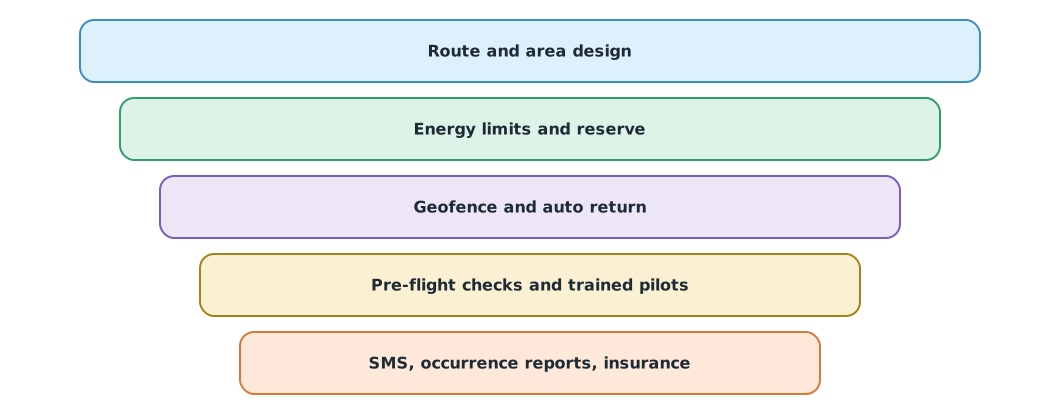
No single layer prevents every accident; safety comes from overlapping layers. Routes avoiding communities reduce the consequences of a crash, energy reserve (module 2) reduces the chance of running out of battery, a geofence keeps the drone inside its area, and occurrence reporting lets the system learn from near misses.
Total cost of ownership and break-even
The knowledge unit on life-cycle cost uses: initial cost + years × (annual fixed cost + jobs × cost per job). Options must deliver the same kind of result to be compared. In our case the existing option is paying a motorcycle courier per trip.
Example 1. Five-year cost and break-even
Assumed figures (baht): drone initial cost 1,500,000, annual fixed cost 300,000 (pilot, insurance, maintenance), 60 per trip; motorcycle 250 per trip.
YEARS, SETUP, FIXED, DRONE_TRIP, BIKE_TRIP = 5, 1_500_000, 300_000, 60, 250

def drone_cost(trips_per_year):
    return SETUP + YEARS * (FIXED + trips_per_year * DRONE_TRIP)

def bike_cost(trips_per_year):
    return YEARS * trips_per_year * BIKE_TRIP

for n in (1000, 3000, 5000):
    d, b = drone_cost(n), bike_cost(n)
    print(f"{n:>5} trips/yr: drone {d:>10,.0f}  motorcycle {b:>10,.0f}  -> {'drone' if d < b else 'motorcycle'} cheaper")
break_even = (SETUP + YEARS * FIXED) / (YEARS * (BIKE_TRIP - DRONE_TRIP))
print(f"break-even about {break_even:,.0f} trips per year ({break_even / 365:.1f} per day)")
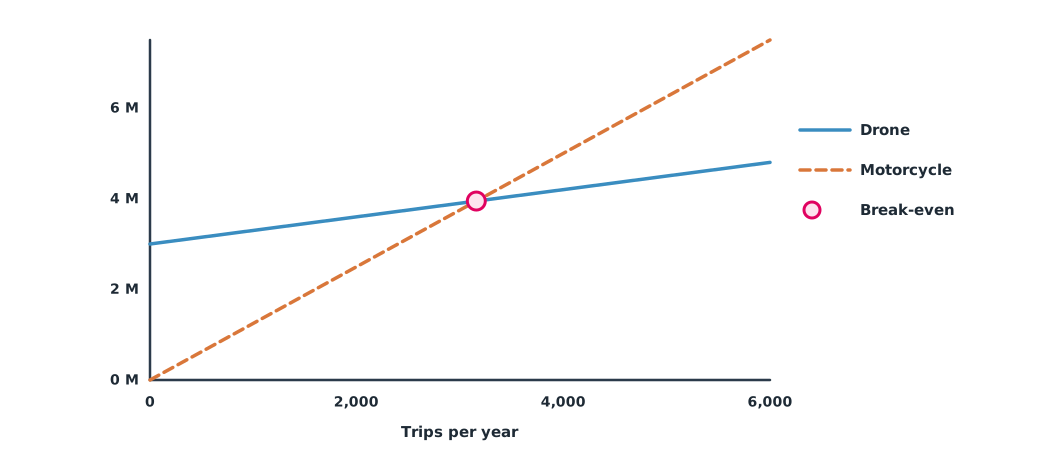
1000 trips/yr: drone 3,300,000 motorcycle 1,250,000 -> motorcycle cheaper
3000 trips/yr: drone 3,900,000 motorcycle 3,750,000 -> motorcycle cheaper
5000 trips/yr: drone 4,500,000 motorcycle 6,250,000 -> drone cheaper
break-even about 3,158 trips per year (8.7 per day)The drone pays off with enough trips; in the example, above about 8–9 trips a day. If the hospital sends 4 trips a day, the drone costs more, but may still be worthwhile once other benefits are counted, such as delivering during floods or getting blood samples to the lab faster, which must be identified and assessed separately.
Present value
Money paid in the future is worth less than money today. NIST’s life-cycle costing manual (Handbook 135) therefore discounts each year’s cost with a discount rate before adding. An option with a large up-front payment is slightly disadvantaged when discounted.
Example 2. Present value at a 3% discount rate
YEARS, SETUP, FIXED, DRONE_TRIP, BIKE_TRIP = 5, 1_500_000, 300_000, 60, 250
RATE, TRIPS = 0.03, 4000

pv_drone = SETUP + sum((FIXED + TRIPS * DRONE_TRIP) / (1 + RATE) ** t for t in range(1, YEARS + 1))
pv_bike = sum(TRIPS * BIKE_TRIP / (1 + RATE) ** t for t in range(1, YEARS + 1))
print(f"{TRIPS} trips/yr, discount {RATE:.0%}: PV drone {pv_drone:,.0f}, PV motorcycle {pv_bike:,.0f}")
print(f"undiscounted: drone {SETUP + YEARS * (FIXED + TRIPS * DRONE_TRIP):,.0f}, "
      f"motorcycle {YEARS * TRIPS * BIKE_TRIP:,.0f}")
4000 trips/yr, discount 3%: PV drone 3,973,042, PV motorcycle 4,579,707
undiscounted: drone 4,200,000, motorcycle 5,000,000Non-monetary value
Stolaroff and colleagues (2018) found that small drones delivering light packages use less energy and emit less greenhouse gas per package than delivery trucks in most cases, but heavy packages may reverse this, and extra warehouse energy must be included. Environmental benefit therefore depends on the details of the service, and drones should not be claimed as always “greener”. Other effects to assess include shorter delivery times, service continuity during disasters, and community effects such as noise.
Module lab
Lab: a service proposal to management
- Write a safety-layer plan for the service following Figure 1 and list the permissions required
- Collect real costs or quotations for the drone, insurance, training and current transport, and find the break-even point with Example 1
- Compute present value with Example 2 at two discount rates
- Identify at least three non-monetary benefits with a way to measure each
- Present a one-page proposal to the “hospital director” (the instructor), with the conditions that would change the recommendation
Common mistakes
Watch out
- Comparing the drone purchase price with a per-trip courier fee without life-cycle cost
- Forgetting pilot, insurance, training and spare parts costs
- Claiming environmental benefits without data from the actual service
- Relying on a single safety layer, such as a geofence
- Starting the service before all permissions are in place
Summary
- Safety comes from several layers, and permission follows SORA and CAAT announcements
- Total cost = initial + years × (fixed + trips × cost per trip); drones pay off beyond the break-even point
- Discount costs to present value following NIST Handbook 135
- Assess non-monetary and environmental effects from real data
Check your understanding
- Initial cost 1,000,000 baht, fixed 200,000 baht a year over 5 years, drone 50 per trip against 200 for the existing option. What is the break-even point in trips per year?
- What is the present value of 100,000 baht paid in 2 years at a 3% discount rate?
- Why are future costs discounted?
- Which category of operations does SORA apply to?
- Why should drones not be claimed as always more energy-efficient than vehicles?
Answers
- trips per year
- baht
- Money in the future is worth less than money today
- The Specific category
- It depends on package weight, the electricity source and extra warehouse energy; heavy packages may use more
Key formulas
| Total cost (undiscounted) | |
| Break-even point | |
| Present value |
Key references
- Joint Authorities for Rulemaking on Unmanned Systems. (2024). JARUS guidelines on Specific Operations Risk Assessment (SORA), main body, edition 2.5 (JAR-DEL-SRM-SORA-MB-2.5). link
- สำนักงานการบินพลเรือนแห่งประเทศไทย. (2569). ประกาศ กพท. เรื่อง หลักเกณฑ์และวิธีการในการอนุญาตให้ผู้บังคับหรือปล่อยอากาศยานซึ่งไม่มีนักบิน ประเภทอากาศยานที่ควบคุมการบินจากภายนอก ที่มีน้ำหนักไม่เกิน 25 กิโลกรัม ปฏิบัติแตกต่างไปจากเงื่อนไขที่กำหนด พ.ศ. 2569 (มีผล 17 พฤษภาคม 2569). link
- คณะกรรมการการบินพลเรือน. (2558). ข้อบังคับของคณะกรรมการการบินพลเรือน ฉบับที่ 94 ว่าด้วยกฎจราจรทางอากาศ. ราชกิจจานุเบกษา. link
- International Civil Aviation Organization. (2018). Safety management manual (Doc 9859, 4th ed.). link
- Kneifel, J., & Webb, D. (2022). Life cycle costing manual for the Federal Energy Management Program (NIST Handbook 135, 2022 ed.). National Institute of Standards and Technology. link
- Stolaroff, J. K., Samaras, C., O'Neill, E. R., Lubers, A., Mitchell, A. S., & Ceperley, D. (2018). Energy use and life cycle greenhouse gas emissions of drones for commercial package delivery. Nature Communications, 9, 409. link
Further reading
Study the assigned knowledge units in advance, review media and take the module quiz
In class / field
Intensive lab and field practice recorded in a lab notebook
Learning evidence: Lab notebook signed by the instructor