Lifecycle cost and acceptance
Life-cycle cost combines initial cost, fixed costs and per-job costs. Before comparing prices, check that every option can deliver the same type of output, such as a georeferenced map whose error can be checked. Acceptance must be tied to requirements, not to “nice-looking images” alone.
E02 · Exercise and case study

Life-cycle cost combines initial cost, fixed costs and per-job costs. Before comparing prices, check that every option can deliver the same type of output, such as a georeferenced map whose error can be checked. Acceptance must be tied to requirements, not to “nice-looking images” alone.
Read the formulas, worked examples and additional exercises ↓
Before you start
Use a Windows or Linux computer, read CSV files with a spreadsheet program or text editor, and save your own work files separately from the originals. The basic Python kit uses the standard library; AI software and real simulators have separate installation steps.
By the end of this lesson
- Calculate TCO from disclosed assumptions and compare results when the assumptions change
- Write acceptance requirements with a measurement method and decision criteria

Task and hands-on steps
A hypothetical agency produces 24 mapping jobs per year for 3 years. In-house: 240,000 baht initial, 90,000 baht/year fixed and 2,000 baht/job; outsourced: 12,000 baht/job. These figures are for learning only, with no discounts, taxes or residual value.
Unzip the ZIP, then open E02-guide.md and E02-worksheet.csv . Keep assumptions separate from verifiable results. A blank in the worksheet means data must be collected, not that it has passed.
- Open the E02 table in the ZIP and calculate both options with the formula setup + years × (annual + jobs_per_year × per_job)
- Change to 4 jobs/year, then increase the maintenance cost of the in-house option by 30%, keeping the baseline results
- Write 3 acceptance items: the output required, the checking method, and the evidence the contractor must deliver
- Conclude which job frequency changes the recommendation and which costs still lack data
Deliverables and assessment criteria
Submit: TCO workbook and acceptance matrix
Key criteria: show acquisition/operation/maintenance/data/training/disposal costs; change at least 2 assumptions
Attach files that can be opened and checked, with dates, data versions and reasons where no conclusion can yet be drawn. Completing the worksheet does not replace real tests with models or equipment, or real skills assessment.
Reveal the model answer after completing the worksheet
24 jobs/year: in-house 654,000 baht, outsourced 864,000 baht; 4 jobs/year: 534,000 and 144,000 baht. The break-even point in the model is 17 jobs/year. Quality and constraints must be checked before choosing.
Activity plan for instructors
Learners add downtime, data storage costs and training of new staff, separate estimates from quotations, then have a peer check that the two options genuinely deliver comparable outputs.
Review question: Is the cheapest option to buy still the best value over the whole life cycle?
| Learning set | Explain | Practise | Assess | Including equipment stations |
|---|---|---|---|---|
| Executives and policymakers | 45 minutes | 105 minutes | 30 minutes | 0 minutes |
Equipment-station time is part of the total time in the plan and is not added twice. Instructors separate PC results from observed tasks and have each learner explain their work individually before revealing the model answer.
View the full-track activity arrangement and foundation extensions →Bibliography and citation scope
Additional sources checked 9 September 2026 (B.E. 2569). Hypothetical cases, figures, worksheets and activity criteria were newly compiled by PK-Research.
- NASA, Requirements Verification Matrix
Used to link requirements to checking methods; the worksheets and figures in this chapter are our own design.
- ICAO, Safety Management Manual, Chapter 9
Used as a risk-management and monitoring framework, not as a substitute for Thai requirements.
Formulas and additional exercises · updated 2026-09-26
F39: How are today's costs and future costs combined?
Start with an account of actual payments for every job, including rejected jobs, then state whether they will be summed undiscounted or converted to present value. The following figures are an educational model, not a recommended discount rate or real procurement prices.
PV = C0 + Σt=1…N Ct/(1+r)t − S/(1+r)N
unit_cost = total_cost / accepted_outputs
| Variable | Meaning and unit | Range and source of value |
|---|---|---|
| C_0 | Initial payment, THB; input | ≥ 0 from the hypothetical account at year 0 |
| C_t | Expenditure at the end of year t, including failed jobs, THB; input | ≥ 0 from the annual plan; does not include C_0 again |
| r | Annual discount rate, dimensionless; input | > −1 and finite; 0.05 means 5%; must match the price basis |
| N, t | Analysis period and year of payment, years; input | N integer ≥ 1; t = 1…N |
| S | Residual value recovered at the end of year N, THB; input | ≥ 0; decommissioning costs are entered separately in C_N |
| PV, total_cost | Present value or undiscounted total, THB; output/input | State the base year and method; PV may be negative if recoveries exceed payments |
| accepted_outputs | Number of accepted jobs, jobs; input | Integer > 0 over the same period as the costs |
| unit_cost | Cost per accepted job, THB/job; output | State which type of cost is used in the numerator |
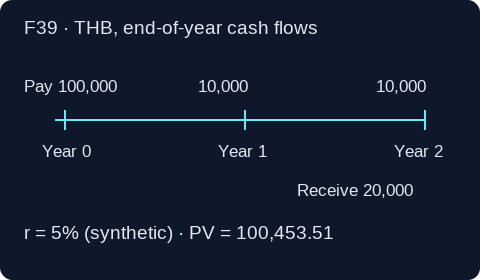
Image description: year 0 pays 100,000 baht, year 1 pays 10,000 baht, year 2 pays 10,000 and recovers 20,000 baht. The recovery at the end of year two is therefore deducted after discounting with a power of two.
Example and scope
Synthetic case C₀ = 100,000, C₁ = C₂ = 10,000, S = 20,000 THB, N = 2 and r = 0.05 gives PV = 100,000 + 10,000/1.05 + (10,000 − 20,000)/1.05² = 100,453.51 THB The 5% rate is used only for arithmetic practice. The undiscounted total = 100,000 + 20,000 − 20,000 = 100,000 THB If 100 jobs are accepted, the undiscounted cost = 1,000 THB/job and PV per undiscounted number of jobs = 1,004.54 THB/job The latter is not a levelized cost that also discounts output.
Use cash flows in constant prices with a real rate, or nominal prices that include inflation with a nominal rate; never mix the two bases. This chapter uses constant cash flows with an assumed real r. The present-value principle and price basis are cited from NIST Handbook 135, 2022 edition (P2A02) , checked 26 September 2026 (B.E. 2569). Only the LCC concept is used; rules or rates for US federal buildings are not adopted as criteria for Thai projects.
Costs must include staff, repairs, batteries, software and rework within the declared scope. The number of successful jobs is an assumption separate from the service life. Compare options over the same period and with the same acceptance criteria. If there are no accepted jobs, report that the per-job rate cannot yet be calculated; do not substitute zero.
Exercise: changing the number of jobs
Keep all costs the same, but only 80 jobs are accepted. What are the undiscounted cost and the PV per number of jobs?
F39 answer key
100,000/80 = 1,250 THB/job and 100,453.514739/80 = 1,255.67 THB/job, accepting ±0.01 THB/job. The total cost does not automatically fall with the number of rejected jobs.
Download the applied-formula practice kit (CSV/JSON with answer key) · synthetic data for comparing answers and units