Spraying and seeding
UAT 365 Unmanned Aircraft Systems Technology for Smart Agriculture and Remote Sensing
Lesson
By the end of this module you will be able to
- Compute the required flow rate from the target application rate, speed and swath width
- Plan the number of sorties, spray lines, swath overlap and buffer zones
- Explain the factors that cause spray drift and the roles of ISO 23117-1 and ASABE S572.3
- Identify Thai requirements for drone spraying and the effect of an emptying tank on the centre of gravity
Why this matters
A spray drone has immediate effects, good and bad. Apply too little and the fertiliser or product does not work. Apply too much and it is wasted, may damage the crop and leaves residues in the environment, while drift can land on houses, fish ponds or neighbouring fields. Drone spraying must therefore be calculable, checkable and strictly compliant. This module uses liquid fertiliser as the example; spraying hazardous agricultural substances has further requirements that must be checked with the authorities directly.
Application rate and flow rate
The NPTC calibration workbook gives application rate (L/ha) = flow (L/min) × 600 ÷ speed (km/h) ÷ swath width (m). The 600 comes from 10,000 m² per hectare ÷ 1,000 m per km × 60 minutes per hour. Beware of sources that use centimetres with the constant 600, which is wrong; with centimetres the constant must be 60,000.
Example 1. Flow rate and tank loads for a 30-rai field
Assumed values: target rate 15 L/ha, 5 m swath, 5 m/s flight speed, 10 L tank.
import math

RATE, SWATH, SPEED_MS, TANK = 15.0, 5.0, 5.0, 10.0      # L/ha, m, m/s, L
AREA_HA = 30 * 1600 / 10_000

speed_kmh = SPEED_MS * 3.6
flow = RATE * speed_kmh * SWATH / 600
volume = RATE * AREA_HA
loads = math.ceil(volume / TANK)
print(f"speed {speed_kmh:.0f} km/h -> flow {flow:.2f} L/min")
print(f"field {AREA_HA} ha needs {volume:.0f} L = {loads} tank loads")
print(f"one tank sprays {TANK / flow:.1f} min and covers {TANK / RATE:.2f} ha")
print(f"check: {flow:.2f} L/min x 600 / {speed_kmh:.0f} km/h / {SWATH:.0f} m = {flow * 600 / speed_kmh / SWATH:.1f} L/ha")
speed 18 km/h -> flow 2.25 L/min
field 4.8 ha needs 72 L = 8 tank loads
one tank sprays 4.4 min and covers 0.67 ha
check: 2.25 L/min x 600 / 18 km/h / 5 m = 15.0 L/haIf the drone flies faster at the same flow, the application rate falls in proportion, so most spray systems adjust flow to speed. Always check by measuring the real output of the nozzles with water before use. The number of loads excludes time for battery changes, refilling and turns.
Spray lines and buffers
The effective swath is not the width the spray reaches at its edges. Deposit is thinner at the edges than in the middle, so lines must be spaced so that edges overlap and give an even dose. This width must be found by a distribution test of the actual machine; ISO 23117-2 specifies such test methods.
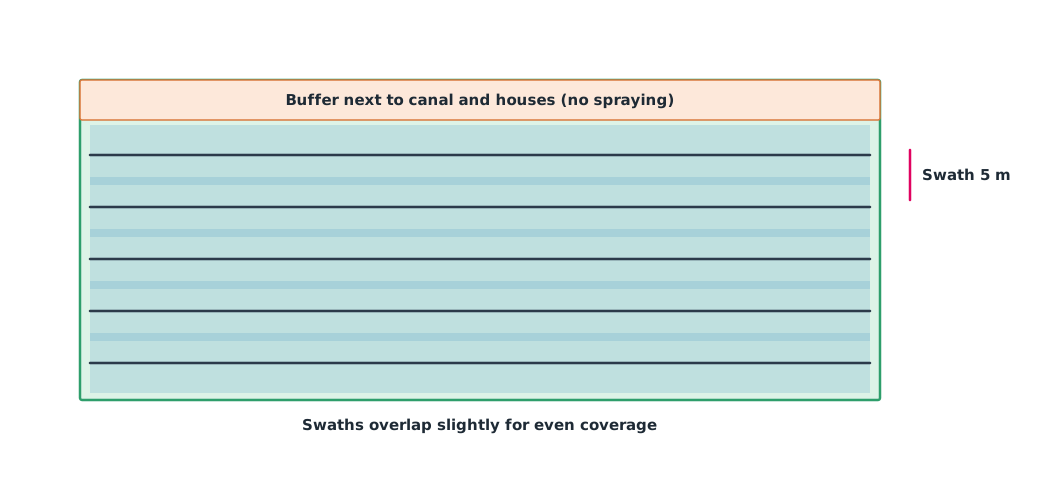
A buffer zone is an unsprayed strip between the field and anything that must be protected, such as canals, ponds, houses and other crops. Its width must follow the product requirements and the authorities’ guidance.
Droplets and drift
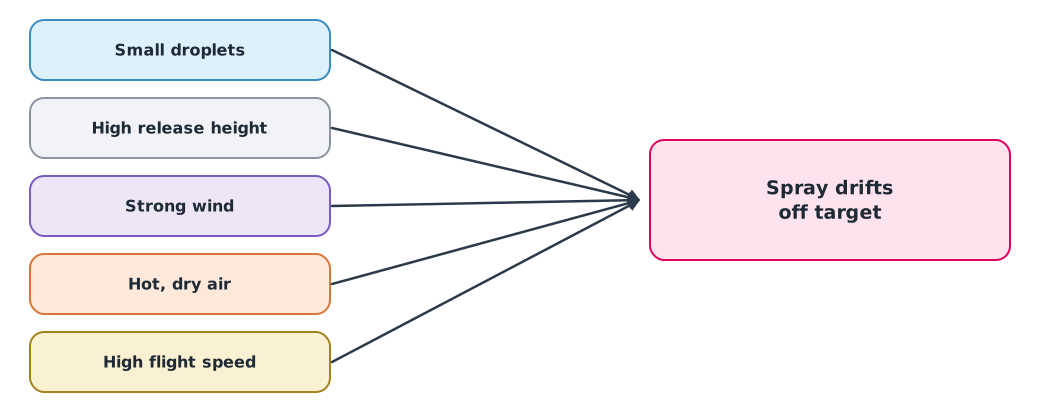
Small droplets cover leaves well but fall slowly and are easily carried by wind. ANSI/ASABE S572.3 classifies nozzles by droplet size so that nozzles can be chosen as the product label requires. ISO 23117-1:2023 sets environmental requirements for unmanned aerial spraying systems (for drones with a maximum take-off mass up to 150 kg). Reading wind, temperature and humidity before flight draws on the meteorology unit linked to this module.
An emptying tank and the centre of gravity
The liquid in the tank is a load that changes throughout the flight. If the tank is not exactly at the aircraft’s centre of gravity, the combined centre of gravity moves as the liquid is used, and the flight controller must compensate continuously.
Example 2. Centre of gravity as the tank empties
The empty aircraft with battery is 18 kg with its centre of gravity at x = 0. The centre of the liquid is 4 cm forward (assumed).
FRAME_KG, TANK_X = 18.0, 0.04          # kg, m (positive = forward)
for liquid in (10.0, 5.0, 0.0):
    total = FRAME_KG + liquid
    x_cg = (FRAME_KG * 0.0 + liquid * TANK_X) / total
    print(f"liquid {liquid:>4.1f} kg: mass {total:.1f} kg, CG {x_cg * 100:+.2f} cm")
liquid 10.0 kg: mass 28.0 kg, CG +1.43 cm
liquid 5.0 kg: mass 23.0 kg, CG +0.87 cm
liquid 0.0 kg: mass 18.0 kg, CG +0.00 cmThe centre of gravity moves about 1.4 cm during the flight and the mass falls by about a third, so the drone responds differently with a full and an empty tank. Test both conditions; liquid sloshing in the tank adds a further disturbance.
Thai requirements
- Department of Agriculture: launched a standard operating practice for spraying with agricultural unmanned aircraft and ID cards for contracted spray operators who pass its training (December 2024). Anyone offering spraying services must check the current training and card conditions with the Department
- CAAT and NBTC: pilot and radio equipment registration as in module 1 and UAT 313
- Product labels and conditions are binding, including rate, droplet size, pre-harvest interval and protective equipment. This module does not replace official training
Module lab
Lab: calibration and a plan with plain water
- Use plain water only. Measure the real output of every nozzle over a set time and compare with the system setting
- Use Example 1 to compute the flow rate and number of loads for the training field
- Plan spray lines and buffers on a map, identifying everything to be protected on every side of the field
- Record wind, temperature and humidity before flight and set stop conditions in advance
- Fly a plain-water test over water-sensitive paper under the instructor’s supervision, assess uniformity and record it in the lab notebook
Common mistakes
Watch out
- Using the constant 600 with a swath in centimetres
- Trusting the on-screen flow rate without measuring it
- Using the maximum spray reach as the line spacing, leaving too little between lines
- Spraying in strong wind or very hot weather
- Not testing flight with a full tank
Summary
- Application rate (L/ha) = L/min × 600 ÷ km/h ÷ swath width (m), used to compute and check flow rate
- Space lines by the measured effective swath and keep buffers around what must be protected
- Small droplets, high release, strong wind and hot dry air increase drift; choose nozzles and weather accordingly
- An emptying tank changes mass and centre of gravity, and spraying in Thailand must meet Department of Agriculture, CAAT and NBTC requirements
Check your understanding
- Flow 1.5 L/min at 18 km/h with a 5 m swath. What is the application rate?
- For 20 L/ha at 21.6 km/h with a 6 m swath, what flow is needed?
- A 4.8 ha field at 15 L/ha with an 8 L tank. How many loads?
- Why do small droplets drift easily?
- An 18 kg aircraft at x = 0 carries 6 kg of liquid at x = 0.05 m. Where is the combined centre of gravity?
Answers
- L/ha
- L/min
- loads
- They fall slowly, stay airborne longer and can be carried far by the wind
- m, or 1.25 cm forward
Key formulas
| Application rate (NPTC) | |
| Required flow rate | |
| Combined centre of gravity |
Key references
- City & Guilds NPTC. (2019). Calibration workbook (V1, April 2019). link
- International Organization for Standardization. (2023). Agricultural and forestry machinery — Unmanned aerial spraying systems — Part 1: Environmental requirements (ISO 23117-1:2023). link
- ASABE. (2020). Spray nozzle classification by droplet spectra (ANSI/ASABE S572.3 FEB2020). American Society of Agricultural and Biological Engineers. link
- กรมวิชาการเกษตร. (2567, 16 ธันวาคม). กรมวิชาการเกษตรเปิดตัวมาตรฐานการปฏิบัติงานการพ่นสารด้วยอากาศยานไร้คนขับทางการเกษตรและบัตรประจำตัวผู้รับจ้างพ่น [ข่าวประชาสัมพันธ์]. link
- สำนักงานการบินพลเรือนแห่งประเทศไทย. (2569). ประกาศ กพท. เรื่อง หลักเกณฑ์และวิธีการในการอนุญาตให้ผู้บังคับหรือปล่อยอากาศยานซึ่งไม่มีนักบิน ประเภทอากาศยานที่ควบคุมการบินจากภายนอก ที่มีน้ำหนักไม่เกิน 25 กิโลกรัม ปฏิบัติแตกต่างไปจากเงื่อนไขที่กำหนด พ.ศ. 2569 (มีผล 17 พฤษภาคม 2569). link
- สำนักงาน กสทช. ระบบลงทะเบียนอากาศยานซึ่งไม่มีนักบิน (โดรน). link
- Food and Agriculture Organization & International Telecommunication Union. (2018). E-agriculture in action: Drones for agriculture. FAO. link
Further reading
Study the assigned knowledge units in advance, review media and take the module quiz
Smart agriculture drones
Payload mass, centre of gravity and energy
Weather and mission assessment
In class / field
Intensive lab and field practice recorded in a lab notebook
Learning evidence: Lab notebook signed by the instructor