Aviation law and authorities
UAT 401 UAS Regulations, Safety and Risk Management
Lesson
By the end of this module you will be able to
- Explain the legal basis for permitting drone flights and the penalties under the Air Navigation Act
- Check missions systematically against the general conditions of the Ministry of Transport announcement B.E. 2558
- Separate matters under CAAT, NBTC and personal data protection law
- Compute the EIRP of a radio setup and compare it with an authority's limit
Why this matters
UAT 313 laid the foundations of Thailand’s drone law hierarchy, registration and permissions. This fourth-year course prepares students to be responsible for legal compliance and safety in an organisation that uses drones. The case used throughout is a hypothetical company, “Fah Sai Survey”, which is contracted to produce aerial photo maps around suburban communities. The drone knowledge base’s unit on where drone law starts advises separating aircraft, radio and land matters, then checking each with the right authority. This module turns that into a procedure others can review.
Legal basis and penalties
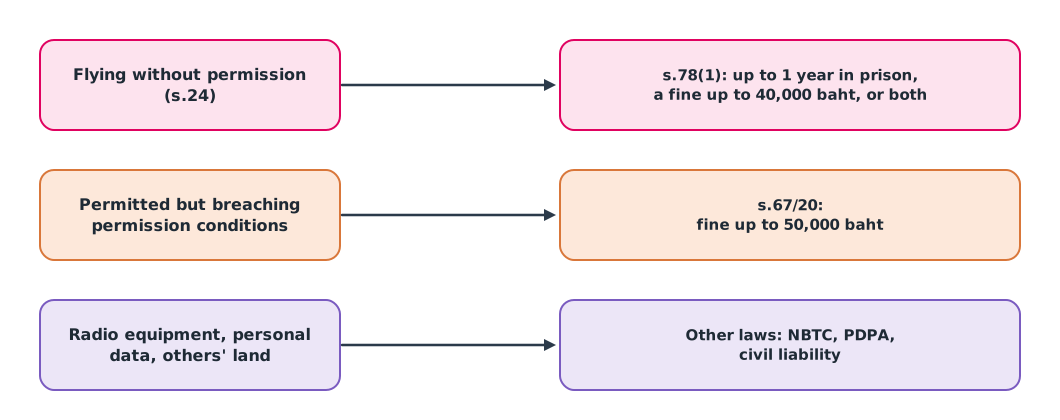
Section 24 of the Air Navigation Act B.E. 2497 prohibits controlling or releasing a pilotless aircraft without the Minister’s written permission and compliance with the conditions set. CAAT’s consolidated translation (amended up to No. 14, B.E. 2562) separates penalties into two cases worth knowing precisely:
- Flying without permission: section 78(1), imprisonment up to 1 year, a fine up to 40,000 baht, or both
- Holding permission but breaching its conditions: section 67/20, a fine up to 50,000 baht
Sections 79 and 80 were repealed by amendment No. 14, yet some published material still cites section 80. This is why the latest consolidated text must always be checked. Beyond criminal penalties, operators bear civil liability for damage to others, which is why third-party liability insurance is a key condition.
General conditions to check for every mission
Article 5 of the Ministry of Transport announcement B.E. 2558 sets general conditions, for example: keep the drone in sight at all times without relying on a monitor; fly between sunrise and sunset; not in or near cloud; not within 9 km of an airport unless permitted; not above 90 m above ground; not over cities, villages, communities or crowds; and 30 m horizontally from people, vehicles and structures. Operators who must register (drones over 2 kg, or used for purposes other than recreation) must keep 50 m from uninvolved people, vehicles and buildings, hold third-party liability insurance of at least 1,000,000 baht per occurrence, and their registration lasts 2 years. Missions that must deviate from these conditions need case-by-case permission, for example under the CAAT Specific announcement of 2569 studied in UAT 313. CAAT’s 2025 leaflet and guidance CAAT-GM-UAS-002 repeat the same conditions.
Example 1 Checking three missions against the general conditions
Fah Sai Survey has three missions. All are commercial, so the 50 m separation applies. Write the check as a program so every mission is checked the same way (hypothetical mission data).
MAX_HEIGHT_M = 90          # Art. 5, MOT announcement B.E. 2558
AIRPORT_KM = 9
SEP_PEOPLE_M = 50          # registered operators: from uninvolved people, vehicles, buildings
INSURANCE_MIN = 1_000_000  # baht per occurrence

def check(m):
    issues = []
    if m["height_m"] > MAX_HEIGHT_M:
        issues.append(f"height {m['height_m']} m > {MAX_HEIGHT_M} m")
    if m["airport_km"] < AIRPORT_KM:
        issues.append(f"{m['airport_km']} km from airport < {AIRPORT_KM} km")
    if m["min_sep_m"] < SEP_PEOPLE_M:
        issues.append(f"separation {m['min_sep_m']} m < {SEP_PEOPLE_M} m")
    if not m["daylight"]:
        issues.append("not between sunrise and sunset")
    if not m["vlos"]:
        issues.append("beyond visual line of sight")
    if m["insurance_thb"] < INSURANCE_MIN:
        issues.append("insurance below 1,000,000 THB")
    return issues

missions = {
    "survey A": dict(height_m=80, airport_km=15, min_sep_m=60, daylight=True, vlos=True, insurance_thb=1_000_000),
    "survey B": dict(height_m=120, airport_km=7.5, min_sep_m=60, daylight=True, vlos=True, insurance_thb=2_000_000),
    "night C":  dict(height_m=60, airport_km=20, min_sep_m=40, daylight=False, vlos=True, insurance_thb=500_000),
}
for name, m in missions.items():
    issues = check(m)
    print(f"{name}: " + ("within general conditions" if not issues
                        else "needs specific permission or change -> " + "; ".join(issues)))
survey A: within general conditions
survey B: needs specific permission or change -> height 120 m > 90 m; 7.5 km from airport < 9 km
night C: needs specific permission or change -> separation 40 m < 50 m; not between sunrise and sunset; insurance below 1,000,000 THBMission A is within the general conditions. Mission B is too high and too close to an airport, so it must be replanned or specifically permitted. Mission C has three problems, including insurance below the minimum, which no permission can fix; the insurance must be completed first. The program ensures nothing is forgotten, but it does not replace reading the latest announcement, and some conditions, such as flying over a community, cannot be checked with numbers.
Radio frequencies and equipment
Drone and remote-controller radios are regulated by the NBTC, separately from CAAT registration. The NBTC registration system states that every drone must register its radio equipment. Power limits are often set as EIRP (equivalent isotropically radiated power), which combines transmit power, antenna gain and cable loss. Fitting a high-gain antenna can therefore exceed the limit even when the transmitter itself is a registered model.
Example 2 Changing the antenna to fly farther
The team wants more range on its 2.4 GHz video link, so it tries a new antenna and an amplifier. The 100 mW limit in this example is an assumed value for practice; learners must check the real value in the current NBTC notice before use.
import math

limit_mw = 100.0        # assumed e.i.r.p. limit for practice; check the current NBTC notice
limit_dbm = 10 * math.log10(limit_mw)

setups = {              # (transmit power dBm, antenna gain dBi, cable loss dB)
    "stock antenna": (17.0, 2.0, 0.5),
    "8 dBi patch": (17.0, 8.0, 0.5),
    "patch + amplifier": (27.0, 8.0, 1.0),
}
print(f"limit {limit_mw:.0f} mW = {limit_dbm:.1f} dBm")
for name, (pt, g, loss) in setups.items():
    eirp = pt + g - loss
    mw = 10 ** (eirp / 10)
    verdict = "OK" if eirp <= limit_dbm else f"over by {eirp - limit_dbm:.1f} dB"
    print(f"{name:18s} EIRP {eirp:5.1f} dBm = {mw:6.0f} mW  {verdict}")
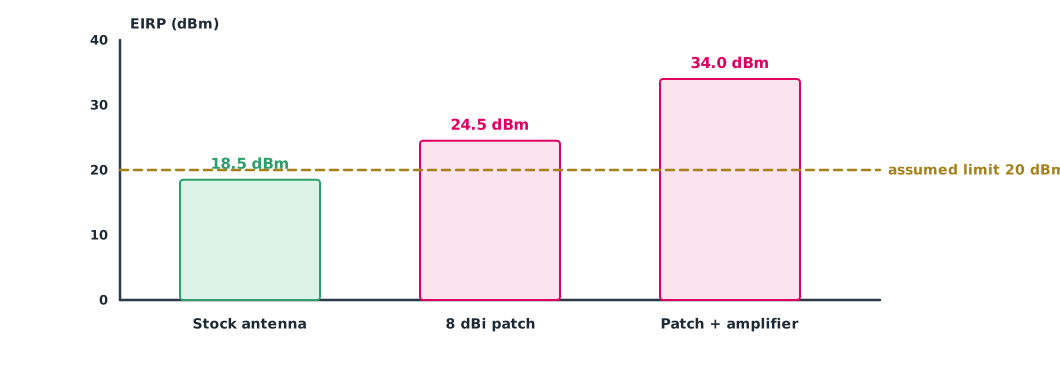
limit 100 mW = 20.0 dBm
stock antenna EIRP 18.5 dBm = 71 mW OK
8 dBi patch EIRP 24.5 dBm = 282 mW over by 4.5 dB
patch + amplifier EIRP 34.0 dBm = 2512 mW over by 14.0 dBThe 8 dBi patch antenna adds 6 dB, about four times the original EIRP, and adding the amplifier exceeds the limit by more than twenty times. The right way to fix link range is to place the ground station where it can see the drone, use a better receiving antenna on the ground side within what is permitted, or change the flight plan, not to raise transmit power beyond the rules.
Class activity
Activity: the company’s legal check file
- In groups, choose a real mission, such as surveying a school or market, and enter its data into the program in Example 1
- Find the latest relevant CAAT and NBTC announcements, noting title, year and source page
- Check the conditions the program cannot, such as flying over a community, and write how a person will check them
- Find the actual power limit for the band you use and compute the EIRP of your radio setup with Example 2
- Present which authorities this mission must contact and which documents must be carried on site
Common mistakes
Watch out
- Citing repealed sections from old published material
- Assuming CAAT registration removes the need to register radio equipment
- Changing antennas or adding amplifiers without computing EIRP
- Using 30 m separation for commercial work when registered operators need 50 m
- Letting a program replace reading the announcements without updating it to the latest version
Summary
- Section 24 is the basis for permission; flying without it is penalised under section 78(1), and breaching permission conditions under section 67/20
- The B.E. 2558 announcement sets general conditions such as 90 m, 9 km, VLOS, daylight, 30/50 m, and insurance of at least 1 million baht per occurrence
- Radio equipment falls under the NBTC and must be registered and within power limits
- EIRP = transmit power + antenna gain − losses
Check your understanding
- Which section penalises flying a drone without permission, and what is the penalty?
- Which section penalises a permit holder who breaches permission conditions?
- Under the B.E. 2558 announcement, how far must registered operators stay from uninvolved people?
- Transmit power 20 dBm, antenna 3 dBi, loss 1 dB. What is the EIRP?
- How many milliwatts is 30 dBm EIRP?
Answers
- Section 78(1): up to 1 year in prison, a fine up to 40,000 baht, or both
- Section 67/20: a fine up to 50,000 baht
- 50 m
- dBm
- mW
Key formulas
| Equivalent isotropically radiated power | |
| dBm to mW |
Key references
- พระราชบัญญัติการเดินอากาศ พ.ศ. 2497 และที่แก้ไขเพิ่มเติม (คำแปลภาษาอังกฤษของ กพท. แก้ไขถึงฉบับที่ 14 พ.ศ. 2562). link
- กระทรวงคมนาคม. (2558). ประกาศกระทรวงคมนาคม เรื่อง หลักเกณฑ์การขออนุญาตและเงื่อนไขในการบังคับหรือปล่อยอากาศยานซึ่งไม่มีนักบิน ประเภทอากาศยานที่ควบคุมการบินจากภายนอก พ.ศ. 2558. ราชกิจจานุเบกษา, 132(86 ง), 6–12. link
- Civil Aviation Authority of Thailand. (2025). Flying a drone in Thailand [Leaflet]. link
- สำนักงานการบินพลเรือนแห่งประเทศไทย. (2565). เอกสารแนวทาง CAAT-GM-UAS-002 (ปรับปรุงครั้งที่ 00). link
- สำนักงาน กสทช. คำถามที่พบบ่อย: การลงทะเบียนโดรน. ระบบลงทะเบียนเครื่องวิทยุคมนาคม. link
- สำนักงานการบินพลเรือนแห่งประเทศไทย. (2569). ประกาศ กพท. เรื่อง หลักเกณฑ์และวิธีการในการอนุญาตให้ผู้บังคับหรือปล่อยอากาศยานซึ่งไม่มีนักบิน ประเภทอากาศยานที่ควบคุมการบินจากภายนอก ที่มีน้ำหนักไม่เกิน 25 กิโลกรัม ปฏิบัติแตกต่างไปจากเงื่อนไขที่กำหนด พ.ศ. 2569 (มีผล 17 พฤษภาคม 2569). link
Further reading
Study the assigned knowledge units in advance, review media and take the module quiz
In class / field
Lecture, case discussion and in-class problem solving
Learning evidence: Quiz results and submitted exercises