Who regulates drones
Separate aircraft, radiocommunication and site matters so you check information with the agency responsible for each

Know what you are checking first
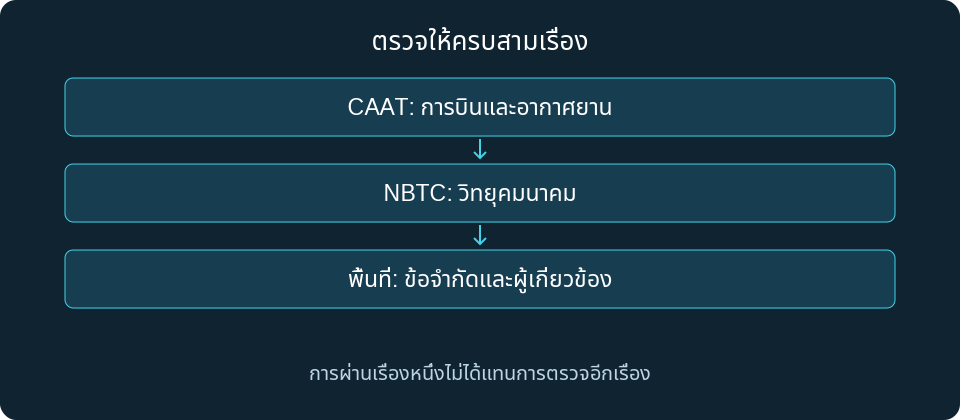
One mission involves several matters, so holding a registration from one agency should not be read as full authorisation in every respect. Start by identifying the aircraft, remote pilot, purpose, area, date and time, and type of operation before opening the relevant requirements
| Matter | Where to start checking | Evidence to record |
|---|---|---|
| Remote pilot, aircraft and flight conditions | CAAT UAS Portal | Service type, requirements and record status |
| Radiocommunication and related registration | NBTC | Equipment model, current announcements and channels |
| Airspace and aeronautical information | eAIP and related notices | Scope, effective date and conditions |
| Use of the site | Landowner or site manager | Scope of consent and the coordinator |
Read the scope of a rule before applying it
Weight, purpose, aircraft characteristics and type of operation can lead to different requirements. Do not generalise the Open/Specific/Certified framework from foreign documents into a conclusion about Thailand, and do not infer an exemption merely from working for a government agency
This page teaches how to separate the issues; it does not present fees or distance criteria from old slides as current information. Open the official sources and record the check date every time you prepare a mission
Practice example
Hypothetical scenario: a team will survey a building with a camera drone and already has the building owner's permission. What still needs checking is the status of the persons/aircraft/radio, airspace restrictions, notices in effect and the conditions for the type of work; they cannot start flying immediately just because the site owner agreed
Check your understanding: Write one question for each row of the table. If you answer every one with the name of a single agency, go back and separate the scopes again
Next: preparing information before registration →
References and scope
Sources checked 7 September B.E. 2569 (2026); compiled to accompany knowledge kindly contributed by DTI
Connecting knowledge with missions and data
Make a list separating the remote pilot, aircraft, radiocommunication, site and personal data. Each matter may involve different agencies and evidence. The portal page is an entry point for checking information, not evidence that every mission is authorised Read the reference: CAAT, UAS Portal
Practice check: Make a table of the matters to check, the agency, the original source, the check date and what still needs confirmation, without putting real personal data in the exercise
Read more Lessons that apply this knowledge in simulated work · sources reviewed 26 September B.E. 2569 (2026)