Risk-based inspection mission planning
UAT 453 UAS for Infrastructure, Energy and Utility Inspection
Lesson
By the end of this module you will be able to
- Explain risk-based inspection (RBI) and use it to rank industrial assets
- Compare drone inspection with traditional methods on time, risk to people and cost
- Plan inspection missions within the maintenance shutdown and the plant's permit-to-work system
- Identify hazards specific to flying in plants and confined spaces
Why this matters
Industrial plants have assets that are tall, hot, cramped or part of processes that cannot stop. Traditional inspection means scaffolding, rope access, or sending people into tanks and boilers, which is risky and consumes valuable shutdown time. Drones help a great deal, but inspecting everything equally wastes time and misses what matters. This module practises planning what to inspect, in what order, and how to do it safely in a plant.
Modules 11 to 15 of the course follow one fictional case through all of them: a sugar mill with a biomass power plant in north-eastern Thailand inspects its assets during a 21-day off-season shutdown. The assets are a 60 m boiler stack, a painted steel molasses tank 20 m in diameter and 15 m high, the idler rollers of the bagasse conveyor, the sugar warehouse roof and the drum inside the boiler. All figures are fictional. The Python code can be downloaded from /downloads/uat-453/.
Risk-based inspection
Risk-based inspection (RBI) uses each asset’s risk to decide what to inspect, by which method and how often. API RP 580 from the American Petroleum Institute sets out the elements of an RBI programme, and ISO 55000 sets asset-management principles for decisions based on value and risk over the whole life.
The simplest form scores risk as , from the probability of deterioration and the consequence of failure , each rated 1–5. Consequence covers people’s safety, the environment and lost production.
Example 1 Ranking five assets
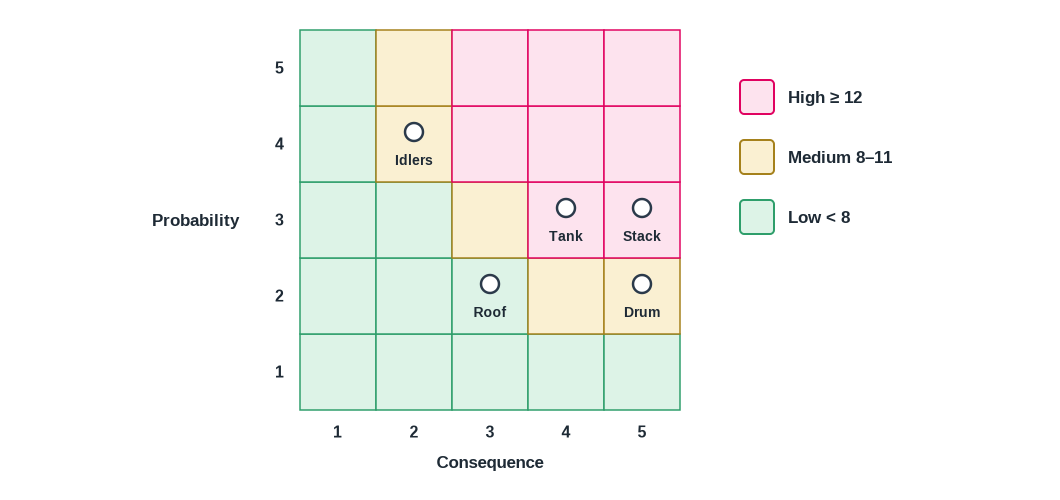
The maintenance team scores assets from repair history and consequences. The plant’s bands are high from 12, medium 8–11, and low below 8.
# (asset, probability of deterioration 1-5, consequence 1-5)
assets = [("Boiler stack", 3, 5), ("Molasses tank", 3, 4), ("Conveyor idlers", 4, 2),
          ("Warehouse roof", 2, 3), ("Boiler drum", 2, 5)]

def band(r):                            # plant criteria (assumed)
    return "high" if r >= 12 else ("medium" if r >= 8 else "low")

ranked = sorted(assets, key=lambda a: a[1] * a[2], reverse=True)
for name, p, c in ranked:
    r = p * c
    print(f"{name:16s} P={p} C={c} risk={r:2d} {band(r)}")
Boiler stack P=3 C=5 risk=15 high
Molasses tank P=3 C=4 risk=12 high
Boiler drum P=2 C=5 risk=10 medium
Conveyor idlers P=4 C=2 risk= 8 medium
Warehouse roof P=2 C=3 risk= 6 lowThe boiler stack (15) and molasses tank (12) are high and need detailed inspection every shutdown. The boiler drum (10) and conveyor idlers (8) are medium, and the warehouse roof (6) can be sampled or inspected every other cycle. The idlers are likely to fail but have low consequence because they are quick to replace, so they suit frequent but light inspection.
When drones pay off
Drones do not replace every inspection. Photographs show only the surface. Ultrasonic thickness (UT) measurement must touch the metal, which some contact-inspection drones or rope-access technicians can do. The common approach is to use the drone to sweep for suspect areas, then send people or contact tools only to those spots.
Example 2 How to inspect the 60 m stack?
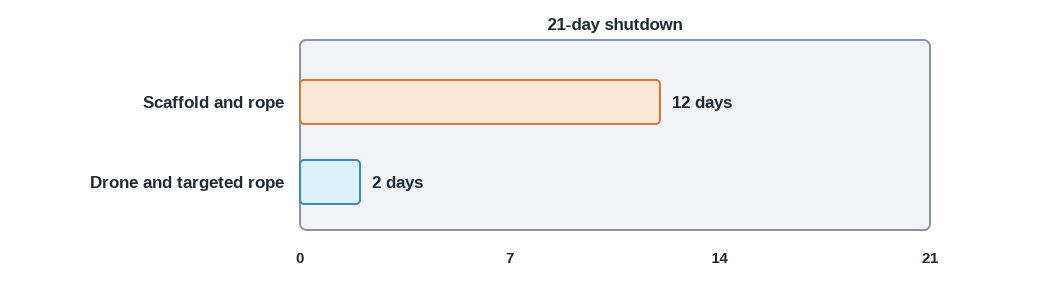
Two fictional quotations, compared with the 21-day shutdown.
# inspecting a 60 m stack: scaffold versus drone (values from fictional quotations)
plans = {
    "scaffold + rope access": {"days": 12, "people_at_height": 6, "cost_kbaht": 850},
    "drone + targeted rope":  {"days": 2,  "people_at_height": 2, "cost_kbaht": 180},
}
shutdown_days = 21                      # shutdown window available for maintenance

for name, p in plans.items():
    person_days = p["days"] * p["people_at_height"]
    share = p["days"] / shutdown_days
    print(f"{name:24s} {p['days']:2d} days ({share:.0%} of shutdown), "
          f"{person_days:2d} person-days at height, {p['cost_kbaht']} kbaht")
scaffold + rope access 12 days (57% of shutdown), 72 person-days at height, 850 kbaht
drone + targeted rope 2 days (10% of shutdown), 4 person-days at height, 180 kbahtScaffolding takes 12 days, 57% of the shutdown, with 72 person-days of work at height. The drone with targeted rope access takes 2 days and 4 person-days, and costs far less. The most important number is not the price but the person-days at height avoided, a direct reduction in risk to people, and the time left in the shutdown can go to repairing what is found.
Flying safely in a plant
Plants have their own safety systems, and the drone team works inside them. Under Thailand’s Occupational Safety, Health and Environment Act B.E. 2554 (2011), employers and contractors must provide safe working conditions.
- Permit to work obtain permission from the area owner every time, stating the area, time, task and responsible person, including isolating energy or stopping related machinery
- Hazardous areas from flammable vapour or dust, such as fuel tanks or sugar dust; ordinary drones are not designed to prevent ignition and need assessment and permission before entering
- Interference large steel structures disturb the compass and block GNSS and radio; plan flights that do not rely on the compass near steel
- Heat and hot updraughts a stack recently taken out of service is still hot with rising air; wait for it to cool as the plant requires
Confined spaces
The boiler drum and the tank are confined spaces under Thailand’s Ministerial Regulation on confined-space safety of B.E. 2562 (2019), which requires a written work permit, atmospheric testing before entry, and a rescuer stationed at the entrance throughout. Flying a caged drone in instead of a person greatly reduces entry, but opening the access, retrieving a crashed drone and later repair entries must still follow the regulation in full. Inside there is no GNSS and no light, so the drone needs lighting and collision protection.
Module lab
Lab: drafting a shutdown inspection plan
- Your lecturer provides 6–8 assets of a fictional or partner plant with repair history
- Score and with reasons, then rank them with the code in Example 1
- Choose the inspection method for each (drone, person, contact tool or a mix) and compare time with the shutdown using the code in Example 2
- List the permits needed, area-specific hazards and controls
Common mistakes
Watch out
- Inspecting every asset in equal detail, leaving too little time for high-risk assets
- Thinking drones replace thickness measurement when images show only the surface
- Flying without a permit to work or without coordinating machinery shutdown
- Relying on the compass near steel, so the drone heads the wrong way
- Assuming a drone in a confined space removes the need to follow the regulation
Summary
- RBI ranks assets with to set inspection method and frequency
- Drones pay off most by reducing work at height and in confined spaces, sweeping for suspect areas before sending contact tools
- Plant work sits inside the permit-to-work system; watch flammable areas, interference and heat
- Confined spaces follow the B.E. 2562 regulation even when a drone replaces a person
Check your understanding
- An asset with probability 4 and consequence 4 has what risk score, and which plant band?
- Inspection takes 6 days of a 20-day shutdown. What percentage is that?
- Why are conveyor idlers medium risk despite a high probability of failure?
- Why should a drone not rely on its compass near a steel tank?
- What does the B.E. 2562 confined-space regulation require at the entrance throughout the work?
Answers
- , high
- Because the consequence is low: they are quick to replace and pose little risk to people
- Large steel structures disturb the magnetic field and make the compass point wrongly
- A rescuer stationed at the entrance throughout
Key formulas
| Risk score | |
| Share of shutdown time |
Key references
- American Petroleum Institute. (2023). Elements of a risk-based inspection program (API RP 580, 4th ed.). link
- International Organization for Standardization. (2024). Asset management — Vocabulary, overview and principles (ISO 55000:2024). link
- กฎกระทรวงกำหนดมาตรฐานในการบริหาร จัดการ และดำเนินการด้านความปลอดภัย อาชีวอนามัย และสภาพแวดล้อมในการทำงานเกี่ยวกับที่อับอากาศ พ.ศ. 2562. (2562). ราชกิจจานุเบกษา. link
- พระราชบัญญัติความปลอดภัย อาชีวอนามัย และสภาพแวดล้อมในการทำงาน พ.ศ. 2554. (2554). ราชกิจจานุเบกษา, 128(4 ก). link
- Barnhart, R. K., Marshall, D. M., & Shappee, E. (Eds.). (2021). Introduction to unmanned aircraft systems (3rd ed.). CRC Press. link
Further reading
Study the assigned knowledge units in advance, review media and take the module quiz
In class / field
Lab or field practice from worksheets with a safety checklist
Learning evidence: Checked worksheets and quiz results